What Is Dark Social? Why B2B Buyers Decide Where You Can’t See
Originally published April 2023. Updated September 2026.
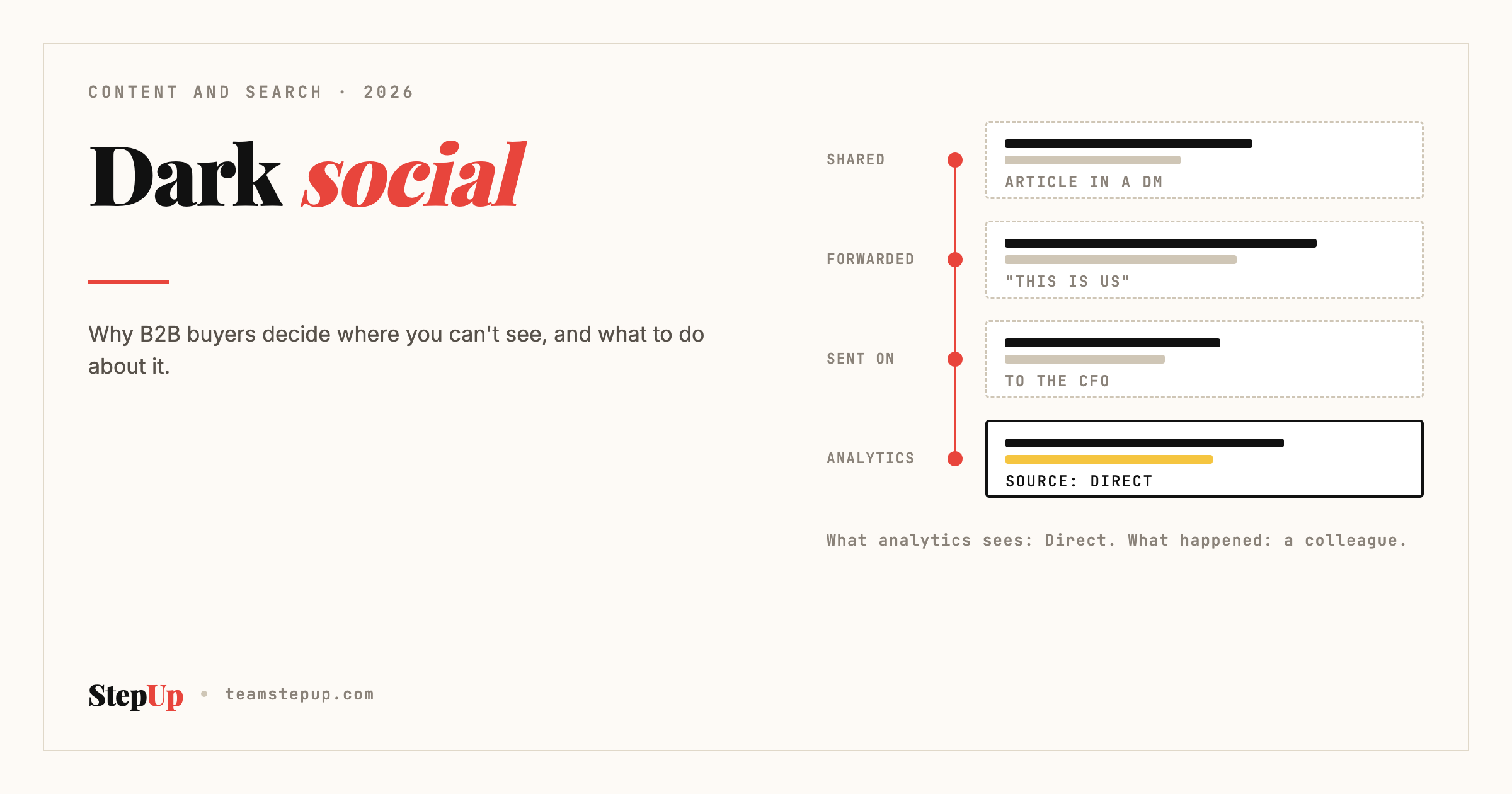
A prospect books a demo. The form asks how she heard about you, and she writes “a colleague.” Your analytics say she arrived by typing your web address directly. Your attribution report gives the credit to “direct traffic,” which tells you nothing.
What actually happened is simpler. Three weeks earlier, someone on her team pasted one of your articles into a Slack channel with the note “this is exactly our problem.” Two people read it. One forwarded it to her. She remembered your name.
That chain of private sharing is dark social. It is where a large share of B2B buying influence now lives, and almost none of it shows up in a dashboard.
What dark social means
Dark social is the sharing of content through private channels that analytics tools cannot track. It covers messaging apps, email, internal chat tools, text messages and private communities.
The term was coined in 2012 by Alexis Madrigal, then a writer at The Atlantic. He noticed that a large portion of the site’s traffic arrived with no referral information at all. People were not typing long article addresses by hand. They were clicking links that friends had sent them privately.
In B2B, the channels have changed since then, but the behavior has only grown. Today, dark social typically means:
- Slack and Microsoft Teams channels inside a buyer’s company
- Direct messages on LinkedIn
- Email forwards between colleagues
- WhatsApp and text groups among peers
- Private communities and member forums
- Conversations on calls and at events, which leave no digital trace at all
Why dark social matters so much in B2B
B2B purchases are group decisions. Several people need to agree, and they rarely do their thinking in public.
Instead, they share an article in a team channel, forward a guide to their boss, or ask a peer in a private group which vendors they trust. By the time anyone visits your website with intent, much of the decision has already taken shape in conversations you never saw.
This matters for two reasons.
First, it means your analytics undercount what works. Content that shapes buying decisions often looks weak in reports, because the traffic it drives arrives later, labeled as direct or branded search. As a result, teams cut the very content that is doing the persuading.
Second, it means trust travels through people, not ads. A recommendation from a colleague carries more weight than any campaign. Therefore the content that wins in dark social is the content people are willing to put their own name behind when they share it.
Why analytics can’t see dark social
When someone clicks a link inside a private app or an email client, the browser often passes no information about where the click came from. The visit lands in your analytics as direct traffic, the same bucket as someone typing your address from memory.
Similarly, when a buyer hears your name on a call and later searches for it, the visit shows up as branded search. The call gets no credit.
This is not a tracking bug you can fully fix. Private channels are private by design. The goal, then, is to design your content and your measurement so that the effect of those conversations becomes visible.
How to measure dark social, roughly
You will not get precise numbers. You can, however, get a reliable signal.
Ask people. Add an open text field to your demo and contact forms: “How did you first hear about us?” Answers like “a colleague sent me your article” or “my old boss recommended you” are dark social in plain words. Review them monthly.
Watch direct traffic to deep pages. Hardly anyone types a long article address by hand. So a rise in direct visits to a specific blog post usually means it is being shared privately.
Track branded search over time. When more people search for your company name, something is spreading. Compare it with what you published and where your team showed up.
Use tracked links where you control the share. In newsletters, sales emails and posts, add simple tracking parameters. They will not catch every forward, but they show which pieces travel furthest.
Listen in sales conversations. Ask your sales team to note what prospects mention on first calls. “We’ve been reading your stuff” is a data point.
For the handoff between marketing interest and sales conversation, our guide on converting MQLs to SQLs covers how to agree on what counts as a real opportunity.
How to make content that travels in dark social
People share content privately for one reason: it helps them make a point to someone whose opinion matters to them. That sets a high bar, and it shapes what works.
Answer a question a buyer would ask a colleague
The best dark social content answers the question someone is already debating inside their company. How much should we spend on marketing next year? Should we hire or outsource? Is our customer profile still right? Content that settles an internal argument gets forwarded.
Say something specific enough to disagree with
Generic content does not get shared, because it does not help anyone make a point. A clear point of view does. It gives the person sharing it something to say: “This is what I’ve been trying to explain.”
Make it easy to lift
Short summaries at the top, clear headings, a table or a simple framework. Buyers often paste a single section into a chat rather than the whole link. Content built in pieces travels further.
Be consistent where your buyers already are
On LinkedIn in particular, people who see your thinking repeatedly start to associate your name with a problem. Then, when the problem comes up in a private channel, your name comes up with it.
Dark social and your wider marketing
Dark social is not a channel you can buy. Rather, it is the result of everything else working.
A clear narrative gives people words to repeat. Useful content gives them something to send. Visible people, especially founders and sales leaders on LinkedIn, give them a face to recommend. Together, these create the conditions for private sharing.
This is also why attribution arguments so often go nowhere. When most of the influence happens out of sight, the last click tells a very small part of the story. A better approach is to agree on a few leading signals, such as self-reported source, direct visits to deep pages and branded search, and review them alongside pipeline.
If you are planning next year’s spend with this in mind, our B2B marketing budget guide covers how to protect the work that does not show up neatly in reports.
Frequently asked questions
What is dark social in simple terms?
Dark social is content shared privately, through messaging apps, email, internal chat tools or direct messages, where analytics cannot see where the visit came from. It usually shows up in reports as direct traffic.
Why is it called dark social?
The term was coined in 2012 by Alexis Madrigal at The Atlantic. “Dark” refers to the fact that analytics tools cannot see this sharing, not to anything secretive or negative about it.
How much traffic comes from dark social?
Nobody can measure it exactly, because it is untraceable by design. For B2B companies, the practical sign is a large share of direct traffic landing on deep pages like blog posts, which people rarely type by hand.
How do you track dark social?
You can estimate its effect rather than track it directly. Ask “how did you hear about us” in an open text field, watch direct visits to specific articles, monitor branded search over time, use tracked links where you control the share, and listen to what prospects say on first calls.
Is dark social good or bad for B2B marketing?
It is good for companies with useful, specific content and a clear point of view, because private recommendations carry more trust than ads. It is hard for teams that rely only on last-click attribution, because the work that drives decisions looks weaker in reports than it is.
What is an example of dark social?
A manager pastes your article into her team’s Slack channel with a note saying it describes their problem. A colleague forwards it to the head of the department, who later types your web address and books a call. Your analytics record a direct visit. The article did the work.
So the next time a demo form says “a colleague,” ask which one.
Then ask what they forwarded.
Want to know where your marketing stands against the market? The AI-Readiness Audit is a short call that looks at your marketing and pinpoints exactly where the gap is — and what it is worth to close first. You leave with a clear picture, even if we never work together.

The Types of Marketing Professionals: A Field Guide for CEOs and the People Who Work With Them
September 2, 2026