AI Marketing Strategy: Why Most B2B Teams Get It Backwards
A while ago we found two pages on our own website competing for the same Google search. Two good articles, written months apart, both aimed at the same phrase. Google could not decide which one to show, so it showed neither very well.
Nobody did anything wrong. In fact, AI made both articles fast and easy to produce. What was missing was the decision above them: what each page was for, and which search it owned.
That is the pattern behind most AI marketing problems we see. The tools work. The strategy that tells them what to do is missing, or it was written for a slower world and never updated.
So this article is about the strategy, not the tools. It covers the five ways AI marketing breaks without one, what an AI marketing strategy actually needs to contain, and how to write one on a single page.
The short version
AI does not fix a weak marketing strategy. It speeds it up. Whatever was unclear before becomes unclear in more places, faster.
Without a strategy, AI marketing tends to fail in five predictable ways: mixed messages, the wrong accounts, pages that compete with each other, automations that clash, and reports that disagree.
An AI marketing strategy is mostly a normal marketing strategy, written down precisely enough for a machine to follow. Goals, audience, narrative, ownership and measurement.
The new part is the written rulebook the AI works from, and a person who owns it.
It fits on one page. If it does not, it is not finished.
Why AI makes a weak strategy worse
Before AI, a vague strategy was slowed down by people. A writer would ask what the campaign was for. A salesperson would push back on a message that did not match the calls. Things were slow, but the friction caught mistakes.
AI removes that friction. After all, it does not ask what the campaign is for. It produces what it is asked for, immediately, in volume.
As a result, a vague strategy no longer produces a few confused pieces. It produces a confused marketing department, running at full speed.
That is why the most common complaint we hear is not “AI doesn’t work.” It is “we are doing much more and it feels less under control.” Both halves of that sentence are true.
The five ways AI marketing fails without a strategy
1. Every channel starts saying something different
AI can write for five channels at once. Without one agreed message, each channel drifts. The LinkedIn posts say one thing, the email sequence another, and the sales deck contradicts both.
On its own, each piece looks fine. The buyer, however, sees all of them. When a prospect cannot say what you do in one sentence, no amount of personalization will rescue the deal.
What fixes it: one written narrative that every piece of AI output starts from. Formats vary. The core message does not.
2. The wrong accounts get targeted, faster
AI-powered account targeting can score hundreds of companies and trigger outreach automatically. That is powerful when the customer profile is clear. But when it is not, AI spends the budget on companies that were never a fit, with a message written for the wrong person.
What fixes it: a precise, written ideal customer profile, checked against the deals you actually won. The AI should carry out your targeting logic, not invent it.
3. Your own pages compete with each other
This is the one we lived through. AI makes it easy to publish ten articles a month. Yet without a plan for which page owns which search, those articles end up competing for the same keywords. More content, weaker rankings.
What fixes it: a simple content map. Every page gets one main search it owns, and no two pages share one. AI then writes inside the map, not around it.
4. Automations clash
AI-triggered workflows now run across the CRM, email, ads and data tools. So when nobody owns the whole picture, they collide. A lead gets a nurture email and a sales sequence on the same day. A disqualified account keeps seeing ads. Enriched data overwrites notes a salesperson typed in by hand.
What fixes it: a list of every active automation, each with a named owner. Clear the conflicts before adding anything new.
5. The reports disagree
Each AI tool reports its own numbers in its own way. Consequently, leadership gets five dashboards that contradict each other, and nobody can answer the one question that matters: what is actually bringing in business?
What fixes it: one agreed set of measures that connects the marketing work to sales results. In short: clean data first, AI analysis second.
What an AI marketing strategy actually contains
Here is the part most guides skip. An AI marketing strategy is not a list of tools. In fact, it is mostly a normal marketing strategy, written precisely enough that a machine can follow it.
It has six parts.
Part
The question it answers
What happens without it
Goals
What must marketing achieve this quarter?
Volume becomes the goal
Audience
Who exactly are we for, and who are we not for?
Content speaks to everyone and no one
Narrative
What do we believe, and why should a buyer care?
AI writes the average of the internet
Voice rules
How do we sound, and what do we never say?
Every draft needs rewriting
Ownership
Who owns each channel, tool and automation?
Nobody corrects the AI
Measurement
How will we know it worked?
Output gets mistaken for progress
The first three are classic strategy. In other words, nothing about them is new. Many companies already have them somewhere, in a deck or in the founder’s head.
The last three, however, are what AI adds. Voice rules have to be explicit, because AI cannot absorb a culture by sitting in meetings. Ownership has to be named, because AI does not raise its hand when something looks wrong. Measurement has to be agreed in advance, because AI will always make output look impressive.
Where people fit in an AI marketing strategy
Even so, a strategy that ends at the document is only half done. Someone has to own it.
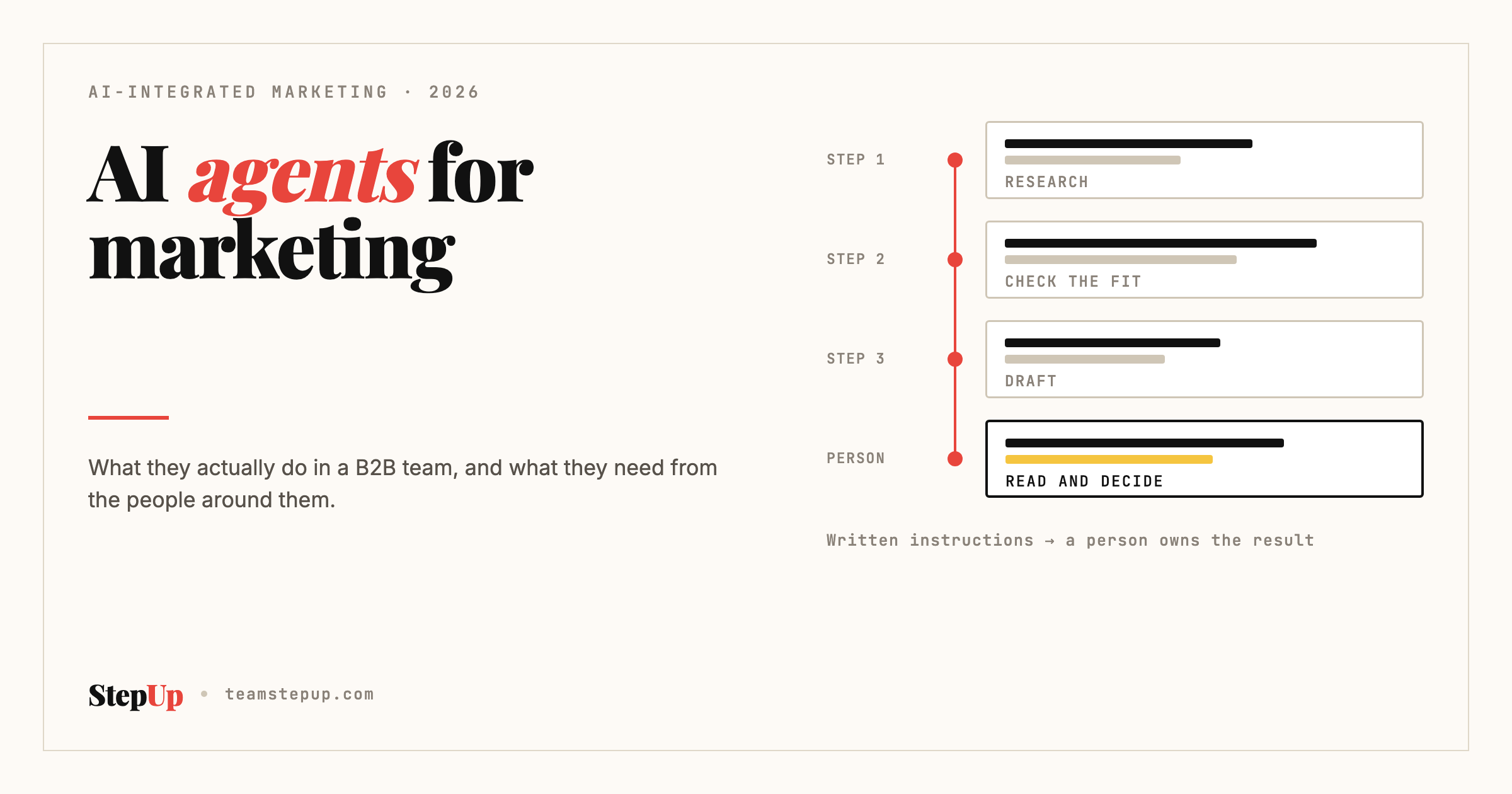
In practice, that means one senior person who holds the goals and the narrative, and someone who reads what the AI produces and corrects the written rules when it gets something wrong. In a small team, that can be the same person.
The AI does the production underneath. However, it works from what the people wrote down, and it gets better only when they update it.
Start with what you already know. Then, write it down more precisely than feels necessary.
Write three to five goals for the quarter. Outcomes, not activities. “Twenty qualified sales conversations” is a goal. “Post three times a week” is an activity.
Describe the customer in one paragraph. Job title, company type, the problem in their words, and who you are not for.
Write the narrative in five sentences. What you believe, what you are against, and why a buyer should choose you.
List the voice rules. How long sentences run, the words you never use, spelling, tone.
Name the owners. One person per channel, tool and automation.
Pick the measures. Two or three numbers leadership already cares about.
Only then, choose where AI starts. One function first, usually content or reporting.
If that sounds like a normal marketing plan, it is. Our one-page marketing plan walks through the same structure with a worked example. The AI part is steps 4 and 5, plus the discipline to update them.
An AI marketing strategy is a marketing plan written precisely enough for AI to follow. It sets the goals, the audience, the narrative, the voice rules, who owns each tool, and how success is measured. The AI then handles production inside those limits, while people own decisions and corrections.
How do you create an AI marketing strategy?
Start with three to five quarterly goals, a one-paragraph customer description and a short narrative. Add written voice rules, a named owner for each channel and tool, and two or three agreed measures. Then introduce AI into one function first and expand once it works.
What are the biggest challenges of AI in marketing?
The most common are inconsistent messaging across channels, targeting the wrong accounts at scale, pages competing with each other in search, clashing automations, and reports that disagree. Almost all of them come from a missing or vague strategy rather than from the AI tools themselves.
What are the disadvantages of AI in marketing?
AI produces confident, polished output whether or not it is right for your market, so weak ideas look finished. It tends toward generic language without clear brand rules. It also multiplies existing problems: a vague message or a poor customer definition spreads faster with AI than without it.
Is an AI marketing plan different from a regular marketing plan?
Mostly, no. The goals, audience and narrative are the same. An AI marketing plan adds explicit voice rules, named owners for every tool and automation, and a routine for correcting the AI’s instructions when output is wrong.
Which AI marketing tools should a strategy include?
Fewer than you think, and chosen last. Decide the goals, audience and narrative first, then pick tools that serve one function at a time. A modest tool working from a clear strategy will outperform an advanced one working from none.
The teams that get the most from AI are rarely the ones with the most tools.
They are the ones who decided, in writing, what the tools are for.
Want to know where your marketing stands against the market? The AI-Readiness Audit is a short call that looks at your marketing and pinpoints exactly where the gap is — and what it is worth to close first. You leave with a clear picture, even if we never work together.