The Types of Marketing Professionals: A Field Guide for CEOs and the People Who Work With Them
September 2, 2026

Originally published January 2020. Updated October 2026.
Manufacturing marketing has a reputation problem, and it’s mostly earned. For decades the plan was a trade show booth, a brochure that hadn’t been updated since the previous CEO, and a sales team that “handled the relationships.” (It’s always the relationships.) Marketing was the department that ordered the lanyards.
Then buyers changed. The engineer who specs your part now does most of her research before she ever talks to you. She reads datasheets at 11 pm, compares three suppliers on Google, and asks ChatGPT which one has the better tolerance range. By the time she calls, the shortlist is done.
It’s a strange time to be marketing a machine.
Meanwhile, someone in the boardroom has decided AI will fix it, and that by Q3 the company will have “a digital-first industrial brand” with the same two people who currently run the website and the trade shows. Bless.
The good news is that manufacturers don’t need a giant team to compete. They need a plan: written down, tied to sales, aimed at the right buyers and honest about what the team can do. A manufacturing marketing plan is that document, and it fits on a few pages.
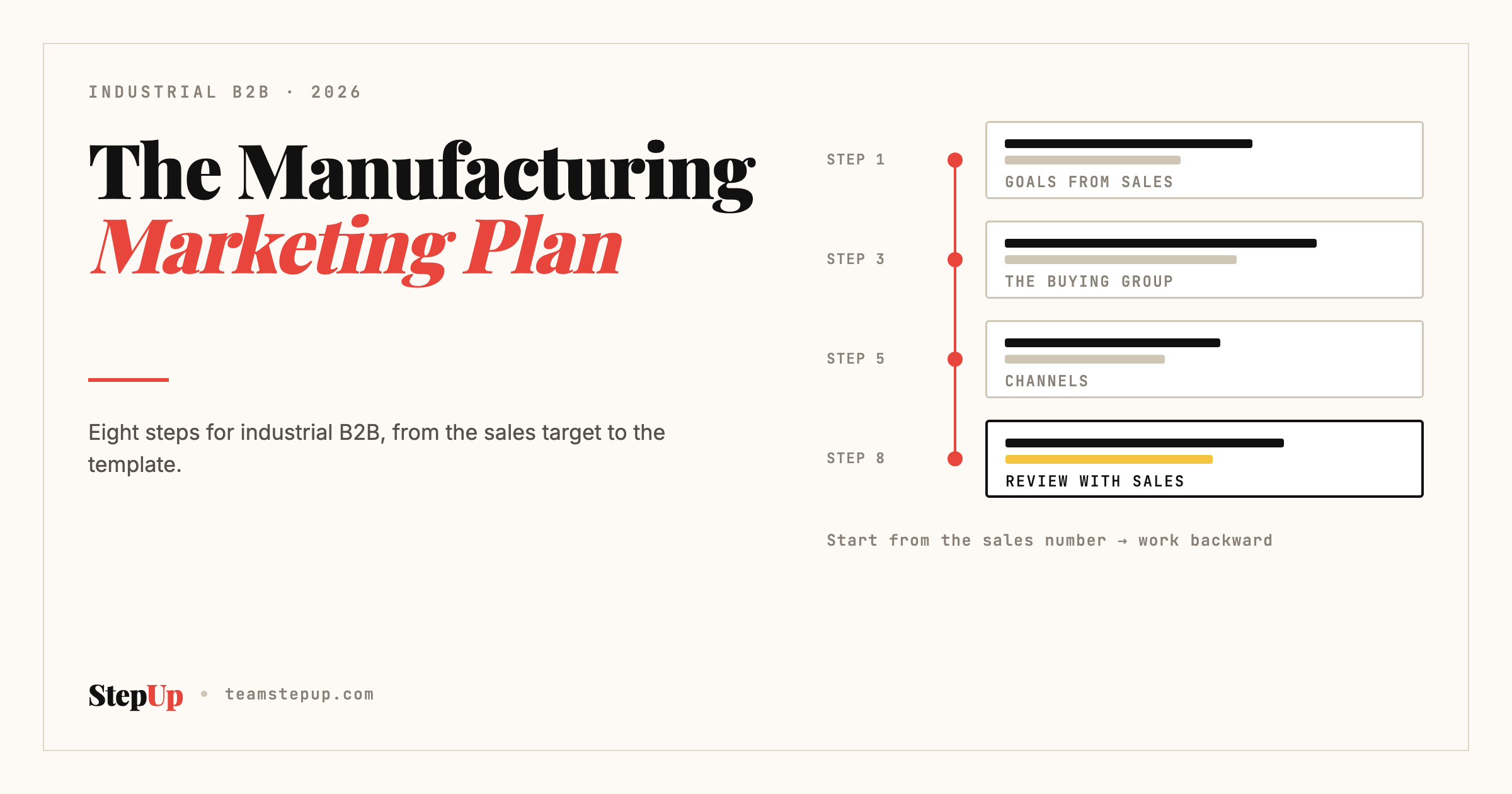
This guide walks through how to build one in eight steps, with a template at the end.
A manufacturing marketing plan is a written plan for how a manufacturer will find, win and keep the right customers over the next year. In short, it sets the goals, names the buyers, picks the channels, assigns the work and decides how results are measured.
What makes it different from a general marketing plan is the buyer. Industrial purchases are technical, slow, expensive and decided by several people at once. So the plan has to speak to an engineer, a buyer in procurement and an operations manager, often for the same order.
Four things set manufacturing marketing apart:
As a result, the plan leans on content that answers technical questions, a website that works as a sales tool, and tight alignment with the sales team. Our post on industrial marketing challenges also covers the common traps in more detail.
Begin with the number sales needs. How many new customers this year? Then, how many opportunities does that take, at your usual win rate? How many qualified conversations to create those opportunities?
Work backward from there. If sales needs 40 opportunities and half of qualified conversations become opportunities, marketing needs to help create 80 qualified conversations. That is a goal both teams can agree on, and it beats “increase brand awareness” every time.
Then write the goals as two or three objectives with numbers attached. Our guide to marketing OKRs shows the format.
List the industries, company sizes and regions where you win most often and at the best margin. Then describe the companies you want more of. This list then becomes your ideal customer profile, and every other step points at it.
If you don’t have one written down yet, our practical guide to building an ICP walks through it step by step.
For each target account, name the people involved in a purchase and what each one needs from you.
| Role | What They Care About | What Wins Them Over |
|---|---|---|
| Design or process engineer | Specs, tolerances, materials, compatibility | Datasheets, CAD files, application notes, a fast answer from a real engineer |
| Procurement | Price, lead times, supplier risk | Clear terms, certifications, references |
| Operations or plant manager | Uptime, installation, support | Case studies, service plans, training |
| Finance or leadership | Total cost, payback, risk | A cost comparison and proof from similar companies |
Engineers deserve special attention, because they often decide the shortlist. Our post on marketing for engineers explains why your own technical team belongs in the process.
In one paragraph: who you serve, the problem you solve, and why you’re the better choice. Then the three proof points that back it up, such as a certification, a performance number, or a customer result.
This sounds basic, yet most manufacturers skip it. As a result, the website, the brochure and the sales deck each describe the company differently. Write it once and use it everywhere.
Pick the few channels where your buyers actually look, and do them well. For most industrial B2B companies, that means:
In general, two to four channels done consistently beat seven done occasionally. For inspiration on the website side, see our roundup of industrial website examples.
List the questions each member of the buying group asks, then plan one piece of content for each important question. Organize the plan by quarter, with one main theme per quarter, so the work builds on itself.
For example, a quarter on “reducing downtime” might include an application note for engineers, a cost comparison for finance, a customer story for operations and a webinar recording for sales to send. Our collection of content marketing examples for manufacturers has more ideas.
Decide what you’ll spend on each channel and who does the work: your team, sales, engineering, an agency or AI. Be honest about capacity, because a plan that needs 30 hours a week from a team of one will fail by March.
This is also where AI earns its place. An AI assistant can draft application notes from engineering’s notes, keep product pages current, pull the monthly numbers and repurpose one webinar into five posts. A person still owns the technical accuracy and the sign-off, which in manufacturing matters more than anywhere. Our AI marketing playbook for manufacturers goes deeper.
Track a short list of numbers tied to the goals in step 1: qualified conversations, opportunities created, website leads from target accounts and pipeline from marketing. Then review them every month with sales and adjust every quarter.
Keep the list short. Our guide to B2B marketing KPIs covers which numbers to keep and which to drop.
Use this outline as your plan’s table of contents. Each section can be a few lines.
| Section | What Goes In It |
|---|---|
| 1. Goals | Two or three objectives with numbers, worked back from sales targets |
| 2. Ideal customer | Industries, sizes, regions, and why you win there |
| 3. Buying group | Each role, what they need, what wins them over |
| 4. Positioning | One paragraph and three proof points |
| 5. Channels | Two to four channels and the job of each |
| 6. Content plan | One theme per quarter and the pieces under it |
| 7. Budget and team | Spend by channel, who does what, where AI helps |
| 8. Measurement | Five to seven numbers, reviewed monthly with sales |
If you’d like to fit it all on a single page first, start with our one-page marketing plan and expand from there.
“Attend four trade shows” is an activity. “Create 30 qualified conversations from trade shows” is a goal, and it changes how you plan each show.
A plan aimed at “manufacturers” is aimed at no one. Name the industries and roles. It’s also fine to say no to the rest.
A plan that sales hasn’t seen will be ignored by sales. Instead, build the goals with them, agree on what a qualified lead is, and review results together.
For an engineer at 11 pm, your website is the salesperson. If she can’t find specs, compare options or reach someone technical, she moves to the next supplier.
A manufacturing marketing plan should include goals tied to sales targets, an ideal customer profile, a map of the buying group, written positioning, two to four channels, a quarterly content plan, a budget with owners, and a short list of numbers reviewed monthly.
Start from the sales target and work backward to how many qualified conversations marketing must help create. Then define the ideal customer, map who is involved in buying, write the positioning, choose the channels, plan content by quarter, set the budget and team, and review results with sales every month.
For most industrial B2B companies, the website and search, technical content, LinkedIn, trade shows with planned follow-up, and email to existing contacts. Two to four channels done consistently work better than many done occasionally.
A few pages is enough. Each of the eight sections can be a short paragraph or a table. A one-page version is a good starting point, and the full plan grows from it.
Yes. AI can draft technical content from engineering’s notes, keep product pages current, pull monthly numbers and repurpose content. A person should still own technical accuracy, the message and the final sign-off.
Marketing at a manufacturer doesn’t need to stop ordering lanyards. It just needs a plan that sits next to the order form: goals sales agreed to, buyers with names and roles, and a website that answers the engineer at 11 pm.
Write it down. Review it with sales. Let AI carry some of the load, and keep the technical sign-off with someone who knows the tolerance range by heart.
The board’s “digital-first industrial brand” will show up eventually. Probably by Q4.
Want to know if your team is ready to bring AI into the plan? Take the free AI-Readiness Self-Audit.
Want to know where your marketing stands against the market? The AI-Readiness Audit is a short call that looks at your marketing and pinpoints exactly where the gap is — and what it is worth to close first. You leave with a clear picture, even if we never work together.