The Types of Marketing Professionals: A Field Guide for CEOs and the People Who Work With Them
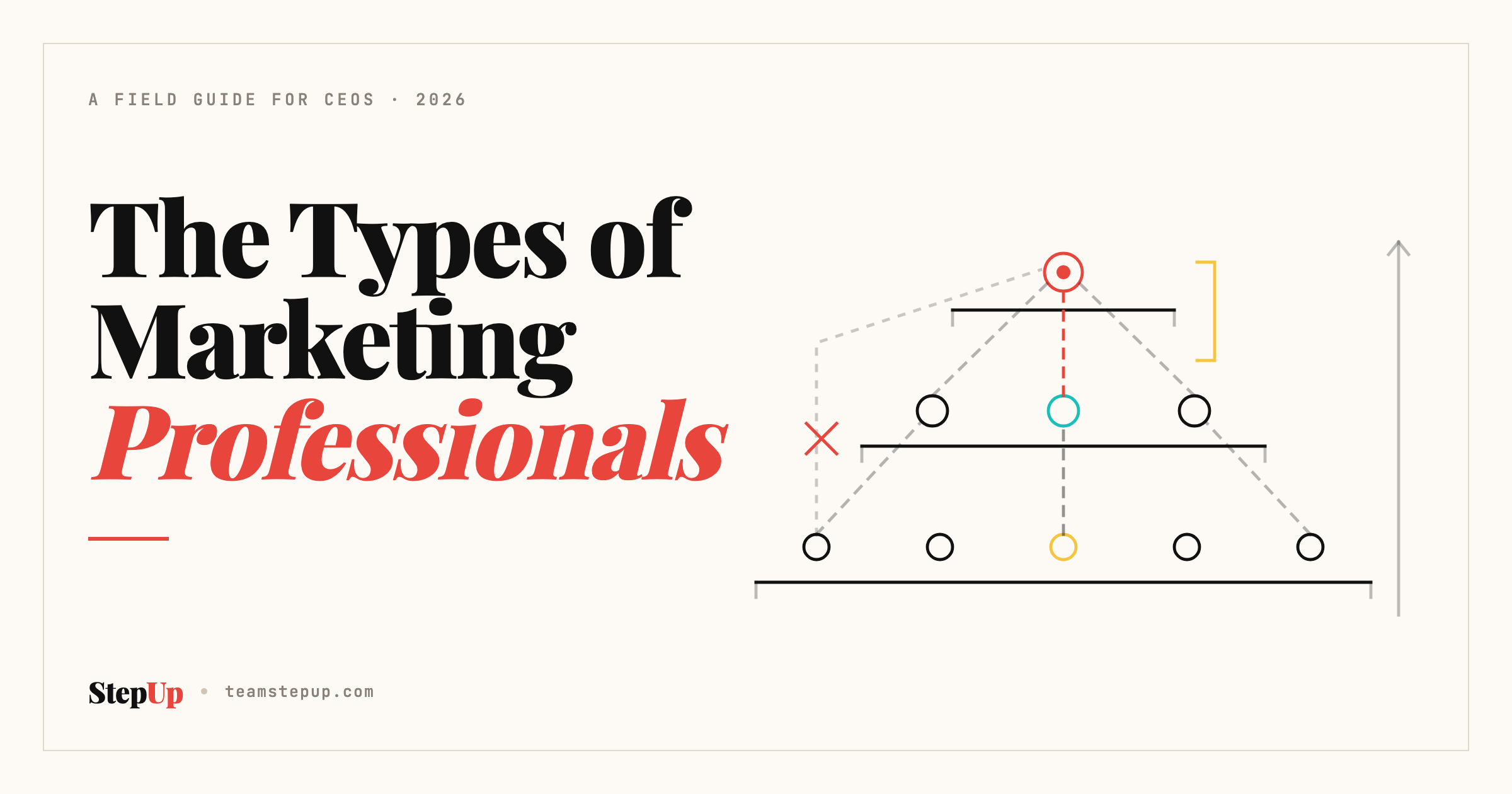
Most marketing problems inside a company are relationship problems wearing a job title.
A CEO briefs a brand strategist the way he’d brief a designer, and gets a logo when he needed a position. A VP Product treats the product marketer as a copywriter with a launch calendar. Someone senior is hired to build a department and spends eight months receiving tasks, then leaves. Nobody in any of those stories is bad at their job. The wiring is wrong.
This guide is about the wiring. For every kind of marketing professional: what they own, how you should work with them if you’re the CEO, how you should work with them if you’re a peer running sales or product, and whether they belong inside your company or outside it.
What job titles hide
Two people can hold the same title and be doing entirely different jobs. The thing that separates them isn’t years, and it isn’t the org chart. It’s how far their decisions reach.
Specialists own a craft. The question they answer best is how. How do we get this page ranking. How do we cut cost per lead in half. Hand them a clear problem and a real standard, and they will beat anyone in the building at that one thing.
Function owners own an outcome. The question they answer best is what, and by when. What produces pipeline next quarter. What this launch needs to land. They direct specialists, run a budget line, and answer for a result — inside a scope that stops at the edge of their function.
Department builders own the system everything else runs inside. The question they answer best is why this and not that. What marketing is for. What it measures. Who gets hired, in what order. What the company stops doing. Every company has exactly one of these, and if nobody was hired for it, it’s the CEO, doing it in the margins of another job.
Almost every leadership-level frustration with marketing is one of these three mismatched. A function owner promoted into a builder’s seat, still executing because that’s what they know. A builder hired to run a channel, restless by month four and gone by month twelve. A specialist handed a strategy question they were never equipped to answer, giving a confident answer anyway because somebody had to.
Altitude doesn’t cost you depth
There’s a lazy version of this map where the people at the top are pure orchestrators — fluent in meetings, no craft left, forwarding the real questions to the real practitioners. That version describes a specific kind of failed executive. It does not describe the job.
Altitude is what depth becomes when you’ve accumulated enough of it. Nobody arrives at the top of marketing as a generalist. They arrive as a writer, or a demand gen lead, or a brand strategist, or the person who rebuilt the attribution model — and then they kept going and added the rest. Fifteen years in, a good one has two or three disciplines they can still personally out-execute their own team in, and enough working knowledge of the others to know within ten minutes when they’re being sold something.
That accumulation is the whole reason their judgment is worth anything. Breadth on its own produces an administrator who can’t tell good work from expensive work. Depth on its own produces someone who over-funds their own specialty and starves everything else. The combination — real range, real depth, real scars — is what you’re actually buying at the top of a marketing organisation, and it takes a long time to make.
Message, brand and voice don’t get delegated
Here’s the mis-wiring that costs companies the most: treating positioning, messaging, brand and tone as craft work to hand off.
They aren’t deliverables. They’re the system itself — the thing every campaign, page, deck and sales call derives from. The person who owns the marketing system owns them, full stop. A CMO who has outsourced what the company sounds like has outsourced their actual job, and you’ll see the result within two quarters as every channel starts saying something slightly different.
Senior people absolutely bring in help. A brand strategist for a repositioning. A researcher for the customer language. A naming specialist, a voice writer, an analyst to pressure-test a claim. But that’s a consult, the way a surgeon consults a radiologist — the input sharpens a decision that stays firmly with the person accountable for it. And often enough the CMO is the specialist in the room, because brand or messaging or measurement is one of the deep areas they came up through. Being able to do the work yourself doesn’t oblige you to do all of it. It’s what lets you direct it.
Trust the judgment. Ask for the defence.
Trusting a senior person is not the same as taking their word for it. The test is whether they can defend any choice they’ve made, on the spot, in two registers:
Pattern. “I’ve watched this fail at three companies and it fails the same way each time — here’s the shape of it.” That’s fifteen years of watching things break, compressed into a call you get to make in thirty seconds instead of eighteen months.
Proof. “Here’s the evidence behind it. Here’s what I’d expect to see by March. And here’s the number that would tell us I’m wrong.”
Either one alone should worry you. All pattern and no proof is instinct with a résumé attached. All proof and no pattern is somebody reading you a dashboard. Together, they’re the thing you can’t hire cheaply, and the thing that makes it safe to stop supervising.
One more marker: a genuinely senior person will change their position when the evidence turns, and say so out loud. That’s the system working, not a crack in it. What should worry you is the leader who can’t articulate why, or who hides behind “the data says” without owning the interpretation.
And the flip side, worth sitting with: if you find yourself second-guessing your marketing lead’s subject lines and colour choices, one of two things is true. You hired the wrong person, or you’re spending your time at the wrong altitude.
Five ways to work with someone
Pick the wrong mode and even a strong person underdelivers.
Partner. You bring the business problem. They bring the answer. You argue it out and decide together. This is for department builders — anyone you’d want contradicting you in front of the board.
Direct. You agree the outcome and the deadline. They pick the method. You review results, not steps. This is how you work with function owners.
Brief. You supply context, audience and the standard for good. They produce. You respond to the work. This is how you work with specialists.
Commission. You buy defined work against a written spec. Deliverable in, deliverable out. Most outside vendors.
Route. You don’t manage them directly at all. You go to whoever owns their function. This one applies whenever a CEO is tempted to Slack a specialist, which is most weeks.
That last mode needs a warning attached. When a CEO briefs a specialist directly, the specialist always says yes — you’re the CEO. The work gets done, their actual manager finds out afterwards, the priorities they’d set get rearranged without them, and inside a quarter nobody is really running marketing. If you want something fast, ask the function owner for it fast.
Inside or outside — ask this last
Knowledge, altitude and function come first. Get those wrong and where the person sits is irrelevant.
Once they’re right, here’s what changes. Inside buys context and continuity: someone who knows how your company argues, what you mean when you say “premium,” which customer stories are safe to tell. They also carry political weight, which decides everything cross-functional. Outside buys range and candour: someone who has watched thirty companies solve this, who starts faster, and who can say the uncomfortable thing because their salary doesn’t depend on the answer. More per hour, less per year.
The rule that holds up: buy craft outside, build judgment inside. Specialist execution outsources beautifully. Anything that needs deep knowledge of your company — narrative, positioning, hiring, what to kill — belongs inside, or in a fractional arrangement designed to leave the system behind when it ends.
The roles
Chief Marketing Officer
Altitude: Department builder
If you’re the CEO: Partner. Your peer, not a report with extra steps.
If you’re a peer VP: Partner. Align quarterly on plans. Don’t hand them work.
Where they sit: Inside. Fractional before you can fund the seat; full-time once there’s a team and a budget to run.
The CMO builds marketing as a system, holds the company’s message, and answers for both to the rest of the executive team.
They own the narrative — one documented answer to what the company is, who it’s for, and why it wins, that everything downstream derives from. They own the department design: which roles exist, in what order, what’s in-house, what’s bought, what’s automated. They own measurement, which mostly means deciding what to stop measuring. They own the operating rhythm — quarterly objectives, weekly check-ins, and a straight answer every Monday to whether the needle moved. They own the budget and the trade-offs that fund it. They translate marketing into language a CFO makes decisions with, and company strategy back into direction the team can act on.
And they own AI at the system level. Not which tools to buy — which parts of the engine AI runs, what standard its output is held to, who reviews it, and how the whole thing stays coherent while producing several times as much.
What they need from you: the real business problem and the real constraints. Revenue targets, cash position, where the board is nervous, what you’re afraid of. Give a department builder a task list and you’ve bought a very expensive project manager.
How to tell you have a real one: ask what they killed. Builders can name programs they shut down, roles they chose not to fill, metrics they pulled off the dashboard, and what each decision cost. Then ask why — and listen for both registers, the pattern and the proof.
VP Marketing
Altitude: Builder in a small company, function owner in a large one
If you’re the CEO: Direct, moving toward partner as trust builds.
Where they sit: Inside.
A VP Marketing runs the team and hits the plan. A CMO writes the plan, holds the narrative, and sits where company strategy gets decided. At thirty people that’s one person wearing both. At three hundred it rarely is. If you’re recruiting a “VP Marketing” and expecting them to define what the company stands for, you’re recruiting a CMO and underpaying for it.
Fractional CMO
Altitude: Department builder
If you’re the CEO: Partner, on a clock.
Where they sit: Outside, deliberately.
The same altitude bought part-time, for when the company needs the architecture — narrative, structure, metrics, hiring plan — before it can justify a full executive salary.
Judge them on what survives their exit. If the system keeps running, it worked. If everything stalls the week they stop invoicing, you bought labour and called it leadership.
Product Marketing Manager
Altitude: Function owner
If you’re the CEO: Direct. Agree the launch outcome, then stay out of the copy.
If you’re the VP Product or VP Sales: Partner. This is your closest counterpart in marketing.
Where they sit: Inside. The role runs on product and customer knowledge that takes months to build.
Product marketing sits between what gets built and what the market understands. The PMM owns positioning and messaging for a product or product line, launch planning and execution, competitive intelligence, sales enablement — decks, one-pagers, objection handling, the demo story — plus input on pricing and packaging, and the win/loss research that should be shaping the roadmap.
Done well, it’s hard and chronically undervalued. A strong PMM is often the only person in the building who can describe the product in the customer’s own words, and the difference between a launch with one and a launch without one is visible from across the company.
Where the confusion starts. The PMM works with product, sales, content, demand gen and support, so from outside the role looks like leadership. It isn’t the same thing. The scope is a product, a launch calendar and a sales team to equip — inside a roadmap someone else sets and a company narrative someone else holds. Coordinating across teams and being accountable for the system are different jobs, and conflating them is how companies end up with a very good manager in a seat that needed a builder.
The clean test: ask about the company narrative. A product marketer will describe messaging for their product, well. A department builder will describe the story the whole company tells, and then show you where the product messaging hangs off it.
What they need from you: roadmap visibility, direct access to customers, and a settled company narrative to work inside. Ask a PMM to invent that narrative between launches and you’ll get positioning for a product, applied to a company. It’s the single most common reason a company’s message reads like a feature list.
PMM vs Product Manager: the PM owns what gets built. The PMM owns how it’s explained, launched and sold.
Brand strategist
Altitude: Function owner, working under the marketing lead’s ownership of the message
If you’re the CEO: Partner during a repositioning, brief for execution — and route the final call through whoever owns your narrative.
Where they sit: Fractional or outside for the strategic sprint, outside for execution.
A brand strategist works on what the company means to people who aren’t buying today: the positioning story, the identity, the voice, the consistency of it everywhere.
Note the altitude carefully, because this is where companies most often mis-wire. Bringing in a brand strategist doesn’t transfer ownership of the message — it buys concentrated expertise for a decision your marketing lead still owns and still has to defend. In plenty of companies the CMO is the stronger brand thinker of the two and hires the specialist for execution horsepower and an outside read. Both arrangements work. What doesn’t work is a brand project that runs around the person accountable for the narrative, which produces a beautiful deck nobody’s marketing actually uses.
Brand is also the hardest discipline to prove on a quarterly cycle, which is why it’s cut first and missed longest. Good brand people tie it to commercial reality without pretending the attribution is cleaner than it is. Be wary of certainty here, and equally wary of anyone who uses the difficulty as an excuse to avoid numbers altogether.
Demand generation manager
Altitude: Function owner
If you’re the CEO: Direct. Agree the pipeline number and the budget. Leave the channel mix alone.
If you’re the VP Sales: Partner. You two either agree on what a good lead is, or you blame each other indefinitely.
Where they sit: Inside, with outside execution help.
Owns the programs that produce qualified pipeline: campaigns, paid channels, webinars, nurture, scoring, and the handoff to sales. Answers for pipeline volume, quality and cost.
The classic failure is a demand gen lead optimising toward a target sales can’t actually work. That’s almost never their fault — it happens when nobody above them reconciled the pipeline number with the capacity to follow it up.
What they need from you: a defined ideal customer, an agreed definition of a qualified lead, and a sales team that responds. Without the first two, they’ll hit the number and none of it will convert.
Growth marketer
Altitude: Specialist, sometimes function owner
If you’re the CEO: Direct — and protect their right to run experiments that fail.
Where they sit: Inside. The work needs product access.
Experiment-driven, working across acquisition, activation and retention rather than one channel. Heavy on analytics and product-adjacent work: onboarding, funnels, in-product prompts. Most at home where the product itself is a channel.
In long-cycle B2B, “growth marketer” is frequently demand gen with a newer title. Worth checking which one you’re getting before you build a team around it.
How to spot a real one: ask for the last three experiments that failed and what changed as a result. Testing culture shows up in what happens after a loss, not in the number of tests.
Performance / paid media marketer
Altitude: Specialist
If you’re the CEO: Route. Go through demand gen. CEOs in ad accounts is a well-documented way to burn money.
Where they sit: Outside, usually. Platform depth is a craft, and an agency sees more accounts in a month than you will in a decade.
Owns paid channels and their economics: cost per acquisition, spend efficiency, channel mix. Deeply technical inside the platforms, and genuinely fast when the inputs are right.
Their results depend entirely on someone else having defined the audience and the message correctly. When paid performance disappoints, look hard at the positioning before you replace the person.
Content marketer
Altitude: Specialist, rising to function owner when they own the architecture
If you’re the CEO: Brief. Your thinking is the scarce input here. Your edits aren’t.
Where they sit: Strategy inside, production outside. The cleanest split in marketing.
At specialist level: writes and publishes. At function-owner level: owns a content architecture where every piece maps to a buyer question and a business objective — and can tell you why something shouldn’t be written at all.
What they need from you: thirty minutes of your real thinking, not a review cycle. Executives who give content people access to their genuine opinions get content worth reading. Executives who only give edits get bland work, and then complain about it.
SEO specialist
Altitude: Specialist
If you’re the CEO: Route, through content or marketing leadership.
Where they sit: Outside, or one person inside directing outside execution.
Owns organic visibility: technical health, site structure, keyword and topic strategy, internal linking, and increasingly whether AI answer engines cite you at all. Distinct from content marketing, and both fail badly when they operate separately.
Lifecycle / CRM marketer
Altitude: Specialist to function owner
If you’re the CEO: Direct if retention is a live problem. Otherwise route.
Where they sit: Inside. They live in your customer data.
Owns everything after the first touch: onboarding, nurture, retention, reactivation, and the segmentation underneath it all. Usually knows the CRM better than anyone else and is the only person who can explain why the data looks the way it does.
Marketing operations
Altitude: Function owner, load-bearing
If you’re the CEO: Direct — and take their objections seriously. When MOps says the data won’t support the report you want, they’re right.
Where they sit: Inside. Implementation projects outside.
Owns the plumbing: tech stack, data hygiene, lead routing, attribution, reporting infrastructure, integrations. Invisible until it’s missing, at which point every dashboard disagrees and nobody can say what produced pipeline.
Any marketing leader who can’t hold a real conversation with their MOps person will eventually present numbers they can’t defend.
Field marketer and partner marketer
Altitude: Function owner
If you’re the CEO: Direct. Expect to see them at customer events beside you.
If you’re the VP Sales: Partner. Field marketing is closer to your team than to marketing’s.
Where they sit: Inside, regionally. Event logistics outside.
Field marketing owns regional and in-person programs: events, roadshows, local campaigns, tight alignment with regional sales. Partner marketing owns co-marketing with resellers, integration partners and alliances. Both are relationship businesses, and both are undervalued in enterprise selling.
Communications and PR
Altitude: Specialist to function owner
If you’re the CEO: Partner in a crisis, brief the rest of the time.
Where they sit: Outside for reach and media relationships. Inside once you need someone reachable in ten minutes.
Owns earned attention: press, analysts, executive visibility, and what happens on the bad day. A different muscle from demand generation, a slower clock, and usually a different personality in the room.
Marketing analyst
Altitude: Specialist
If you’re the CEO: Brief — and ask for the answer you don’t want.
Where they sit: Inside, or shared with the wider data team.
Owns measurement itself: models, dashboards, and the uncomfortable conclusions. Folded into MOps in small teams; separating the two is what ends attribution arguments.
Where AI actually changes this
The common assumption is that AI eats this map from the bottom — specialists get automated, everything above carries on unchanged. The first half is partly true. The second half is wrong, and it’s the half that determines how you should organise.
What AI really changes is the ratio between producing and judging. Drafts, variants, reports, first-pass analysis: nearly free now. Deciding what should exist, what standard it’s held to, and what to do when it’s wrong: exactly as hard as it ever was, and now the bottleneck.
Which leads somewhere people find counterintuitive. The strongest people managers turn out to be the strongest AI managers. It’s the same skill set, close to line for line.
Managing a capable person well means writing a brief that survives contact with reality. Giving context instead of instructions. Defining what good looks like before the work starts. Reviewing against that standard rather than your mood that afternoon. Recognising a confident answer that’s wrong — which you can only do in a discipline you actually know. Building a loop so the same mistake doesn’t reappear next month.
Every one of those is what running AI systems well requires. And notice the one in the middle: catching the plausible wrong answer takes real depth in the subject. This is where the accumulated expertise of a senior marketer stops being a nice-to-have. AI produces work that looks right. Only someone who has done the work can tell you it isn’t.
The inverse is easier to watch happen. Managers who never learned to delegate — who hand over tasks with no context, accept work because it’s polished, and can’t articulate a standard — get exactly the result from AI they always got from people. Fast output, wrong direction, and a growing pile of rework nobody owns.
So AI integration is a leadership question, not a procurement one. Anyone can buy the tools, and most companies already have. What decides whether it works is which parts of the system AI runs, what the review standard is, who owns the output when it’s wrong, and how the whole thing stays coherent while producing three times the volume. Those are the same decisions a department builder makes about people, applied to a faster and considerably more literal kind of worker.
If your AI marketing effort has produced volume and no clarity, the tools aren’t the problem. Look at the altitude and the depth of whoever is managing them.
Quick reference
| Role | Altitude | CEO works with them as | Peer VPs work with them as | Inside or outside |
|---|---|---|---|---|
| CMO | Department builder | Partner | Partner | Inside (fractional early) |
| VP Marketing | Builder / function owner | Direct → partner | Partner | Inside |
| Fractional CMO | Department builder | Partner | Partner | Outside, by design |
| Product Marketing Manager | Function owner | Direct | Partner (Product, Sales) | Inside |
| Brand strategist | Function owner, under the message owner | Partner on repositioning | Brief | Fractional or outside |
| Demand generation | Function owner | Direct | Partner (Sales) | Inside + outside execution |
| Growth marketer | Specialist → function owner | Direct | Direct | Inside |
| Performance / paid | Specialist | Route | Route | Outside |
| Content marketer | Specialist → function owner | Brief | Brief | Strategy in, production out |
| SEO specialist | Specialist | Route | Route | Outside |
| Lifecycle / CRM | Specialist → function owner | Direct | Direct | Inside |
| Marketing operations | Function owner | Direct | Direct | Inside |
| Field / partner | Function owner | Direct | Partner (Sales) | Inside |
| Communications / PR | Specialist → function owner | Partner in crisis | Brief | Outside, then inside |
| Marketing analyst | Specialist | Brief | Brief | Inside |
Three questions that show you someone’s altitude in ten minutes
“What did you kill, and how did you decide?” Builders have a list, and the cost of each one. Function owners have one example inside their own scope. Specialists have none, because killing things was never theirs to do.
“Show me how your metrics connect.” Ask for the line from a weekly team number all the way up to something the board sees. A builder draws it in one breath. Everyone else describes their dashboard.
“Defend a choice I might disagree with.” You’re listening for both registers — the pattern from experience and the proof from evidence, plus the number that would change their mind. One without the other is half a leader.
A closing note on shape
You’ll hear people described as T-shaped: broad working knowledge across marketing, with real depth in one or two areas. It matters more the higher you go, because leading marketing means making trade-offs between disciplines. Only depth, and you over-fund your own specialty. Only breadth, and you can’t tell competent work from expensive work — something specialists detect inside a month.
The variants are worth knowing. I-shaped is deep in one area and narrow elsewhere: excellent specialists, rarely happy running a department. Generalists are broad with no strong stem: invaluable in an early-stage company where one person does everything, ceiling-bound as soon as the team grows. M-shaped people carry several deep areas plus breadth, usually built across fifteen or more years and several stages of company. Those are the people who build departments out of nothing, because they’ve personally done enough of the jobs to know how the pieces fit — and because they can still sit down and do any one of them when it matters.
None of this ranks anyone’s worth. A brilliant specialist beats a mediocre executive on almost any given day. It’s a map of scope and of accumulated judgment, and those are the two things a job title reliably hides.
Frequently asked questions
What are the main types of marketing professionals?
Marketing roles fall into three altitudes rather than a flat list of titles. Specialists own a craft and answer how — SEO, paid media, content, analytics. Function owners own an outcome and answer what, and by when — product marketing, demand generation, lifecycle, marketing operations, field and partner marketing, communications. Department builders own the whole system and answer why this and not that — the CMO, the fractional CMO, and a VP Marketing in a smaller company.
What is the difference between a CMO and a VP Marketing?
A VP Marketing runs the team and hits the plan. A CMO writes the plan, holds the company narrative, and sits where company strategy is decided. In a thirty-person company that is often one person doing both. In a three-hundred-person company it rarely is. Recruiting a VP Marketing and expecting them to define what the company stands for means recruiting a CMO and underpaying for it.
How should a CEO work with their marketing team?
Match the working mode to the altitude. Partner with department builders: bring the business problem, decide together. Direct function owners: agree the outcome and the deadline, review results rather than steps. Brief specialists: supply context, audience and the standard for good, then respond to the work. Commission outside vendors against a written spec. And route around specialists you do not manage — ask the function owner, not the practitioner.
Should marketing roles be hired in-house or outsourced?
Ask this last, after knowledge, altitude and function. The rule that holds up is buy craft outside, build judgment inside. Specialist execution — paid media, SEO delivery, content production, event logistics — outsources well. Anything that needs deep knowledge of your company, such as narrative, positioning, hiring and what to kill, belongs inside, or in a fractional arrangement designed to leave the system behind when it ends.
What is a fractional CMO, and when does it make sense?
A fractional CMO is department-builder altitude bought part-time, for a company that needs the architecture — narrative, structure, metrics, hiring plan — before it can justify a full executive salary. Judge them on what survives their exit. If the system keeps running after they leave, it worked. If everything stalls the week they stop invoicing, you bought labour and called it leadership.
Does AI replace marketing specialists?
AI has made producing nearly free — drafts, variants, reports, first-pass analysis. It has not made judging any easier, and judging is now the bottleneck. Catching a confident but wrong AI answer requires real depth in the subject, which is exactly what an experienced marketer has. The strongest people managers turn out to be the strongest AI managers, because writing a brief, defining a standard and reviewing against it are the same skills either way.
If reading this map made you realise the mis-wiring is in your own company — the wrong altitude in a seat, or the right person being briefed the wrong way — that is a structural question, not a hiring one. It is the first thing we look at when we build a marketing system for a company. What would change if the person holding your message were sitting at the right altitude?
Want to know where your marketing stands against the market? The AI-Readiness Audit is a short call that looks at your marketing and pinpoints exactly where the gap is — and what it is worth to close first. You leave with a clear picture, even if we never work together.