The Types of Marketing Professionals: A Field Guide for CEOs and the People Who Work With Them
September 2, 2026

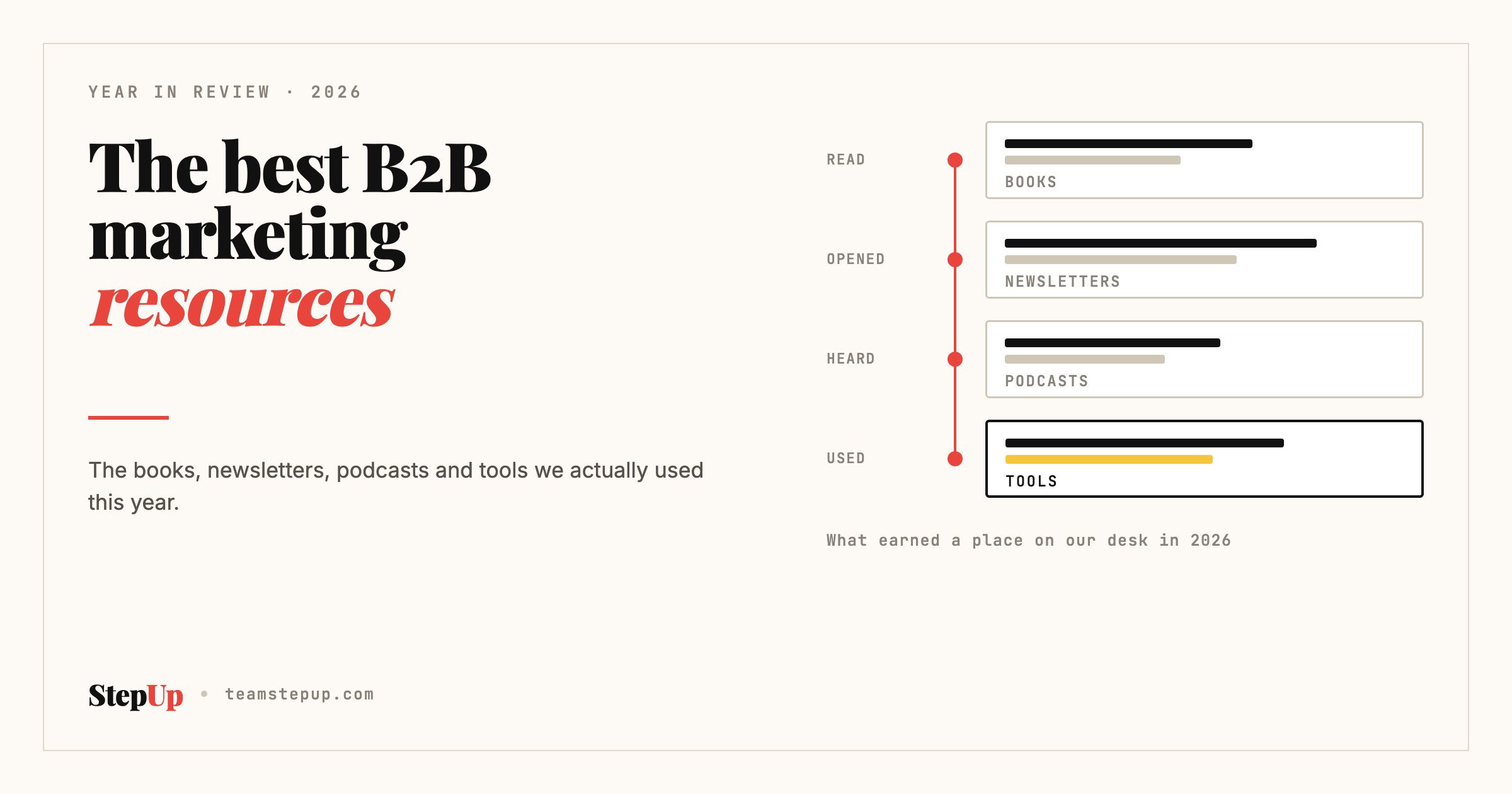
Every year we write this list, and every year it gets harder to keep short.
2026 was the year AI stopped being an experiment in most marketing teams and became part of the daily work. It was also the year a lot of teams discovered that producing more did not mean getting further. The resources that earned a place on this list are the ones that helped us think more clearly.
Below is what we actually read, listened to and used this year, plus the handful of lessons from our own marketing that we are carrying into next year.
Before the list, a short honest look at the year.
AI moved from the side of the desk to the center of it. Drafting, research, reporting and list building now take minutes. As a result, the bottleneck moved. It is no longer production. It is judgment: deciding what to say, to whom, and what to stop doing.
Buyers also changed how they research. More of them now ask AI tools for recommendations before they ever visit a website. Meanwhile, much of the real persuasion still happens in private, in team chats and forwarded emails that no analytics tool can see. We wrote about that in our guide to dark social.
Finally, cold outreach got harder. Inboxes filled with AI-written sequences that all sound alike. So the teams that did well were the ones buyers already recognized before the first message arrived.
We use our own methods on ourselves first. Here is what this year taught us.
We rebuilt our website in four days with AI. The speed was not the interesting part. The interesting part was that it only worked because our positioning, audience and voice were already written down in detail. We wrote up the whole process in how we built our website in 4 days with AI.
This year we looked at which of our pages appear in Google’s results but rarely get clicked. Rewriting how those pages read in search results, the title and the short description underneath, is some of the fastest work available to any B2B site. It needs no new content, just a clearer promise.
We refreshed about twenty older blog posts this year. Several had solid rankings but outdated advice. As a result, updating them was faster than writing new ones, and it protected traffic we had already earned.
We run much of our marketing on Claude. The lesson that stuck: when an output is wrong, fix the written rule that produced it, not just the output. We explain how in Claude for marketing.
The clearest practical book on positioning we know. It walks through how to decide what market you compete in and why a buyer should care. If your sales team and your website describe the company differently, start here.
The book that made OKRs mainstream. We plan all of our marketing, and our clients’ marketing, in quarterly objectives and measurable key results. This book explains why that structure works and where teams usually misuse it.
A grounded, readable take on working alongside AI. In particular, Mollick avoids both hype and panic. For marketing leaders trying to decide what AI should and should not do in their team, it is a sensible place to begin.
The case for category design: defining the problem you solve so clearly that the market starts to use your language. Useful for any company that feels it is being compared on the wrong terms.
These are the ones we still open, week after week.
We keep our stack small. These are the tools that did real work this year.
For a wider comparison of AI tools specifically, see our guide to the best AI marketing tools for B2B.
If you only read a few of our pieces from 2026, make it these.
The most useful mix is a small set of books for lasting thinking, a few newsletters for current practice, a podcast or two for perspective, and tools you actually use every week. Our 2026 picks include Obviously Awesome, Measure What Matters, Why We Buy, Lenny’s Newsletter, Women in B2B Marketing and Google Search Console.
For B2B marketers specifically, Women in B2B Marketing and Marketing Against the Grain are both strong. Marketing Trends is good for hearing how CMOs plan around AI. Lenny’s Podcast is broader, focused on product and growth, but many episodes apply directly to B2B marketing.
For positioning, start with Obviously Awesome by April Dunford. Measure What Matters by John Doerr is the one for planning and measurement. On working with AI, read Co-Intelligence by Ethan Mollick. And for category thinking, Play Bigger.
We open Why We Buy, Lenny’s Newsletter and Marketing Dive. Pick two or three that match your role and read them properly, rather than subscribing to twenty and skimming them all.
Google Search Console is the most valuable free tool for most B2B websites. It shows which searches bring people to your site, which pages Google shows, and where people see you but do not click.
We promised ourselves a shorter list this year.
We will promise it again next year.
Want to know where your marketing stands against the market? The AI-Readiness Audit is a short call that looks at your marketing and pinpoints exactly where the gap is — and what it is worth to close first. You leave with a clear picture, even if we never work together.