Will Marketing Be Replaced by AI? What the Marketing Team Looks Like Now
The demo went well. The vendor showed the CEO an AI agent that wrote a blog post, three LinkedIn posts and a nurture email in the time it took to refill her coffee. Then came the slide she had been waiting for: Your content team, at a fraction of the cost.
She did the math on the way back to her office. Two content marketers, one coordinator, part of an agency retainer. The number was not small.
Then she did a second kind of math, and it did not add up. Because the content was never the hard part. The hard part was deciding what to say, to whom, and why anyone should care. Nobody in the demo had mentioned that.
That gap is the real answer to the question every B2B leader is now being asked by vendors, by boards, and by their own finance teams. Will marketing be replaced by AI?
The short answer
- No. AI replaces tasks. It does not replace the decisions that make marketing work.
- The tasks it replaces are real, and a lot of hours sit inside them. Drafting, research, reformatting, reporting and list building are all now faster by an order of magnitude.
- The decisions it cannot make are the ones that were always scarce: what the company stands for, who it is for, what to stop doing, and whether a piece of work is good.
- So the team does not disappear. It changes shape. Fewer hands on production. More weight on judgment.
- Companies that cut the team first and add AI second usually end up with more content and less marketing.
- A marketing team decides what AI does. Without that team, AI does whatever it was last asked to do, at scale.
What AI actually replaces in a marketing team
Start with the honest part, because the fear is not irrational.
A large share of what marketing teams do every week is production. First drafts. Resizing a post for four channels. Pulling last month’s numbers into a slide. Turning a webinar into a blog, a blog into an email, an email into three social posts. Researching a target account before a sales call. Building a list of companies that match a profile.
AI does all of that now, and it does it well enough that pretending otherwise is a waste of everyone’s time. In our own marketing, work that took a junior marketer a day now takes an agent minutes. The agents do not get bored, and they do not forget the brand guidelines on a Friday afternoon.
So yes, some roles built mostly around production are shrinking. For example, a coordinator whose week was 80% reformatting will find that week much shorter. Likewise, an agency billing by the hour for first drafts is in trouble, and most of them know it.
Still, notice what every item on that list has in common. Someone else decided what it was for.
What AI does not replace
AI is very good at producing an answer. However, it is not good at knowing which question matters.
It cannot decide your positioning. It will happily write positioning, and it will sound confident. But it has no stake in whether the market believes it, and it cannot sit in a sales call and hear the moment a prospect’s attention drops.
It cannot choose what to stop doing. Every marketing team is carrying work that should have been cut a year ago. Cutting it takes someone willing to own the consequence.
It also cannot tell good from average. This one surprises people. The output reads well, so it feels finished. Yet “reads well” is exactly what generic looks like now. When every competitor has the same tools, polished and forgettable becomes the default. Only someone who knows the market can see the difference.
Finally, it cannot own the result. When the quarter goes badly, the CEO does not ask the model what happened. She asks a person.
Why “fewer people plus AI” usually fails
The most common plan we see is simple. Cut the team, buy the tools, keep the output. On a spreadsheet, it works.
In practice, it tends to fail in a predictable way. AI does not fix broken marketing. It exposes it, and then it speeds it up.
If the company never agreed on who it sells to, AI now produces content for everyone, which means for no one. If the messaging was already inconsistent across sales and marketing, AI makes it inconsistent in six more places per week. Similarly, if nobody owned the plan before, nobody owns the agents now, and the agents do not ask.
The result is a strange kind of busy. More posts, more emails, more pages. Meanwhile, the pipeline looks exactly the same, and leadership trusts marketing a little less each quarter.
This is not a technology problem. It is the same problem most B2B marketing departments had before AI: no clear goals, no strong narrative, no system that connects the work to the business. AI just removes the delay that used to hide it.
The fix starts with the plan, not the tools. We cover that in detail in how to build an AI marketing strategy.
What an AI marketing team looks like
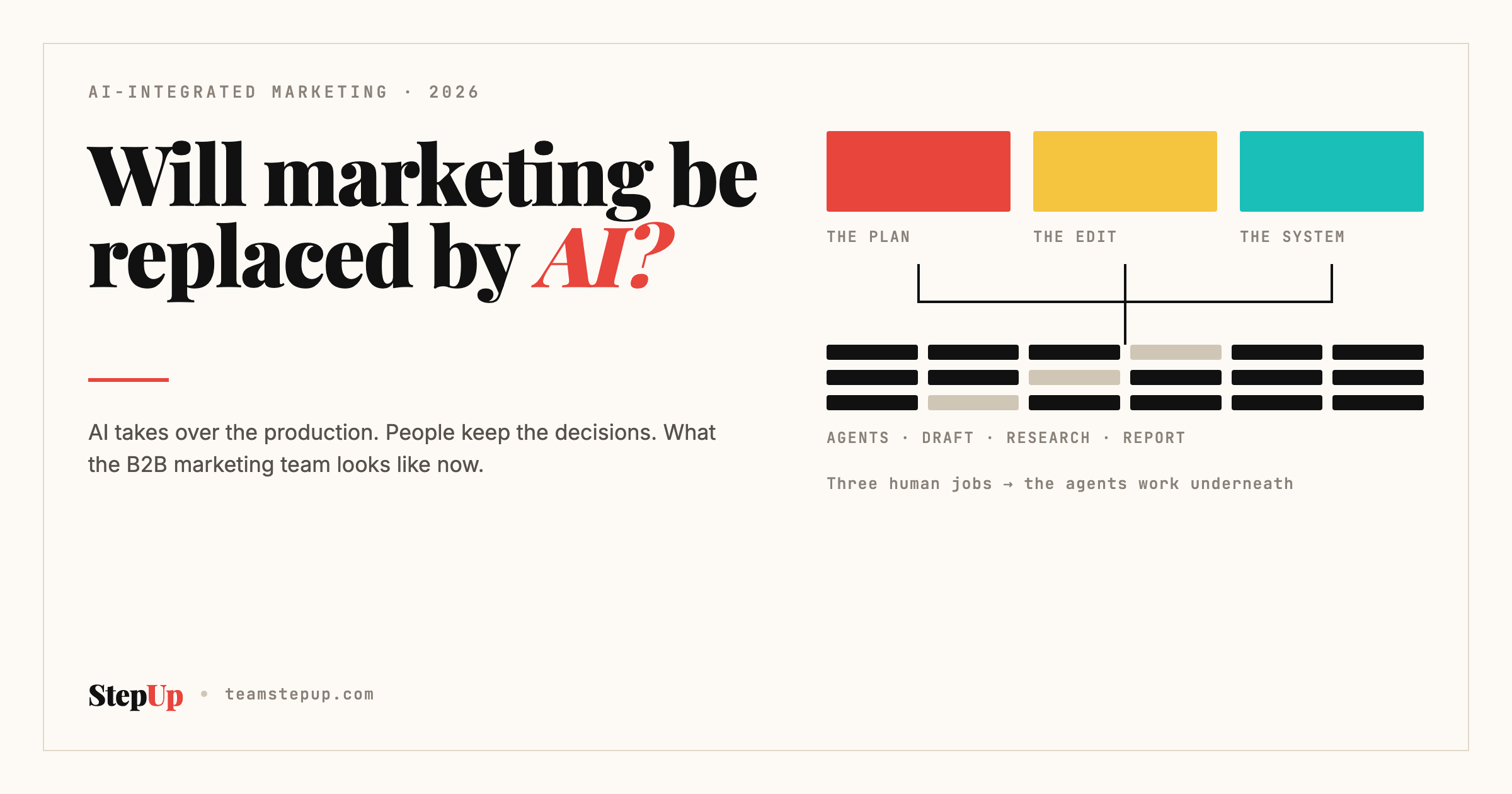
An AI-integrated marketing team is smaller in some places and deeper in others. The agents take the production. The people take everything that requires a point of view.
In our experience, it comes down to three human jobs.
The owner of the plan
One senior person who holds the goals, the narrative and the priorities. She decides what the team works on this quarter and, just as important, what it does not. She reports to leadership in language leadership understands. In a small company, this is often the only full-time marketing seat, and it should be the most experienced one.
The editor
Someone who reads what the agents produce and knows when it is wrong. Wrong does not only mean inaccurate. It also means off-brand, off-strategy, or technically correct and completely forgettable. The editor is the quality bar. Without one, the bar is whatever the model defaults to.
The operator of the system
Someone who maintains the instructions the agents work from: the brand file, the audience definitions, the writing rules, the examples of good and bad. When an output is wrong, she does not just fix the output. Instead, she fixes the rule that produced it, so the mistake does not come back.
In a lean team, one person may hold two of these jobs. What matters is that all three are held by someone.
The agents sit underneath. They draft, research, repurpose, report and build lists. They work fast, and they work from what the humans wrote down.
How we run our own marketing this way
We use this model on ourselves first, because we would not ask a client to trust a system we have not lived in.
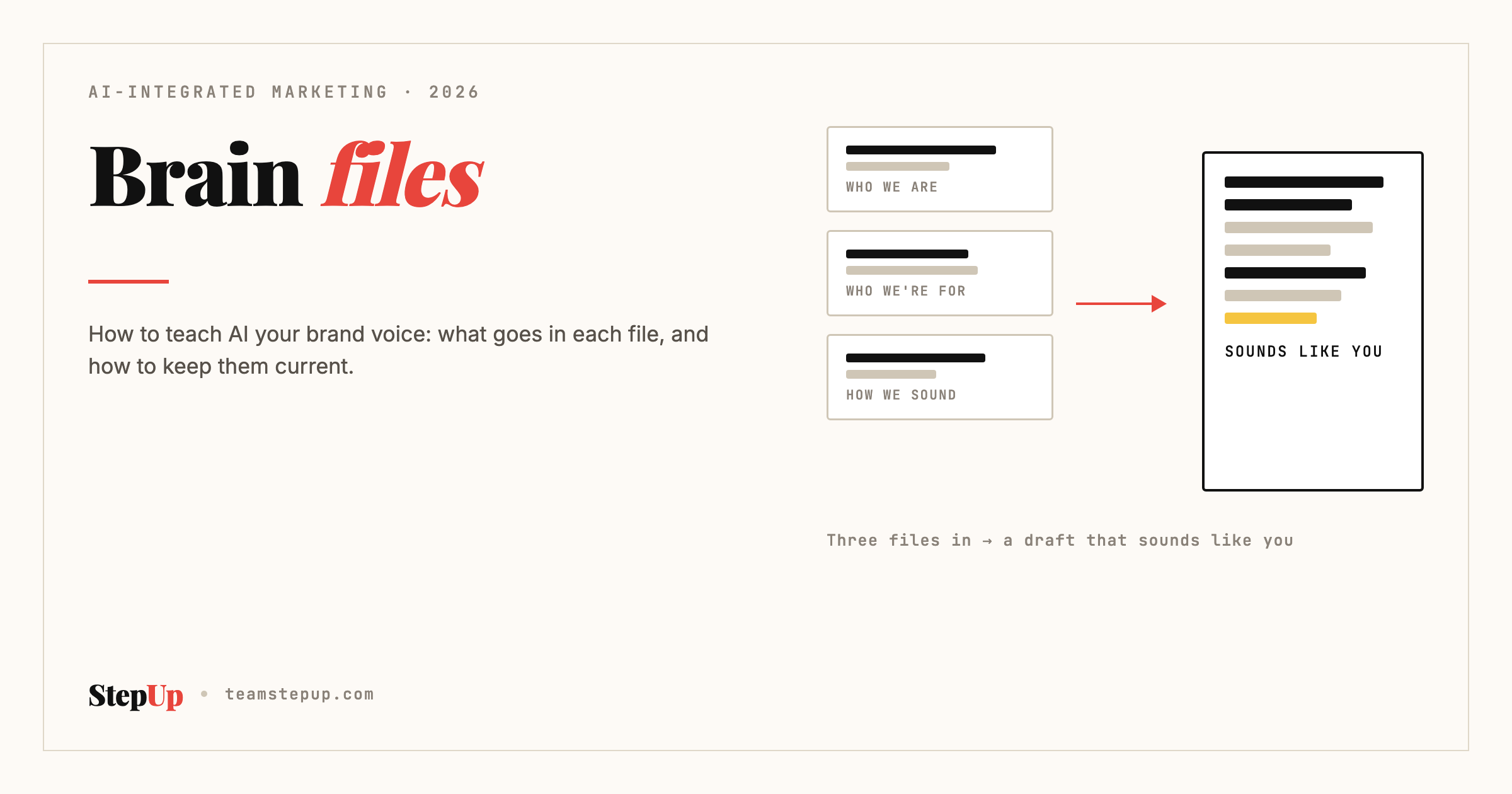
Our marketing runs on Claude, with a set of written files every agent reads before it works. One describes who we are and what we believe. Another describes who we write for. Another holds the writing rules, down to the words we never use. Those files are the real asset. The model is replaceable. The thinking in the files is not.
When we rebuilt our website, the build took four days instead of the usual months. That was not because the AI designed a strategy. Rather, the strategy was already written down, so the AI had something precise to build from. We wrote up the whole process in how we built our website in 4 days with AI.
Our outbound works the same way. Agents find the companies, check them against our customer profile, and draft the messages. A person reviews and approves.
It is not flawless. When an agent gets something wrong, we do not just fix that one message. Instead, we fix the rule the agents read before every message, so the same mistake cannot come back.
Each correction takes minutes. Because the whole system learns from it, it keeps paying off. That is the difference between using AI and running a team with it.
What this means for headcount and budget
This is the question behind the question. So here is a direct answer.
Do not cut first. Before you remove anyone, write down what your marketing is supposed to achieve and what the team actually spends its week on. Most leaders find that half the week goes to work nobody would miss. That is the real saving, and AI is not required to find it.
Move budget from hours to systems. Money that used to pay for production time should now pay for the plan, the narrative and the written rules that make AI output worth using. Those are one-time builds that keep working.
Hire senior, not more. A team of juniors with AI produces a lot of average work very quickly. One experienced marketing leader with AI produces less, and it moves the business. If you can only afford one person, make it the owner of the plan.
Measure execution, not output. Output will go up no matter what, because that is what AI does. Therefore the useful question is whether the work matches the plan and whether the plan is moving the numbers leadership cares about.
For many companies with a small team, the realistic end state is one senior marketing leader, a partner for depth, and a set of agents doing the production. That is not a smaller marketing function. In most cases, it is a more capable one.
Where to start
If you are being asked to “do more with AI” this quarter, start here.
- Write down the narrative. Who you are for, what you believe, and why a buyer should care. If this does not exist in writing, every AI output will be a guess.
- Write down the plan. Three to five measurable goals for the quarter. Not activities. Outcomes.
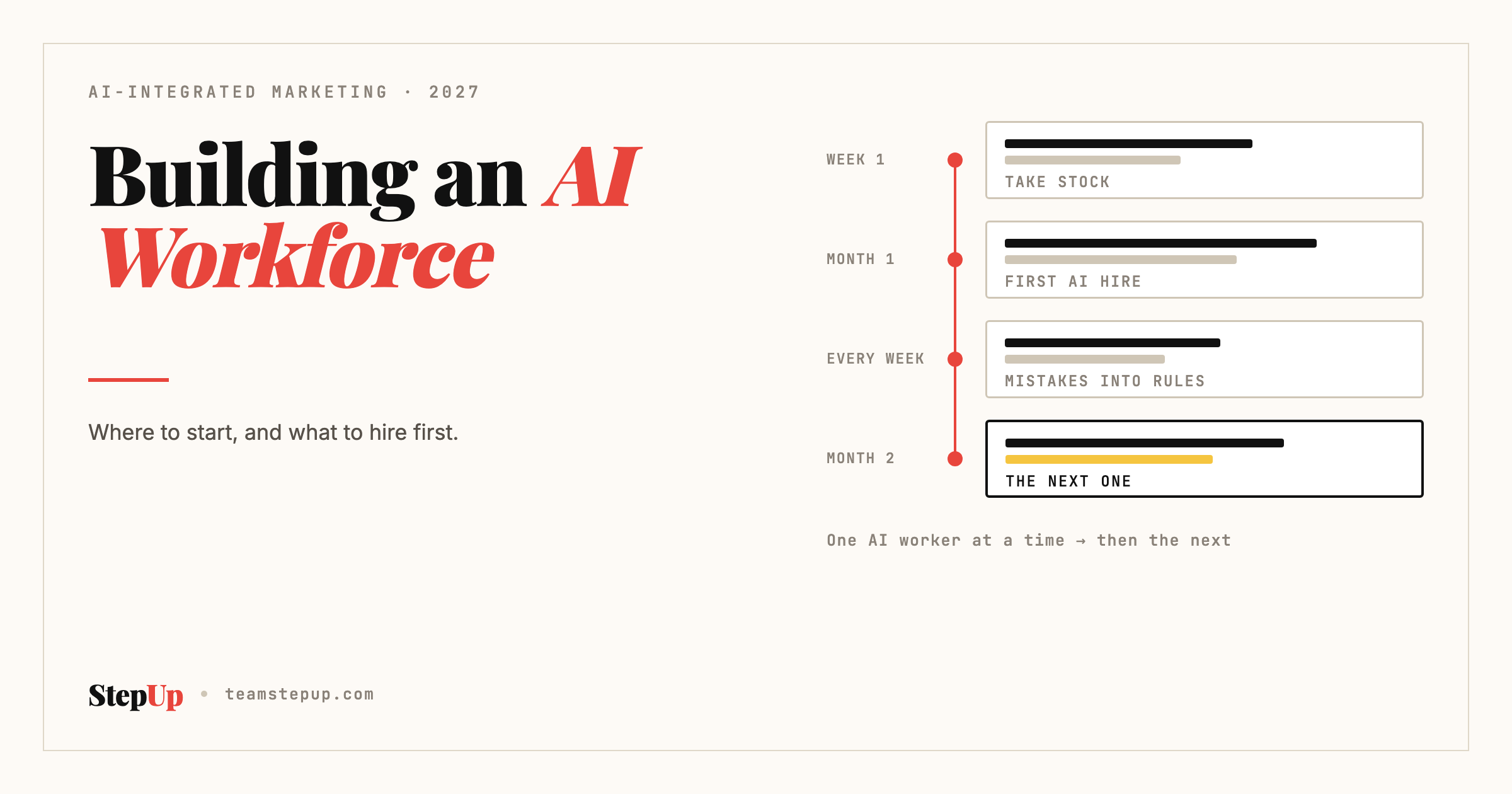
- Pick one function. Content, outbound research or reporting. Put AI to work on one, with one owner, before expanding.
- Give every agent a human owner. Someone who reads the output, corrects it, and updates the rules when it is wrong.
- Review the rules monthly. The agents are only as good as the instructions they read. Instructions age.
If you want a wider view of where AI fits across B2B marketing functions, our AI in B2B marketing playbook goes function by function.
Frequently asked questions
Will AI replace marketing jobs?
AI will replace some marketing tasks and shrink some roles, especially roles built mostly on production, like drafting, reformatting and reporting. It will not replace the people who decide strategy, positioning and priorities, or the people who can judge whether work is good. In fact, those roles become more valuable, because AI multiplies whatever direction they set.
Will digital marketers be replaced by AI?
Digital marketers whose work is mainly executing channel tasks will see much of that work automated. Digital marketers who understand the audience, the message and the numbers will use AI to do far more than before. The skill that matters now is directing and correcting AI, not competing with it on speed.
Can a small B2B company run its marketing with AI and no marketing team?
It can produce content with AI and no team. However, it will struggle to produce marketing that works, because no one is deciding what the content is for or checking whether it is good. The minimum viable setup is one experienced person who owns the plan, supported by AI and, where needed, an outside partner.
What is an AI marketing team?
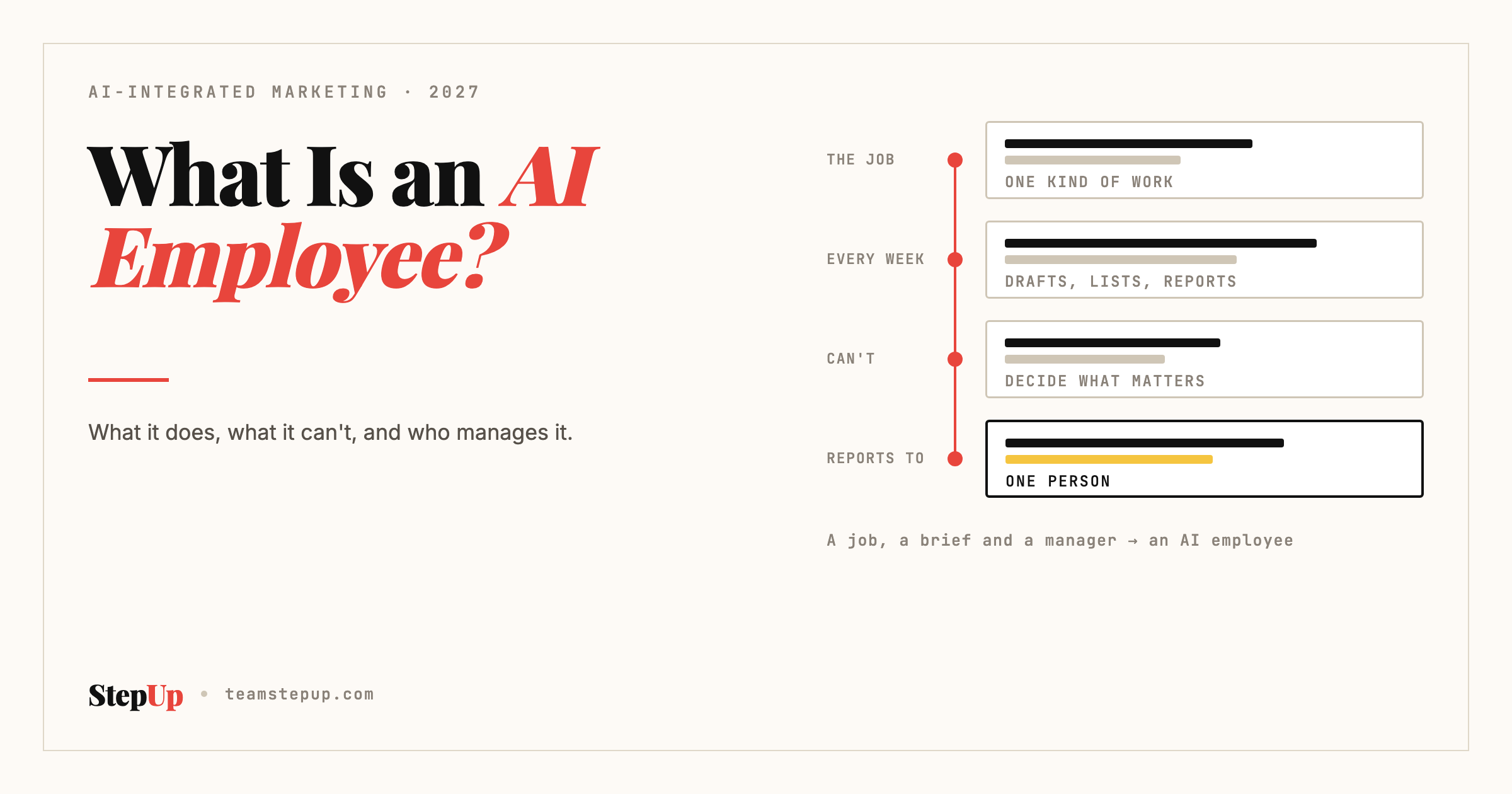
An AI marketing team is a marketing team where AI agents handle production work, such as drafting, research, repurposing and reporting, while people handle strategy, judgment and quality. The people write the rules the agents follow and correct them when the output is wrong.
Which marketing roles are most affected by AI?
Roles centered on first drafts, content repurposing, basic reporting, list building and routine campaign setup are most affected. Roles centered on positioning, planning, editing, customer insight and leadership communication are least affected, and often grow.
What should a CEO do first when told AI can replace the marketing team?
Ask what the marketing team is supposed to achieve, and whether that is written down. If it is not, AI will not fix it. It will only produce more work in the absence of a plan. Write down the narrative and the plan first, then decide where AI takes over production.
The question was never whether AI can write the blog post. It can.
The question is who decides which blog post is worth writing. That job is still open, and it is still the most important one in marketing.
Want to know where your marketing stands against the market? The AI-Readiness Audit is a short call that looks at your marketing and pinpoints exactly where the gap is — and what it is worth to close first. You leave with a clear picture, even if we never work together.