Brain Files: How to Teach AI Your Brand Voice
A marketing manager pastes a request into an AI tool: “Write a LinkedIn post about our new service, in our brand voice.” The draft comes back polished and confident. It also sounds exactly like every other company in the industry.
The tool did nothing wrong. In fact, it simply had no idea what “our brand voice” meant. After all, nobody had told it, in writing, who the company is, who it talks to or how it sounds.
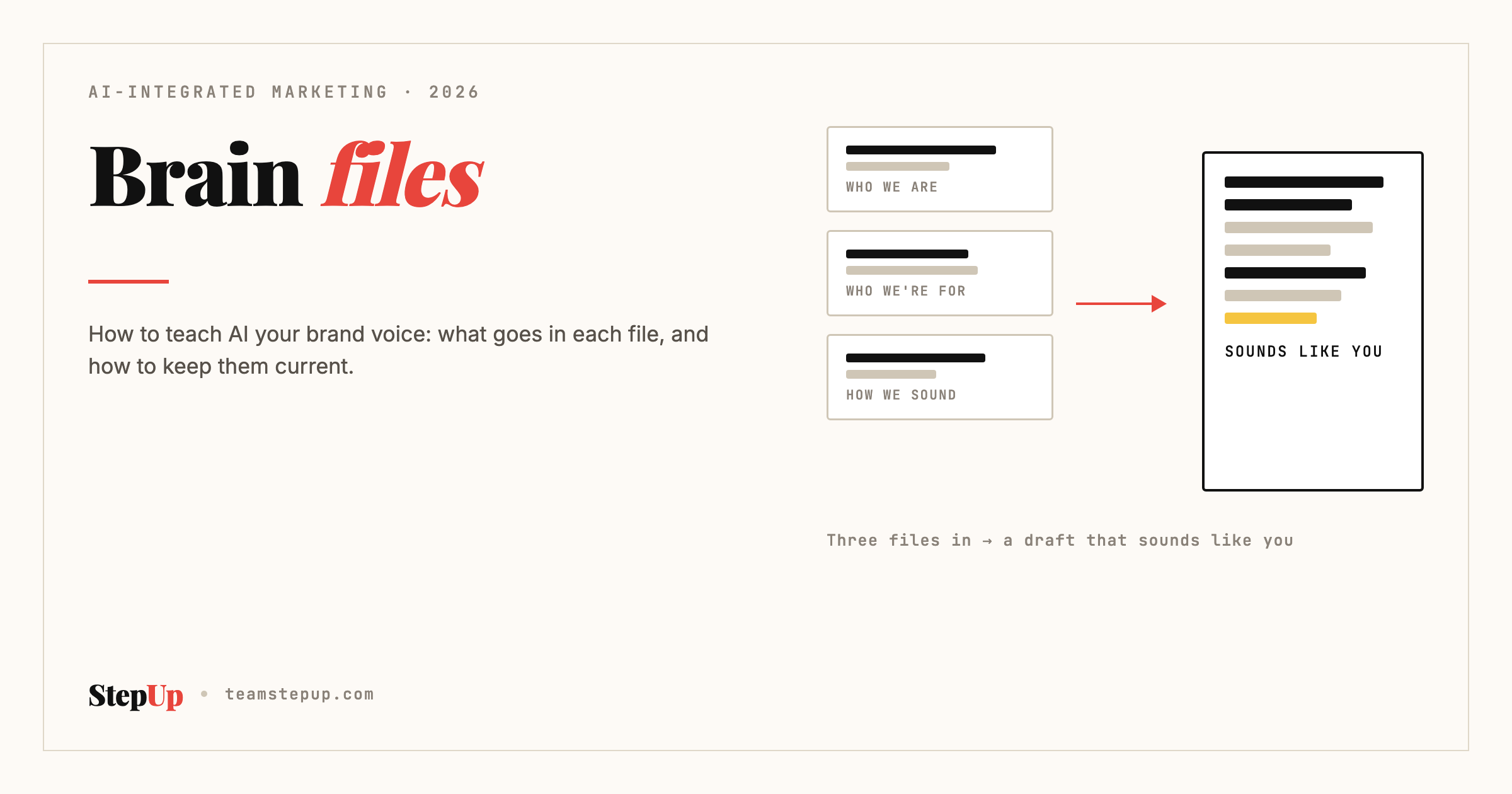
That is what brain files fix. They are the small set of written documents an AI reads before it does any work for you. If you get them right, AI drafts start sounding like your company. Skip them, and no tool or prompt will close the gap.
What are brain files?
Brain files are short, plain documents that describe your company, your customer and your voice precisely enough for an AI to follow.
We use the term because, in effect, they work like a memory the AI does not otherwise have. Every time it writes, researches or plans for you, it reads them first. For that reason, they need to hold the decisions a new senior hire would need in their first week, written down rather than absorbed over months of meetings.
Most companies need three:
- Who we are. What the company does, what it believes and what makes it different.
- Who we are for. The customer, described in their own words.
- How we sound. The voice rules, including the words you never use.
Why AI needs brain files to match your brand voice
People absorb a brand voice by being around it. They sit in meetings, read old campaigns and hear the founder talk. An AI does none of that. Instead, it only knows what you give it, and when you give it nothing, it falls back on the most common way of saying things.
That is why AI content so often sounds generic. The tool is doing its best with no information.
There is also a second, less obvious benefit. Writing brain files forces decisions most companies have left vague. Who exactly is the customer? What do we believe that competitors do not? What will we never say? For many teams, agreeing on these answers turns out to be the hardest part of using AI well.
Brain file 1: who we are
This file tells the AI what your company is and why it exists. Even so, keep it to a page or two.
What to include
- What we do, in one or two sentences a buyer would understand.
- The problem we are against. Every strong brand has an enemy, usually a common way of doing things that fails the customer.
- What we believe that others in the market do not.
- What makes us different, stated plainly and backed by something real.
- The main message and the three or four themes that support it.
An example of the level of detail
Here is how our own file describes the problem we are against: without a clear marketing plan, tasks and scope spiral, teams fill their days with busy work, and leaders end up reacting to noise instead of driving strategy. That is specific enough, for example, for an AI to recognize when a draft is drifting away from it.
Brain file 2: who we are for
Similarly, this file describes your customer so precisely that the AI can write to one real person rather than to “B2B decision makers.”
What to include
- Their role and company, including size and industry.
- Their problem in their own words. Use phrases customers actually say on sales calls, not your marketing language.
- What triggers them to look for help, such as a bad quarterly review or a competitor pulling ahead.
- Who decides, and who else is involved.
- Who you are not for. This matters as much as who you are for.
If you already have an ideal customer profile, however, start from it. Our guide on what an ICP is explains the difference between a customer profile and a buyer persona.
Brain file 3: how we sound
This is the file that most directly shapes brand voice. It turns a vague feeling about tone into rules a machine can follow.
What to include
- Three words for how you sound, and three for how you never sound.
- Sentence rules. Short or long, simple or layered, and how paragraphs should feel.
- How to open and how to close. For example, open with a real problem, never with a question, and end with a thought rather than a pitch.
- Words and phrases you never use. Be specific. A list of banned words does more than a paragraph about tone.
- Spelling and punctuation rules, such as American spelling only.
- Two or three real examples of writing that sounds right, taken from your best work.
The examples do a lot of the work, because an AI learns more from one good sample than from a page of adjectives.
Where to put your brain files
The files only help if the AI reads them every time. Therefore, how you set that up depends on the tool.
- Claude Projects. Attach the files to a Project, and every conversation in it starts with them.
- Claude Code. Keep them in the project folder, where they load automatically for each session.
- Other AI tools. Most offer custom instructions or knowledge files. Put the most important rules in the instructions and attach the full files where possible.
For how we use them day to day, see Claude for marketing.
How to keep brain files current
Brain files are never finished. Instead, they should change whenever your company, your customer or your voice changes.
Still, the most useful habit is simple. When an AI draft is wrong in a way that keeps happening, do not just fix the draft. Instead, add a rule to the right brain file so it does not happen again. Over a few months, those small corrections turn a decent file into a precise one.
In addition, review all three files at least once a quarter. Remove anything that no longer applies, and check that everyone on the team is working from the same version.
A quick test for your brand voice files
First, give your files to an AI and ask for a short post on a topic you know well. Then ask yourself three questions.
- Could a competitor publish this without changing a word?
- Does it use any phrase you would never say?
- Would your best customer recognize their own problem in it?
If the answer to the first two is yes, or the third is no, then the files need more detail. In particular, look for decisions they leave open.
Frequently asked questions
How do I teach AI my brand voice?
Write your voice down as rules and examples rather than adjectives. Describe how you sound and never sound, your sentence style, how you open and close, the words you never use, and include two or three real samples of your best writing. Then make sure the AI reads that file every time it writes for you.
What are brain files?
Brain files are short written documents that describe your company, your customer and your voice in enough detail for an AI to follow. The AI reads them before any task, so its work reflects your decisions instead of generic defaults.
Why does AI content sound generic?
Because the AI usually has no information about your company, customer or voice, so it falls back on the most common way of saying things. Giving it precise written context fixes most of the problem.
What should an AI brand voice guide include?
At minimum: words that describe your tone, words that describe what you never sound like, sentence and paragraph rules, how to open and close, a list of banned words and phrases, spelling rules, and real examples of writing that sounds right.
How long should brain files be?
Usually one to two pages each. Long enough to hold real decisions and examples, short enough that the most important rules are not buried. Precision matters more than length.
How often should I update brain files?
Add a rule whenever the same mistake shows up twice, and review all of them at least once a quarter, or whenever your positioning, customer or offer changes.
Next time that marketing manager asks for a LinkedIn post “in our brand voice,” the AI will know what the words mean.
It read the file first.
Want to know where your marketing stands against the market? The AI-Readiness Audit is a short call that looks at your marketing and pinpoints exactly where the gap is — and what it is worth to close first. You leave with a clear picture, even if we never work together.