Marketing OKRs: How to Set Them, With Examples for B2B Teams
Every January, a marketing team somewhere writes 23 objectives on a whiteboard. By February, nobody can remember objective 14. By March, the whiteboard is being used for the office fantasy football league, and the quarter is being run the way it always was: by whoever shouted last.
OKRs were supposed to fix that. Done well, they do. A short list of goals, a few numbers that prove you got there, and a team that knows what to say no to.
Done badly, they are a to-do list wearing a blazer.
And lately there’s a new twist. Your CEO has read that AI can “run the OKR process,” so the expectation is that the objectives will now write themselves, the key results will track themselves, and you will spend the saved hours (all 40 of them) on strategy. (I’d love to see the calendar where that happened.)
Truth is, AI can help a lot with OKRs. It can pull the numbers, draft the first version and flag the key result that’s sliding. What it can’t do is decide what matters this quarter. That part is still yours, and it’s the part that makes marketing OKRs work.
This guide explains what marketing OKRs are, how to write them, nine examples for B2B teams, and the mistakes to avoid.
What Are Marketing OKRs?
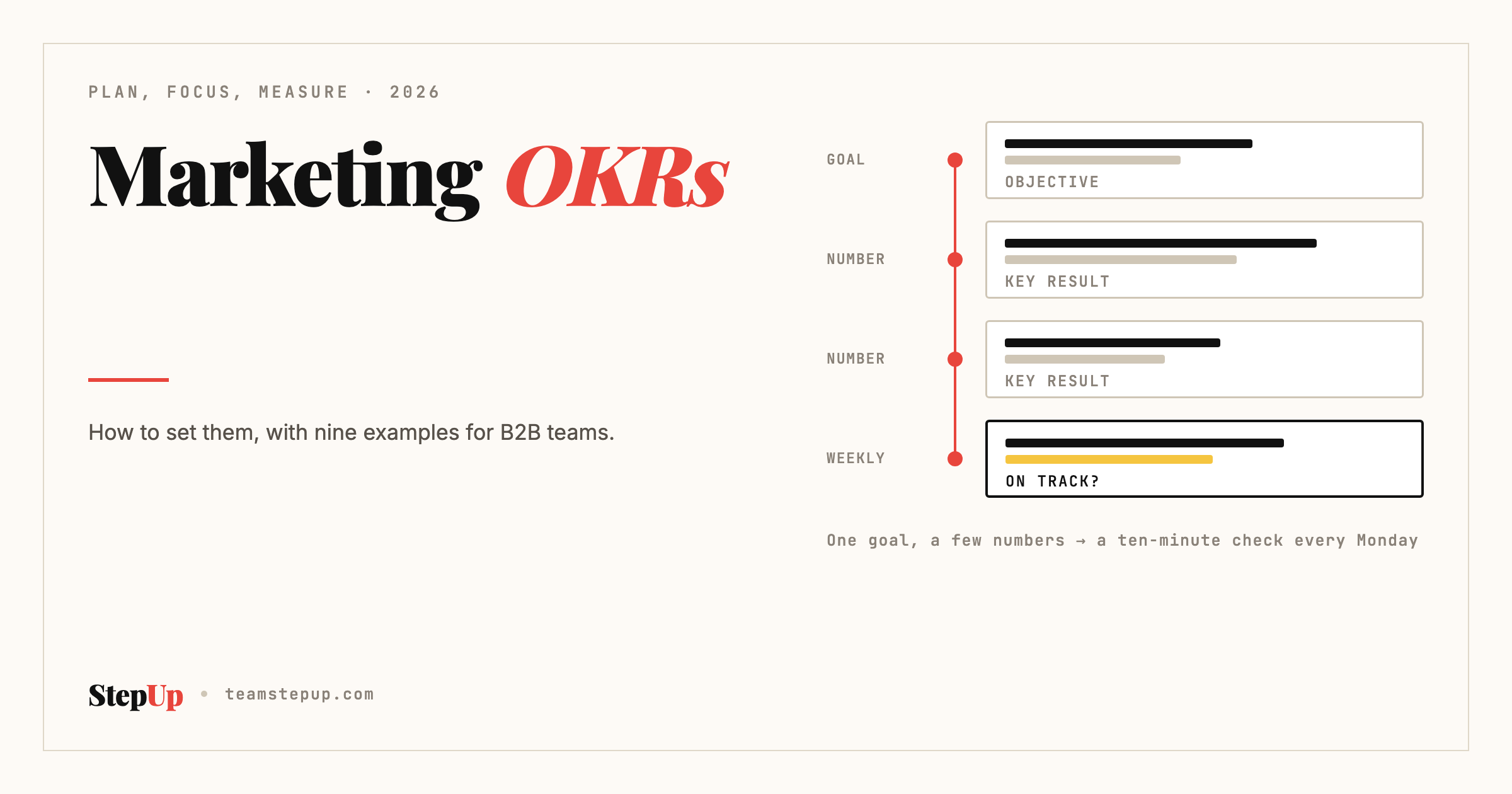
OKR stands for Objectives and Key Results. An objective is what you want to achieve, written in plain words. Key results, meanwhile, are the two to four numbers that prove you achieved it.
For a marketing team, OKRs turn “we want more pipeline” into a goal the whole team can work toward, check every week, and report on without arguing about what counts.
A simple example:
- Objective: Make our website a real source of sales conversations.
- First key result: Google clicks grow from 40 to 140 per four weeks.
- Second: Website form fills grow from 5 to 12 per quarter.
- Third: 6 sales calls booked from website leads.
The objective says where you’re going. The key results say how you’ll know you got there.
OKRs vs. KPIs: What’s the Difference?
KPIs and OKRs get mixed up all the time, partly because a KPI can become a key result. The difference is in the job each one does.
| KPIs | OKRs | |
|---|---|---|
| What it is | A number you watch all the time | A goal for a set period, with numbers attached |
| Time frame | Ongoing | Usually a quarter |
| Job | Tells you if things are healthy | Tells you what to change and by how much |
| Example | Cost per lead | Cut cost per lead from $240 to $180 by March 31 |
In short, KPIs are the dashboard and OKRs are the destination. If you want the dashboard side in more detail, our guide to B2B marketing KPIs covers which ones a CEO actually needs.
How to Set Marketing OKRs in Six Steps
1. Start From the Company’s Goals
Marketing OKRs sit under the company’s goals, not next to them. Before writing anything, find out what the business needs this quarter: more pipeline in a new region, more revenue from existing customers, a launch that has to land. Then ask which part of that marketing owns.
If the company has no written goals, write down what the CEO said in the last two leadership meetings. That’s usually the real plan anyway.
2. Write One to Three Objectives
An objective should be short, plain and a little ambitious. Moreover, it should describe an outcome, not an activity. “Publish 60 blogs” is an activity. “Become the site B2B buyers find when they search for our category” is an outcome.
So keep it to three objectives at most. Teams with five objectives usually have zero priorities.
3. Give Each Objective Two to Four Key Results
Each key result has a starting number, a target and a date. For example, “improve SEO” is not a key result. “Searches where we show on Google’s first page grow from 232 to 315 by December 31” is.
A useful test: could someone outside marketing read the key result and agree, on the last day of the quarter, whether you hit it? If not, rewrite it.
4. List the Work Under Each Objective
The work (campaigns, blogs, the new landing page) goes underneath as initiatives. They are how you plan to move the key results, so they can change mid-quarter if they aren’t working. The key results stay put.
Many teams skip this split, and as a result their OKRs fill up with tasks. Keeping the work separate is what lets you say “this campaign isn’t moving the number, let’s change it” without rewriting the goal.
5. Agree Them With Sales and Leadership
Marketing OKRs that sales has never seen are a private diary. Walk your CEO and head of sales through them before the quarter starts, especially any key result that depends on them: lead follow-up times, the definition of a qualified lead, budget.
6. Check Them Every Week, Score Them Every Quarter
Each week, update the numbers and ask one question per key result: on track, at risk or off track? Then, at the end of the quarter, score each key result from 0 to 1. A score around 0.7 on an ambitious key result is a good quarter. A team that scores 1.0 on everything set its targets too low.
Marketing OKR Examples for B2B Teams
Here are nine marketing OKR examples, grouped by the three goals most B2B teams have. Swap in your own starting numbers.
Website and Search
Objective: Make the website a reliable source of new buyers.
- Google clicks grow from 40 to 140 per four weeks.
- Pages fixed for search grow from 26 to 50.
- 5 of 7 target searches show the website on Google’s first two pages.
Demand and Pipeline
Objective: Fill the pipeline with buyers who match our ideal customer.
- 120 people join the funnel (quiz, audit or contact form).
- 40 of them come from our target region.
- 6 sales calls booked from marketing-sourced leads.
Brand and Audience
Objective: Become the voice our buyers follow on LinkedIn.
- Newsletter subscribers grow from 156 to 400.
- Company page followers grow by 300.
- 39 posts published across the company page and the founder’s profile.
Marketing Operations OKR Examples
Marketing operations OKRs are a small search on their own, and a useful one, because they cover the systems everyone else depends on.
Objective: Make our numbers something leadership trusts.
- Every lead in the CRM tagged with its source, from 60% to 100%.
- Weekly marketing report sent every Monday, 13 of 13 weeks.
- Analytics connected to the CRM by October 31.
Where AI Helps With OKRs, and Where It Doesn’t
AI is genuinely useful through the OKR cycle. Still, the split matters, because the parts it can’t do are the parts that decide whether the OKRs mean anything.
| Step | What AI Does Well | What Stays With a Person |
|---|---|---|
| Research | Pulls last quarter’s numbers, finds benchmarks, summarizes what sales heard | Deciding which numbers matter |
| Drafting | Writes a first version of the objectives and key results from your plan | Choosing the one to three objectives |
| Tracking | Updates the numbers every week and flags what’s sliding | Deciding what to change |
| Reporting | Drafts the quarterly score and the summary | The story you tell leadership, and the ask |
In our own team, AI pulls the Search Console and CRM numbers each week and checks each one against its source. Then a person reads the five-minute version and decides what moves. Overall, that split saves hours without handing over the judgment.
Common Mistakes With Marketing OKRs
Writing Tasks as Key Results
“Launch the new website” is a task. “Website form fills double after launch” is a key result. If you can complete it by doing the work, regardless of the outcome, it’s a task.
Too Many Objectives
Every objective you add takes attention from the others. Three is the ceiling. One is fine.
Key Results Nobody Can Measure Yet
If the tracking doesn’t exist, the first key result is to build it. Otherwise you’ll reach the end of the quarter with a target and no number.
Setting Them and Forgetting Them
OKRs that are only opened at quarter end are a report card, not a plan. Therefore, the weekly check is the part that actually changes behavior. It takes ten minutes.
Measuring Marketing Alone
If a key result depends on sales following up, say so, and agree it with sales. Shared key results are the honest way to measure the handoff. Our guide to MQL vs. SQL covers how to define it.
A Simple Marketing OKR Template
Copy this into a doc or spreadsheet and fill it in for next quarter.
| Field | What to Write |
|---|---|
| Company goal it supports | One line from the company’s plan |
| Objective | A plain-language outcome, ambitious but believable |
| Key result 1 to 4 | Starting number, target number, date |
| Owner | One person per key result |
| Initiatives | The work you’ll do to move each key result |
| Weekly status | On track, at risk or off track, with one line on why |
| Quarter-end score | 0 to 1 for each key result |
If you’d rather start from a full plan, the one-page marketing plan puts the OKRs, the audience and the budget on a single page.
Frequently Asked Questions
What are OKRs in marketing?
OKRs in marketing are a goal-setting method: one to three objectives for the quarter, each with two to four key results that prove you reached it. They connect marketing’s work to the company’s goals and give the team a short list to focus on.
How many OKRs should a marketing team have?
One to three objectives per quarter, each with two to four key results. More than that and the team loses focus, because every objective competes for the same people and budget.
What is a good marketing OKR example?
Objective: make the website a reliable source of new buyers. Key results: Google clicks grow from 40 to 140 per four weeks, website form fills grow from 5 to 12 a quarter, and 6 sales calls are booked from website leads.
What is the difference between OKRs and KPIs in marketing?
KPIs are numbers you watch all the time to check the health of your marketing, like cost per lead. OKRs are goals for a set period, with key results that say how far a number should move and by when. A KPI can become a key result when you decide to change it.
Can AI write marketing OKRs?
AI can draft OKRs from your plan, pull the starting numbers and track progress every week. A person still has to choose the objectives, agree them with sales and leadership, and decide what to change when a key result slides.
Back to the Whiteboard
Twenty-three objectives was never a plan. It was a list of everything everyone wanted, written in dry-erase marker so nobody had to commit.
Three objectives, ten numbers and a ten-minute check every Monday will do more. Let the AI update the numbers. You decide what they’re for.
And the fantasy football league can keep the whiteboard.
Not sure your team is set up to run OKRs with AI in the loop? The free AI-Readiness Self-Audit shows where you stand.
Want to know where your marketing stands against the market? The AI-Readiness Audit is a short call that looks at your marketing and pinpoints exactly where the gap is — and what it is worth to close first. You leave with a clear picture, even if we never work together.