

Claude Skills for Marketing: The 5 We Use Every Week
Every marketing team has jobs it explains over and over. How to write a post in the company voice. What to check before a blog goes live. How to plan the week. The steps rarely change, yet someone still has to explain them again, to a new hire, to an agency or to an AI tool.
Claude skills solve that. A skill is a saved set of instructions that Claude loads whenever a task calls for it. In other words, you explain the job properly once, and Claude follows the same method every time.
We run a large part of our marketing on Claude, and skills are where much of the consistency comes from. Here is what they are, the five we use every week, and how to write your first one.
What are Claude skills?
A Claude skill is a small package of instructions, and sometimes supporting files or scripts, that teaches Claude how to do a specific task your way.
Think of it as the difference between briefing a freelancer from scratch every time and handing them your team’s written playbook. The playbook holds the steps, the standards, the examples and the mistakes to avoid. Claude reads it when the task comes up and follows it.
Skills work across Claude’s apps and in Claude Code. You can write your own, and many teams share them internally so everyone works from the same method.
Why skills matter for marketing
Marketing depends on consistency, however. The same voice across channels, the same standards on every blog post and the same process every week. That consistency usually lives in people’s heads, which is why it breaks when people are busy or new.
Skills, by contrast, move it out of heads and into writing. As a result, three things improve:
- Quality stops depending on who asks. A junior marketer and a senior one get the same method.
- Nobody re-explains the job. The instructions are written once and improved over time.
- Mistakes get fixed once. When something goes wrong, you update the skill, and every future task benefits.
The 5 Claude skills we use every week
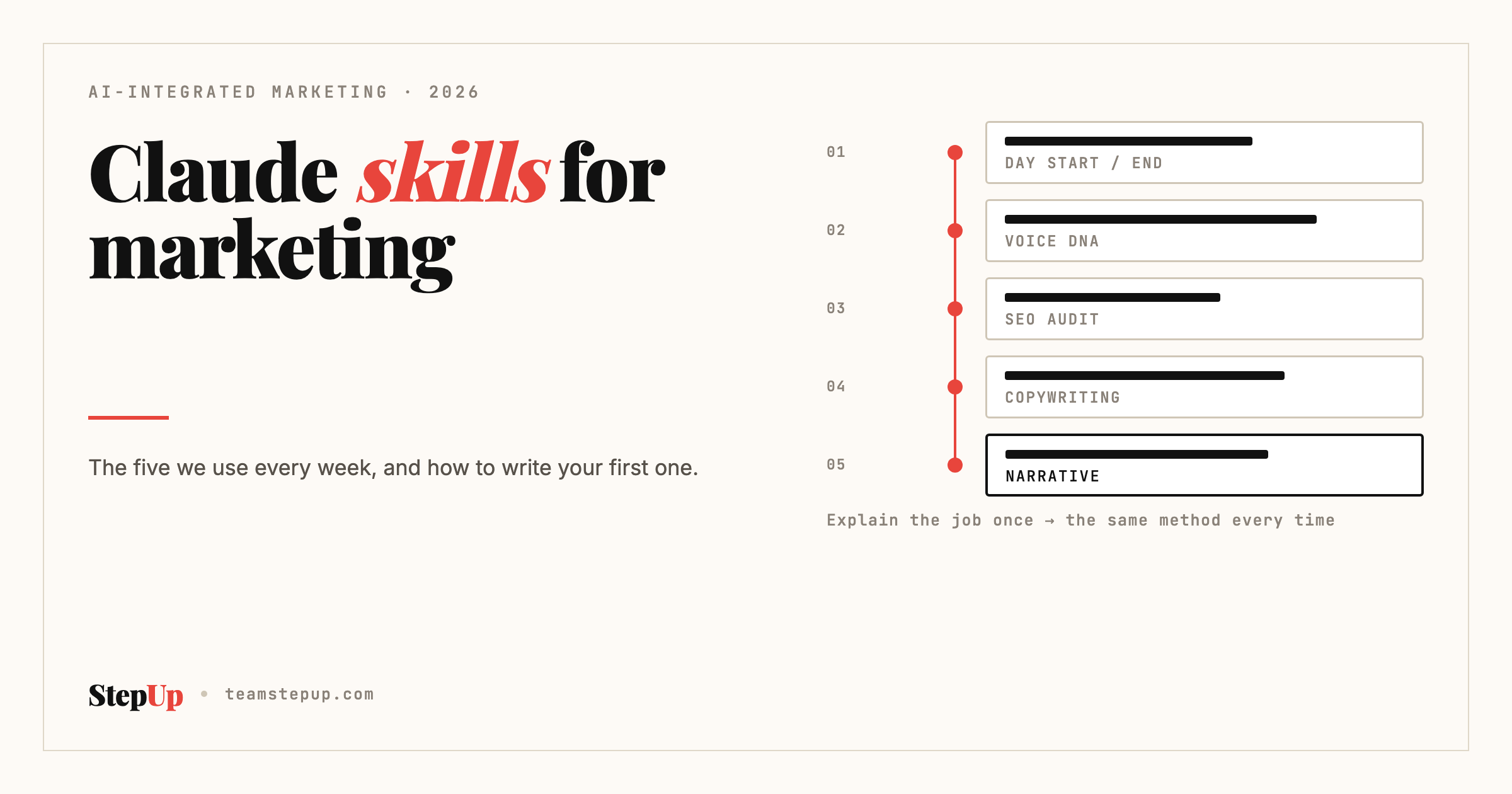
1. Day start and day end
These two run our daily planning. In the morning, the day start skill checks our quarterly goals, reads the calendar and new client email, and produces one short, prioritized list for the day. At the end of the day, the day end skill records what actually got done and what carries over.
The skill holds rules we learned the hard way. For example, one main priority and three supporting ones, each measurable, and never an invented task. Every item must come from the plan, the calendar, email or something a person actually said.
2. Voice DNA
This skill studies a set of writing samples and extracts the writer’s patterns: sentence length, how they open and close, the phrases they use and the ones they never would. The result is a written voice profile that Claude uses whenever it drafts in that person’s name.
We use it for our own LinkedIn and newsletter drafts. We also run it with clients during our workshops. The difference in the first draft is obvious. Without it, AI writes like the average of the internet. With it, the draft sounds close enough to edit rather than rewrite.
3. SEO audit
Before we refresh or publish a blog post, this skill checks it against a fixed list: the title and description, headings, internal links, readability and the questions people actually search. It returns a short list of fixes rather than a lecture.
Since the checklist lives in the skill, every post gets the same review, whether it is our first of the week or our tenth.
4. Copywriting
This one handles page copy: homepages, landing pages and service pages. It works from our brand files, so it starts from the customer’s problem, avoids the phrases we never use and ends with a question rather than a hard pitch.
It also pushes back, because a page that tries to say three things at once gets flagged before writing a word.
5. The narrative workshop
We run a structured workshop with clients to build their company narrative: the problem they solve, what they believe, who they are for and what they will never say. This work is split into a set of skills, one for each session, so every client goes through the same steps in the same order.
Finally, the skills turn the approved narrative into the written files the client’s own AI tools will work from. That handover is what makes the work last.
How to write your first Claude skill
To start, pick a task you explain more than once a month. Then write it down as if you were briefing a capable new team member.
- Name the job and when to use it. One line on what the skill is for and what should trigger it.
- Write the steps in order. Plain instructions, one step at a time.
- Set the standard. What does good look like? Include one or two real examples.
- List the traps. The mistakes people usually make, and what to do instead.
- Add the rules that never change. Spelling, words to avoid, tone, anything non-negotiable.
- Test it on real work. Run it three or four times and compare the results with your own.
- Update it when it fails. Every correction goes into the skill, not into a one-off fix.
A good first skill is short, since you can always add to it once you see where it falls short.
Skills, Projects and brain files: how they fit together
These three are easy to confuse. So here is how we use each.
| What | What it holds | When Claude uses it |
|---|---|---|
| Brain files | Who you are, who you sell to, how you sound | Almost always, as background |
| Projects | A workspace with standing instructions and files | For ongoing work, such as writing on-brand content |
| Skills | The method for one specific task | Whenever that task comes up |
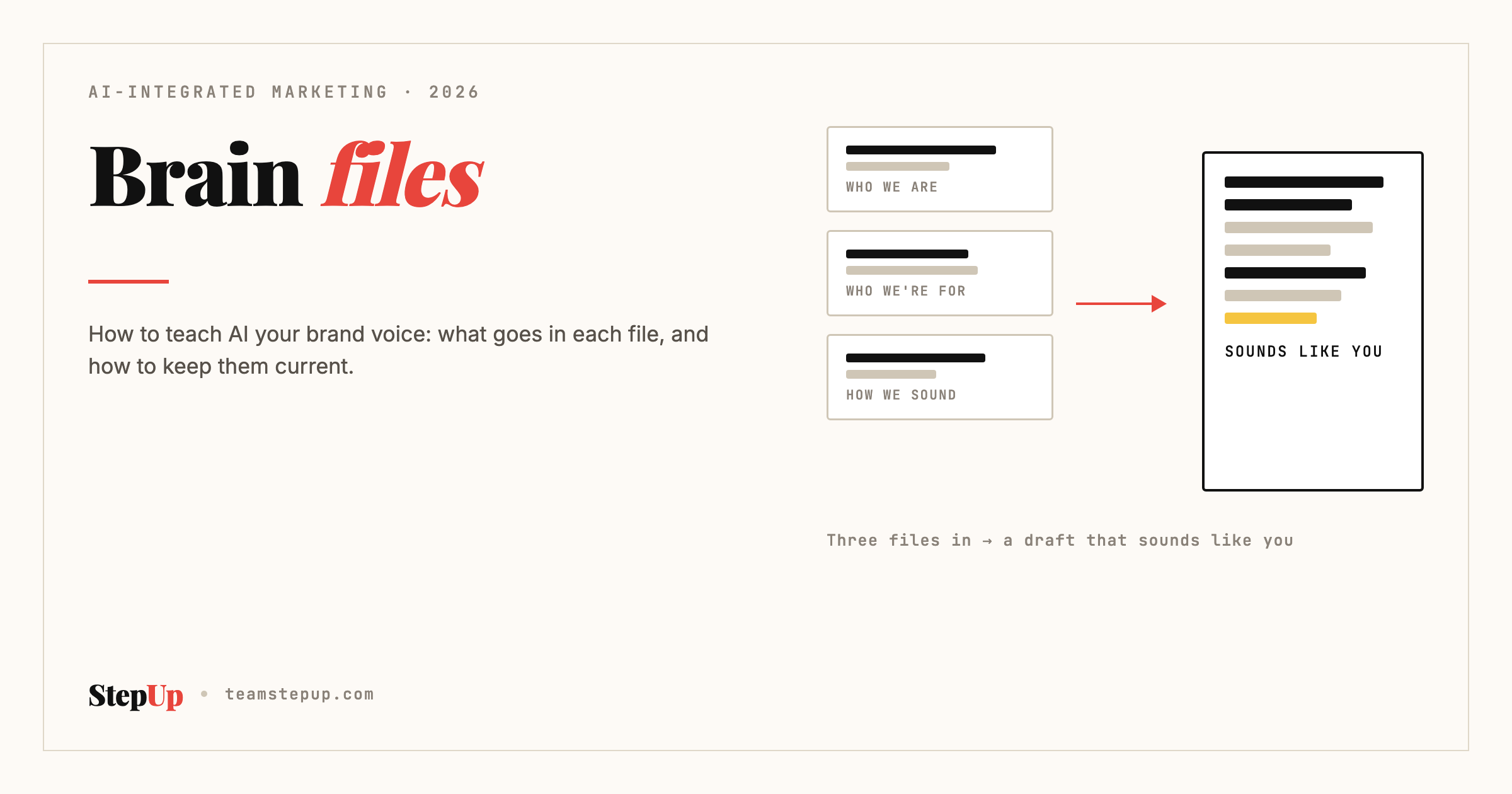
Brain files describe the company. Skills describe the work. Most teams need the brain files first, because a skill that follows a perfect method with the wrong picture of your company still produces the wrong result. We explain how to write them in brain files: how to teach AI your brand voice.
For the wider picture of how we use Claude, see Claude for marketing.
Frequently asked questions
What are Claude skills for marketing?
Claude skills for marketing are saved sets of instructions that teach Claude how to do a specific marketing task your way, such as planning the week, auditing a blog post or drafting in a particular voice. Claude loads the skill when the task comes up and follows the same method every time.
How do I create a Claude skill?
Choose a task you explain often. Write the steps in order, describe what good looks like with an example, list the common mistakes and add any rules that never change. Test it on real work and update it whenever the result falls short.
What is the difference between a Claude skill and a Project?
A Project is a workspace with standing instructions and files, useful for ongoing work like writing on-brand content. A skill is a method for one specific task that Claude can use whenever that task comes up.
Do I need to be technical to write Claude skills?
No. Most marketing skills are plain written instructions. If you can write a clear brief for a new team member, you can write a skill.
Which marketing tasks work best as Claude skills?
Tasks that repeat and follow a consistent method: weekly planning, content audits, SEO checks, drafting in a specific voice, repurposing content and structured workshops. Tasks that need fresh judgment every time benefit less.
The next new hire still gets the welcome lunch.
They just skip the afternoon where someone explains, for the fourth time this year, what to check before a blog goes live.
Want to know where your marketing stands against the market? The AI-Readiness Audit is a short call that looks at your marketing and pinpoints exactly where the gap is — and what it is worth to close first. You leave with a clear picture, even if we never work together.

AI Marketing Consultant: What One Actually Does, and When You Need One
September 29, 2026