Will Marketing Be Replaced by AI? What the Marketing Team Looks Like Now
September 27, 2026

The keyword research behind this article took about fifteen minutes. Claude pulled close to 900 related searches from SEMrush, checked who ranks on Google for the main ones, and handed back a ranked list.
Deciding which of those searches deserved an article took longer. That part was ours.
That split is the most useful thing we can tell you about using Claude for marketing. It does the work at a speed that still surprises us. However, it does the work you point it at, and pointing it well is a marketing skill, not a technical one.
We are a B2B marketing team. Our website, our SEO, our content and a large part of our daily planning run on Claude. Here is how that works in practice, including the parts where we overrule it.
Most marketing work is not creative in the romantic sense. Instead, it is structured work with a clear input and a clear standard. Claude is strong at exactly that.
In our own work, it handles:
It is also patient in a way people are not. It will check 80 blog posts for a missing field without getting bored at post 40.
Still, notice the word in every item: clear. Where the input is vague, the output is vague, just faster.
Most people start with prompts. We think that is backwards.
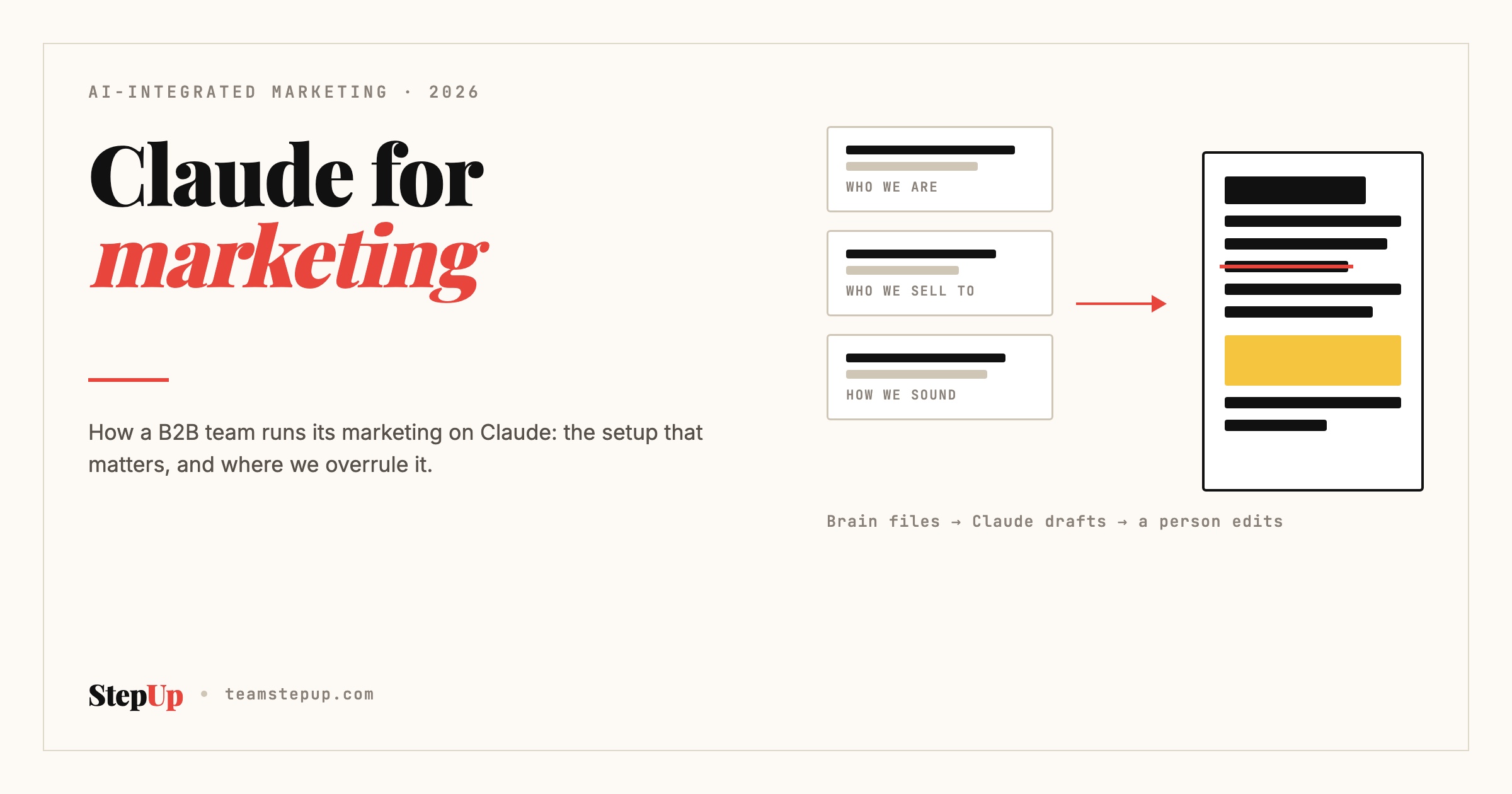
Before Claude writes anything for us, it reads a small set of written files. One describes who StepUp is and what we believe. Another describes who we write for, down to the job title and the problem they would describe in their own words. A third holds the voice rules: sentence length, the phrases we never use, American spelling only.
We call these brain files. In Claude, you can attach them to a Project so every conversation starts with them. In Claude Code, they sit in the project folder and load automatically.
The difference is obvious in the first draft. Without the files, Claude writes like the average of the internet. With them, it writes something we can edit rather than rewrite.
This is also where most teams get stuck. The files force you to decide things marketing has often left vague: who exactly the customer is, what you believe that competitors do not, what you will never say. Claude cannot make those decisions for you. Nevertheless, it will expose very quickly that nobody has made them.
Claude comes in a few forms, and the names confuse people. Here is how we use each one.
| Tool | What it is | What we use it for |
|---|---|---|
| Claude chat | The regular Claude conversation | Quick questions, brainstorming, editing a single piece |
| Projects | A workspace with standing instructions and files | Writing anything on-brand: posts, emails, articles |
| Claude Code | Claude working directly with files and tools on a computer | The website, the SEO pipeline, keyword research, publishing |
| Skills | Saved, reusable instructions for a specific task | Repeat jobs, such as a daily plan or a set of workshop steps |
| Connectors | Links to tools like Google Drive, Gmail, HubSpot and Canva | Reading source material and working inside the tools we already use |
You do not need all of them. Most marketing teams will get far with Projects alone.
Claude Code sounds technical, but it is not only for developers. We are marketers, not engineers, and we rebuilt our website with it in four days. The skill it requires is the same one a good marketing brief requires: knowing exactly what you want and saying it clearly. We wrote up that whole build in how we built our website in 4 days with AI.
Here is where it actually sits in our week.
Our blog runs through a set of Claude tools. Claude pulls keyword data from SEMrush, finds which of our pages compete with each other, drafts or refreshes the article against our brand files, and checks it against the readability rules our site uses. Then it prepares the page for publishing.
A person decides the topic, approves the draft and says when it goes live.
Our site was rebuilt in Claude Code, working inside WordPress rather than replacing it. Before any code was written, we wrote the brain file. That file did more to protect the result than any technical choice.
LinkedIn posts start in a Project that holds the voice rules and examples of posts that worked. Claude drafts; we rewrite the opening, cut what does not sound like us, and post by hand.
Each week’s plan lives in a written file Claude reads before any session. As a result, it knows what this week is for before we ask it anything. It also stops it from suggesting work nobody agreed to.
Using Claude well means knowing where not to trust it. These are the places we overrule it most.
It sounds confident when it is wrong. A draft can read beautifully and still make a claim we cannot support. So every factual statement gets checked before publishing.
It drifts toward generic. Left alone, it reaches for familiar phrases and neat three-part lists. The brand files reduce this, but they do not remove it. An editor still has to read everything.
It cannot tell which work matters. It will happily optimize a page nobody visits. Choosing priorities is a human job, and it should stay one.
It misses tone. A message can be accurate and still land wrong with the person reading it. That is why anything going to a real prospect or client gets read by a person first. When the tone is off, we fix the rule behind it, not just the message.
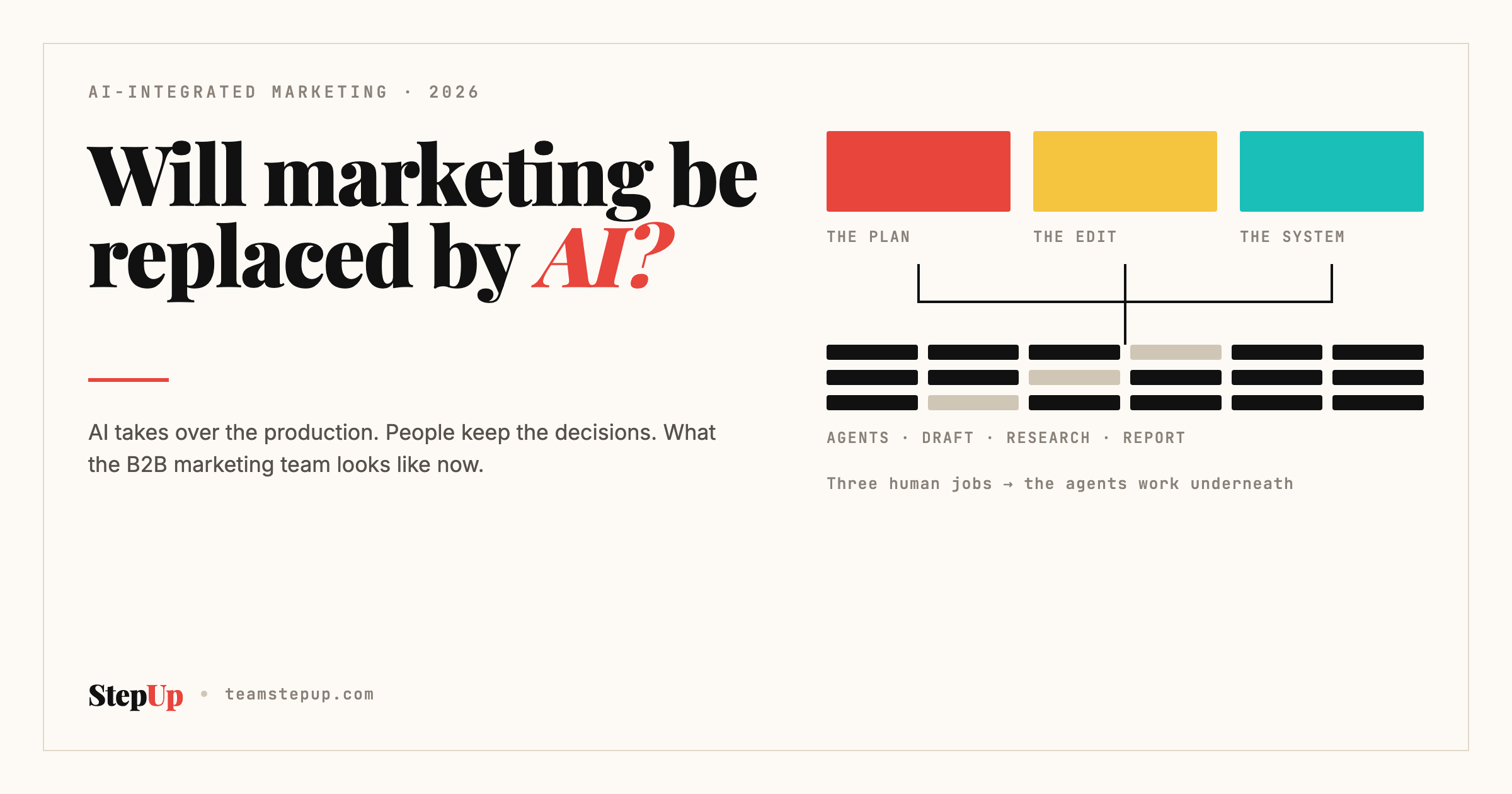
None of this is a reason not to use Claude. Rather, it is the job description of the person who runs it. We wrote more about that shift in will marketing be replaced by AI.
If you are starting this month, this order works.
Before any of this, it helps to know what your marketing is supposed to achieve. Our AI marketing strategy article covers that part. For a wider view of AI across B2B marketing functions, see our AI in B2B marketing playbook.
Yes, for work with clear inputs and standards: research, first drafts, rewrites, audits and reporting. It is especially strong at following long written instructions, such as a brand voice guide. It is weaker at judgment, like deciding which idea is worth pursuing, which is why a person should stay in charge of priorities.
Start by writing a few short files about your company, your customer and your voice. Then load them into a Claude Project so every conversation begins with that context. From there, move one repeated task, such as first drafts, into Claude and review the results before expanding.
Both are capable. We chose Claude because it handles long documents well and follows detailed written rules consistently, which matters when every draft has to match a brand voice. In practice, the setup matters more than the model. A well-briefed tool beats a better tool with no context.
Skills are saved sets of instructions Claude can use for a specific, repeated task. For example, a skill could hold the steps for writing a weekly plan or running a content audit. They save you from re-explaining the same process every time.
Not to start. Projects cover most writing work. Claude Code becomes useful when your work involves many files, data or your website, such as bulk-updating blog posts or pulling keyword data. It does not require being a developer, but it does require clear instructions.
No. It replaces a large share of production work, but it cannot decide positioning, set priorities or judge whether work is good for your market. Teams that use it well tend to shift people toward those decisions rather than remove them.
We did not get better at marketing by using Claude. We got faster at the parts we already knew how to do.
The parts we did not know how to do, it simply showed us sooner.
Want to know where your marketing stands against the market? The AI-Readiness Audit is a short call that looks at your marketing and pinpoints exactly where the gap is — and what it is worth to close first. You leave with a clear picture, even if we never work together.