AI Marketing Consultant: What One Actually Does, and When You Need One
In the wild, wild west of AI, mastery is elusive and the playing field can feel like auditions at Barnum’s.
The best are engineer/hackers, free-wheeling their way through agentic stacks that cut down on busy work. The worst have automated the production of slop and contribute (as one worries they might) to the morass of mediocrity that’s taken down brand giants as well as high school English teachers.
It’s a rough time to be in marketing.
But truth is, many marketers need help. And that’s legit. Marketing was already the position to wear the most hats within an organization before the advent of tools that seem to have convinced our bosses that for a mere $20 tab we should improve our output by 85% and automate the chores. (Images of moms on the beach sipping cosmos float through my mind).
It’s a fantasy.
Truth is, AI is a hell of a tool, but learning it is a full-time job, and if you’re reading this, you probably already have a full-time job (or two).
You might want to consider hiring an AI marketing consultant to effectively integrate AI into your marketing and thus deliver on your boss’s dreams (and your cosmo-seaside fantasy).
This guide explains what an AI marketing consultant should actually do for a B2B company, when you need one, and how to tell the difference between help and noise.
What is an AI marketing consultant?
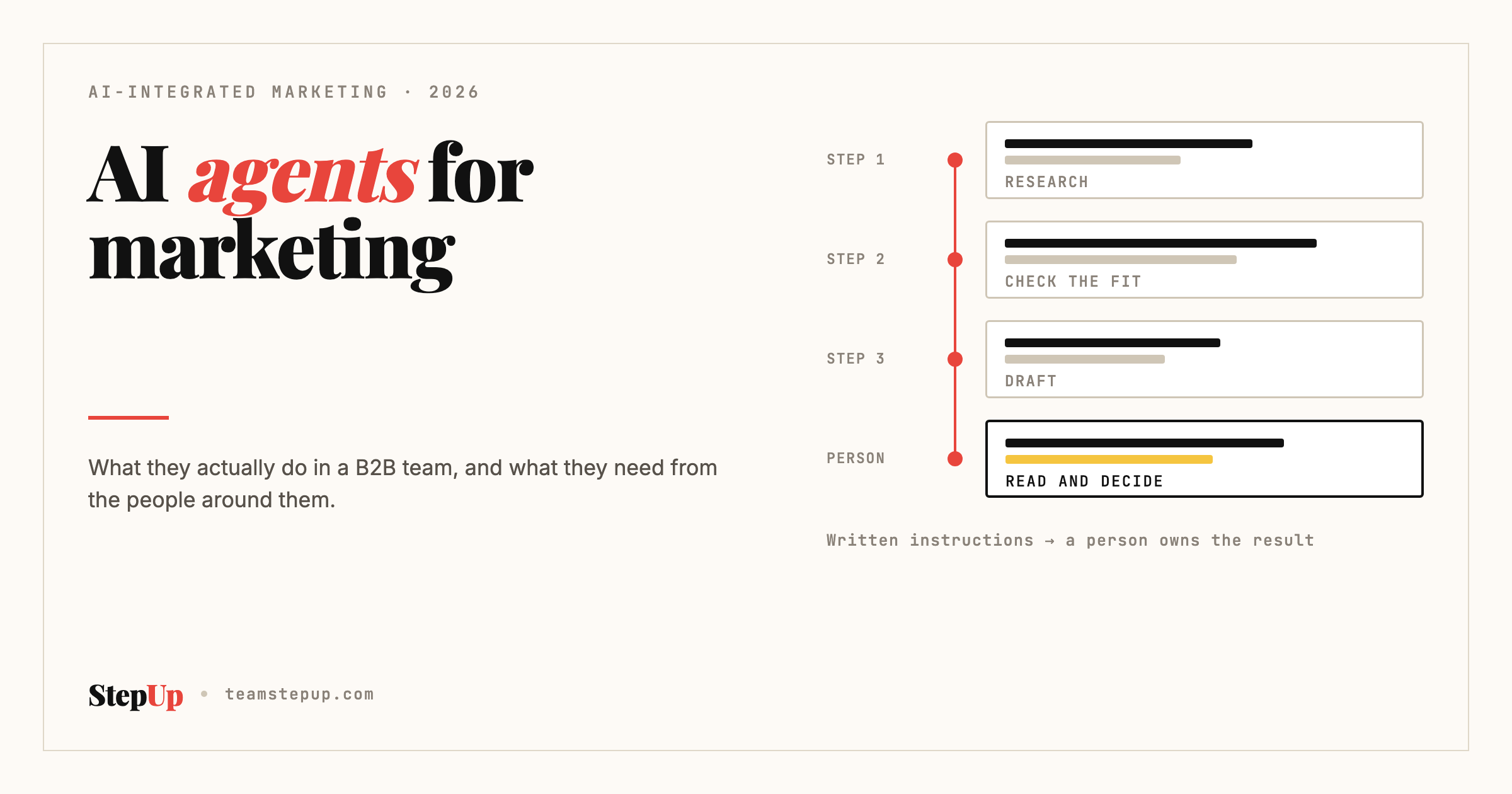
An AI marketing consultant helps a company decide where AI belongs in its marketing, sets it up so it produces work that is actually usable, and makes sure a person stays in charge of the results.
That definition has three parts, and a good consultant covers all three:
- Deciding. Which marketing jobs should AI take over, which should stay human, and in what order.
- Setting up. The written instructions, brand files, tools and workflows that make AI output consistent and on-brand.
- Owning. Who reviews the output, who corrects it, and how the team measures whether any of it is working.
Most people who use the title only cover the middle part. They set up tools. That is useful. On its own, however, it tends to produce more content without better marketing.
What an AI marketing consultant is not
It helps to be clear about what you are not buying.
First, an AI marketing consultant is not a software vendor. If every recommendation leads back to one platform, you are in a sales process.
It is also not a prompt workshop. Training your team to write better prompts has value. However, prompts are the smallest part of the problem. Without a clear strategy and written brand rules, even perfect prompts produce generic work.
Finally, it is not a replacement for a marketing plan. If your company has not agreed on who it sells to and what it wants marketing to achieve, AI will not settle that. It will simply produce more material in the absence of a decision. We cover this in detail in AI marketing strategy.
When you need an AI marketing consultant
Not every company needs outside help with AI. Here are the situations where it usually pays off.
Your team is using AI, but nothing is consistent
Different people use different tools. As a result, some output sounds like the brand, but most does not. Nobody knows which prompts work. This is the most common situation, and it is very fixable with written rules and a shared setup.
You are being asked to cut marketing costs with AI
Leadership has heard that AI can replace part of the team. Before anyone is cut, someone needs to map what the team actually does and which parts AI can genuinely take over. After all, getting this wrong is expensive. We wrote about it in will marketing be replaced by AI.
You have no senior marketing leader
Many B2B companies with strong sales teams, for example, have little or no marketing leadership. For them, AI is an opportunity to run a capable marketing function with a small team. However, someone experienced still has to decide what the AI works on.
You tried AI and it produced generic content
In most cases, this means the AI had no real information about your company, your buyers or your voice. The fix is better inputs: written rules about who you are, who you sell to and how you sound.
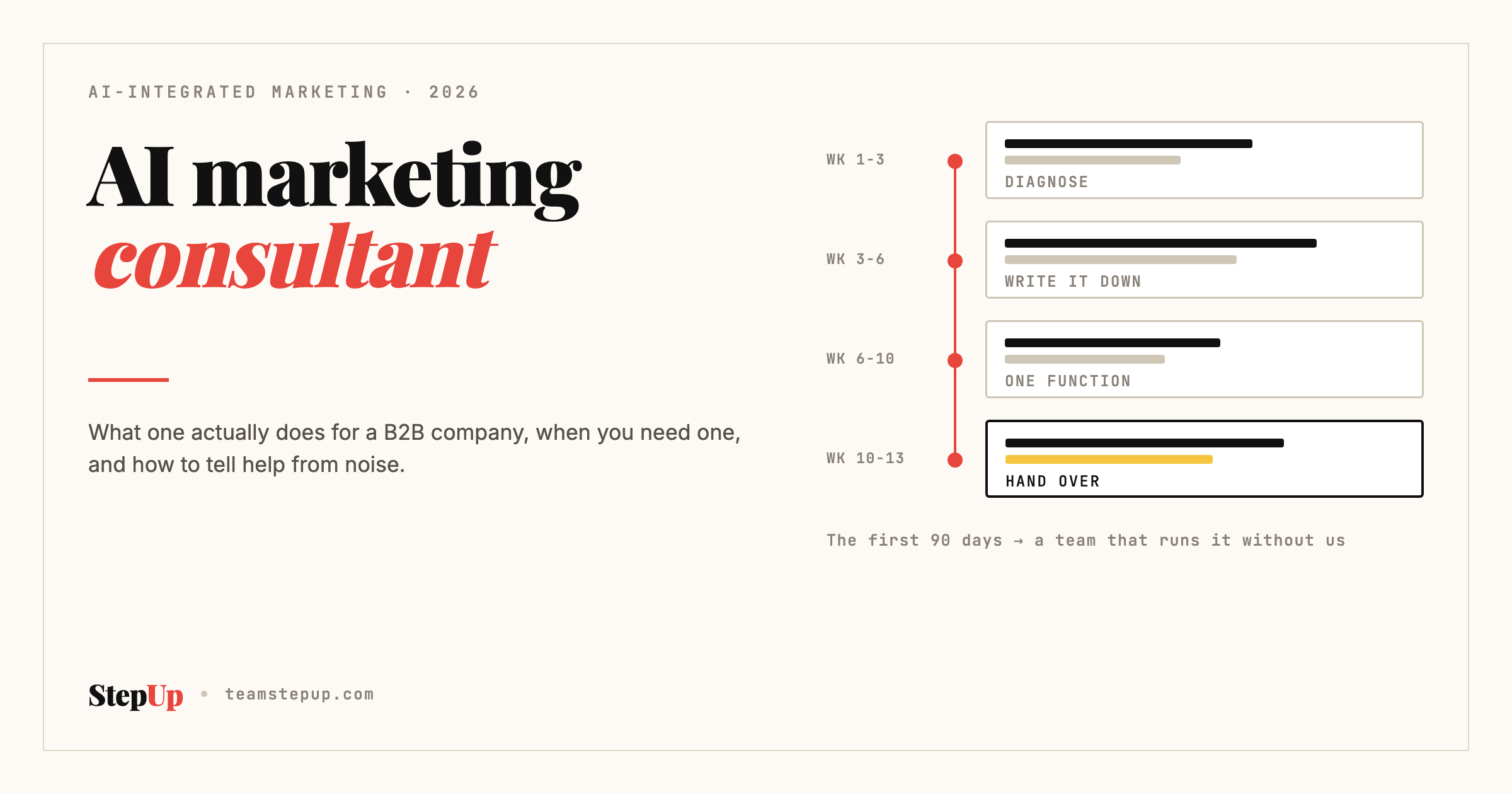
What a good AI marketing consultant does in the first 90 days
The work should follow a sensible order. Here is what to expect.
Weeks 1 to 3: diagnosis
To begin, a good consultant looks at the marketing itself. What are the goals? Who is the customer? What does the team spend its week on? What is working and what is not? Only then does the question of AI come up.
Weeks 3 to 6: the written foundation
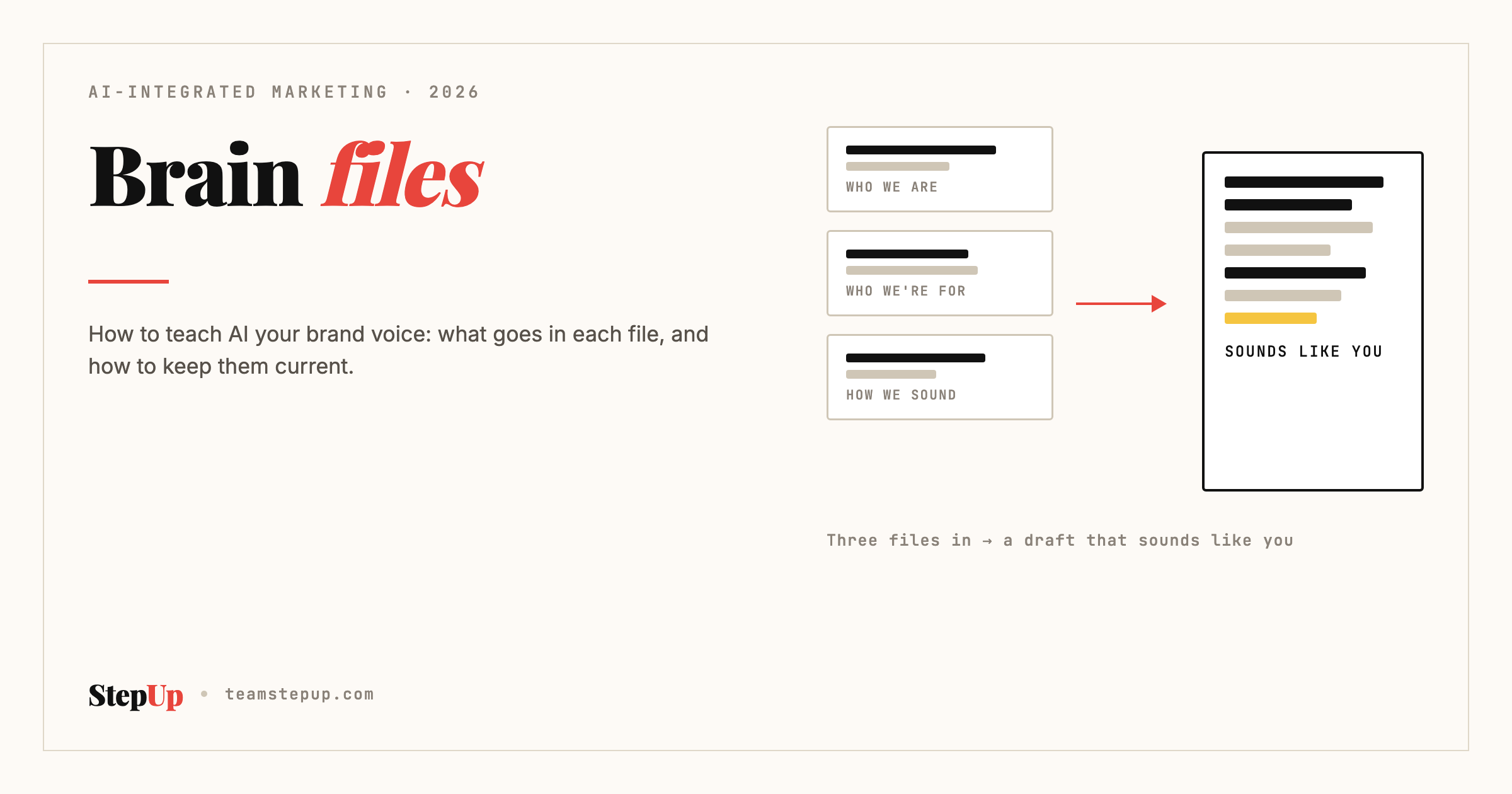
Next comes the material AI needs to do good work: a clear description of the company and what it believes, a precise customer profile and a set of voice rules. We call these brain files. Most companies discover here that several important decisions were never actually made.
Weeks 6 to 10: the first function
A good consultant then picks one function to start with, often content, research or reporting, and sets it up properly. One owner, clear instructions and a routine for reviewing and correcting the output.
Weeks 10 to 13: measure and hand over
Finally, the team measures what changed against the goals set at the start. After that, the consultant hands over the system so the team can run it without them. If the plan depends on the consultant forever, that is a warning sign.
Questions to ask before hiring an AI marketing consultant
Ask these in the first conversation. The answers tell you a lot.
- What would you look at before recommending any tool? A good answer covers goals, customers and the team’s work before it mentions a single product.
- How do you make AI output sound like us? Listen for written brand and voice rules that the AI works from every time.
- Who owns the AI once you leave? A good answer names a role inside your company and a routine for correcting it.
- How will we know it worked? Look for measures tied to your business goals, such as qualified sales conversations or a shorter sales cycle.
- Do you use this approach in your own marketing? Someone who runs their own marketing this way will describe it in specific detail.
- Do you earn anything from the tools you recommend? Referral fees are not automatically bad, but you should know.
Warning signs
A few patterns suggest the help will not help.
Tool first. The first meeting is a platform demo, and nobody has asked about your business yet.
Volume promises. Promises of “triple the content” miss the point. More content is easy. Better marketing is the hard part.
No strategy work. Nobody asks who your customer is or what marketing is supposed to achieve.
Permanent dependence. The setup only works while the consultant stays involved.
No human in the loop. Any plan where AI publishes, emails or makes decisions without review is a risk to your brand.
AI marketing consultant vs. agency vs. in-house
| Option | Best for | Watch out for |
|---|---|---|
| AI marketing consultant | Setting direction, building the system and training the team | Advice without execution, if you have nobody to run it |
| Marketing agency using AI | Producing campaigns and content at volume | Output that is fast but disconnected from your strategy |
| In-house hire | Long-term ownership of marketing | Hiring for AI skills without senior marketing judgment |
In practice, many companies end up with a mix: a senior marketing leader, inside or outside, who owns the plan, supported by AI and a small team. The types of marketing professionals guide explains who does what.
How StepUp approaches it
We are a B2B marketing team, and we run our own marketing on AI first. We bring clients the same system: a written narrative, a clear plan in quarterly goals, brain files the AI works from, and a named owner for every tool. Then we hand it over so the team can run it.
If you want to see what that looks like in practice, Claude for marketing walks through how we use it day to day.
Frequently asked questions
What does an AI marketing consultant do?
An AI marketing consultant helps a company decide where AI fits in its marketing, sets up the instructions and tools so AI produces usable work, and makes sure a person reviews and owns the results. The best ones start with your marketing goals and customers, and choose tools last.
Do I need an AI marketing consultant?
You likely do if your team uses AI inconsistently, if leadership is asking marketing to cut costs with AI, if you have no senior marketing leader, or if your AI-generated content sounds generic. If your strategy is clear and your team already has a working setup, you may not.
How much does an AI marketing consultant cost?
Pricing varies widely, from hourly advice to monthly retainers. Rather than comparing rates alone, compare what you get at the end: a written strategy, a working system your team can run, and measures tied to your goals.
What is the difference between an AI marketing consultant and an AI marketing agency?
A consultant mainly helps you decide, set up and own how AI is used in your marketing. An agency mainly produces marketing for you, often using AI to do it faster. Some firms do both. The question is whether you need direction, production or both.
How long does it take to set up AI in a marketing team?
A sensible first phase takes about three months: diagnosis, the written foundation, one function set up properly, and measurement. Expanding to other functions comes after the first one works.
What should an AI marketing consultant deliver?
At minimum: a clear view of where AI fits in your marketing, written brand and voice rules the AI works from, one function running with a named owner, and measures tied to your business goals. You should be able to run it without them.
The $20 subscription can earn its keep. It just needs a written plan, a clear voice and one person whose job is to check its work.
The cosmo is on you.
Want to know where your marketing stands against the market? The AI-Readiness Audit is a short call that looks at your marketing and pinpoints exactly where the gap is — and what it is worth to close first. You leave with a clear picture, even if we never work together.