Marketing Team Structure for 2027: The Org Chart With AI Employees on It
Every few years, someone redraws the marketing org chart and calls it the future. We’ve had the full-funnel team, the growth team, the pod, the squad and (my personal favorite) the tiger team, which as far as I can tell was a regular team that had a very good offsite.
Now the boxes on the chart are filling up with AI. Some companies are doing it with care: a research agent here, a writing assistant there, and a person who checks the work before anything goes out. Others bought eleven tools in a single quarter, wired them together with digital duct tape, and are still waiting for pipeline to fall out the bottom.
It’s a confusing time to run a marketing team.
And the pressure is real. Somewhere a board deck says marketing will do twice the work with half the headcount by Q2, and someone (usually you) has to work out what that means on Monday morning. Nobody ever says which half.
So before anyone moves another box, it helps to answer the question underneath all of it: what should your marketing team structure look like in 2027, when part of the team is AI?
This guide covers the classic structures, what changes with AI employees on the team, the 2027 org chart, three set-ups by team size, and how to make the change without breaking what already works.
What Is a Marketing Team Structure?
A marketing team structure is how you divide marketing work into roles, who owns each role, and who reports to whom. In other words, it is the answer to “whose job is this?” for every task marketing does.
Most B2B companies have used one of three classic models, or a mix of them.
Structure by Function
Each person owns a type of work: content, demand generation, product marketing, events, marketing operations. This is the most common marketing department structure in B2B, because each skill gets a clear owner. The weak spot is handoffs, since a campaign has to pass through four people to go live.
Structure by Channel
Each person owns a channel: the website, LinkedIn, email, paid ads, events. It works well when one or two channels bring most of the business. However, it tends to produce channel goals (more followers, more opens) instead of business goals.
Structure by Product, Region or Segment
Each person or small team owns a market: a product line, a region, an industry. Large companies use it so each market gets its own voice. For a team of five, though, it usually means everyone does a little of everything.
In practice, most B2B companies under 500 people run a mix: a head of marketing, two or three generalists, and an agency or freelancers filling the gaps. If you want to see the roles themselves in more detail, our field guide to the types of marketing professionals walks through each one.
What Changes When Part of the Team Is AI
The classic models divide work by job. AI divides it by task. That one shift changes the whole chart.
A content marketer’s week, for example, includes research, outlining, drafting, editing, repurposing, publishing and reporting. Some of those tasks can go to AI, some should stay with a person, and some are shared. So the useful question is no longer “do we hire a content marketer?” but “which parts of content work does a person need to own?”
We call the AI side of that split an AI employee: an AI agent with one defined job, written instructions, access to the tools it needs, and a person who reviews its work. The last part matters most. An AI agent without a manager is a tool someone forgot to put away. (Our guide to AI agents for marketing covers what they do well and where they slip.)
Four things change once AI employees join the team:
- The team gets smaller in headcount, not in responsibility. Someone still owns every result.
- The scarce skills move. Judgment, voice, priorities and review become the core of each human role.
- Every AI employee needs a named manager. One person writes its instructions, checks its output and answers for its mistakes.
- Written material becomes infrastructure. Your plan, your message and your voice guide are what the AI employees work from, so they have to exist on paper.
The 2027 Marketing Org Chart
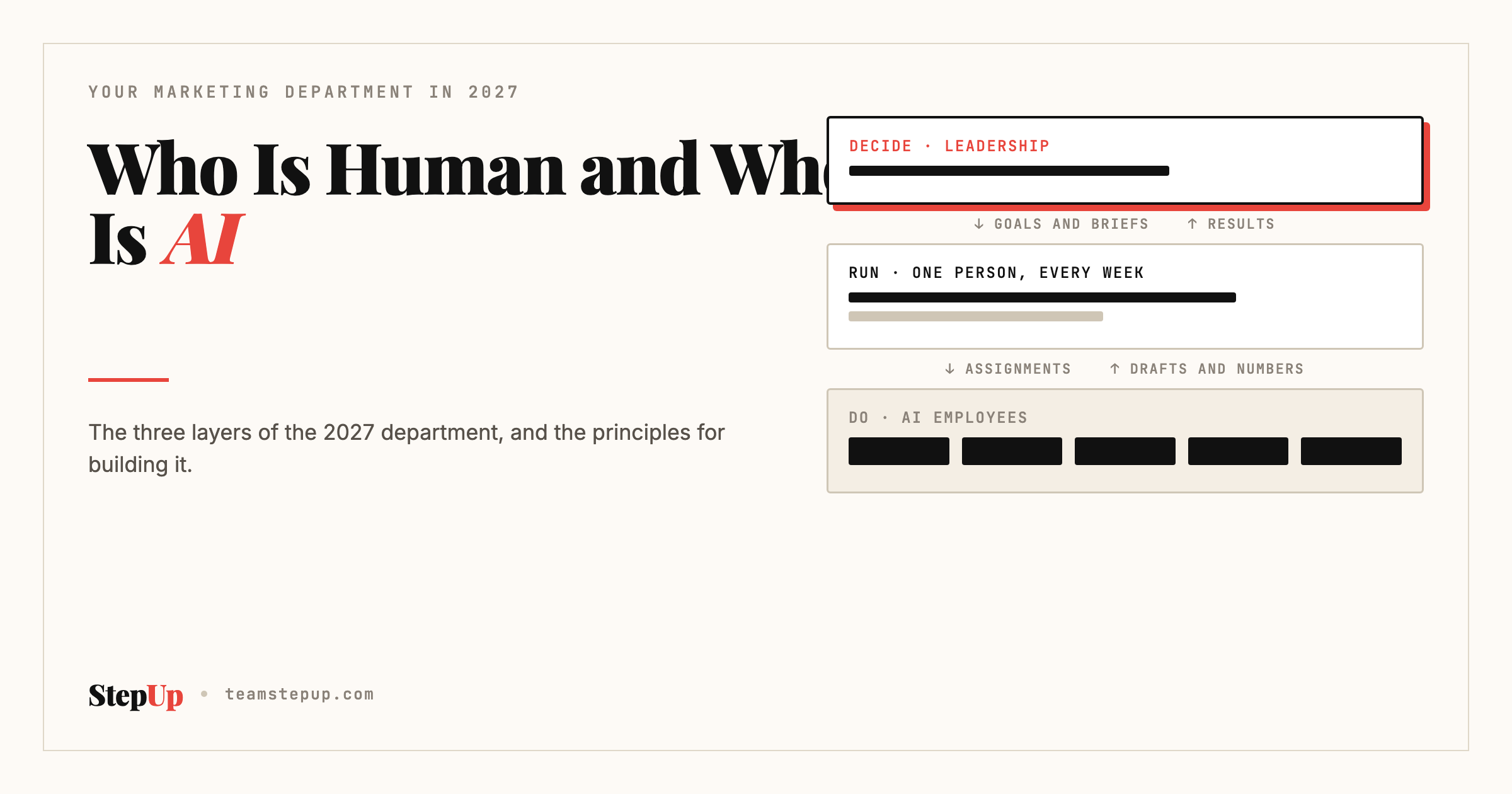
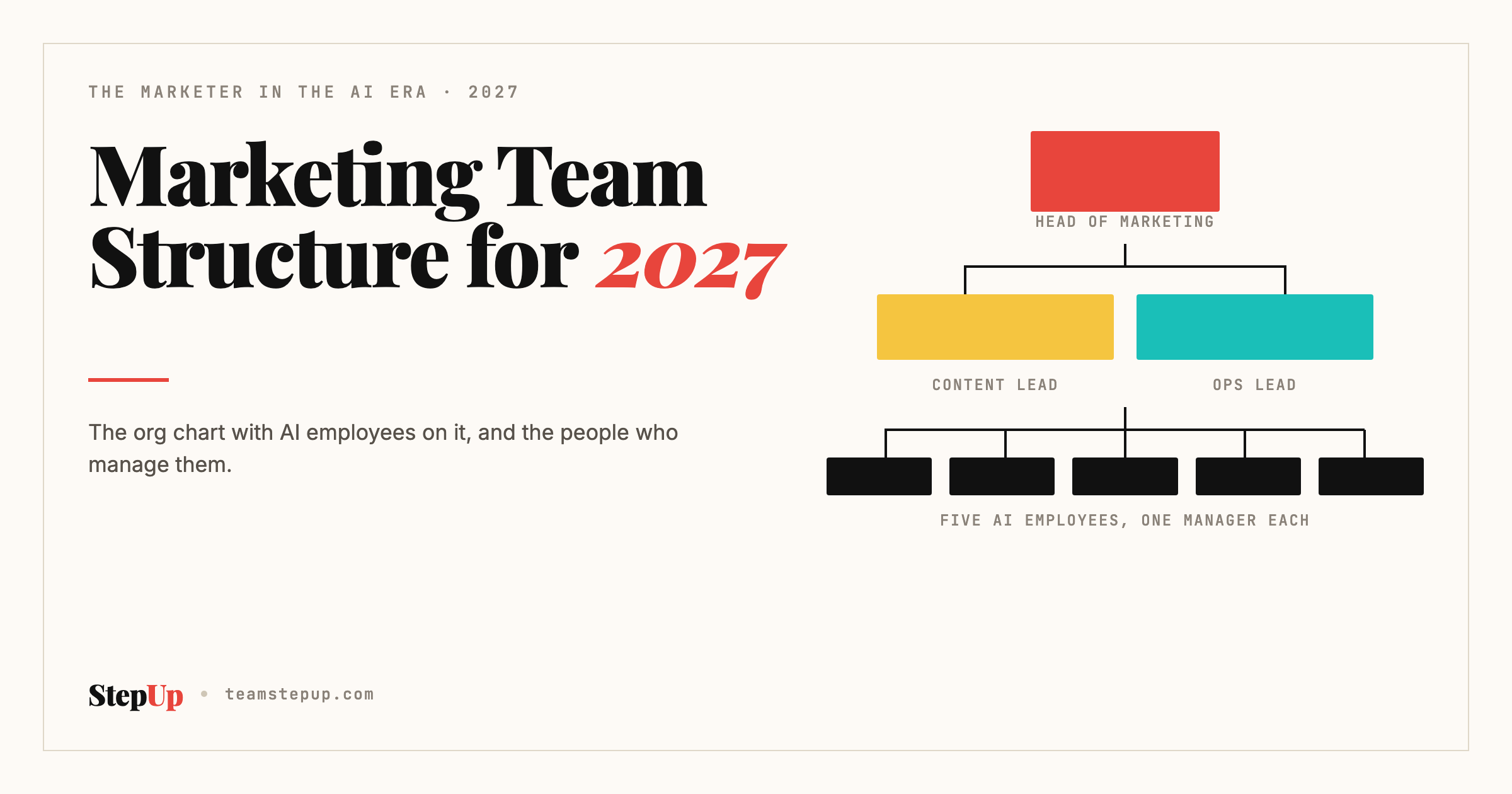
Here is the structure we use and recommend for a B2B marketing team in 2027. It has a person at the center, two or three people around her, and a small set of AI employees, each reporting to one of them.
| Role | Human or AI | What It Does | Reports To |
|---|---|---|---|
| Head of Marketing | Human | Sets the plan and goals, owns the message, makes the calls, signs off on what goes out | CEO |
| Content and Brand Lead | Human | Owns the voice, edits everything public, runs thought leadership | Head of Marketing |
| Marketing Operations Lead | Human | Owns the systems: CRM, website, tracking, and the AI employees’ set-up | Head of Marketing |
| Market Researcher | AI | Tracks competitors, keeps the customer profile current, turns sales notes into buyer questions | Head of Marketing |
| Content Writer | AI | Drafts blogs, posts and newsletters from the brand files; turns one piece into five | Content and Brand Lead |
| Search Specialist | AI | Reads Search Console, fixes page titles and links, plans the searches to win | Marketing Operations Lead |
| Outreach Rep | AI | Builds account lists, drafts first messages and follow-ups, keeps the CRM clean | Head of Marketing, with sales |
| Analyst | AI | Writes the weekly one-page report and checks every number against its source | Marketing Operations Lead |
Two details in this chart do most of the work. First, every AI employee has exactly one human manager. Second, nothing public goes out without a person’s sign-off, which is why the content lead and the head of marketing sit where they do.
Agencies and freelancers still have a place. Design, video, events and paid media buying often stay outside the team, because they need specialist hands or bursts of capacity.
Who Is Human, Who Is AI, and What Is Shared
For every task on the team, ask one question: does this need judgment about our business, or does it need speed on a clear standard? That sorts most tasks into three groups.
| Keep Human | Share | Hand to AI |
|---|---|---|
| Strategy, positioning and priorities | Campaign planning | Research summaries |
| The final word on voice | Message testing | First drafts |
| Relationships with customers, sales and leadership | Reading the numbers | Repurposing one piece into many |
| Budget and goals | Editing | Pulling reports |
| Sign-off on anything public | Customer profile updates | Website and search upkeep |
The middle column is where most of the value is. In shared work, the AI employee does the first 70% fast, and the person does the last 30% well. Teams that skip the middle column tend to land at one of two extremes: they either use AI for almost nothing, or they publish whatever comes back.
Three Marketing Team Structures by Size
The chart above is the full version. Most B2B teams start smaller, so here is how the same structure works at three sizes.
A Team of One
One person runs marketing, often next to another job. She is the head of marketing, the content lead and the operations lead at once. In this case, start with one AI employee, usually the content writer or the analyst, whichever task eats more of her week. She keeps strategy, voice and sign-off. An agency or freelancer still handles design.
A Team of Two or Three
A head of marketing plus one or two people, usually a content person and someone who handles the website and CRM. Here the split above works almost as drawn: the content lead manages the content writer, the operations person manages the search specialist and the analyst, and the head of marketing manages research and outreach with sales.
A Team of Four to Ten
At this size, the change is less about adding AI and more about reorganizing around it. Roles that were mostly production (a second content writer, a reporting analyst) shift toward review and editing. Meanwhile, the marketing operations role grows, because someone has to own how the AI employees are set up, what they can access and how their work is checked.
Who Reports to Whom
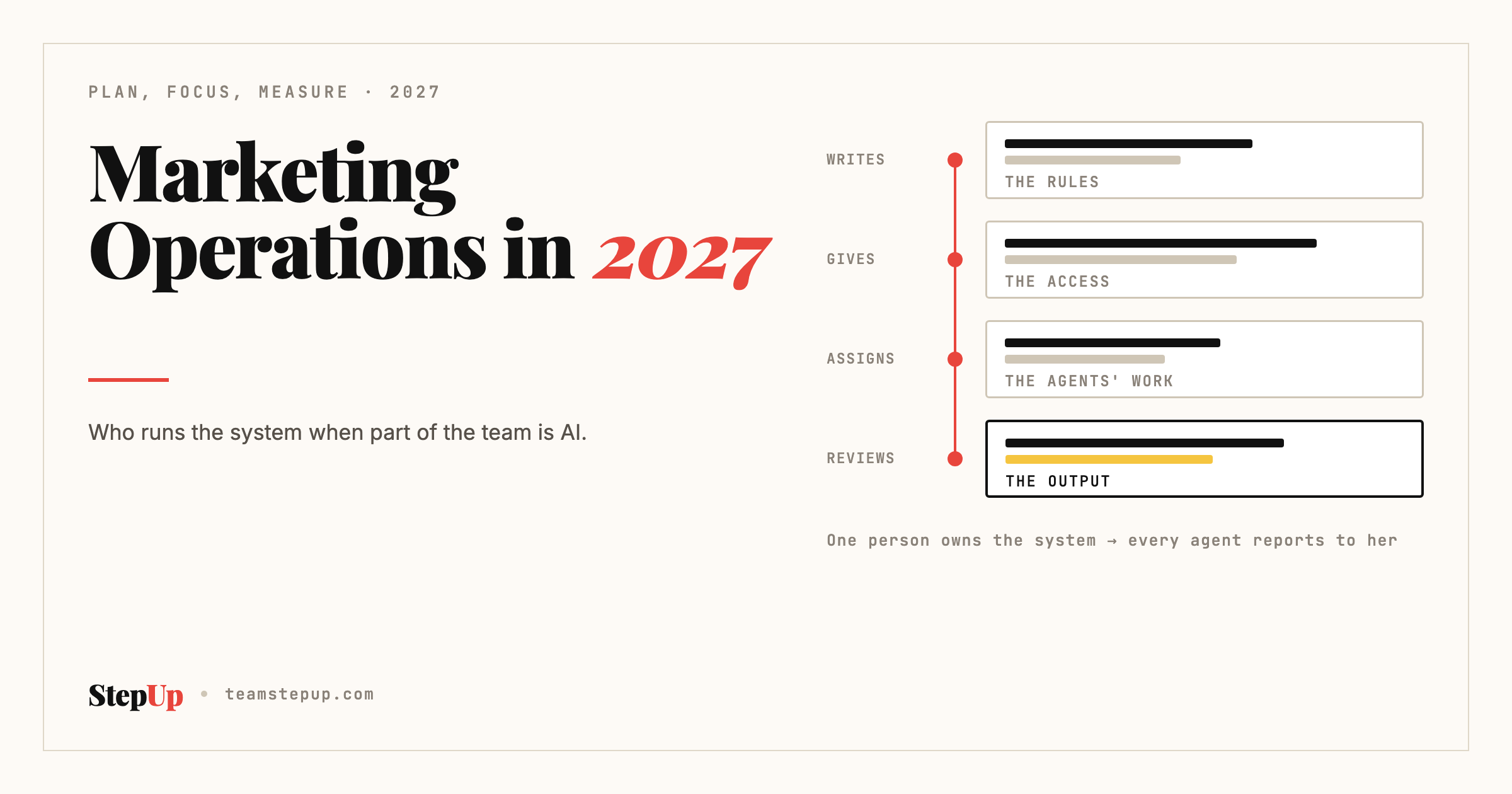
Reporting lines matter even more with AI on the team. An AI employee will happily do the wrong work at great speed, so each one needs a person who decides what it works on.
In our experience, three rules keep the lines clear:
- One manager per AI employee. Two managers means nobody checks the work.
- The manager owns the output. If the AI content writer gets a fact wrong, the content lead answers for it, the same way she would for a junior writer.
- Marketing and sales share the goals. The outreach rep works for both, so its instructions, lists and results should be agreed with sales.
How to Restructure Without Breaking the Team
The safest way to change a team structure is one step at a time. Here is the order we use with clients.
Start From the Plan, Not the Tool
Write down what marketing has to achieve this quarter before choosing any AI employee. The one-page marketing plan is a good format. Then pick the AI employee that moves the plan most, rather than the one with the best demo.
Write Your Message Down First
AI employees work from what you give them. If your positioning, audience and voice live only in someone’s head, the output will sound like everyone else. Our guide to brain files shows how to put them on paper.
Add One AI Employee at a Time
Give each new AI employee a month. Check the work every week, write down what it got wrong, and update its instructions. Only then add the next one.
Name the Reviewer Before You Start
Decide who reviews each AI employee’s work before it does any. Also decide what “good” looks like, so the review is quick and consistent.
Measure After 30 Days
Compare the month with the month before: hours saved, output, quality and results against the plan. If the numbers didn’t move, change the job or retire the AI employee. Either way, you learn something about your structure.
Frequently Asked Questions
What is a marketing team structure?
A marketing team structure is how a company divides marketing work into roles, who owns each role, and who reports to whom. The classic models organize by function, by channel, or by product, region or segment. Most B2B companies use a mix.
What does a marketing department structure look like in 2027?
In 2027, a B2B marketing department has a small human team at the center, usually a head of marketing plus one or two leads, and a set of AI employees with defined jobs. Each AI employee reports to one person, and people keep strategy, voice, relationships and sign-off.
How do you structure a small B2B marketing team?
Start with the plan and one owner for marketing. Then add one AI employee for the task that takes the most time, usually drafting content or pulling reports. Keep strategy and sign-off with a person, and use an agency or freelancers for specialist work like design.
Will AI replace marketing team roles?
AI replaces tasks more than roles. Research, first drafts and reporting move to AI employees, while judgment, voice and relationships stay with people. We go deeper in Will Marketing Be Replaced by AI?
Who should manage AI employees in a marketing team?
Each AI employee should report to one named person, usually the lead whose work it supports. That person writes its instructions, reviews its output and owns its mistakes.
The Chart, Redrawn
The tiger team had a great offsite. Your 2027 team gets something more useful: a written plan, a few AI employees with clear jobs, and one person in the middle who decides.
And when the board deck asks which half of the work AI is doing, you’ll have an org chart that answers.
So which job would you hand off first? The free AI-Readiness Self-Audit shows whether your team is ready for its first AI employee.
Want to know where your marketing stands against the market? The AI-Readiness Audit is a short call that looks at your marketing and pinpoints exactly where the gap is — and what it is worth to close first. You leave with a clear picture, even if we never work together.