Your Marketing Department in 2027: Who Is Human and Who Is AI
Every era of marketing gets its prophecy. Television would kill print. The internet would kill television. Social media would kill the website, and then the website would come back, slightly embarrassed, with a cookie banner.
The prophecy this time is that AI will kill the marketing department. Some say gently, by doing all the work. Some say rudely, by making the work so cheap that nobody needs to be paid for it.
Meanwhile, the actual marketing department is in a meeting, trying to work out why the new AI writing tool keeps describing the company as “a leading provider of innovative solutions.” (It is not a leading provider. Nobody is sure what the solutions are. The tool has been told this three times.)
It’s an unnerving time to work in marketing.
The honest answer to “what happens to the marketing department?” is more interesting than either prophecy. Your department doesn’t disappear. It changes shape. Part of the team is now AI, part of it is still people, and the work that matters most is deciding which is which.
This is the main guide to our series on the marketing department in 2027: what it does, how it’s built, who is human and who is AI, and the principles we use to build one.
What Does a Marketing Department Do?
A marketing department finds the right customers, gives them a reason to choose you, and makes it easier for sales to win them. In a B2B company, that usually covers five jobs:
- Understanding the market. Who the best customers are, what they need, and who else they’re considering.
- Deciding the message. What you stand for, who it’s for, and how you say it.
- Getting found. The website, search, content, social, events and ads.
- Starting conversations. Turning interest into leads and handing them to sales.
- Measuring what works. Reporting results and changing the plan when the numbers say so.
None of those jobs go away in 2027. What changes, however, is who does each part of each one.
The Three Layers of the 2027 Marketing Department
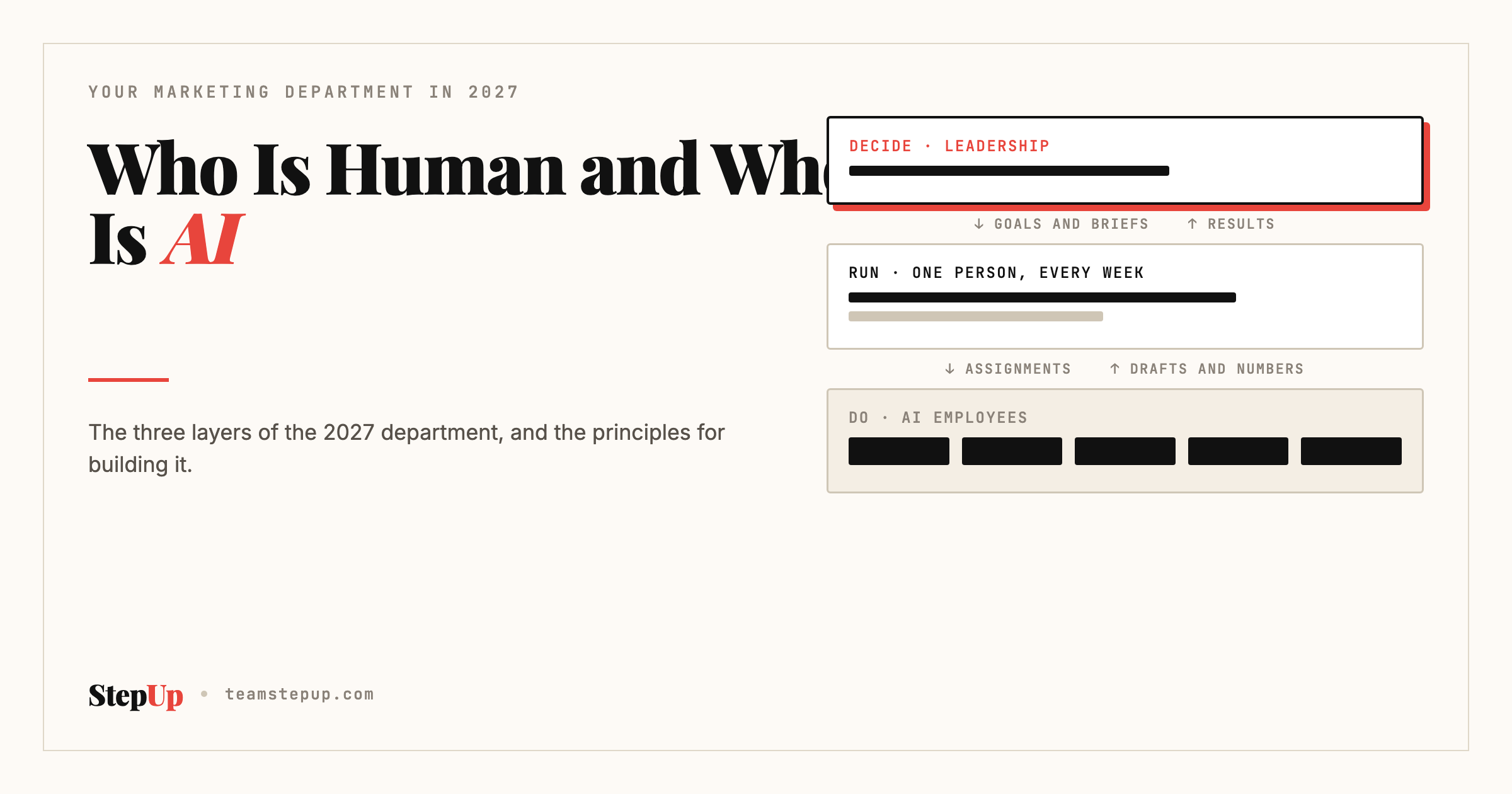
The simplest way to picture the new department is in three layers.
| Layer | Who | What They Do |
|---|---|---|
| Decide | Leadership: the CEO and the head of marketing | Set the goals, approve the message and the budget, decide when to stop |
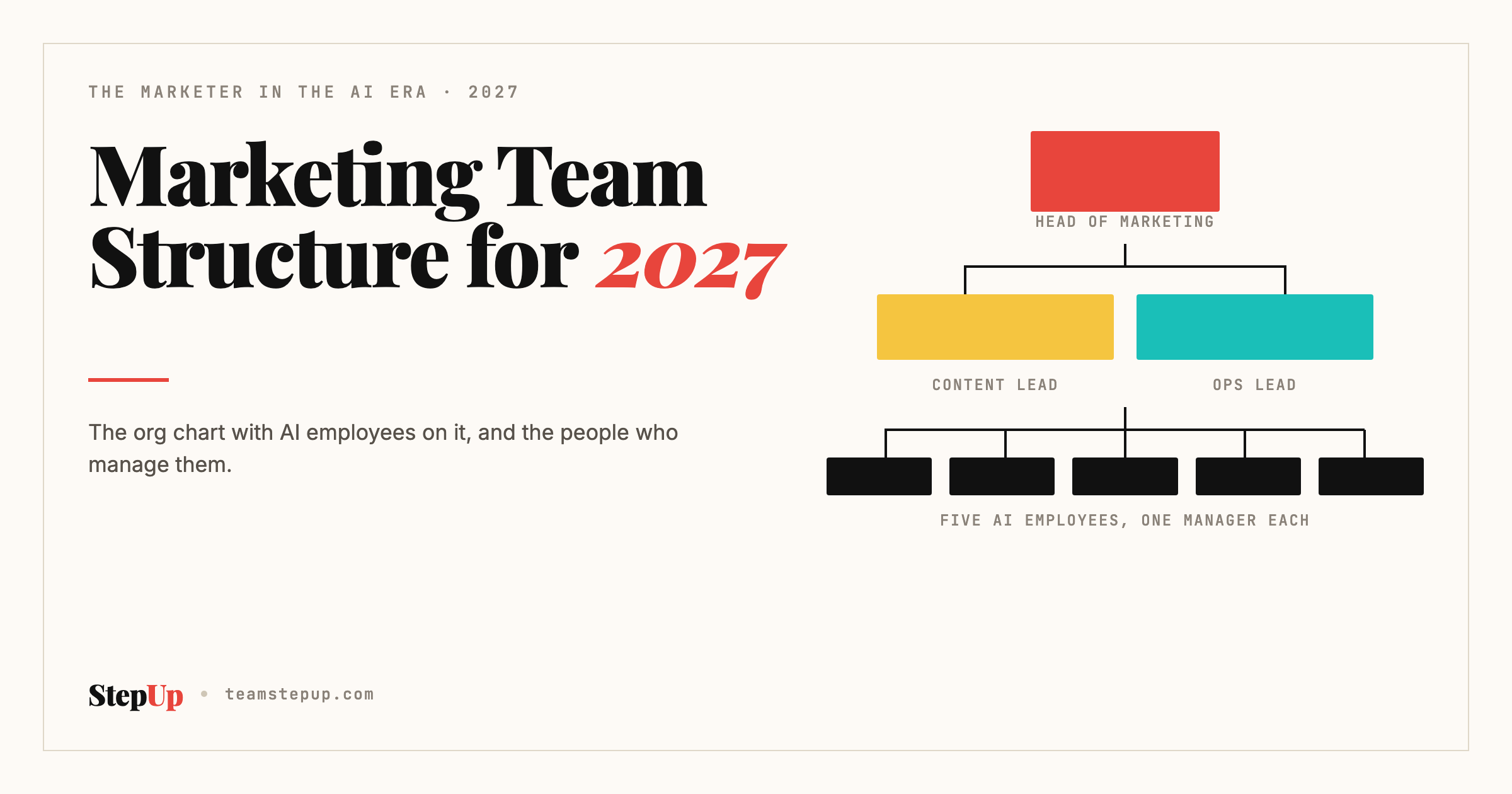
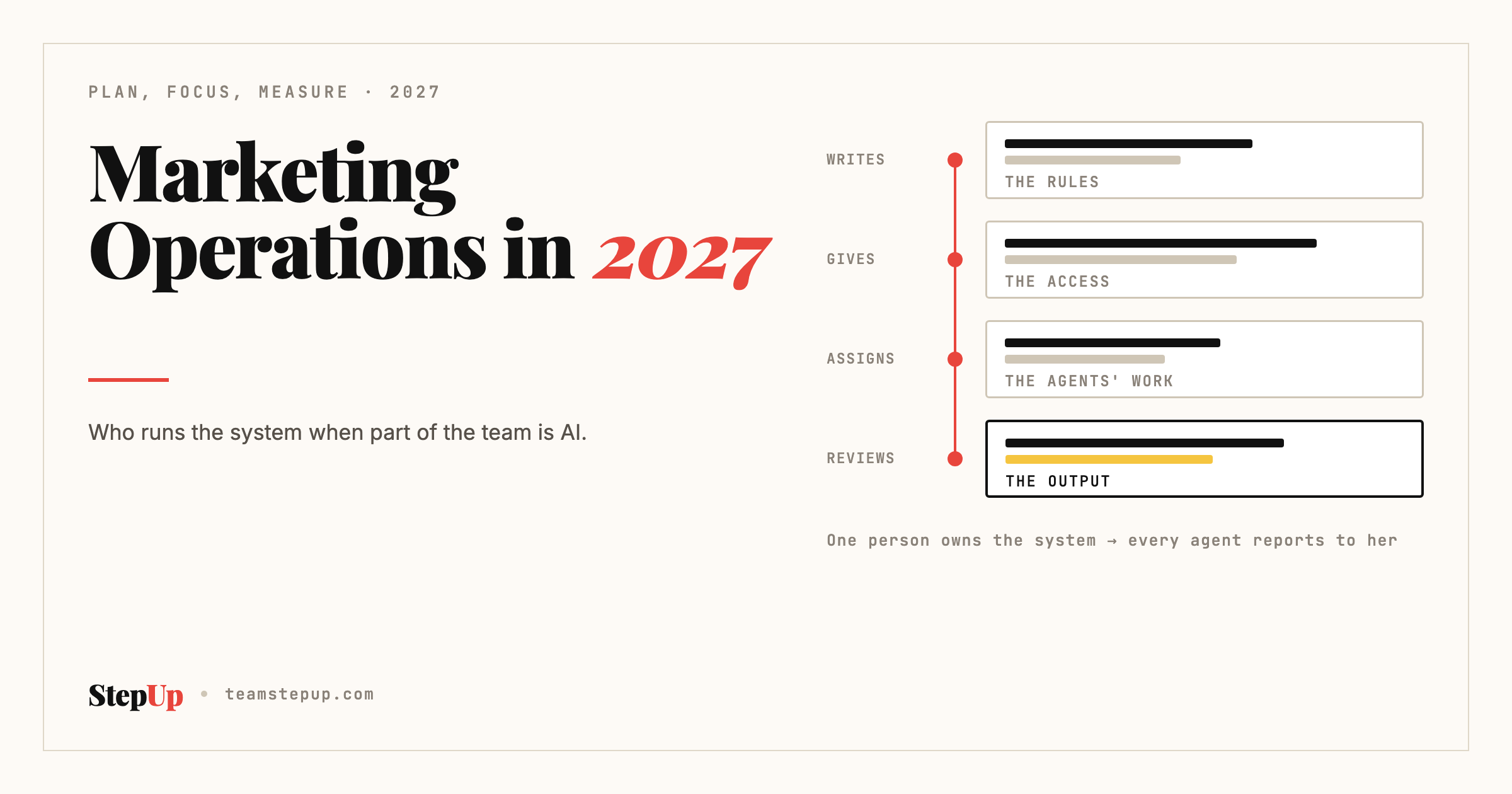
| Run | One person who runs the week, usually a marketing lead | Turns goals into weekly work, briefs the AI agents, reviews and approves what they make |
| Do | AI agents, each with one kind of work | Research, draft, update the website, prepare outreach, pull the numbers |
Goals and briefs move down. Drafts and results move up. When an agent starts deciding, or a leader starts drafting, the department stops working.
For the org chart version, with each role and who reports to whom, see our guide to marketing team structure for 2027.
Who Is Human and Who Is AI
For every task in the department, ask three questions:
- Does it need judgment about our business? Priorities, positioning, budget and anything that commits the company.
- Does it need a relationship? Customers, sales, partners and leadership.
- Does it need speed on a clear standard? Research, first drafts, reports and upkeep.
If the answer to the first or second question is yes, a person keeps it. If only the third is yes, it can go to AI. A mix means it’s shared: AI does the first version fast and a person finishes it.
For example, here’s how that sorts the work in a typical B2B department.
| Area | What AI Does | What Stays With a Person |
|---|---|---|
| Strategy | Market and competitor research, summaries of customer interviews | The decision, the goals, when to stop |
| Content | Drafts of blogs, posts and newsletters from the brand files | The opinion, the voice, approval of every message |
| Search and the website | Pages to fix, new titles and descriptions, the questions buyers ask | Approving changes to the live site |
| Outreach | Lists of the right accounts, drafts of first messages and follow-ups | Sending, the calls, the relationship |
| Data and the CRM | Duplicate cleanup, tagging where each lead came from | The lead rules: stages, scoring, who gets which lead |
| Numbers | The weekly report, with every number checked against its source | What matters, and what to do about it |
This is the split StepUp uses for its own marketing, and the one we recommend to clients.
Meet the AI Employees
We call the AI side of the department AI employees: agents with one job each, written instructions, the access their job needs, and a person they report to. In most B2B departments, five jobs cover the work. Still, the value is in the whole department rather than in any single agent. Most companies are buying agents one at a time, so the teams that get results are the ones that design how the agents work together.
- Market Researcher. Tracks competitors, keeps the customer profile current, and turns sales notes into the questions buyers ask.
- Content Writer. Drafts blogs, posts and newsletters in your voice, and turns one strong piece into five smaller ones.
- Search Specialist. Reads Search Console, fixes page titles and links, and shapes content so search engines and AI answers can find it.
- Outreach Rep. Builds lists of the right companies, drafts first messages and follow-ups, and keeps the CRM clean.
- Analyst. Writes the weekly one-page report and checks every number against its source.
However, none of them decide what to work on, and nothing they make goes out without a person’s approval. For a closer look at what an AI employee is and isn’t, see our guide to AI employees.
What Stays Human, No Matter What
Some parts of marketing don’t move to AI, and they’re the parts that make the department worth having.
- Deciding what matters. Which customers, which message, which three things this quarter.
- The voice. AI can write in your voice once you’ve defined it. It can’t decide what you believe.
- Relationships. With the CEO, with sales, with customers. Trust is built by people.
- Judgment on the output. Catching the claim with nothing behind it, the number that doesn’t fit, the post that’s on brand but wrong for this week.
- Accountability. When something goes wrong, a person answers for it.
These are also the skills that make a marketer hard to replace. If anything, they’re worth more now.
The Principles for Building the Department
These are the rules we build by, with clients and in our own team.
Start From the Plan, Not the Tool
Write down what marketing has to achieve before choosing any AI agent. Then pick the agent that moves the plan most. Our one-page marketing plan is a good format.
Buy Smart, Build Fast
You don’t need a new platform for every job. Most of the department can run from one workspace that sits on top of the tools you already have: the CRM, the website and analytics. So buy only what fills a real gap, and build the rest quickly. We also use one test for every tool and every agent: if setting it up and keeping it running takes more energy than the result it brings, it is not a growth system.
Write the Brand Down First
Agents work from what they’re given. Your positioning, audience, voice and the words you never use have to exist on paper before any agent starts. Our guide to brain files shows how.
Hire One AI Employee at a Time
Give each new agent a month. Check its work every week, write down what it got wrong, and update its instructions. Only then add the next one.
Every Agent Gets a Job Description and a Manager
One page per agent: what it does every week, what it needs from you, what it can’t do, and who it reports to. One manager per agent, so someone always checks the work.
Give Each Agent Only the Access It Needs
Most agents read and draft. Publishing and sending stay with a person.
Turn Every Correction Into a Rule
When an agent gets something wrong, fix the draft and add a line to its instructions. In the end, those lines become the department’s most valuable document.
A Person Signs Off on Everything Public
No exceptions. In fact, this is the rule that protects the brand.
Where to Start
You don’t need to redesign the whole department at once. Start here:
- Write the plan for next quarter on one page.
- Write the brand files, if they don’t exist yet.
- Pick the task that eats the most hours each week, and give it to one AI employee.
- Name the person who reviews that agent’s work.
- Check after 30 days: hours saved, quality, results against the plan.
If you’re a team of one, our guide to the one-person marketing team shows how far that can go.
Frequently Asked Questions
What does a marketing department do?
A marketing department finds the right customers, gives them a reason to choose the company, and helps sales win them. In B2B, that covers understanding the market, deciding the message, getting found, starting conversations and measuring what works.
Will AI replace the marketing department?
AI replaces tasks more than departments. Research, first drafts, reporting and website upkeep move to AI agents, while strategy, voice, relationships and the final sign-off stay with people. The department gets a new shape, not a pink slip. We go deeper in Will Marketing Be Replaced by AI?
What does an AI marketing department look like?
It has three layers: leadership decides the goals and budget, one person runs the week and reviews the work, and AI agents each handle one kind of work, such as research, writing, search, outreach drafts or reporting. Every agent reports to a named person.
Which marketing jobs should stay human?
The jobs that need judgment about the business or a relationship: strategy and priorities, the brand voice, relationships with customers, sales and leadership, review of AI output, and accountability for results.
How do you start building a marketing department with AI?
Write the plan and the brand files first, then give the most time-consuming task to one AI employee with a named reviewer. Check the results after 30 days before adding the next one.
The Prophecy, Revised
The marketing department survived television, the internet and the cookie banner. It will survive this too, with fewer people doing the typing and more people doing the deciding.
And that writing tool will eventually stop calling you a leading provider of innovative solutions. Somebody just has to write the rule.
Which job would you hand off first? The free AI-Readiness Self-Audit shows whether your team is ready for its first AI employee.
Want to know where your marketing stands against the market? The AI-Readiness Audit is a short call that looks at your marketing and pinpoints exactly where the gap is — and what it is worth to close first. You leave with a clear picture, even if we never work together.