AI in B2B Marketing: An Operator’s Playbook for 2026
AI in B2B marketing uses machine learning and predictive models to do three jobs marketers once did by hand. It analyzes account and buyer signals, generates content variations, and decides who to target and when. Everything else is a variation on those three verbs.
Most articles about AI in B2B marketing read like a vendor’s product tour with a few stats bolted on. They tell you AI can “personalize at scale” and “surface intent signals,” then push you toward a platform demo. What they don’t tell you is how AI earns its place inside a working go-to-market motion. It has to sit somewhere specific: your ICP definition, your content pipeline, your ABM plays, your TAM math. You also need a way to keep the output from sounding like every other AI-generated blog post on the internet.
This is that guide. We’re a GTM execution agency, not an AI vendor. We have no platform to sell you, so we can tell you the truth about what works and what doesn’t. That includes where the “loss of human connection” problem everyone name-checks actually comes from. Hint: it isn’t the AI’s fault.
What This Guide Covers
By the end of this piece you’ll have:
- A clear, jargon-free definition of what AI in B2B marketing actually means in 2026
- A function-by-function breakdown of where AI is genuinely earning its keep (and where it’s theater)
- A vendor-neutral map of the tool landscape, organized by GTM function instead of by which company paid for the “best of” listicle
- A real, anonymized client example showing AI embedded at three different GTM stages with actual before/after numbers
- A concrete method for fixing “AI content sounds robotic” — not just a warning that it can
- An AI-Integrated GTM Maturity Model you can use to self-assess where you are today
- A step-by-step implementation framework tied back to ICP, TAM, and GTM strategy — not a standalone AI initiative floating apart from the rest of your marketing
What Is AI in B2B Marketing?
AI in B2B marketing covers three jobs a marketing team used to do entirely by hand. Analyze signals about accounts and buyers. Generate content and creative variations. Decide, in real time, who to target and what to say to them.
That’s it. Strip away the hype and AI in B2B marketing collapses into those three verbs: analyze, generate, decide.
One distinction matters more than the rest, and almost every other article glosses over it. It’s the difference between AI as a bolt-on tool and AI as an integrated layer of your GTM system. A bolt-on tool means someone on your team uses ChatGPT to draft blog outlines. An integrated layer means your ICP data, intent signals, content engine, ABM sequencing, and lead scoring all feed each other through AI. That happens continuously, with nobody re-keying data between five different tabs.
Most companies are doing the first. The ones winning right now are doing the second. That gap — not access to the technology itself, since everyone has access to the same handful of tools — is what separates AI-integrated marketing from AI-decorated marketing.
We use the term AI-integrated marketing deliberately instead of “AI marketing” for this reason. AI marketing implies AI is the strategy. AI-integrated marketing means AI is embedded inside a strategy that already exists — your GTM strategy, built around a real ICP and a real TAM. That strategy then executes faster and targets more sharply than a human-only team could manage.
How AI Is Used Across B2B Marketing Functions
AI’s usefulness varies enormously by function. Some of this is genuinely transformative. Some of it is still better done by a person. Here’s the honest breakdown, function by function.
AI in Content Marketing and Creation
This is where AI gets the most attention and, frankly, causes the most damage when misused. AI can draft outlines, generate first-pass copy, repurpose long-form content into social posts and email snippets, and summarize research at a speed no writer can match.
What it can’t do on its own is sound like you. Generic prompting into a generic model produces generic output — which is exactly why AI Overviews and search results are now saturated with interchangeable, forgettable B2B content. We’ll cover the actual fix for this in the “loss of human connection” section below, because it’s solvable, and almost nobody explains how.
Where AI genuinely earns its place in content workflows:
- Research synthesis. AI pulls themes out of interview transcripts, call recordings, and review comments faster than a human could read them.
- Draft velocity — turning a structured brief into a first draft in minutes instead of hours, freeing a writer’s time for the editing pass that actually matters
- Repurposing — turning one pillar asset into a dozen distribution formats without a dozen separate writing projects
- SEO structural work — mapping search intent, clustering keywords, and identifying content gaps against competitors at a scale manual research can’t match
AI in Account-Based Marketing (ABM)
AI has changed ABM more than almost any other function. ABM has always been a data-matching problem at its core: which accounts look like our best customers, and what signals tell us they’re in-market right now.
Predictive account scoring models now ingest firmographic data, technographic data, intent data, and engagement history. They rank accounts by propensity to buy, updated continuously rather than quarterly. AI-driven ABM platforms can also auto-generate account-specific messaging variants. They identify the “buying committee” too — the cluster of individuals at a target account genuinely influencing the decision — well before a sales rep would spot them manually.
AI in Lead Scoring and Predictive Analytics
Traditional lead scoring was a static point system: download a whitepaper, get 10 points; visit pricing page, get 20 points. It was crude and it aged badly. AI-based predictive lead scoring instead trains on your actual closed-won and closed-lost history to find the real patterns — which often aren’t the ones marketers assume. We’ve seen models surface an unexpected combination: job title plus company size plus a single content download. It predicted conversion far better than the “high engagement” leads everyone assumed were hottest.
This matters enormously for TAM and ICP work: predictive scoring is only as good as the ICP definition feeding it. Garbage ICP in, garbage lead scoring out — which is why this function can’t be separated from your foundational GTM strategy work (more on this in the implementation section).
AI in Personalization at Scale
AI enables 1:1 personalization across web experiences, email sequences, and ad creative. It works at a granularity no human team could manage by hand. Landing pages shift headline and proof points based on the visitor’s industry. Email send times optimize per recipient. Ad creative rotates toward whichever variant a specific account segment responds to.
The risk here is the uncanny valley of personalization: name-merge-field emails that technically say “Hi {FirstName}” but clearly weren’t written with any real understanding of that account’s situation. Real personalization requires the underlying data (ICP segments, account research, buying stage) to actually be good — AI amplifies whatever strategy is underneath it, for better or worse.
AI in Email Marketing and Nurture
AI now handles subject line testing, send-time optimization, dynamic content blocks based on lifecycle stage, and predictive churn/re-engagement flags for dormant leads. This is one of the lowest-risk, highest-ROI applications of AI in the entire B2B stack. Email is a closed, measurable channel, so you can A/B test and iterate with real data almost immediately.
AI in SEO and Search
AI tools now handle keyword clustering, content gap analysis, and structured data generation. Increasingly they also optimize directly for AI Overviews and answer engines rather than traditional blue-link SERPs. This last point deserves attention. More B2B research now happens inside AI chat interfaces than on search results pages. Being cited as a source inside an AI-generated answer has become its own optimization target, separate from ranking position. We built the FAQ section of this very article with that in mind.
The Benefits of AI-Integrated B2B Marketing
AI adoption in B2B marketing has moved fast, from early-adopter experimentation to default practice in a couple of years. Marketers using it consistently report gains in content output volume and campaign turnaround time. Efficiency, not creativity, remains the number one reported benefit — teams are producing more variants, more segments, and more campaigns in the same headcount, not necessarily better strategy.
That’s an important distinction: the data consistently shows AI amplifies execution speed. It does not, on its own, improve strategic clarity. Every survey report on this topic buries that nuance under the headline efficiency number. That’s exactly why the “AI in B2B marketing” conversation keeps producing thin, stat-heavy articles with no execution framework behind them. Speed without direction just gets you to the wrong place faster.
The real, durable benefits we see across GTM-integrated deployments:
- Faster time from research to launch. The ICP-to-content-to-campaign cycle drops from 4-6 weeks to 1-2 when AI handles synthesis and first drafts.
- Better signal-to-noise in targeting — predictive scoring surfaces accounts sales would have deprioritized manually
- Content volume without proportional headcount growth — a lean team can now sustain a publishing cadence that used to require double the writers
- Faster feedback loops — AI-assisted analytics shorten the time between “we tried this” and “here’s what happened,” letting teams iterate weekly instead of quarterly
Limitations and Challenges
Every top-ranking article on this topic lists these limitations as a paragraph of caveats. None of them tell you how to actually solve them. Here’s the honest version.
Data Quality Is the Real Bottleneck
AI models are only as good as the data they’re trained and run on. Say your CRM has duplicate records, inconsistent firmographic tagging, and a lead source picklist nobody’s cleaned up in two years. Your predictive scoring model will confidently produce garbage. Because it’s a model rather than a spreadsheet formula, that garbage will look authoritative. We’ve walked into engagements where the single highest-leverage AI project wasn’t a new tool at all — it was a CRM data hygiene sprint that had to happen first.
The fix: before any predictive AI investment, audit your source-of-truth data — lead source attribution, firmographic completeness, deduplication — and lock down your data model. This is unglamorous and it’s also the actual prerequisite everyone skips.
Over-Reliance and the Erosion of Judgment
The failure mode isn’t “AI made a bad decision.” It’s “the team stopped checking AI’s decisions.” Lead scores, content recommendations, and audience segments all flow through automated models. A team can lose the muscle of asking the obvious question: does this actually make sense for our ICP? AI should compress the time to a decision. The judgment about whether the output is right stays with a person.
The fix: build a standing review cadence — even fifteen minutes weekly — where a human GTM owner spot-checks AI-driven scoring and targeting decisions against real deal outcomes. Treat AI outputs as a strong first draft of a decision, not the decision itself.
Loss of Human Connection — And How to Actually Fix It
This is the limitation every single competing article names and none of them solve. “AI content can feel generic” is treated as an inherent, unfixable property of AI. It isn’t. It’s a symptom of a specific, correctable input problem: generic prompts produce generic output because most teams never give the model anything specific to say.
Here’s the method that actually works, and it’s the one we use with every client:
The Three-Step Fix for Generic AI Content
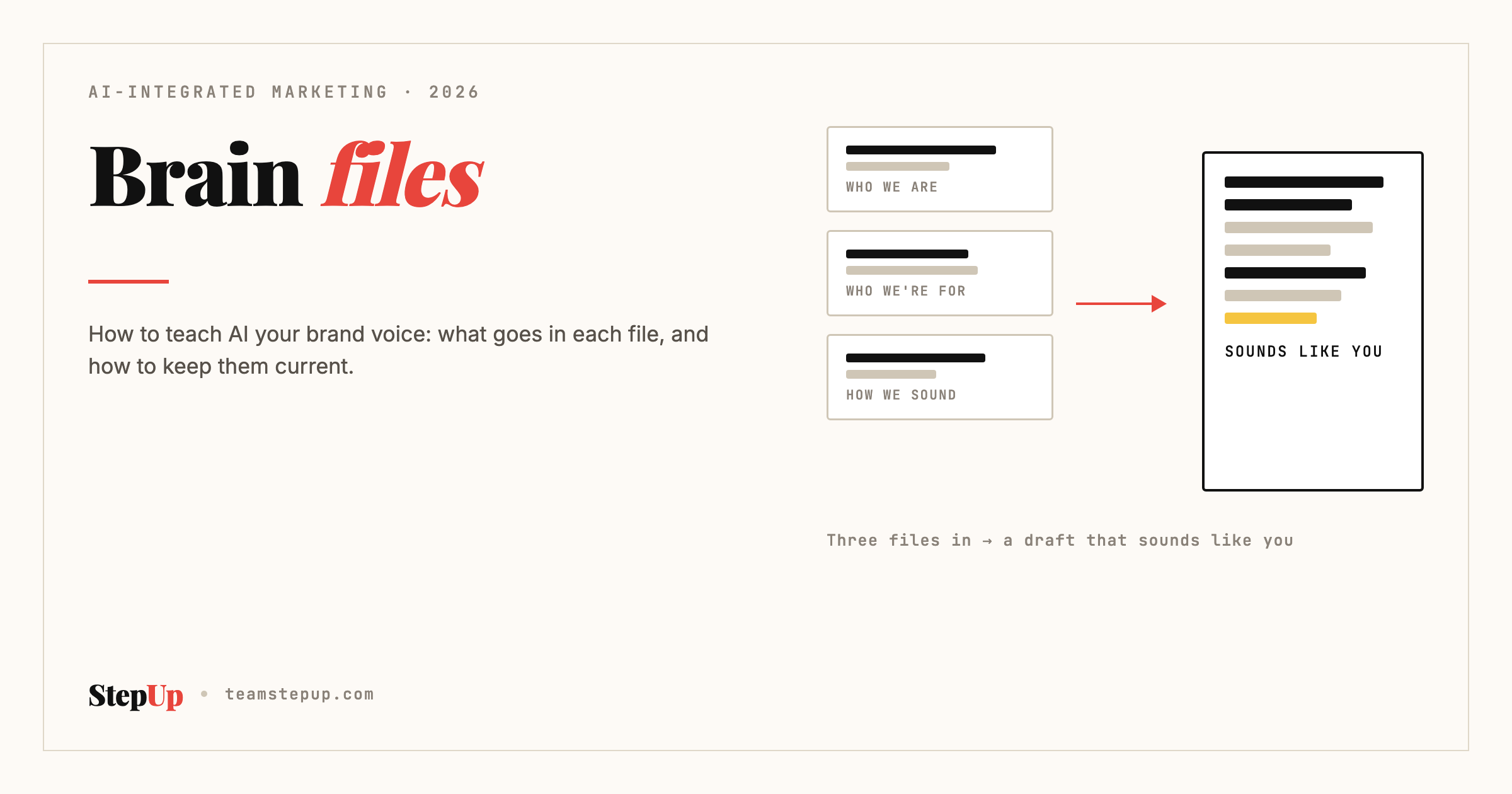
- Build a narrative foundation before you generate anything. Before AI ever writes a word, we compile a structured knowledge base. It holds customer language pulled directly from sales calls and reviews, the client’s positioning and point of view, the real objections prospects raise, and the proof points that differentiate them. We call this a brain file. Without it, an AI model defaults to the statistical average of everything ever written about your topic — which is precisely why so much AI content sounds the same. With it, the model has something specific to draw from instead of generic industry-speak.
- Generate from that foundation, not from a bare prompt. “Write a blog post about AI in B2B marketing” produces filler. “Write from this positioning, using this customer language, making this specific argument, with this proof point” produces something that sounds like a person who knows the subject.
- Always close with a human edit pass focused on specificity, not grammar. The edit that matters isn’t fixing typos — it’s stripping out every sentence a competitor could publish word-for-word and replacing it with something only your company could credibly say.
Skip step 1 and no amount of prompting cleverness in step 2 will fix it. This is the actual answer to “why does AI content feel robotic” — and it’s the reason a genuinely narrative-first, GTM-integrated process outperforms a bare AI writing tool every time.
AI Marketing Tools and Platforms (Vendor-Neutral)
Every other article ranking for this term is written by a vendor pushing their own platform through the “best tools” section. We don’t sell software, so here’s the landscape organized by the GTM function it actually serves — not by whose blog you’re reading.
The Tool Landscape by GTM Function
| GTM Function | What These Tools Do | Key Selection Criterion | Red Flag |
|---|---|---|---|
| Content Generation & Optimization | LLM interfaces, AI writing assistants, and SEO content platforms. They draft, repurpose, and structure content. | Can it ingest your own brand and customer data as context? Or does it only generate from generic training data? | Output needs a full rewrite, not a light edit. You added a step instead of saving one. |
| ABM & Predictive Account Intelligence | Platforms that combine intent, technographic, and firmographic data into account scoring models. | How many data sources it draws on. Also how cleanly the scores flow back into your CRM and ad platforms. | You need a manual list export to act on the scores. The “integration” is a spreadsheet. |
| Lead Scoring & CRM-Native Predictive Tools | Predictive scoring built into — or bolted onto — the CRM you already run. | What your existing CRM already does natively, before you buy anything standalone. | Paying for a point solution that delivers the same 80% your CRM already gives you on clean data. |
| Personalization & Dynamic Content | Tools that change web pages, email content, and ad creative based on who is looking at them. | Speed, so personalization does not slow the page down. And whether the segments are genuinely granular. | “1:1 personalization” that turns out to be a handful of broad segments. |
| SEO & Answer-Engine Optimization | Keyword clustering, content gap analysis, structured data, and AI Overview visibility tracking. | Whether it tracks answer-engine citations, not just blue-link rank. | Ask the vendor about their AI Overview roadmap. No answer is the answer. |
The Real Selection Criteria
Across every category, the questions that matter more than any feature checklist:
- Does it integrate with the CRM and data you already have? Or does it need a parallel data model?
- Can it ingest your own brand/customer context, or only generate from generic training data?
- Does the output require a full human rewrite, or a light edit? (If it’s the former, you haven’t saved time — you’ve added a step.)
- Is there a clear owner on your team who will actually maintain it, or will it join the pile of unused logins six months from now?
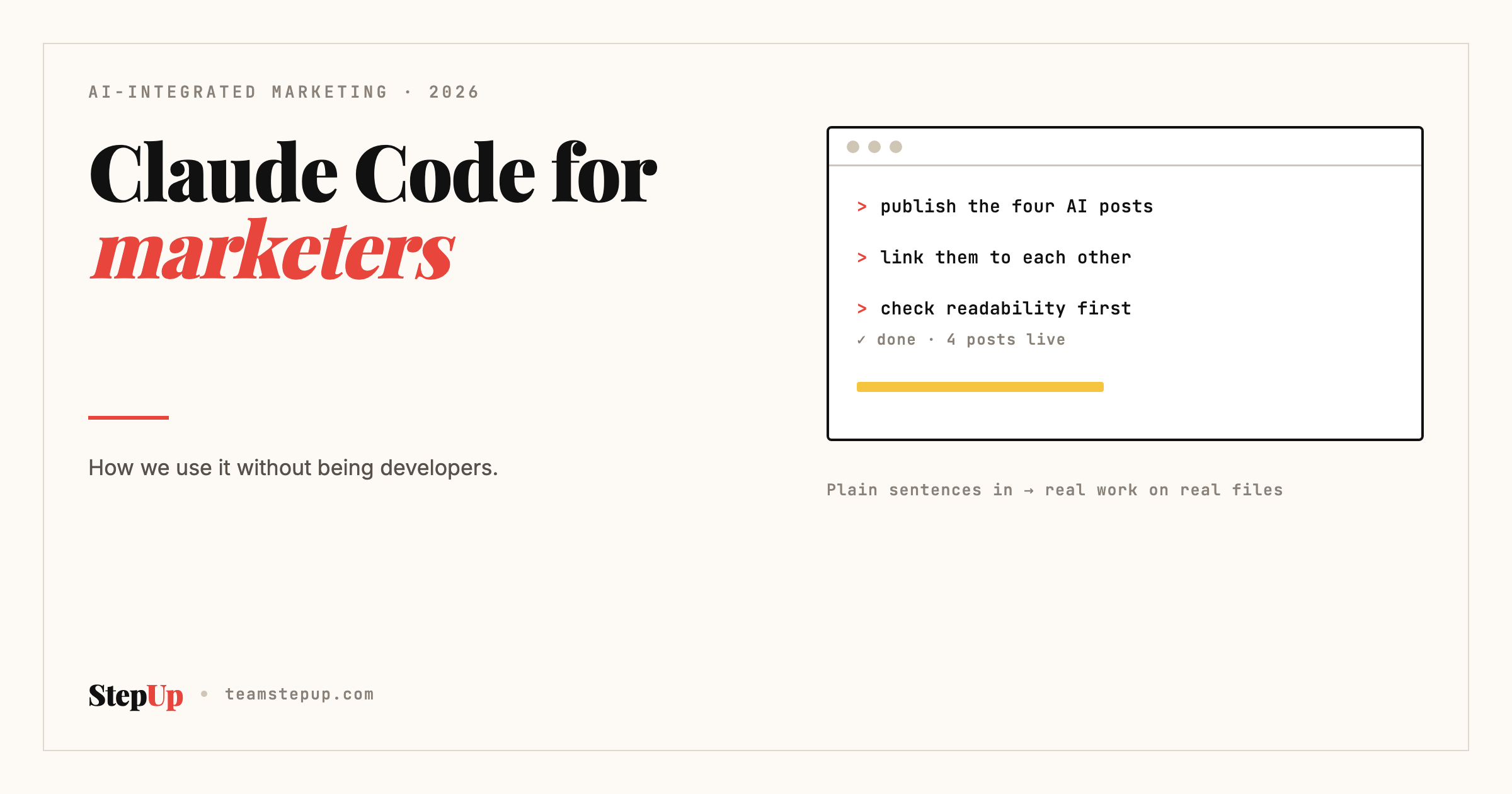
Buy for the workflow gap you have today, not the roadmap a sales rep shows you in a demo. For a look at one tool inside a real team’s week, see how we use Claude for marketing.
Trends and the Future of AI in B2B Marketing
A few shifts are worth planning around now rather than reacting to later:
Answer-engine visibility is becoming its own optimization discipline, separate from traditional SEO. Being the cited source inside an AI-generated answer requires structured, specific, well-sourced content. That holds in ChatGPT, Perplexity, and Google’s AI Overviews alike. Thin, generic filler never gets there. Ironically, the flood of generic AI content is making specific, well-researched content more valuable. It’s what the answer engines have to reach for when everything else is indistinguishable across ten competing sites.
Predictive and prescriptive analytics are converging with execution. Today’s tools mostly tell you which accounts are hot. The next generation increasingly suggests — or auto-executes — the next best action: which sequence to trigger, which ad variant to serve, which rep to route a lead to. The GTM teams that win this transition will be the ones with clean enough data and clear enough playbooks that automated execution is trustworthy rather than reckless.
AI-integrated marketing is becoming a baseline expectation, not a differentiator. The differentiator is shifting. It used to be “do you use AI,” and soon everyone will. The real question becomes whether your AI usage is embedded in a GTM strategy or bolted onto disconnected point tools. That’s the gap this guide has been describing, and it’s only going to widen.
Human specificity becomes the scarce resource. AI-generated content is saturating every category. That makes specific insight the scarce thing: real customer language, real proof points, a real point of view. It’s hard to fake and therefore valuable. Teams that treat AI as a speed multiplier on top of real strategic work will pull further ahead of teams using it as a replacement for strategic work.
A Real Example: AI Embedded Across GTM Stages
Here’s what AI-integrated marketing looks like in practice, from an engagement with one of our clients — a mid-sized industrial equipment manufacturer selling to plant operations and engineering buyers. We’re not naming the client, per our standard confidentiality practice, but the numbers and workflow are accurately represented.
Stage 1: ICP and TAM Refinement
The team came to us with a TAM estimate built on a broad industry code list and no real segmentation of which sub-segments actually converted. We ran AI-assisted analysis of their closed-won deal data, cross-referencing firmographic data, technographic signals, and deal size. One combination stood out. Plant size paired with equipment age converted at nearly 3x the rate of the “average” target account the team had been chasing. That single refinement cut their addressable list by roughly 40% while increasing average deal size in the remaining segment.
Stage 2: Content and Demand Generation
Using the narrative-first method described earlier, we built a brain file from sales call transcripts and customer interviews. It captured the actual language engineering buyers used to describe their problems, which differed sharply from the marketing department’s internal language. Content generated from that foundation was briefed and edited by a human strategist, then drafted with AI assistance. Production time fell by roughly 55%. Organic traffic to the new content cluster grew month over month, because the content used language buyers actually searched for.
Stage 3: ABM and Lead Scoring
With the refined ICP from Stage 1 feeding a predictive scoring model, sales development reps stopped working a flat, unranked list of several hundred accounts. They worked a ranked list instead. Top-quintile accounts converted to opportunity at more than double the rate of the unranked baseline. Reps reported meaningfully shorter time spent per qualified opportunity because they were prioritizing the right accounts instead of working the list top to bottom.
The throughline across all three stages: AI wasn’t a separate initiative. It was embedded inside GTM strategy work that already had a clear ICP and TAM foundation. Remove that foundation and the same AI tools would have simply executed the wrong strategy faster.
AI-Integrated GTM Maturity Model: Where Are You Right Now?
Use this to self-assess before investing further in any AI tool. Most teams overestimate their stage.
| Stage | What It Looks Like | Diagnostic Question |
|---|---|---|
| Stage 0 Ad Hoc |
People use general AI tools informally. Someone drafts emails in ChatGPT. No shared process, no brand context, no measurement. | Is there any shared process at all, or is it whoever remembers to try it? |
| Stage 1 Point Tools |
One or two dedicated AI tools are in place. They run in isolation from each other and from any documented ICP or GTM strategy. | Do the tools talk to each other, or does someone re-key data between them? |
| Stage 2 Embedded Workflows |
AI tools connect to clean CRM data and a documented ICP. Content draws on a real narrative foundation. Someone owns the stack and reviews output on a regular cadence. | Can you point to a specific ICP document your AI scoring model is built from? |
| Stage 3 Compounding System |
AI sits across the full GTM motion — TAM and ICP, content, ABM, scoring, nurture. Each stage feeds the next. | Does better ICP data measurably produce better scoring, and better scoring better-targeted content? |
Most B2B marketing teams sit at Stage 1 — they assume adopting a tool means they’ve reached Stage 2 without ever connecting it to real ICP data. If you can’t point to that document, you’re at Stage 1, regardless of how many AI tools are in your stack.
How to Implement AI in Your Marketing Strategy: Step by Step
This is the framework every other article skips in favor of generic “start small, measure often” advice. Here’s the actual sequence, tied back to GTM fundamentals instead of floating as a standalone AI initiative. If you have not written the strategy itself yet, start with how to build an AI marketing strategy.
Step 1: Fix Your ICP and TAM Foundation First
Before touching any AI tool, get honest about who your best customers actually are — not who you wish they were. Pull your closed-won data, identify the real patterns in firmographics, deal size, and sales cycle length, and use that to sharpen your ICP definition and TAM estimate. Every AI tool downstream — scoring, targeting, content — inherits the quality of this step. Skipping it is the single most common reason AI initiatives underdeliver.
Step 2: Audit and Clean Your Core Data
Check lead source attribution, deduplicate CRM records, and standardize firmographic tagging. This is unglamorous work and it’s the actual prerequisite for any predictive model to produce trustworthy output. Budget real time for this. It’s frequently the highest-leverage week of the entire project.
Step 3: Build Your Narrative Foundation
Compile the knowledge base AI will draw from — real customer language from sales calls and reviews, your actual positioning, your proof points, your competitive differentiation. This is what separates AI-integrated content from generic AI-generated filler, and it’s a one-time investment that pays off across every piece of content you produce afterward.
Step 4: Pick One Function to Integrate First
Don’t try to embed AI across content, ABM, scoring, and email simultaneously. Pick the function where clean data already exists and the strategic foundation is already built. That’s usually content or lead scoring. Get that one workflow fully embedded before expanding.
Step 5: Assign a Human Owner and a Review Cadence
Every AI-integrated workflow needs a named owner who reviews output against real outcomes on a fixed schedule. Content and email deserve a weekly review; ABM scoring can run monthly. This is the guardrail against the over-reliance failure mode covered above.
Step 6: Measure Against Pipeline, Not Just Output Volume
The easy trap is measuring AI success by content volume or email sends — vanity metrics that go up regardless of strategic quality. Measure against the metrics that actually matter. Compare opportunity conversion rates for AI-scored accounts against unscored ones. Track organic traffic growth from content built on a real narrative foundation, and sales cycle length for AI-prioritized accounts.
Step 7: Expand One Function at a Time, Compounding as You Go
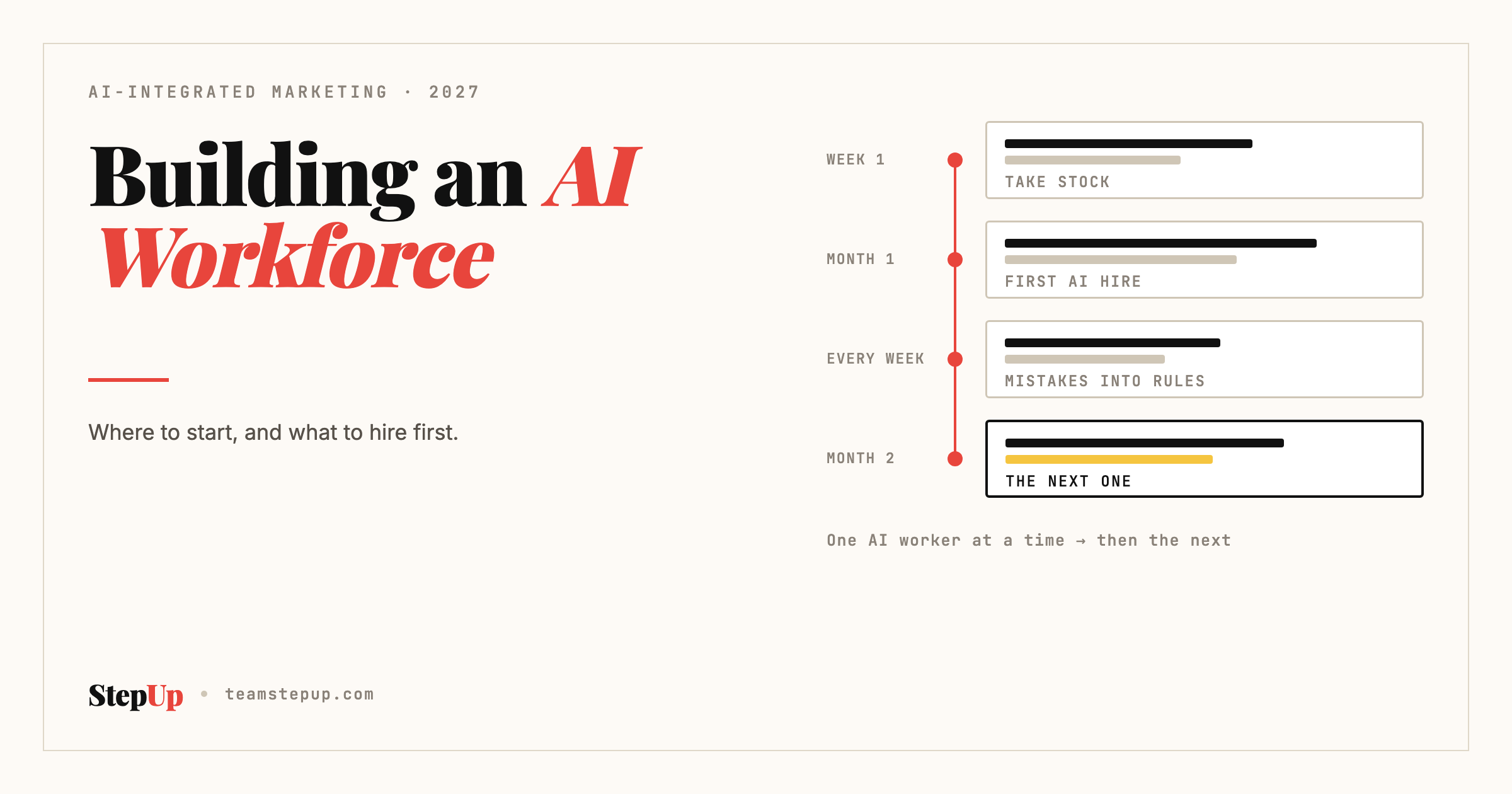
Once one workflow is genuinely embedded, connected to clean data and a real strategic foundation, expand to the next function. Feed its output back into the ones already running. This is how you move from Stage 1 to Stage 3 on the maturity model above: one deliberate, measured expansion at a time, not a simultaneous tool-buying spree.
FAQs
What does AI in B2B marketing actually mean?
It means using machine learning and generative AI to analyze account and buyer data, generate content and campaign variations, and make real-time targeting decisions. The best results come when it sits inside an existing GTM strategy rather than running as a standalone initiative.
Is AI replacing B2B marketers?
No. Adoption data consistently shows AI improving execution speed and content volume, not replacing strategic decision-making. Teams that treat AI outputs as decisions to be reviewed, not decisions already made, get the best results. We cover what changes for the team itself in will marketing be replaced by AI.
What’s the difference between AI marketing and AI-integrated marketing?
AI marketing often means point tools used in isolation — a writing assistant here, a scoring tool there. AI-integrated marketing means those tools draw from the same ICP data and narrative foundation and feed each other, compounding in effectiveness rather than operating as disconnected experiments.
Why does AI-generated content sound generic?
Because most teams prompt AI models with no specific brand or customer context, so the output defaults to the statistical average of everything else written on the topic. The fix is building a structured narrative foundation — real customer language, positioning, and proof points — before generating anything, then editing for specificity, not just grammar.
What should I fix before investing in AI marketing tools?
Your ICP definition, your CRM data quality, and your core narrative/positioning. AI tools amplify whatever foundation is underneath them — a weak ICP or messy data produces confidently wrong output at scale, which is worse than no automation at all.
Which AI tools should a B2B marketing team start with?
Start with the function where your data is already clean and your foundation is built. That’s usually content generation or lead scoring. Avoid buying tools across every function at once. Evaluate any tool on whether it can ingest your own brand and customer context, not just its feature list.
How do I measure whether AI is actually working in my marketing?
Track pipeline-level outcomes. Compare opportunity conversion rates for AI-scored versus unscored accounts, and watch AI Overview citations for narrative-founded content. Sales cycle length for AI-prioritized targets tells you more than content volume or emails sent.
Will AI content ranking hurt my SEO?
Generic AI content is increasingly indistinguishable from every other site’s generic AI content, which makes genuinely specific, well-sourced content more valuable, not less. Content built on a real narrative foundation performs well in traditional search and in AI Overview citations. Content generated from bare prompts blends into the noise.
AI in B2B marketing isn’t a separate strategy from your GTM plan — it’s an execution layer on top of one. The teams pulling ahead right now aren’t the ones with the most AI tools. They’re the ones who fixed their ICP and TAM foundation first, built a real narrative to feed the models, and embedded AI inside a GTM system that was already sound. Everything else is just faster execution of whatever strategy — good or bad — was already underneath it.
Want to know where your marketing stands against the market? The AI-Readiness Audit is a short call that looks at your marketing and pinpoints exactly where the gap is — and what it is worth to close first. You leave with a clear picture, even if we never work together.