Building an AI Workforce for Marketing: Where to Start and What to Hire First
Every few months a new report arrives to tell us how many jobs AI will take. The number is always large, always precise to the decimal, and always slightly different from last month’s equally precise number. Somewhere, a consultant is building a slide that says “47.3% of tasks are automatable,” and somewhere else, a CEO is reading it upside down on a plane.
Meanwhile, the marketing team has a more practical question: what do we actually do on Monday?
Because “build an AI workforce” sounds like something you do with a budget line and a press release. In real life, it starts with one agent, one job and one very patient person checking its work. (The press release, if there is one, comes much later, and it should probably be written by a human.)
It’s a strange moment to be planning a team.
And it’s easy to get wrong in both directions. Buy too little, and the team keeps doing by hand what a well-briefed agent could do in minutes. Buy too much, and you get eleven tools, no owner, and a CRM full of confident nonsense.
So if you’re going to build an AI workforce for marketing, it helps to know where to start and what to hire first.
This guide covers what an AI workforce is, what it means for marketing jobs, the order to build it in, which AI worker to start with, and the mistakes to avoid.
What Is an AI Workforce?
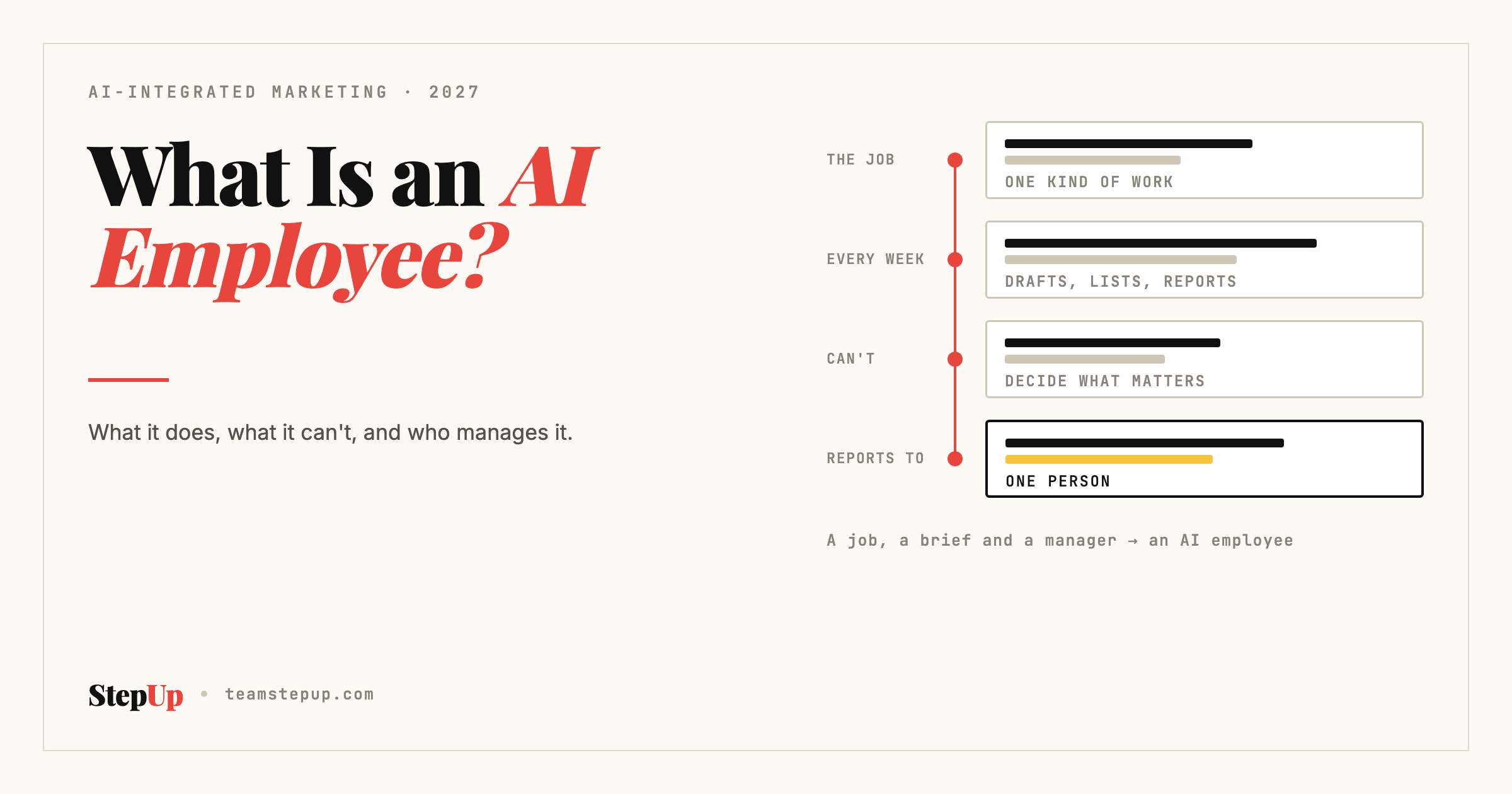
An AI workforce is the set of AI agents a company uses to do recurring work, each with a defined job, managed by people. In marketing, that usually means a handful of AI workers handling research, drafting, search upkeep, outreach preparation and reporting, alongside a small human team.
The word “workforce” matters. A workforce has roles, instructions, managers and rules. A pile of AI subscriptions does not.
What an AI Workforce Means for Marketing Jobs
This is the question most people searching for “AI workforce” actually want answered, so here’s the short version from inside a working team.
- Tasks move first, not roles. First drafts, research summaries, reports and website upkeep move to AI workers. The jobs around them change shape rather than vanish.
- The scarce skills shift. Judgment, voice, priorities, relationships and checking AI output become the core of every human marketing role.
- New work appears. Someone has to write the agents’ instructions, decide their access, review their work and turn mistakes into rules. That work didn’t exist three years ago.
- Smaller teams can do more. A team of two or three with a well-run AI workforce can cover work that used to need six. That’s a real change in hiring, and it’s worth being honest about.
For a longer look at what stays human, see Will Marketing Be Replaced by AI?
Before You Build: Four Things to Have in Place
An AI workforce amplifies what’s already there. These four need to exist before the first agent starts.
A Written Plan
What marketing must achieve this quarter, in numbers. Without it, AI workers produce more of whatever is easiest, not what matters. The one-page marketing plan is a good format.
Written Brand Files
Positioning, audience, voice and the words you never use. AI workers write from these every time, so they have to be on paper. Our guide to brain files shows how.
A Rule for Every Tool
Buy smart, build fast. Most of the workforce can run from one workspace on top of the tools you already have, rather than a new platform per job. And if setting something up and keeping it running takes more energy than the result, it isn’t a growth system, so cancel it.
A Named Owner
One person who runs the AI side of the team: assigns work, controls access, reviews output. In a small team, it’s the head of marketing. In a larger one, it’s often marketing operations. Our guide to marketing operations in 2027 covers the role.
The Order to Build It In
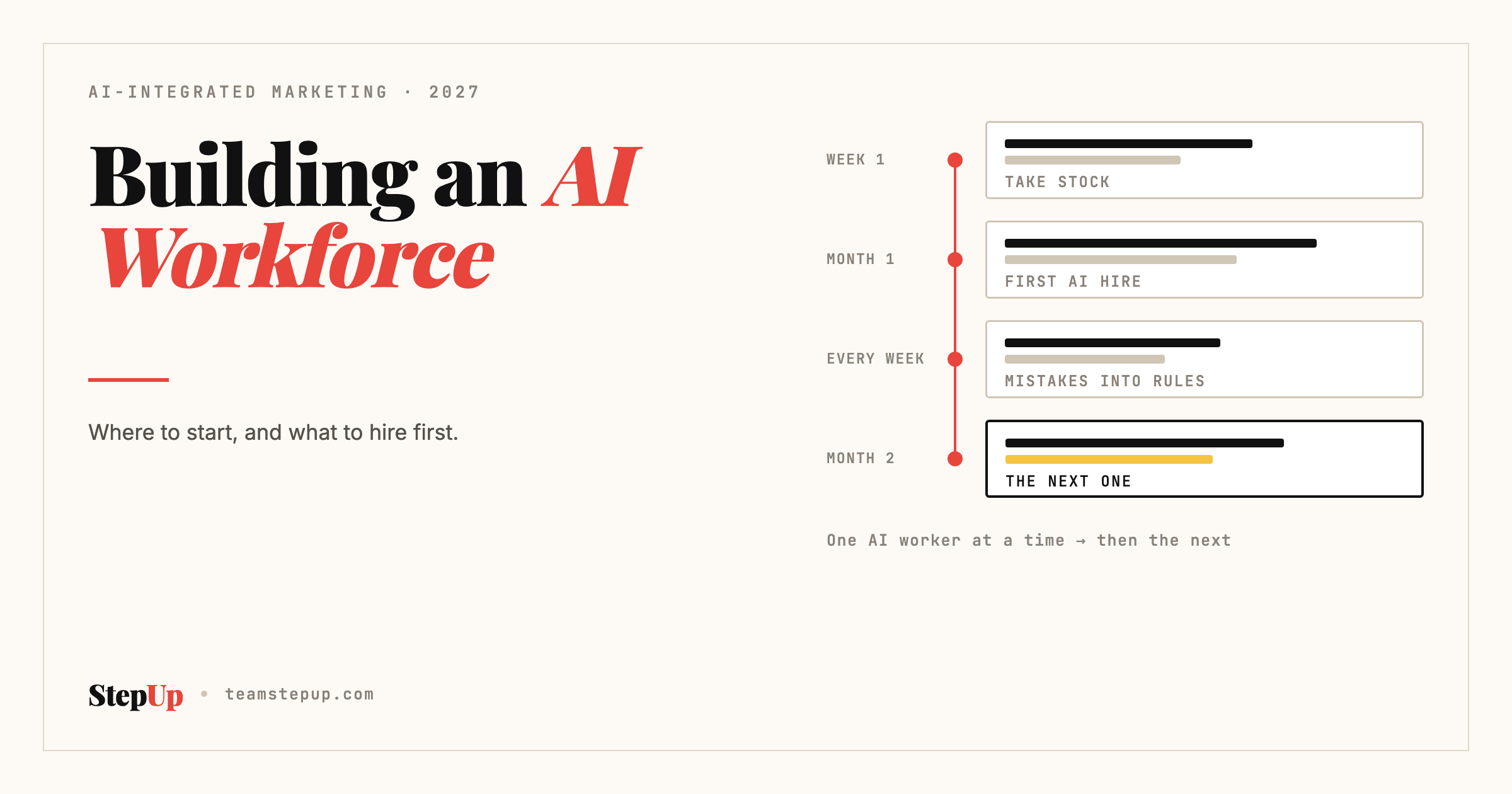
Build one AI worker at a time. Each one gets a month before the next one starts.
| Step | What Happens | Done When |
|---|---|---|
| 1. Take stock | List every AI tool already in use and match each to a job, or cancel it | Every tool has an owner, and the gaps are named |
| 2. Hire the first AI worker | The job that eats the most hours and follows a clear standard | A month of its work reviewed, with hours saved written down |
| 3. Write down every correction | Each mistake becomes a line in its instructions | The same mistake stops coming back |
| 4. Add the second | Usually the job that feeds or uses the first one’s work | Both run for two weeks without extra effort from you |
| 5. Lock the weekly routine | Plan, agents work, review, publish, read the numbers | Three weeks running on it |
| 6. Measure and decide | Compare output, quality, hours and results against before | A one-page before-and-after |
This is the same order we’re using to build StepUp’s own marketing team, and the before-and-after will become one of our case studies.
Which AI Worker to Hire First
The best first hire is the one that removes your biggest weekly time sink. Here’s how to choose.
| If This Sounds Like You | Hire First | Its First Week |
|---|---|---|
| You know what to say and never have time to write it | Content writer | Three LinkedIn posts and a blog draft, in your voice, from one conversation |
| You can’t tell your CEO what marketing did last month | Analyst | A one-page report on last month, every number checked against its source |
| Your website has good content nobody finds | Search specialist | The ten pages closest to Google’s first page, and what to fix on each |
| You’re not sure why you win or lose deals | Market researcher | A one-page profile of your best customer and what three competitors changed |
| Sales has no time to start new conversations | Outreach rep | A list of 50 right-fit companies and a first message you approve |
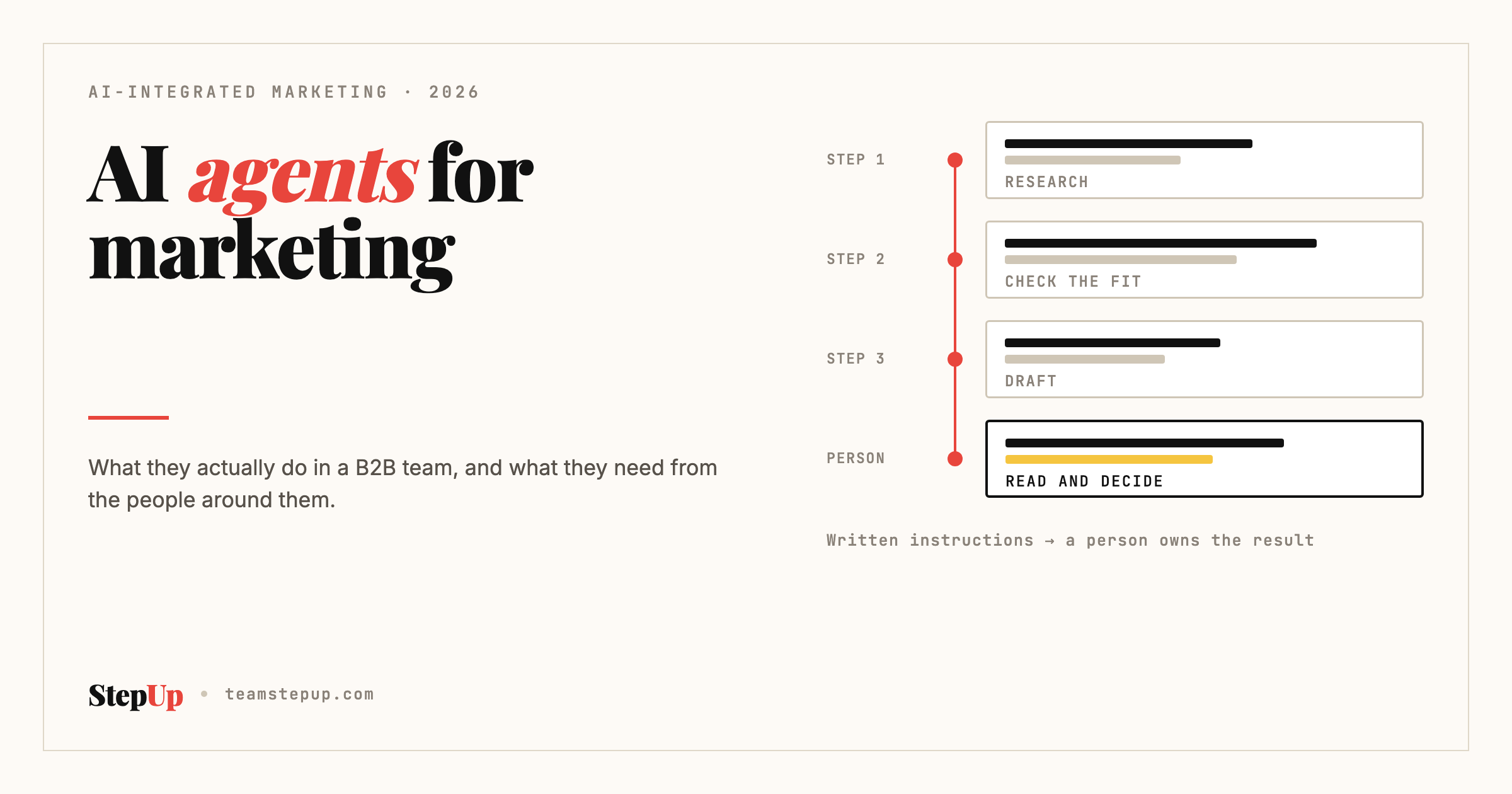
For a fuller description of each one, including what it can’t do, see What Is an AI Employee?
How to Keep People in Charge
An AI workforce works when the people running it stay in charge of four things.
- The work. A person decides what each AI worker does this week, based on the plan.
- The access. Each AI worker gets only what its job needs. Most read and draft; people publish and send.
- The output. A person reviews everything public before it goes out, and spot-checks the rest.
- The rules. Every correction becomes part of the worker’s instructions, so the workforce gets better every week.
Common Mistakes When Building an AI Workforce
Buying Tools Before Writing the Plan
The tool is the easy part. Without a plan, it’s just faster busy work. Our guide to the best AI marketing tools for B2B explains why the tool is rarely the problem.
Hiring Five at Once
Five new AI workers in a month means five sets of mistakes to catch at the same time, with nobody sure which one caused what. One at a time is faster in the end.
No Owner
AI workers without a named manager drift. Their instructions go stale and nobody checks the output. It’s the most common reason AI projects stall.
Giving Publishing Access Too Early
An AI worker that can publish to the website or send email on its own will, eventually, publish something it shouldn’t. Keep that permission with people.
Measuring Only Speed
Hours saved matter, but so do quality and results. An AI workforce that produces twice the content and no extra pipeline hasn’t helped yet.
Frequently Asked Questions
What is an AI workforce?
An AI workforce is the set of AI agents a company uses to do recurring work, each with a defined job and a human manager. In marketing, it typically includes AI workers for research, content drafting, search upkeep, outreach preparation and reporting.
How will an AI workforce affect marketing jobs?
Tasks move to AI workers first, especially first drafts, research and reporting. Marketing roles shift toward judgment, voice, relationships and reviewing AI output, and new work appears in managing the AI workers. Smaller teams can cover more work than before.
How do you build an AI workforce for marketing?
Write the plan and the brand files, name one owner, then add one AI worker at a time, starting with the job that takes the most hours. Review its work every week for a month, turn each mistake into a rule, and measure the before-and-after before adding the next.
Which AI worker should a marketing team hire first?
The one that removes the biggest weekly time sink. For most B2B teams, that’s either a content writer, for teams short on writing time, or an analyst, for teams that struggle to report on results.
Do you need technical skills to manage an AI workforce?
Not deep technical skills. The key skills are writing clear instructions, spotting wrong output quickly and deciding what each AI worker should be allowed to access. Comfort with the CRM and analytics tools helps.
Monday, Then
The 47.3% slide will be updated again next month. Let it.
On Monday, you’ll pick one job, write one page of instructions, and name the person who checks the work. That’s an AI workforce. It just starts smaller than the press release.
And the CEO can turn the slide the right way up.
Not sure which AI worker to hire first? The free AI-Readiness Self-Audit shows whether your team is ready.
Want to know where your marketing stands against the market? The AI-Readiness Audit is a short call that looks at your marketing and pinpoints exactly where the gap is — and what it is worth to close first. You leave with a clear picture, even if we never work together.