Originally published November 2017. Updated September 2026.
Most B2B companies have two funnels and do not know it.
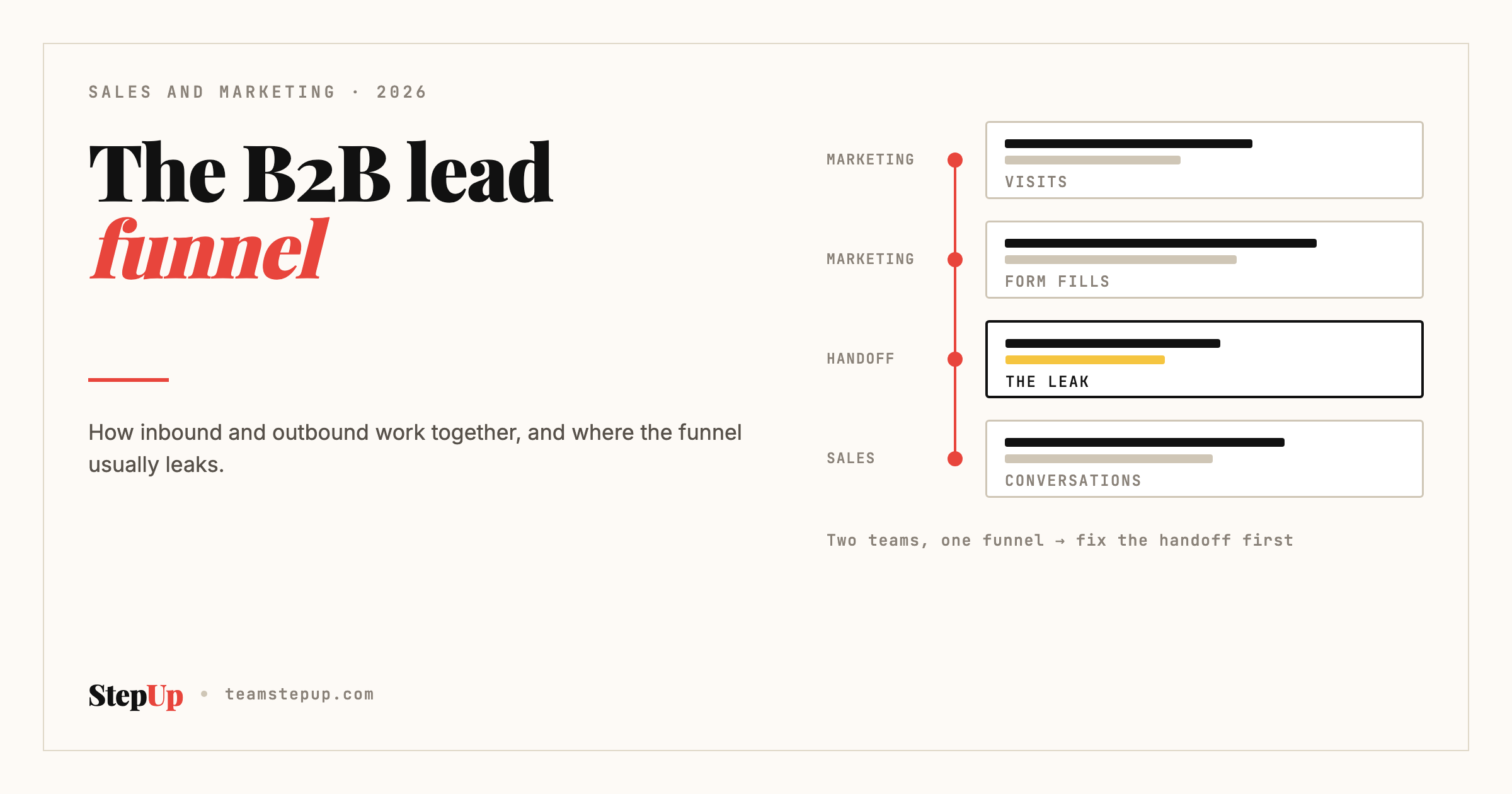
Marketing runs one. It attracts visitors, collects form fills and scores contacts. Sales runs the other. It works a list, makes calls and books meetings. Each team reports its own numbers. As a result, each is convinced the other one is the problem.
A lead funnel only works when those two become one. This guide explains what a B2B lead funnel actually is, where inbound and outbound each belong, and how to connect them so interest turns into conversations instead of stalling somewhere in the handoff.
What is a lead funnel?
A lead funnel is the path a potential buyer takes from first becoming aware of you to becoming a sales conversation. It is called a funnel because many people enter at the top and fewer move through each stage.
In B2B, the funnel has a few features that consumer funnels do not:
- Several people buy together. A single decision can involve a finance lead, an operations head and a technical evaluator, each moving at their own pace.
- The cycle is long. Months, sometimes more than a year.
- Most of the research happens without you. Buyers read, compare and ask peers long before they speak to a salesperson.
So a B2B lead funnel is less a straight line and more a set of stages that different people move through at different times. Still, the stages are useful, because they tell you what each person needs next.
The stages of a B2B lead funnel
| Stage | What the buyer is doing | What they need from you |
|---|---|---|
| Awareness | Noticing a problem, or noticing you | A clear point of view on the problem |
| Interest | Reading, comparing, asking around | Useful content that helps them think |
| Consideration | Building a shortlist | Proof: examples, clear offers, answers to hard questions |
| Conversation | Talking to vendors | A salesperson who already understands their situation |
| Decision | Getting internal agreement | Material that helps them make the case to others |
Different teams name these stages differently. The names matter less than agreeing on them, and on what moves someone from one stage to the next.
Inbound and outbound: two ways into the funnel
Inbound
Inbound brings buyers to you. They find an article through search, see a post on LinkedIn, hear a colleague mention you, or download a guide. They arrive with a need already forming.
Inbound is strong at the top and middle of the funnel, because it builds familiarity and trust over time, and it tends to attract people who are already looking. Its weakness, however, is timing. It works on the buyer’s schedule, not yours, and it can take months to build.
For the difference between content marketing and inbound as disciplines, see our comparison of content marketing vs. inbound marketing.
Outbound
Outbound goes to buyers. Your team identifies the right companies and people, then reaches out directly: email, phone, LinkedIn, events.
Outbound is strong when you know exactly who you want to reach and cannot wait for them to find you. In addition, it gives you control over timing and focus. However, cold outreach without context is getting harder. Buyers are flooded with generic sequences, and most of them get ignored.
Why you need both
Inbound without outbound tends to attract some people who are not a fit and miss some who are. Outbound without inbound tends to reach the right people with no reason for them to listen.
Together, they cover each other’s gaps. Inbound creates familiarity, so outbound lands warmer. Outbound focuses attention on the accounts that matter most, so inbound content gets read by the right people.
How to connect inbound and outbound in one funnel
The idea is simple. The execution is where most teams struggle, so here is how to make it concrete.
1. Agree on who the funnel is for
First, both teams need the same customer profile, in writing. Which companies, which roles and what problem. If marketing is attracting one kind of buyer and sales is calling another, no process will fix the gap. Our guide on how to create an ideal customer profile walks through building one.
2. Use inbound signals to guide outbound
When someone from a target account reads three articles about a specific problem, that is a signal. Rather than waiting for a form fill, sales can reach out with context: “A few people on your team have been reading about this. Is it something you are working on?”
This is where inbound and outbound genuinely meet. Marketing surfaces interest. Sales responds to it quickly and personally.
3. Make outbound point to inbound
Similarly, outbound messages should rarely end with “book a demo.” A better first touch offers something useful: an article that answers a question the buyer probably has, or a short guide. That gives the buyer a low-pressure way to engage and brings them into the part of the funnel marketing nurtures.
4. Define the handoff
Decide exactly when a contact moves from marketing’s care to sales. What behavior or information qualifies them? How fast must sales follow up? What happens if sales decides the contact is not ready? Our guide on converting MQLs to SQLs covers this handoff in detail.
5. Close the loop
Finally, sales should tell marketing what happened to every contact it received. Which ones became conversations, which went quiet and why. Without that feedback, marketing keeps optimizing for volume instead of quality.
Where the phone still fits
Speed matters more than most teams admit. When a qualified buyer shows interest, a prompt, personal response, often a phone call or a short personal message, turns interest into a conversation far more reliably than an automated email sequence.
The call is not a pitch. Instead, it is a question: what prompted your interest, and what are you trying to solve? Listening well on that first call does more to move the funnel than any clever sequence.
How to measure a lead funnel
Resist measuring each team on its own numbers alone. Marketing reporting form fills and sales reporting meetings creates two funnels again.
Instead, track a small set of shared measures:
- Conversion between stages, so you can see where people stall.
- Time between stages, especially from first interest to first conversation.
- Source of conversations, including self-reported sources like “a colleague recommended you.”
- Quality feedback from sales, meaning how many handed-over contacts were genuinely a fit.
Together, these show where the funnel leaks. In most B2B companies, the biggest leak is in the handoff, where interested buyers wait too long or get a generic response.
Common lead funnel mistakes
Treating the funnel as marketing’s job. The funnel belongs to both teams. When sales treats it as marketing’s problem, the handoff breaks.
Chasing volume at the top. More contacts are not better if they do not match the customer profile. They just create work.
Slow follow-up. Interest fades quickly. A day’s delay costs more conversations than most teams realize.
Automating the first real conversation. Automation is useful for organizing and nurturing. However, the moment a buyer is ready to talk, a person should respond.
No agreed definitions. If the teams disagree on what a qualified contact is, every meeting about the funnel becomes an argument about numbers.
Frequently asked questions
What is a lead funnel?
A lead funnel is the path a potential buyer takes from first becoming aware of your company to becoming a sales conversation. It is usually divided into stages, such as awareness, interest, consideration and conversation, with fewer people moving through each stage.
What is a B2B lead funnel?
A B2B lead funnel is a lead funnel designed for business buying, where several people are involved in each decision, the cycle is long and most research happens before a buyer speaks to sales. It needs to serve multiple people at different stages at the same time.
What is the difference between inbound and outbound marketing?
Inbound attracts buyers to you through content, search, social media and referrals. Outbound reaches out to buyers directly through email, phone, LinkedIn or events. Inbound works on the buyer’s timing. Outbound gives you control over who you reach and when.
Can inbound and outbound marketing work together?
Yes, and they work best together. Inbound creates familiarity, so outbound outreach lands warmer. Outbound focuses attention on the right accounts, so inbound content reaches the people who matter. The connection point is a shared customer profile and a clear handoff.
What are the stages of a lead funnel?
Common stages are awareness, interest, consideration, conversation and decision. The exact names vary by company. What matters is that marketing and sales agree on them and on what moves a buyer from one stage to the next.
How do you improve a B2B lead funnel?
Start with a shared customer profile, agree on the handoff between marketing and sales, respond quickly and personally when a qualified buyer shows interest, and track conversion and time between stages. In most companies, the handoff is where the biggest gains are.
So next quarter, give both teams one report with one set of numbers.
Then see how long it takes someone to ask where the webinar leads went.