B2B Marketing Budget: A Step-by-Step Guide to Spending Smart in 2026

This guide to B2B marketing budgets was originally published August 2023. Updated September 2026.

If you haven’t built your foundational marketing machine, you haven’t built anything.

That is the message we spend most of our time trying to get across. You are hungry for leads. You have decent instincts about converting them. But a pipeline, a machine that reliably refills your qualified lead pool, takes strategy and real investment, and no amount of tactical activity substitutes for it.

So how should you spend when you are cash-constrained, time-poor, and need customers now? Five steps, below.

One thing has changed enough since we first wrote this that it deserves saying up front. AI has genuinely changed what a marketing budget buys. Production costs have fallen sharply. Strategy costs have not. If anything, they have risen in importance, because AI amplifies whatever definition you give it. Spend accordingly: less on volume production, more on getting the thinking right. We will come back to this.

Step 1: Set clear goals (spoiler: the goal is qualified leads)

All marketing effort should attract qualified prospects with a real interest in what you sell.

Too many early-stage companies skip the MQL stage entirely: no pipeline of warm prospects, everything resting on cold outreach from a small sales team. That works until the team stops, and then nothing arrives.

Not just leads: marketing qualified leads

Setting goals around MQLs forces you into the metrics that matter: acquisition cost, conversion rate between stages, and return on the content and campaigns feeding the pipeline. Those numbers are how you find out which activities are working, which is the only way to reallocate a budget intelligently.

When you set the target, account for your audience, your category’s dynamics, the competitive landscape, and what you can actually resource. A goal disconnected from resourcing demotivates the team rather than directing it.

Not all activities generate leads equally. Clear goals let you concentrate budget on the ones that do.

Clarity is a management tool

When everyone is aligned on one objective, collaboration gets easier and the strategy stays coherent. This sounds obvious on paper, but for the most budget-stressed team in the business, alignment is what turns a spending plan into shared momentum.

Measurable goals also let you distinguish a bad quarter from a bad strategy. Without them, every disappointing month is an argument rather than an analysis.

Step 2: Map every cost before you cut any

Our instinct when budget-setting is to work out what to take out of the trolley. Resist that for one draft. Build the complete picture first, then cut deliberately.

Early-stage B2B companies routinely hold big ambitions: dominating a region, owning a category. Big goals are fine, but they need a realistic account of what the work costs. You do not have to fund all of it this year. You do have to know the number.

What is commonly spent: B2B companies typically run marketing at somewhere between 5% and 12% of revenue, weighted higher in early-stage and growth-stage companies competing for category position. Treat that as orientation, not instruction: your number depends on deal size, sales cycle, and how contested your category is.

Here is what belongs in the picture.

Paid advertising

Your message has to reach the right audience, and in most B2B categories some of that reach is paid: search, LinkedIn, display, trade publications, wherever your buyers actually are.

Paid is also the fastest way to test messaging. Before committing to a positioning across your whole site, you can learn a great deal for a modest sum about which framing your market responds to.

Bottom line: budget for a genuine paid test, not a token amount that cannot produce a signal.

Content and the martech stack

Content is the backbone, and it is no longer just a well-written 2,000-word article. It is search structure, distribution, measurement, and increasingly whether AI systems can read and cite your material.

Budget for both the people and the tooling: writers and subject-matter input, SEO and analytics tools, a CMS and CRM, and the automation layer connecting them.

A 2026 note on this line. Production cost has fallen further than most budgets have been updated to reflect. The trap is treating that as license to publish more. What actually earns attention now is content nobody else could produce: your data, your customers’ results, your point of view. Move the savings from volume into depth and distribution.

Bottom line: budget to create genuinely good content, and to make sure it gets seen.

Events

Events remain one of the most effective B2B channels, digital or in person. They create direct conversations with buyers, showcase what you do, and build the category presence that makes every other channel work better.

Bottom line: from webinars to trade-show booths, budget for showing up where your market gathers.

People, contractors, and agencies

Talent costs, and talent matters. Keep salary and contract spend in a separate line from media spend: mixing them hides what is actually happening to your reach when you make a hire.

And be honest about capability. You cannot wing SEO, and you cannot wing GTM strategy.

Step 3: Build the go-to-market machine before you buy tactics

Plan and budget deliberately for go-to-market strategy work, ideally before investing in channels and tactics.

However good your in-house marketing hire is, building a GTM strategy from scratch is a distinct skill. Companies that skip it end up funding tactics that execute a plan nobody wrote.

What a GTM machine actually is

A framework designed to generate demand from your ideal market: who you talk to, and how, grounded in real understanding of your product and your market.

  • It is the alternative to guesswork and blind experimentation.
  • Put simply, it answers “what is your plan for growth?”
  • It is the work that happens before sales picks up the phone.
  • It is the foundation every effective marketing effort afterward rests on.

What you should get for the money

  1. Deep understanding of your business, products, and services.
  2. Competitive analysis: their messaging, positioning, and offers.
  3. Defined ICPs and personas: goals, challenges, and how you solve them.
  4. Value proposition messaging tying your product to your buyers’ most painful problems.
  5. A content strategy covering awareness, consideration, and decision stages.
  6. An execution and distribution plan.
  7. Guidance on the martech stack: what you need, and what you can skip.

One addition for 2026, and it is not optional any more. Ask for the work to be delivered as a documented brain: ICP, narrative, messaging hierarchy, and voice, written down in a form both your team and your AI systems can use directly.

This is the difference between a strategy deck and an operating asset. A deck gets read once. A documented brain becomes the context every agent, tool, and new hire inherits, and it is the single highest-leverage thing on your budget, because everything downstream is only as good as it is.

Step 4: Hire your in-house marketer

No marketer is a jack of all trades, and the ones who claim to be are usually expensive to discover.

Hire for strengths that match your actual needs. Skill-set fit and industry fit are both valid bases: pick the one your situation demands. And treat the hire as a partner: invest in judgment, then give them the support to execute the vision you and your GTM partners built.

What has changed here. The most valuable marketing hire in 2026 is not the person with the longest tool list. It is the person who can define what good looks like and then direct systems, human and automated, to produce it. That is a thinking role, and it is worth paying properly for.

Step 5: Review the pipeline every six months

Set aside budget for two strategy refreshes a year.

Markets shift. Buyer behavior shifts. Keyword costs shift. Channels that worked stop working, usually gradually enough that nobody notices until a quarter has gone.

Analyze which channels are producing leads and conversions. Test creative, landing pages, and sequences. Adjust messaging based on what buyers actually say back to you.

A B2B marketing budget is not fixed. It should be agile enough to follow evidence, which requires reviewing the evidence on a schedule, not when something breaks.

Frequently asked questions

How much should a B2B company spend on marketing?

Commonly between 5% and 12% of revenue, higher for early-stage companies competing for category position. The right number depends on deal size, sales cycle length, and competitive intensity more than on any benchmark.

What should a B2B marketing budget include?

Strategy and GTM foundations, salaries and contractors, content production, martech and tools, paid media, events, and a reserve for twice-yearly strategy reviews.

How should an early-stage B2B company split its marketing budget?

Fund the strategic foundation first: ICP, narrative, messaging. Then content and search, which compound. Then paid, sized to produce a real signal. Events once you know which rooms your buyers are in.

Has AI reduced B2B marketing budgets?

It has reduced production cost, not total cost. The saving tends to be reallocated toward strategy, distribution, and proprietary research, because generic content produced at volume no longer earns attention.

Should you hire an agency or build in-house first?

For most early-stage companies, an external partner for the GTM foundation and an in-house marketer to run the operation. The strategic build is a one-off specialist project; the operation is continuous.

How often should a B2B marketing budget be reviewed?

Reallocate quarterly based on channel performance; revisit the underlying strategy every six months.

The short version

Set goals around qualified leads. Map every cost before cutting any. Build the go-to-market foundation before buying tactics, and insist it is delivered as a documented brain rather than a deck. Hire for judgment. Review twice a year.

Production is cheaper than it has ever been. Thinking is not, and it is now the part of the budget that determines whether everything else works.

StepUp builds AI-integrated go-to-market operations for global B2B companies: the strategy, the documented brain behind it, and the system that runs on top. Let’s talk about your plan.


Use the Value Proposition Canvas to build your early-stage B2B Start-Up’s Messaging

Why does marketing messaging even matter? Really, you put so much work (and money) into “the right words”, what’s it all about? Well, the truth is — messaging that connects your audience to what you offer is the key piece of the puzzle in emotionally connecting with your potential audience and getting them to take the next (or first) step in your funnel. But getting there should not rely on quick scans of your competitors’ ads and guesswork. It should rely on asking good questions about who your target market is and what you offer them that truly improves your life.

That’s why we developed the Value Proposition Canvas — our methodology that helps us to connect the product to the market to the right message. Our unique approach gets us results every time, and we think it’s an ideal approach for early-stage B2B startups. This is why we love it, why we use it (hundreds of times for our customers, and counting) and it’s also the secret sauce behind writing content that works.

Read on to learn!

[And scroll down for our template! We expect you to steal it!]


What is the Benefit of the Value Proposition Canvas?

The Value Proposition Canvas allows businesses to gain a deep understanding of their target market and create the types of products and services that meet their needs. By analyzing your potential customers’ jobs, pains, and gains; you can identify opportunities to differentiate yourself from your competitors and create really compelling marketing that shines.

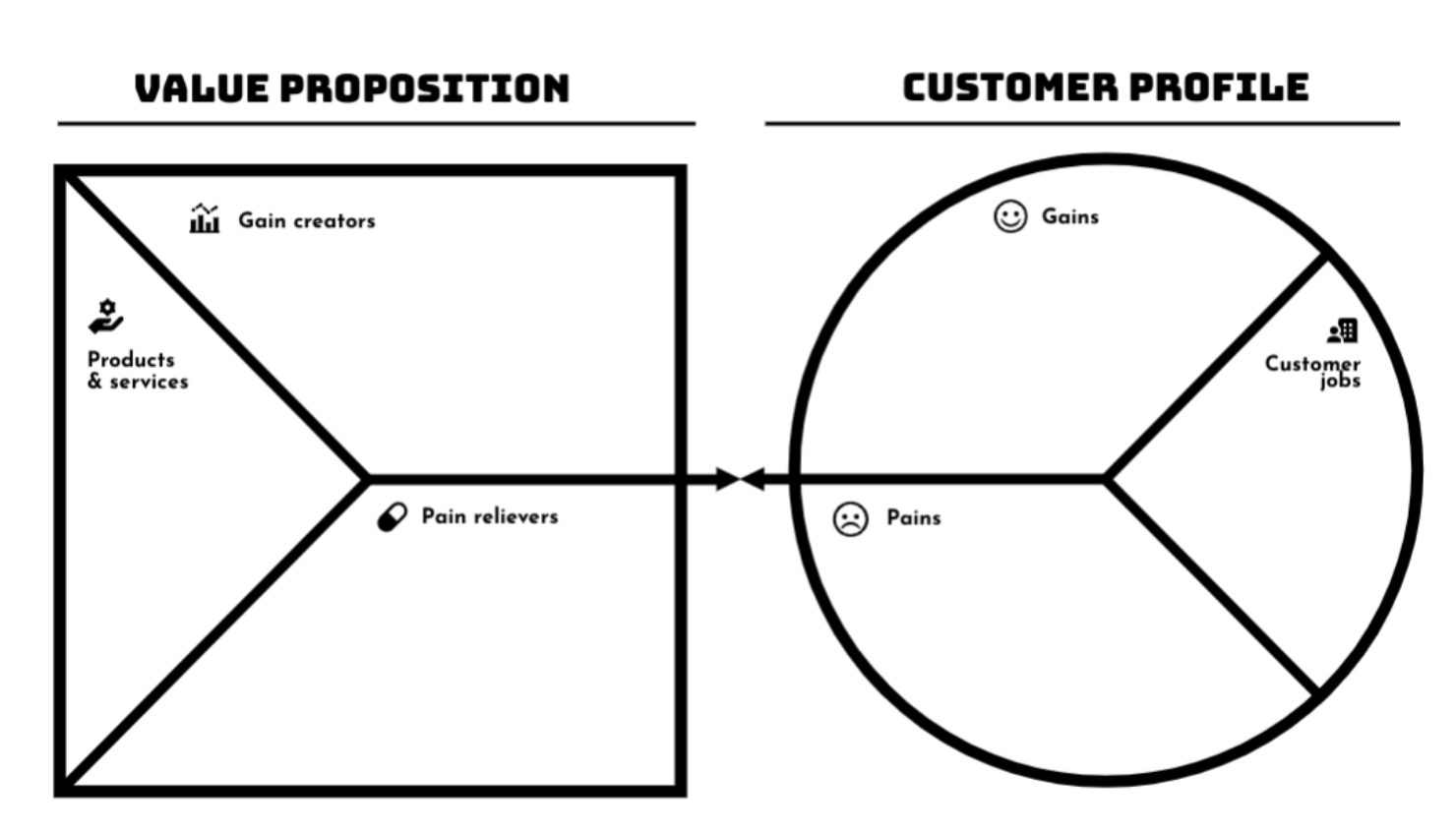
Our Value Proposition Canvas methodology offers a structured framework to systematically analyze and understand your potential customers. This framework consists of two main components: the customer profile and the value map.

This is not like the ICP or Persona development you may have done. This analysis goes beyond simple demographics and explores the deeper motivations and aspirations of your potential clients as it specifically relates to the challenges that your particular product or service might solve. By understanding the jobs customers are trying to get done, the pain they experience (ie: the challenges they encounter trying to meet their goals), and the gains they desire, you’ll develop a clearer picture of your target market and design intuitive-feeling marketing that gets to the heart of how your solution is their solution.

Investing in Creating the Right Messaging Leads to Effective Marketing

Effective marketing is crucial for any business to thrive and reach its target audience. However, without the right messaging, even the most well-designed marketing campaign can fall flat. This is where the Value Proposition Canvas comes into play.

With the Value Proposition Canvas – you’ll develop messaging that speaks to your target market’s specific needs, desires, and challenges, making them more likely to pay attention and take action. By integrating the findings from the Value Proposition Canvas into your marketing efforts, you can create a cohesive and impactful marketing campaign that resonates loudly with your target market.

The bottom line is that the right messaging is crucial.

Understanding Your Customer’s Needs and Expectations

Once the customer profile is established, the value map comes into play. This component helps businesses identify the unique value they can offer their customers.

By using the Value Proposition Canvas as your map you’ll learn:

  • Which pain points are the strongest for your target market.
  • The ongoing impact of their challenges on them, information you can utilize in writing marketing.
  • Which of your product offerings has the potential to resonate most deeply as a solution for your customers.
  • Potential unmet needs — gaps in the market — where you can offer your product as a solution.

With these findings you can develop powerful value proposition messaging that sets you apart from your competitors and speaks directly to the heart of your target market’s needs and hopes.

This knowledge goes beyond marketing — alignment with your target market’s pain can inform your entire customer lifecycle journey, you can tailor your customer service and product messaging around this knowledge, increasing the likelihood of customer satisfaction and loyalty, ultimately leading to long-term business success.

The Psychology of Why People Buy Things

It’s really valuable to take some time to understand the psychology behind people’s buying decisions. There are so many reasons why individuals choose to buy certain products or services. These factors include emotional triggers, social influence, perceived value, and personal beliefs. By understanding these psychological drivers, businesses can craft messaging that speaks directly to their customer’s desires and motivations.

Market psychology is large and fascinating field, while not necessary, we highly encourage people to spend some time learning about the patterns and trends in human behavior that help us to understand buying patterns overall, and shed some insight into why this methodology (and many others — though we’re partial to this one) work over and over again.


How To Use the Value Proposition Canvas


Always Start with the Customer

In order for a business to succeed, it is crucial to understand the needs and wants of the customer — and the best way to do this is to roll up your sleeves and dig into some market research.

You can gather qualitative data about customer needs and wants through approaches such as message mining. This involves analyzing all the feedback your company has received from your existing customers. This includes customer feedback, reviews, and other product comments. With this information in hand, you’ll be able to observe some common themes and use this knowledge to develop solutions that address these specific needs.

Another really valuable approach is through conducting customer and user interviews. By directly engaging with customers and asking high-quality questions, you can gain valuable insights into your existing customer’s preferences, pain points, and expectations. These interviews are a gold mine and a much better replacement for the old-fashioned survey.

Deeply understanding the core needs and core wants of the customer is your business’s silver bullet for writing a successful value proposition. Beyond writing effective marketing — it’s the research that confirms whether you have a true product-market fit and ultimately is a huge driver of lower marketing costs, as you’ll have confidence that you’re investing your paid budget in targeting the right audiences.

Ask Enough ‘Whys’

When using the Value Proposition Canvas it is important to ask enough “whys.” By continuously asking “why,” you can delve deeper into the motivations and desires of your target audience, allowing you to better understand their core pains and their core values.

Asking “why” helps you to go beyond surface-level responses and get to the root of what truly moves and inspires your customers. It helps you to uncover the underlying reasons behind their behaviors and preferences, allowing you to develop core messages that will really connect with them.

Make sure you ask “why” in every area of your Value Proposition Canvas.

Jobs refer to the tasks or problems that your customers are trying to solve, and asking “why” helps you understand the ultimate goals or outcomes they are trying to achieve.

Pain points are the negative experiences or frustrations your customers face, and by asking “why,” you can illuminate the depth of their most challenging obstacles and get to the heart of the solutions you can offer.

Gains, on the other hand, are the positive outcomes or benefits your customers desire, and asking “why” helps you understand their motivations and aspirations.

When considering jobs, pains, and gains, it is important to look at both social, emotional, and functional aspects. Social benefits or social consequences play a huge role here — how will their reputation or their businesses’ reputation be impacted by not solving their challenge at hand, for instance. Emotional aspects relate to how your product or service makes your customers feel, for example, will your solution help them save money or offer them an advantage over their competitors? This will give them joy and relief! Functional aspects include the practical or tangible benefits your customers seek. Perhaps what you offer increases the quality of their work, or makes something easier for them — identifying this will help you communicate it.

By asking enough “whys,” you can gain a deeper understanding of your target audience’s motivations and desires, allowing you to develop a more compelling value proposition that addresses their specific needs and aspirations.

Value Proposition Canvas Structure

Creating value propositions can be a complex task that requires a deep understanding of customers, their needs, and the market. By using the Value Proposition Canvas, you can identify and address the specific needs of your target audience, ensuring that the product or service you’re offering them provides real value for them.

This structure — done right (ie: we recommend it be approached thoughtfully and in a group discussion setting), serves as a valuable tool that will guide you through the intricacies of value proposition creation.

value proposition tools

First: Define the Customer’s Jobs

Begin by making a list of jobs that your target market is tasked with accomplishing. focus specifically on those jobs that relate to your offering (you should have distinguished this when you developed your ICP — which you can learn about here) and try to understand how your customers are currently accomplishing (or failing to accomplish) those jobs.

Second: Lay out the Customer Pains

Once the customer jobs have been defined, the next step is to lay out the customer pains. Pains refer to the frustrations, difficulties, or challenges that customers experience when trying to solve their problems or accomplish their goals. Conduct research, surveys, or interviews to gather insights into the specific pains your target customers face, make a list of their pains, ranked for which are the most painful and relevant for your specific solutions.

Third: Uncover Customer Gains

Gains represent the positive outcomes, benefits, or desires that customers seek when using a product or service. By understanding these gains, you can design value propositions that create a compelling reason why potential customers might choose you and what you offer — instead of your competitors. Said simply, (and frequently) it’s the reason there’s an adage in marketing to focus on the benefits and not the features.

Research in Hand? Time to Write Your Value Propositions

Compose a Remarkable Value Proposition

Once you’ve completed the customer side of the Value Proposition Canvas, it’s time to move on to the value proposition side. A value proposition is a concise statement that communicates the unique value a product or service offers to its customers. It should clearly articulate the benefits, features, and differentiation that make the offering superior to alternatives in the market. Use the insights gathered from the customer side to craft a remarkable value proposition that directly addresses the jobs, pains, and gains of your target customers.

A Few Guidelines for Writing Your Value Propositions:

Guideline 1: Develop a unique value proposition for each buyer persona you serve.

When it comes to attracting and retaining customers, one of the most effective tools for businesses is a unique value proposition. This is especially true when developing a unique value proposition for each buyer persona you serve. By understanding the specific customer pain points and tailoring your products and services to solve them, you can stand out from the competition and create a strong connection with your target audience.

To effectively communicate the value of your products and services, it is important to use clear language that directly addresses a primary customer need. By focusing on the specific pain points of your buyer persona, you can show them how your offerings can provide a solution and improve their lives.

Additionally, it is essential to align the benefits of your offerings with the specific values of your customers. This means understanding what truly matters to your target audience and highlighting how your products and services cater to those values. By doing so, you not only communicate the value of your offerings but also connect at a deeper level with your customers.

Guideline 2: Always Think Like Your Customer

To create effective messaging, it is essential to think like a customer. This means putting yourself in their shoes and understanding their day-to-day activities, needs, and expectations. By doing so, you can develop a deeper understanding of their pain points and create messaging that resonates with them.

When thinking like a customer, it is important to consider their daily routines and activities. What are their priorities? What challenges do they face? By answering these questions, you can tailor your messaging to address their specific needs. For example, if your target audience consists of busy professionals, highlighting the convenience and time-saving benefits of your product or service may be crucial.

Moreover, understanding customer expectations is key. What do they expect from a product or service in your industry? By meeting or exceeding these expectations, you can differentiate yourself from competitors and provide a superior customer experience.

Problem-solving tools like the ‘Five Whys’ can also be helpful in identifying customer needs. By continuously asking “why” until you reach the root cause of a problem, you can uncover insights about what customers truly want and address those needs in your messaging.

Guideline 3: Ensure Your Messaging Needs Fit

Ensuring a fit between your value proposition and your customer’s needs and wants is crucial for the success of your business. When your value proposition aligns with what your customers truly desire, it improves the likelihood of customer satisfaction, loyalty, and ultimately, business growth.

Make sure to take your freshly written value propositions back to your Canvas and ask yourself, “am I really showcasing what we offer and how it benefits my customer, given everything I know about them?” If you can’t answer with a resounding yes, you’ve still got some work to do.

Your Value Proposition Canvas in Action

Here’s two simplistic examples of how the formula works — obviously your real-world value proposition messaging should be much more resonant than this, you should feel excited and even inspired by the messaging you land on. You’ll know it’s right when you read it out loud.

  • A food delivery service: Customer jobs – convenient meal solutions, Customer pains – lack of time to cook, high delivery fees, Customer gains – time-saving, variety of cuisine options, Value proposition – “Fresh, delicious meals delivered to your door in under 30 minutes.”
  • An online learning platform: Customer jobs – skill development, knowledge acquisition, Customer pains – high costs of traditional education, lack of flexibility, Customer gains – improved career prospects, lifelong learning opportunities, Value proposition – “Unlock your potential with affordable and flexible online courses from industry-leading experts.”

Pro Tip: Once you’ve got your value proposition brainstorms written out — it’s a great idea to take your top favorite ones and test them out. You can A/B test on a single variable such as an email or landing page; or you can go further and develop distinct funnels with each proposition, broadcasting your messages loudly and investing budget and several weeks in seeing which of your messages really hit the mark best.

Final Notes: Your Value Proposition vs Tagline vs Slogan

A quick final note (because this comes up often), it’s important to distinguish between a value proposition, tagline, and slogan.

While they may appear similar, they serve different purposes:

  • A value proposition outlines the unique value that a product or service offers to customers.
  • A tagline captures the essence of a brand or product and helps establish brand recognition.
  • A slogan is a catchy phrase or statement that reinforces a brand’s message and differentiates it from competitors.

These should not be identical, but there can definitely be overlap! Of course, everything you create should be unified on tone and brand vibe.

In short, the Value Proposition Canvas — and our methodology for developing key messaging — is a valuable tool for businesses to understand their customers and create compelling value propositions that resonate with their target audience. By thoroughly analyzing customer jobs, pains, and gains, companies can design products and services that address unmet needs and provide remarkable value to customers.

We hope this is helpful and are happy to answer questions should you encounter them on your marketing content creation journey!

(We’re proud HubSpot partners and strongly encourage you to check out their content on the same topic, as well as their Value Proposition Canvas Template by clicking here).