Every year we write this list, and every year it gets harder to keep short.
2026 was the year AI stopped being an experiment in most marketing teams and became part of the daily work. It was also the year a lot of teams discovered that producing more did not mean getting further. The resources that earned a place on this list are the ones that helped us think more clearly.
Below is what we actually read, listened to and used this year, plus the handful of lessons from our own marketing that we are carrying into next year.
What changed in B2B marketing this year
Before the list, a short honest look at the year.
AI moved from the side of the desk to the center of it. Drafting, research, reporting and list building now take minutes. As a result, the bottleneck moved. It is no longer production. It is judgment: deciding what to say, to whom, and what to stop doing.
Buyers also changed how they research. More of them now ask AI tools for recommendations before they ever visit a website. Meanwhile, much of the real persuasion still happens in private, in team chats and forwarded emails that no analytics tool can see. We wrote about that in our guide to dark social.
Finally, cold outreach got harder. Inboxes filled with AI-written sequences that all sound alike. So the teams that did well were the ones buyers already recognized before the first message arrived.
What we learned running our own marketing
We use our own methods on ourselves first. Here is what this year taught us.
Write the thinking down before you automate anything
We rebuilt our website in four days with AI. The speed was not the interesting part. The interesting part was that it only worked because our positioning, audience and voice were already written down in detail. We wrote up the whole process in how we built our website in 4 days with AI.
The pages Google already shows are the fastest win
This year we looked at which of our pages appear in Google’s results but rarely get clicked. Rewriting how those pages read in search results, the title and the short description underneath, is some of the fastest work available to any B2B site. It needs no new content, just a clearer promise.
Old content is an asset, not a liability
We refreshed about twenty older blog posts this year. Several had solid rankings but outdated advice. As a result, updating them was faster than writing new ones, and it protected traffic we had already earned.
Every AI tool needs a human owner
We run much of our marketing on Claude. The lesson that stuck: when an output is wrong, fix the written rule that produced it, not just the output. We explain how in Claude for marketing.
The clearest practical book on positioning we know. It walks through how to decide what market you compete in and why a buyer should care. If your sales team and your website describe the company differently, start here.
The book that made OKRs mainstream. We plan all of our marketing, and our clients’ marketing, in quarterly objectives and measurable key results. This book explains why that structure works and where teams usually misuse it.
A grounded, readable take on working alongside AI. In particular, Mollick avoids both hype and panic. For marketing leaders trying to decide what AI should and should not do in their team, it is a sensible place to begin.
Play Bigger, by Al Ramadan, Dave Peterson, Christopher Lochhead and Kevin Maney
The case for category design: defining the problem you solve so clearly that the market starts to use your language. Useful for any company that feels it is being compared on the wrong terms.
The best marketing newsletters in our inbox
These are the ones we still open, week after week.
Why We Buy by Katelyn Bourgoin. A free weekly newsletter on buyer psychology. Each issue takes one quirk of how people decide and shows what it means for your marketing. Because it is short, you can read it before your first meeting, and it is often funny.
Lenny’s Newsletter by Lenny Rachitsky. Product and growth, but much of it applies directly to B2B marketing. The pieces on how AI-native companies work were among the most useful we read all year.
Marketing Dive. A fast daily summary of what is happening across the industry. Good for context, even when the examples are consumer brands.
The best marketing podcasts we listened to
Women in B2B Marketing, hosted by Jane Serra. Conversations with women who lead B2B marketing, from their first manager job to the CMO seat. It is honest about the career and also specific about the work: account-based marketing, data and building a team.
Marketing Trends, hosted by Stephanie Postles. Interviews with CMOs and founders. This year many episodes dealt with AI directly, for example planning cycles that shrank from years to weeks, and what changes when software does part of the buying.
On with Kara Swisher. Not a marketing podcast. Still, it earned its place: Kara Swisher interviews the people running tech, media and business, and she asks the questions their PR teams hoped she would skip. It is good context on the companies behind the AI tools marketers now use every day.
Marketing Against the Grain, hosted by Kipp Bodnar and Kieran Flanagan. Two marketing leaders testing new ideas, with a lot of attention on AI in practice.
Lenny’s Podcast. Long-form interviews with operators. In particular, the episodes on growth and positioning are worth a marketer’s time.
The marketing tools we actually used
We keep our stack small. These are the tools that did real work this year.
Claude. Our main AI tool for research, drafting, auditing and building. Projects hold our brand files, and Claude Code runs our website and publishing work.
HubSpot. CRM, email and the connection between marketing activity and sales conversations.
Google Search Console. Free, and still the most honest view of how Google sees your site.
SEMrush. Keyword research and competitor visibility.
Canva. Fast, on-brand visuals for social and the blog.
Narrative first. Every tool works better when the message is written down and agreed.
Plans measured by execution, not activity. Three to five quarterly goals, each with a number.
Fix what already exists. Refresh strong old pages before writing new ones.
Write for the forward. Content good enough that someone shares it privately with their boss.
An owner for every AI agent. Someone who reads the output and updates the rules.
Frequently asked questions
What are the best B2B marketing resources?
The most useful mix is a small set of books for lasting thinking, a few newsletters for current practice, a podcast or two for perspective, and tools you actually use every week. Our 2026 picks include Obviously Awesome, Measure What Matters, Why We Buy, Lenny’s Newsletter, Women in B2B Marketing and Google Search Console.
What are the best marketing podcasts for B2B?
For B2B marketers specifically, Women in B2B Marketing and Marketing Against the Grain are both strong. Marketing Trends is good for hearing how CMOs plan around AI. Lenny’s Podcast is broader, focused on product and growth, but many episodes apply directly to B2B marketing.
What are the best marketing books to read this year?
For positioning, start with Obviously Awesome by April Dunford. Measure What Matters by John Doerr is the one for planning and measurement. On working with AI, read Co-Intelligence by Ethan Mollick. And for category thinking, Play Bigger.
Which marketing newsletters are worth subscribing to?
We open Why We Buy, Lenny’s Newsletter and Marketing Dive. Pick two or three that match your role and read them properly, rather than subscribing to twenty and skimming them all.
What free marketing tools should every B2B company use?
Google Search Console is the most valuable free tool for most B2B websites. It shows which searches bring people to your site, which pages Google shows, and where people see you but do not click.
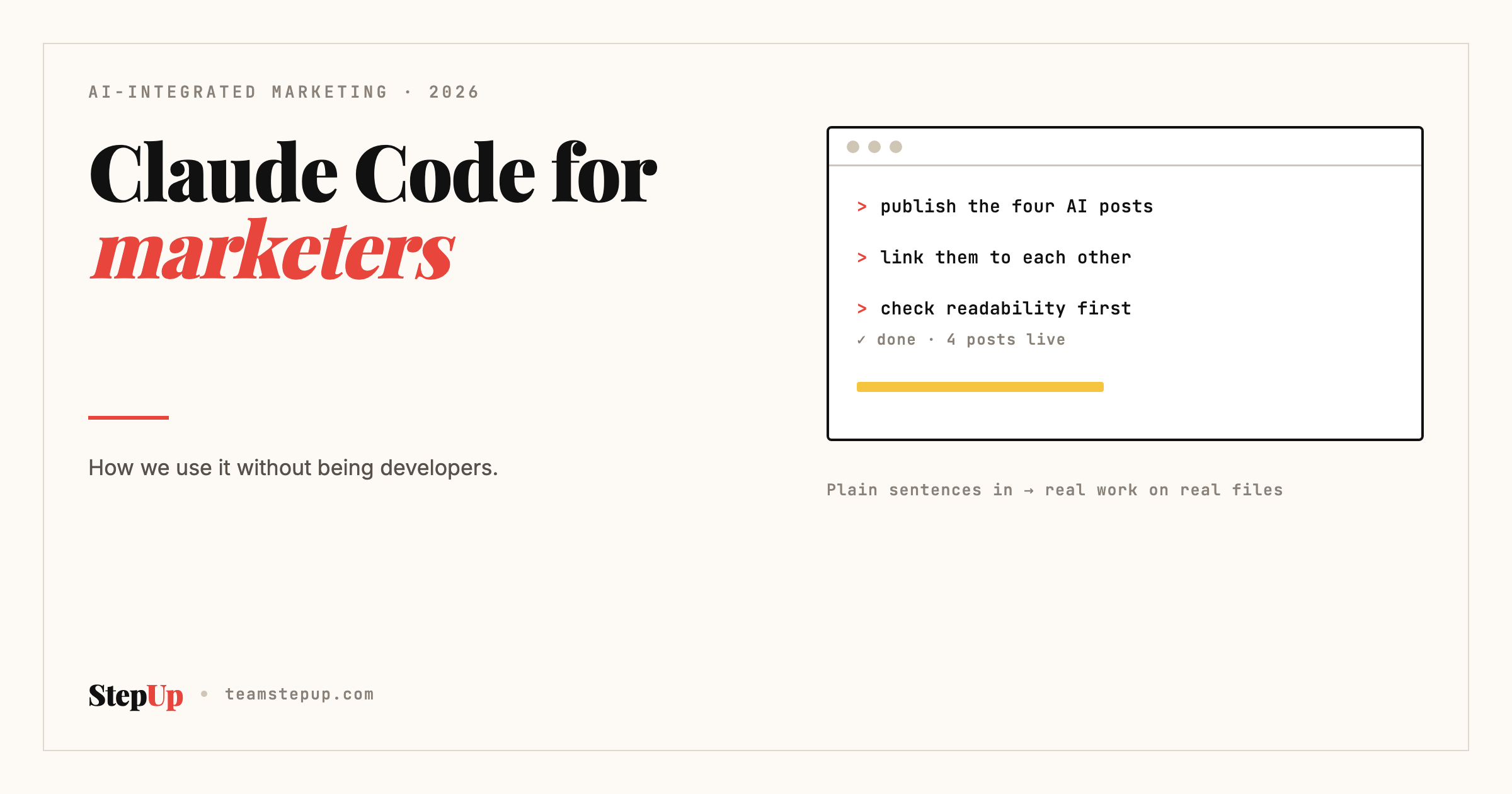
The name puts most marketers off. Claude Code sounds like something for software engineers, and at first glance it looks like one: a plain window where you type instructions instead of clicking buttons.
We are marketers, not engineers. We rebuilt our website with Claude Code, and it now runs our blog publishing, our search research and a good part of our weekly planning.
The skill it asks for turns out to be a marketing skill. It is the same one a good brief requires: knowing exactly what you want and saying it clearly. This article explains what Claude Code is, what we actually use it for, and how a marketer can start without learning to program.
What is Claude Code?
Claude Code is a version of Claude that works directly with the files and tools on your computer, rather than only in a chat window.
In ordinary Claude, you paste something in and get an answer back. In Claude Code, you point it at a folder, and it can read what is there, create and edit files, run tools, connect to services like your website or analytics, and carry out a task with many steps from start to finish.
So the practical difference is this. Chat is where you think and write. Claude Code is where work gets done across many files and systems at once.
You do not need to write code to use it. You describe the job in plain language. Claude Code works out the steps, shows you what it plans to do and asks before doing anything significant.
Why a marketer would use it
Much of marketing work is not writing. It is moving information between systems, checking things at scale and repeating the same steps across dozens of pages. That is exactly where chat tools run out of room and Claude Code keeps going.
A few examples of the difference:
Chat can improve one blog post. Claude Code can check eighty posts for missing descriptions and fix them.
Chat can explain how to read a Search Console report. Claude Code, by contrast, can pull the report, find the pages people see but do not click, and draft a fix for each.
Chat can draft a web page, while Claude Code can build it inside your site.
How we use Claude Code in our marketing
Rebuilding the website
Our website was rebuilt with Claude Code in four days, working inside WordPress rather than replacing it. Before any building started, we wrote down our positioning, audience and voice in detail. That document did more to protect the result than any technical decision. The full story is in how we built our website in 4 days with AI.
Publishing and refreshing blog posts
Our blog runs through a set of Claude Code tools. It converts a finished draft into web-ready format, checks readability against the rules our site uses, adds internal links, builds a cover image in our style and publishes the post. A person approves every draft before it goes live. The difference is that nobody spends an afternoon copying and pasting.
Search research
Claude Code pulls our Search Console and SEMrush data directly. It finds the searches we are close to ranking for, the pages Google shows but nobody clicks, and the pages that compete with each other. Then it drafts a recommendation for each. We decide which ones to act on.
Planning the week
Each week’s plan lives in a simple written file. Every time we open our work, Claude Code reads it first, so it knows what the week is for before we ask it anything. It also stops it from suggesting work nobody agreed to.
Morning briefings
A scheduled task reads the calendar each morning and emails a short brief with the day’s meetings and the week’s goals. It runs whether or not anyone has opened a computer.
What Claude Code does not do for you
It does not decide what matters. It will happily build a page nobody needs or optimize a post nobody reads. Priorities stay with people.
It does not know your market. Everything it knows about your company, it learns from what you write down. Without that, it produces competent, generic work.
It does not remove the need to check. It explains what it did and why, but a person should still look at the result, especially before anything goes live or reaches a customer.
How a marketer can start with Claude Code
Start with one folder. Put your brand files, your customer profile and your current plan in it. This is the information Claude Code will work from.
Pick one repetitive job. For example, checking all your blog posts for outdated years in the title, or pulling last month’s search numbers into a summary.
Describe the job in plain words. What you want, what good looks like and what it should not touch.
Read its plan before saying yes. Claude Code explains what it intends to do. That is your chance to correct it.
Check the result. Look at the output yourself the first few times, even if it looks right.
Write down what you learned. When it gets something wrong, add a rule to your files so it does not happen again.
If you have not set up Claude for writing yet, start there first. Claude for marketing covers Projects and brain files, and Claude skills for marketing explains how to save your methods for repeat jobs.
Frequently asked questions
Can marketers use Claude Code without coding?
Yes. You describe the task in plain language, and Claude Code works out the steps. It helps to be comfortable with folders and files, but you do not need to write code. The most useful skill is giving clear, specific instructions.
What is Claude Code used for in marketing?
Marketing teams use it for work that spans many files or systems: updating many blog posts at once, building or editing website pages, pulling data from tools like Search Console or SEMrush, preparing content for publishing and automating repeat reports.
What is the difference between Claude and Claude Code?
Claude in a chat window is best for thinking, writing and editing individual pieces. Claude Code works directly with files and tools, so it can carry out multi-step jobs, such as auditing eighty blog posts or publishing to a website.
Is Claude Code safe to use on a live website?
It asks before making significant changes and explains what it plans to do. Even so, it is sensible to back up anything you change, test on one page first, and check the live result yourself. We back up every page before changing it.
Do I need Claude Code, or is Claude chat enough?
For writing and editing, Claude chat with Projects is usually enough. Claude Code becomes worth it when your work involves many files, data from several tools or changes to your website.
The plain window still looks like it belongs to an engineer.
Ours mostly holds sentences like “publish the four AI posts together and link them to each other.”
A marketing manager pastes a request into an AI tool: “Write a LinkedIn post about our new service, in our brand voice.” The draft comes back polished and confident. It also sounds exactly like every other company in the industry.
The tool did nothing wrong. In fact, it simply had no idea what “our brand voice” meant. After all, nobody had told it, in writing, who the company is, who it talks to or how it sounds.
That is what brain files fix. They are the small set of written documents an AI reads before it does any work for you. If you get them right, AI drafts start sounding like your company. Skip them, and no tool or prompt will close the gap.
What are brain files?
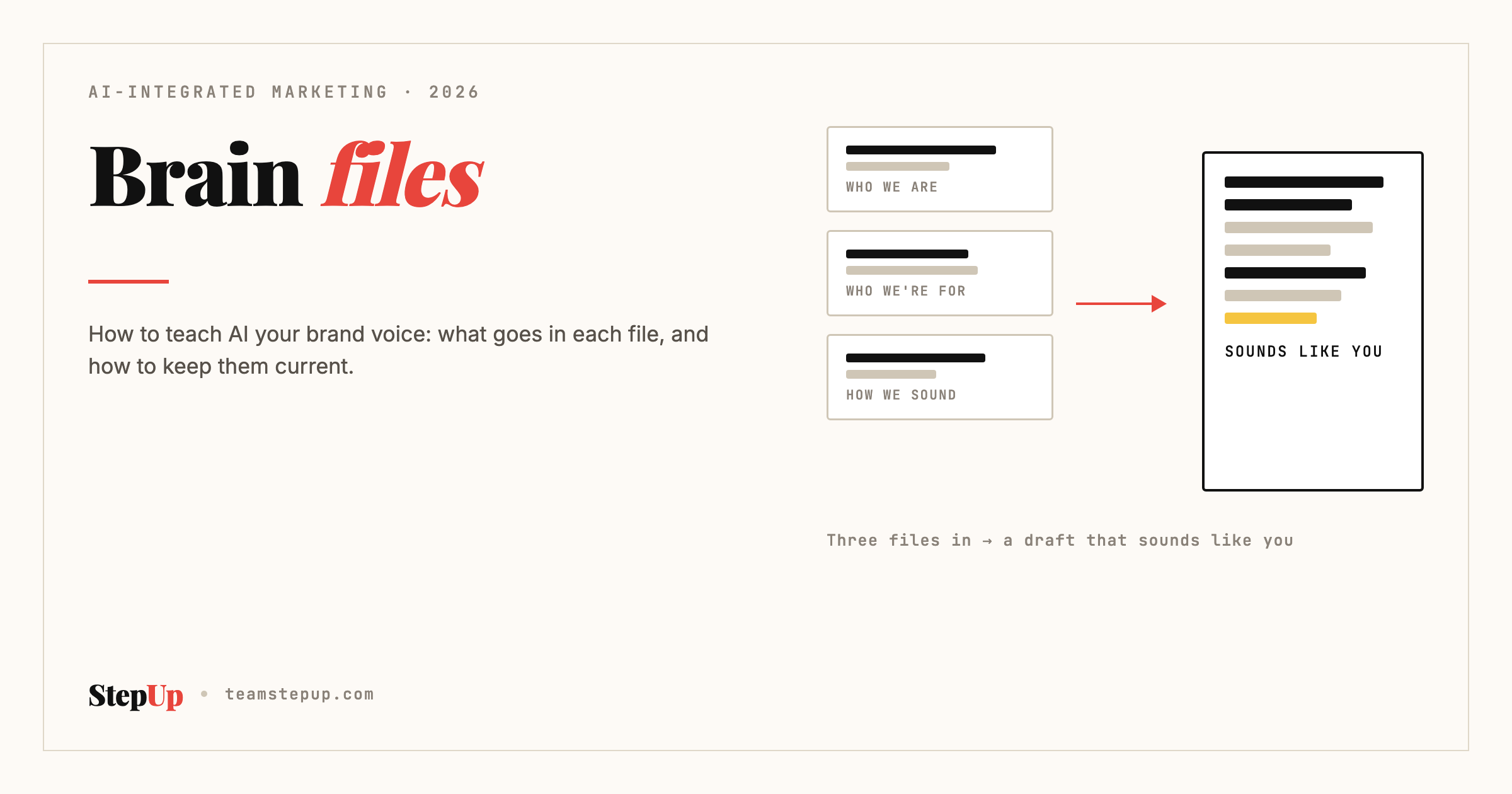
Brain files are short, plain documents that describe your company, your customer and your voice precisely enough for an AI to follow.
We use the term because, in effect, they work like a memory the AI does not otherwise have. Every time it writes, researches or plans for you, it reads them first. For that reason, they need to hold the decisions a new senior hire would need in their first week, written down rather than absorbed over months of meetings.
Most companies need three:
Who we are. What the company does, what it believes and what makes it different.
Who we are for. The customer, described in their own words.
How we sound. The voice rules, including the words you never use.
Why AI needs brain files to match your brand voice
People absorb a brand voice by being around it. They sit in meetings, read old campaigns and hear the founder talk. An AI does none of that. Instead, it only knows what you give it, and when you give it nothing, it falls back on the most common way of saying things.
That is why AI content so often sounds generic. The tool is doing its best with no information.
There is also a second, less obvious benefit. Writing brain files forces decisions most companies have left vague. Who exactly is the customer? What do we believe that competitors do not? What will we never say? For many teams, agreeing on these answers turns out to be the hardest part of using AI well.
Brain file 1: who we are
This file tells the AI what your company is and why it exists. Even so, keep it to a page or two.
What to include
What we do, in one or two sentences a buyer would understand.
The problem we are against. Every strong brand has an enemy, usually a common way of doing things that fails the customer.
What we believe that others in the market do not.
What makes us different, stated plainly and backed by something real.
The main message and the three or four themes that support it.
An example of the level of detail
Here is how our own file describes the problem we are against: without a clear marketing plan, tasks and scope spiral, teams fill their days with busy work, and leaders end up reacting to noise instead of driving strategy. That is specific enough, for example, for an AI to recognize when a draft is drifting away from it.
Brain file 2: who we are for
Similarly, this file describes your customer so precisely that the AI can write to one real person rather than to “B2B decision makers.”
What to include
Their role and company, including size and industry.
Their problem in their own words. Use phrases customers actually say on sales calls, not your marketing language.
What triggers them to look for help, such as a bad quarterly review or a competitor pulling ahead.
Who decides, and who else is involved.
Who you are not for. This matters as much as who you are for.
If you already have an ideal customer profile, however, start from it. Our guide on what an ICP is explains the difference between a customer profile and a buyer persona.
Brain file 3: how we sound
This is the file that most directly shapes brand voice. It turns a vague feeling about tone into rules a machine can follow.
What to include
Three words for how you sound, and three for how you never sound.
Sentence rules. Short or long, simple or layered, and how paragraphs should feel.
How to open and how to close. For example, open with a real problem, never with a question, and end with a thought rather than a pitch.
Words and phrases you never use. Be specific. A list of banned words does more than a paragraph about tone.
Spelling and punctuation rules, such as American spelling only.
Two or three real examples of writing that sounds right, taken from your best work.
The examples do a lot of the work, because an AI learns more from one good sample than from a page of adjectives.
Where to put your brain files
The files only help if the AI reads them every time. Therefore, how you set that up depends on the tool.
Claude Projects. Attach the files to a Project, and every conversation in it starts with them.
Claude Code. Keep them in the project folder, where they load automatically for each session.
Other AI tools. Most offer custom instructions or knowledge files. Put the most important rules in the instructions and attach the full files where possible.
Brain files are never finished. Instead, they should change whenever your company, your customer or your voice changes.
Still, the most useful habit is simple. When an AI draft is wrong in a way that keeps happening, do not just fix the draft. Instead, add a rule to the right brain file so it does not happen again. Over a few months, those small corrections turn a decent file into a precise one.
In addition, review all three files at least once a quarter. Remove anything that no longer applies, and check that everyone on the team is working from the same version.
A quick test for your brand voice files
First, give your files to an AI and ask for a short post on a topic you know well. Then ask yourself three questions.
Could a competitor publish this without changing a word?
Does it use any phrase you would never say?
Would your best customer recognize their own problem in it?
If the answer to the first two is yes, or the third is no, then the files need more detail. In particular, look for decisions they leave open.
Frequently asked questions
How do I teach AI my brand voice?
Write your voice down as rules and examples rather than adjectives. Describe how you sound and never sound, your sentence style, how you open and close, the words you never use, and include two or three real samples of your best writing. Then make sure the AI reads that file every time it writes for you.
What are brain files?
Brain files are short written documents that describe your company, your customer and your voice in enough detail for an AI to follow. The AI reads them before any task, so its work reflects your decisions instead of generic defaults.
Why does AI content sound generic?
Because the AI usually has no information about your company, customer or voice, so it falls back on the most common way of saying things. Giving it precise written context fixes most of the problem.
What should an AI brand voice guide include?
At minimum: words that describe your tone, words that describe what you never sound like, sentence and paragraph rules, how to open and close, a list of banned words and phrases, spelling rules, and real examples of writing that sounds right.
How long should brain files be?
Usually one to two pages each. Long enough to hold real decisions and examples, short enough that the most important rules are not buried. Precision matters more than length.
How often should I update brain files?
Add a rule whenever the same mistake shows up twice, and review all of them at least once a quarter, or whenever your positioning, customer or offer changes.
Next time that marketing manager asks for a LinkedIn post “in our brand voice,” the AI will know what the words mean.
Every marketing team has jobs it explains over and over. How to write a post in the company voice. What to check before a blog goes live. How to plan the week. The steps rarely change, yet someone still has to explain them again, to a new hire, to an agency or to an AI tool.
Claude skills solve that. A skill is a saved set of instructions that Claude loads whenever a task calls for it. In other words, you explain the job properly once, and Claude follows the same method every time.
We run a large part of our marketing on Claude, and skills are where much of the consistency comes from. Here is what they are, the five we use every week, and how to write your first one.
What are Claude skills?
A Claude skill is a small package of instructions, and sometimes supporting files or scripts, that teaches Claude how to do a specific task your way.
Think of it as the difference between briefing a freelancer from scratch every time and handing them your team’s written playbook. The playbook holds the steps, the standards, the examples and the mistakes to avoid. Claude reads it when the task comes up and follows it.
Skills work across Claude’s apps and in Claude Code. You can write your own, and many teams share them internally so everyone works from the same method.
Why skills matter for marketing
Marketing depends on consistency, however. The same voice across channels, the same standards on every blog post and the same process every week. That consistency usually lives in people’s heads, which is why it breaks when people are busy or new.
Skills, by contrast, move it out of heads and into writing. As a result, three things improve:
Quality stops depending on who asks. A junior marketer and a senior one get the same method.
Nobody re-explains the job. The instructions are written once and improved over time.
Mistakes get fixed once. When something goes wrong, you update the skill, and every future task benefits.
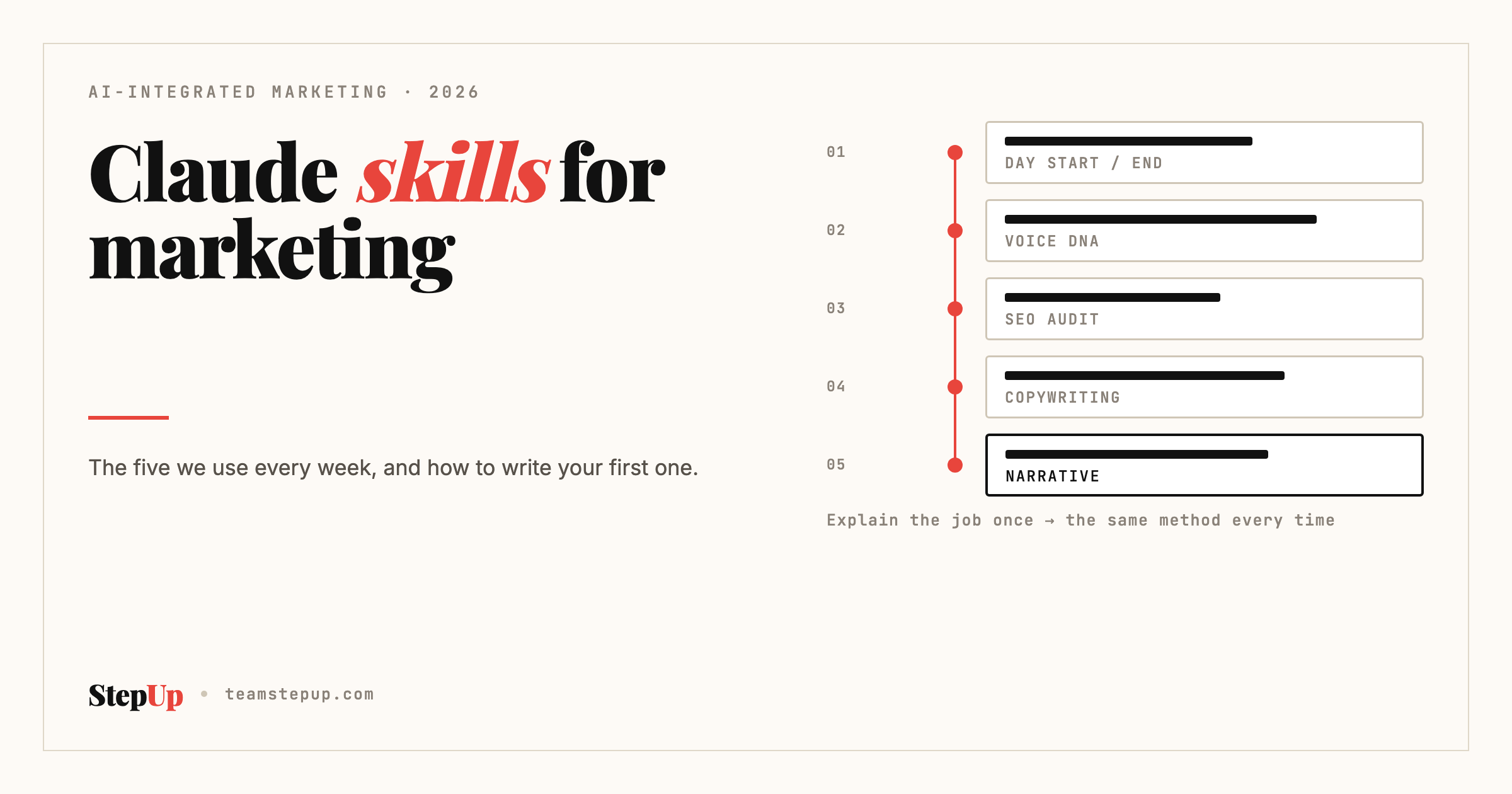
The 5 Claude skills we use every week
1. Day start and day end
These two run our daily planning. In the morning, the day start skill checks our quarterly goals, reads the calendar and new client email, and produces one short, prioritized list for the day. At the end of the day, the day end skill records what actually got done and what carries over.
The skill holds rules we learned the hard way. For example, one main priority and three supporting ones, each measurable, and never an invented task. Every item must come from the plan, the calendar, email or something a person actually said.
2. Voice DNA
This skill studies a set of writing samples and extracts the writer’s patterns: sentence length, how they open and close, the phrases they use and the ones they never would. The result is a written voice profile that Claude uses whenever it drafts in that person’s name.
We use it for our own LinkedIn and newsletter drafts. We also run it with clients during our workshops. The difference in the first draft is obvious. Without it, AI writes like the average of the internet. With it, the draft sounds close enough to edit rather than rewrite.
3. SEO audit
Before we refresh or publish a blog post, this skill checks it against a fixed list: the title and description, headings, internal links, readability and the questions people actually search. It returns a short list of fixes rather than a lecture.
Since the checklist lives in the skill, every post gets the same review, whether it is our first of the week or our tenth.
4. Copywriting
This one handles page copy: homepages, landing pages and service pages. It works from our brand files, so it starts from the customer’s problem, avoids the phrases we never use and ends with a question rather than a hard pitch.
It also pushes back, because a page that tries to say three things at once gets flagged before writing a word.
5. The narrative workshop
We run a structured workshop with clients to build their company narrative: the problem they solve, what they believe, who they are for and what they will never say. This work is split into a set of skills, one for each session, so every client goes through the same steps in the same order.
Finally, the skills turn the approved narrative into the written files the client’s own AI tools will work from. That handover is what makes the work last.
How to write your first Claude skill
To start, pick a task you explain more than once a month. Then write it down as if you were briefing a capable new team member.
Name the job and when to use it. One line on what the skill is for and what should trigger it.
Write the steps in order. Plain instructions, one step at a time.
Set the standard. What does good look like? Include one or two real examples.
List the traps. The mistakes people usually make, and what to do instead.
Add the rules that never change. Spelling, words to avoid, tone, anything non-negotiable.
Test it on real work. Run it three or four times and compare the results with your own.
Update it when it fails. Every correction goes into the skill, not into a one-off fix.
A good first skill is short, since you can always add to it once you see where it falls short.
Skills, Projects and brain files: how they fit together
These three are easy to confuse. So here is how we use each.
What
What it holds
When Claude uses it
Brain files
Who you are, who you sell to, how you sound
Almost always, as background
Projects
A workspace with standing instructions and files
For ongoing work, such as writing on-brand content
Skills
The method for one specific task
Whenever that task comes up
Brain files describe the company. Skills describe the work. Most teams need the brain files first, because a skill that follows a perfect method with the wrong picture of your company still produces the wrong result. We explain how to write them in brain files: how to teach AI your brand voice.
Claude skills for marketing are saved sets of instructions that teach Claude how to do a specific marketing task your way, such as planning the week, auditing a blog post or drafting in a particular voice. Claude loads the skill when the task comes up and follows the same method every time.
How do I create a Claude skill?
Choose a task you explain often. Write the steps in order, describe what good looks like with an example, list the common mistakes and add any rules that never change. Test it on real work and update it whenever the result falls short.
What is the difference between a Claude skill and a Project?
A Project is a workspace with standing instructions and files, useful for ongoing work like writing on-brand content. A skill is a method for one specific task that Claude can use whenever that task comes up.
Do I need to be technical to write Claude skills?
No. Most marketing skills are plain written instructions. If you can write a clear brief for a new team member, you can write a skill.
Which marketing tasks work best as Claude skills?
Tasks that repeat and follow a consistent method: weekly planning, content audits, SEO checks, drafting in a specific voice, repurposing content and structured workshops. Tasks that need fresh judgment every time benefit less.
The next new hire still gets the welcome lunch.
They just skip the afternoon where someone explains, for the fourth time this year, what to check before a blog goes live.
The word “agent” has been stretched to cover almost anything with AI in it. Chatbots, writing tools, email schedulers and full software platforms all claim it.
For a marketing leader, that makes a simple question surprisingly hard to answer. What does an AI agent actually do in a marketing team, and what does it need from the people around it?
We run a good part of our own marketing with AI agents. This is what they do well, where they fall short, and how to run them so the work is worth keeping.
What is an AI agent in marketing?
An AI agent is an AI system that carries out a task with several steps, using tools and information, rather than just answering a single question.
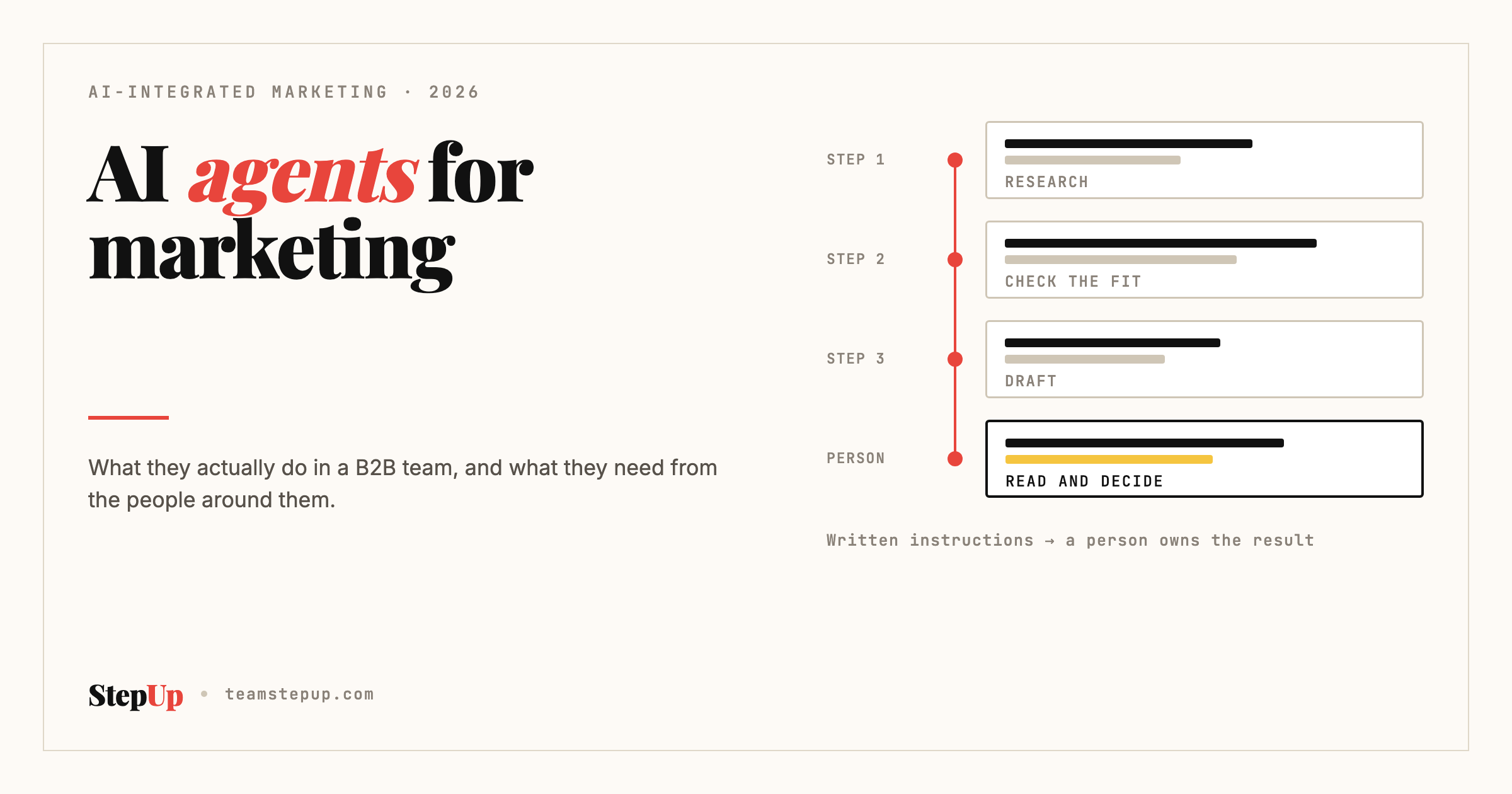
The difference is easiest to see side by side. Ask a chat tool to “write a LinkedIn post” and it writes one. Give an agent the job of “research these twenty companies, check which match our customer profile, and draft a first message for each,” and it works through the steps itself: searching, reading, comparing, deciding and drafting.
So in marketing, an agent is less like a writing tool and more like a very fast, very literal junior team member. It will do exactly what the instructions say, at a speed no person can match. That is both its strength and its risk.
What AI agents do well in a B2B marketing team
In our experience, agents earn their place on work with clear inputs and a clear standard. Here is where they do the most.
Account research
Agents can read company websites, news and public profiles, then summarize what matters: what the company does, recent changes and likely priorities. Research that took a person half a day now takes minutes.
Checking fit against your customer profile
Given a written customer profile, an agent can check a list of companies against it and flag the strong matches. This only works if the profile is precise. Our guide on how to create an ideal customer profile covers what “precise” means.
First drafts of outreach
Agents can draft a first message for each account, based on the research and your voice rules. A person reviews and approves before anything is sent. That review step is not optional, and we explain why below.
Content repurposing
One article can become a LinkedIn post, a newsletter section and a set of talking points for sales. Agents handle this reformatting well, especially when they work from written examples of your best work.
Reporting
Agents can pull numbers from several tools, compare them with last month and write a plain summary. The person reading it still needs to decide what the numbers mean.
Website and content maintenance
Checking old blog posts for outdated facts, missing descriptions, broken links or readability problems is exactly the kind of patient, repetitive work agents do well.
Where AI agents need a person
Agents are fast and tireless. They are not wise. These are the places a person has to stay involved.
Deciding what matters. An agent will optimize whatever it is pointed at, including work nobody needed. Choosing priorities is a human job.
Judging tone. A message can be accurate and still land badly with the person reading it. Anything that goes to a real prospect or client should be read by a person first.
Checking facts. Agents produce confident output whether or not it is right. Claims, numbers and names need checking before they go out.
Protecting the brand. Left alone, agents drift toward generic language. Written voice rules reduce this, but an editor still has to read the work.
Owning the result. When something goes wrong, the agent does not answer for it. A person does.
How to run AI agents so the work is worth keeping
The difference between agents that help and agents that create noise is almost never the technology. It is the setup around them.
Give every agent written instructions
Agents work from what you write down. That means a description of your company and what it believes, a precise customer profile and a set of voice rules. We call these brain files, and we explain how to write them in brain files: how to teach AI your brand voice.
Give every agent a human owner
Every agent needs one person who reads its output, corrects it and updates its instructions. Without an owner, nobody notices when the quality slips.
Fix the rule, not just the output
When an agent gets something wrong, the tempting fix is to correct that one piece of work. The better fix is to change the instruction that produced it, so the same mistake cannot happen again. Each correction takes minutes, and the whole system improves.
Start with one job
Pick the task that takes the most hours each week, set up one agent for it properly, and run it for a month before adding another. Spreading agents across everything at once is the fastest way to lose track of quality.
Keep a person between the agent and the outside world
Agents can draft, research and prepare. Sending, publishing and replying to real people should go through a human review, at least until you have months of evidence that a specific task is safe to automate fully.
What agentic marketing changes for the team
Agentic marketing, meaning marketing where agents carry out much of the production work, does not remove the need for a marketing team. It changes what the team does.
Fewer hours go into drafting, reformatting and research. More go into deciding, editing and maintaining the system the agents work from. In practice, three human jobs matter most: the person who owns the plan, the editor who judges quality and the operator who keeps the instructions current. We describe these in more detail in will marketing be replaced by AI.
AI agents in marketing are AI systems that carry out multi-step tasks, such as researching accounts, checking them against a customer profile and drafting outreach, rather than answering a single prompt. They work from written instructions and use tools and data to complete the job.
What can AI marketing agents do?
They handle work with clear inputs and standards well: account research, checking fit against a customer profile, first drafts of outreach and content, repurposing content across channels, reporting and website maintenance. They need people for priorities, tone, fact-checking and final approval.
What is agentic marketing?
Agentic marketing is an approach where AI agents carry out much of the production work in marketing, such as research, drafting and reporting, while people set direction, review quality and maintain the instructions the agents follow.
Will AI agents replace marketers?
They replace a large share of production tasks, not the people who decide strategy, judge quality and own results. Teams that use agents well usually shift their people toward those decisions rather than removing them.
How do you start using AI agents for marketing?
Write down your company description, customer profile and voice rules first. Then choose one task that takes the most hours each week, set up one agent for it, give it a human owner, and review its output for a month before expanding.
Are AI agents safe to use for customer-facing marketing?
They are safe when a person reviews their output before it reaches customers. Agents can produce confident but wrong or badly toned work, so sending, publishing and replying should stay under human review until a task has a long record of reliable results.
So the next time a vendor calls their email scheduler an agent, ask to see the instructions it runs on.
In the wild, wild west of AI, mastery is elusive and the playing field can feel like auditions at Barnum’s.
The best are engineer/hackers, free-wheeling their way through agentic stacks that cut down on busy work. The worst have automated the production of slop and contribute (as one worries they might) to the morass of mediocrity that’s taken down brand giants as well as high school English teachers.
It’s a rough time to be in marketing.
But truth is, many marketers need help. And that’s legit. Marketing was already the position to wear the most hats within an organization before the advent of tools that seem to have convinced our bosses that for a mere $20 tab we should improve our output by 85% and automate the chores. (Images of moms on the beach sipping cosmos float through my mind).
It’s a fantasy.
Truth is, AI is a hell of a tool, but learning it is a full-time job, and if you’re reading this, you probably already have a full-time job (or two).
You might want to consider hiring an AI marketing consultant to effectively integrate AI into your marketing and thus deliver on your boss’s dreams (and your cosmo-seaside fantasy).
This guide explains what an AI marketing consultant should actually do for a B2B company, when you need one, and how to tell the difference between help and noise.
What is an AI marketing consultant?
An AI marketing consultant helps a company decide where AI belongs in its marketing, sets it up so it produces work that is actually usable, and makes sure a person stays in charge of the results.
That definition has three parts, and a good consultant covers all three:
Deciding. Which marketing jobs should AI take over, which should stay human, and in what order.
Setting up. The written instructions, brand files, tools and workflows that make AI output consistent and on-brand.
Owning. Who reviews the output, who corrects it, and how the team measures whether any of it is working.
Most people who use the title only cover the middle part. They set up tools. That is useful. On its own, however, it tends to produce more content without better marketing.
What an AI marketing consultant is not
It helps to be clear about what you are not buying.
First, an AI marketing consultant is not a software vendor. If every recommendation leads back to one platform, you are in a sales process.
It is also not a prompt workshop. Training your team to write better prompts has value. However, prompts are the smallest part of the problem. Without a clear strategy and written brand rules, even perfect prompts produce generic work.
Finally, it is not a replacement for a marketing plan. If your company has not agreed on who it sells to and what it wants marketing to achieve, AI will not settle that. It will simply produce more material in the absence of a decision. We cover this in detail in AI marketing strategy.
When you need an AI marketing consultant
Not every company needs outside help with AI. Here are the situations where it usually pays off.
Your team is using AI, but nothing is consistent
Different people use different tools. As a result, some output sounds like the brand, but most does not. Nobody knows which prompts work. This is the most common situation, and it is very fixable with written rules and a shared setup.
You are being asked to cut marketing costs with AI
Leadership has heard that AI can replace part of the team. Before anyone is cut, someone needs to map what the team actually does and which parts AI can genuinely take over. After all, getting this wrong is expensive. We wrote about it in will marketing be replaced by AI.
You have no senior marketing leader
Many B2B companies with strong sales teams, for example, have little or no marketing leadership. For them, AI is an opportunity to run a capable marketing function with a small team. However, someone experienced still has to decide what the AI works on.
You tried AI and it produced generic content
In most cases, this means the AI had no real information about your company, your buyers or your voice. The fix is better inputs: written rules about who you are, who you sell to and how you sound.
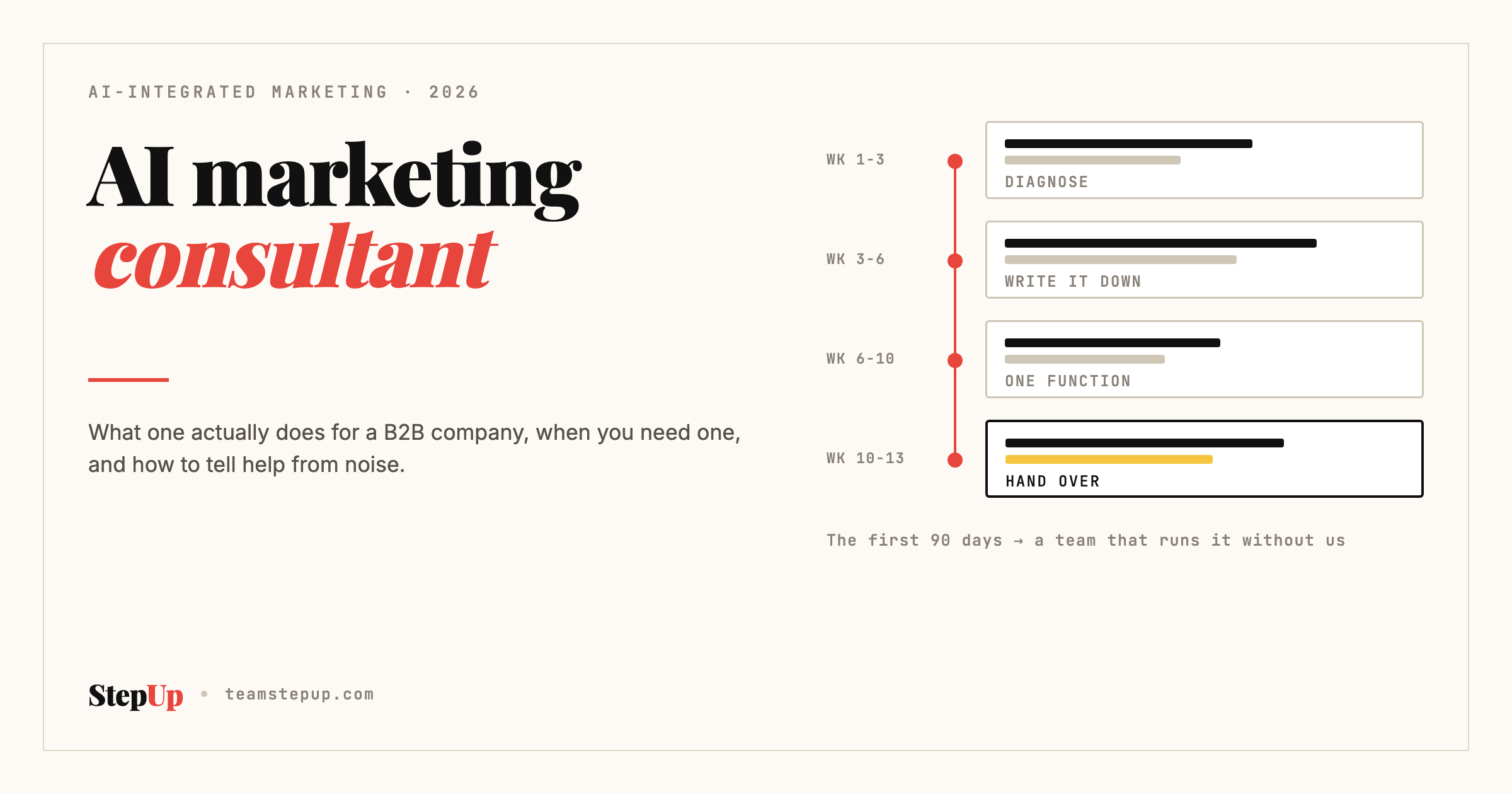
What a good AI marketing consultant does in the first 90 days
The work should follow a sensible order. Here is what to expect.
Weeks 1 to 3: diagnosis
To begin, a good consultant looks at the marketing itself. What are the goals? Who is the customer? What does the team spend its week on? What is working and what is not? Only then does the question of AI come up.
Weeks 3 to 6: the written foundation
Next comes the material AI needs to do good work: a clear description of the company and what it believes, a precise customer profile and a set of voice rules. We call these brain files. Most companies discover here that several important decisions were never actually made.
Weeks 6 to 10: the first function
A good consultant then picks one function to start with, often content, research or reporting, and sets it up properly. One owner, clear instructions and a routine for reviewing and correcting the output.
Weeks 10 to 13: measure and hand over
Finally, the team measures what changed against the goals set at the start. After that, the consultant hands over the system so the team can run it without them. If the plan depends on the consultant forever, that is a warning sign.
Questions to ask before hiring an AI marketing consultant
Ask these in the first conversation. The answers tell you a lot.
What would you look at before recommending any tool? A good answer covers goals, customers and the team’s work before it mentions a single product.
How do you make AI output sound like us? Listen for written brand and voice rules that the AI works from every time.
Who owns the AI once you leave? A good answer names a role inside your company and a routine for correcting it.
How will we know it worked? Look for measures tied to your business goals, such as qualified sales conversations or a shorter sales cycle.
Do you use this approach in your own marketing? Someone who runs their own marketing this way will describe it in specific detail.
Do you earn anything from the tools you recommend? Referral fees are not automatically bad, but you should know.
Warning signs
A few patterns suggest the help will not help.
Tool first. The first meeting is a platform demo, and nobody has asked about your business yet.
Volume promises. Promises of “triple the content” miss the point. More content is easy. Better marketing is the hard part.
No strategy work. Nobody asks who your customer is or what marketing is supposed to achieve.
Permanent dependence. The setup only works while the consultant stays involved.
No human in the loop. Any plan where AI publishes, emails or makes decisions without review is a risk to your brand.
AI marketing consultant vs. agency vs. in-house
Option
Best for
Watch out for
AI marketing consultant
Setting direction, building the system and training the team
Advice without execution, if you have nobody to run it
Marketing agency using AI
Producing campaigns and content at volume
Output that is fast but disconnected from your strategy
In-house hire
Long-term ownership of marketing
Hiring for AI skills without senior marketing judgment
In practice, many companies end up with a mix: a senior marketing leader, inside or outside, who owns the plan, supported by AI and a small team. The types of marketing professionals guide explains who does what.
How StepUp approaches it
We are a B2B marketing team, and we run our own marketing on AI first. We bring clients the same system: a written narrative, a clear plan in quarterly goals, brain files the AI works from, and a named owner for every tool. Then we hand it over so the team can run it.
If you want to see what that looks like in practice, Claude for marketing walks through how we use it day to day.
Frequently asked questions
What does an AI marketing consultant do?
An AI marketing consultant helps a company decide where AI fits in its marketing, sets up the instructions and tools so AI produces usable work, and makes sure a person reviews and owns the results. The best ones start with your marketing goals and customers, and choose tools last.
Do I need an AI marketing consultant?
You likely do if your team uses AI inconsistently, if leadership is asking marketing to cut costs with AI, if you have no senior marketing leader, or if your AI-generated content sounds generic. If your strategy is clear and your team already has a working setup, you may not.
How much does an AI marketing consultant cost?
Pricing varies widely, from hourly advice to monthly retainers. Rather than comparing rates alone, compare what you get at the end: a written strategy, a working system your team can run, and measures tied to your goals.
What is the difference between an AI marketing consultant and an AI marketing agency?
A consultant mainly helps you decide, set up and own how AI is used in your marketing. An agency mainly produces marketing for you, often using AI to do it faster. Some firms do both. The question is whether you need direction, production or both.
How long does it take to set up AI in a marketing team?
A sensible first phase takes about three months: diagnosis, the written foundation, one function set up properly, and measurement. Expanding to other functions comes after the first one works.
What should an AI marketing consultant deliver?
At minimum: a clear view of where AI fits in your marketing, written brand and voice rules the AI works from, one function running with a named owner, and measures tied to your business goals. You should be able to run it without them.
The $20 subscription can earn its keep. It just needs a written plan, a clear voice and one person whose job is to check its work.
The demo went well. The vendor showed the CEO an AI agent that wrote a blog post, three LinkedIn posts and a nurture email in the time it took to refill her coffee. Then came the slide she had been waiting for: Your content team, at a fraction of the cost.
She did the math on the way back to her office. Two content marketers, one coordinator, part of an agency retainer. The number was not small.
Then she did a second kind of math, and it did not add up. Because the content was never the hard part. The hard part was deciding what to say, to whom, and why anyone should care. Nobody in the demo had mentioned that.
That gap is the real answer to the question every B2B leader is now being asked by vendors, by boards, and by their own finance teams. Will marketing be replaced by AI?
The short answer
No. AI replaces tasks. It does not replace the decisions that make marketing work.
The tasks it replaces are real, and a lot of hours sit inside them. Drafting, research, reformatting, reporting and list building are all now faster by an order of magnitude.
The decisions it cannot make are the ones that were always scarce: what the company stands for, who it is for, what to stop doing, and whether a piece of work is good.
So the team does not disappear. It changes shape. Fewer hands on production. More weight on judgment.
Companies that cut the team first and add AI second usually end up with more content and less marketing.
A marketing team decides what AI does. Without that team, AI does whatever it was last asked to do, at scale.
What AI actually replaces in a marketing team
Start with the honest part, because the fear is not irrational.
A large share of what marketing teams do every week is production. First drafts. Resizing a post for four channels. Pulling last month’s numbers into a slide. Turning a webinar into a blog, a blog into an email, an email into three social posts. Researching a target account before a sales call. Building a list of companies that match a profile.
AI does all of that now, and it does it well enough that pretending otherwise is a waste of everyone’s time. In our own marketing, work that took a junior marketer a day now takes an agent minutes. The agents do not get bored, and they do not forget the brand guidelines on a Friday afternoon.
So yes, some roles built mostly around production are shrinking. For example, a coordinator whose week was 80% reformatting will find that week much shorter. Likewise, an agency billing by the hour for first drafts is in trouble, and most of them know it.
Still, notice what every item on that list has in common. Someone else decided what it was for.
What AI does not replace
AI is very good at producing an answer. However, it is not good at knowing which question matters.
It cannot decide your positioning. It will happily write positioning, and it will sound confident. But it has no stake in whether the market believes it, and it cannot sit in a sales call and hear the moment a prospect’s attention drops.
It cannot choose what to stop doing. Every marketing team is carrying work that should have been cut a year ago. Cutting it takes someone willing to own the consequence.
It also cannot tell good from average. This one surprises people. The output reads well, so it feels finished. Yet “reads well” is exactly what generic looks like now. When every competitor has the same tools, polished and forgettable becomes the default. Only someone who knows the market can see the difference.
Finally, it cannot own the result. When the quarter goes badly, the CEO does not ask the model what happened. She asks a person.
Why “fewer people plus AI” usually fails
The most common plan we see is simple. Cut the team, buy the tools, keep the output. On a spreadsheet, it works.
In practice, it tends to fail in a predictable way. AI does not fix broken marketing. It exposes it, and then it speeds it up.
If the company never agreed on who it sells to, AI now produces content for everyone, which means for no one. If the messaging was already inconsistent across sales and marketing, AI makes it inconsistent in six more places per week. Similarly, if nobody owned the plan before, nobody owns the agents now, and the agents do not ask.
The result is a strange kind of busy. More posts, more emails, more pages. Meanwhile, the pipeline looks exactly the same, and leadership trusts marketing a little less each quarter.
This is not a technology problem. It is the same problem most B2B marketing departments had before AI: no clear goals, no strong narrative, no system that connects the work to the business. AI just removes the delay that used to hide it.
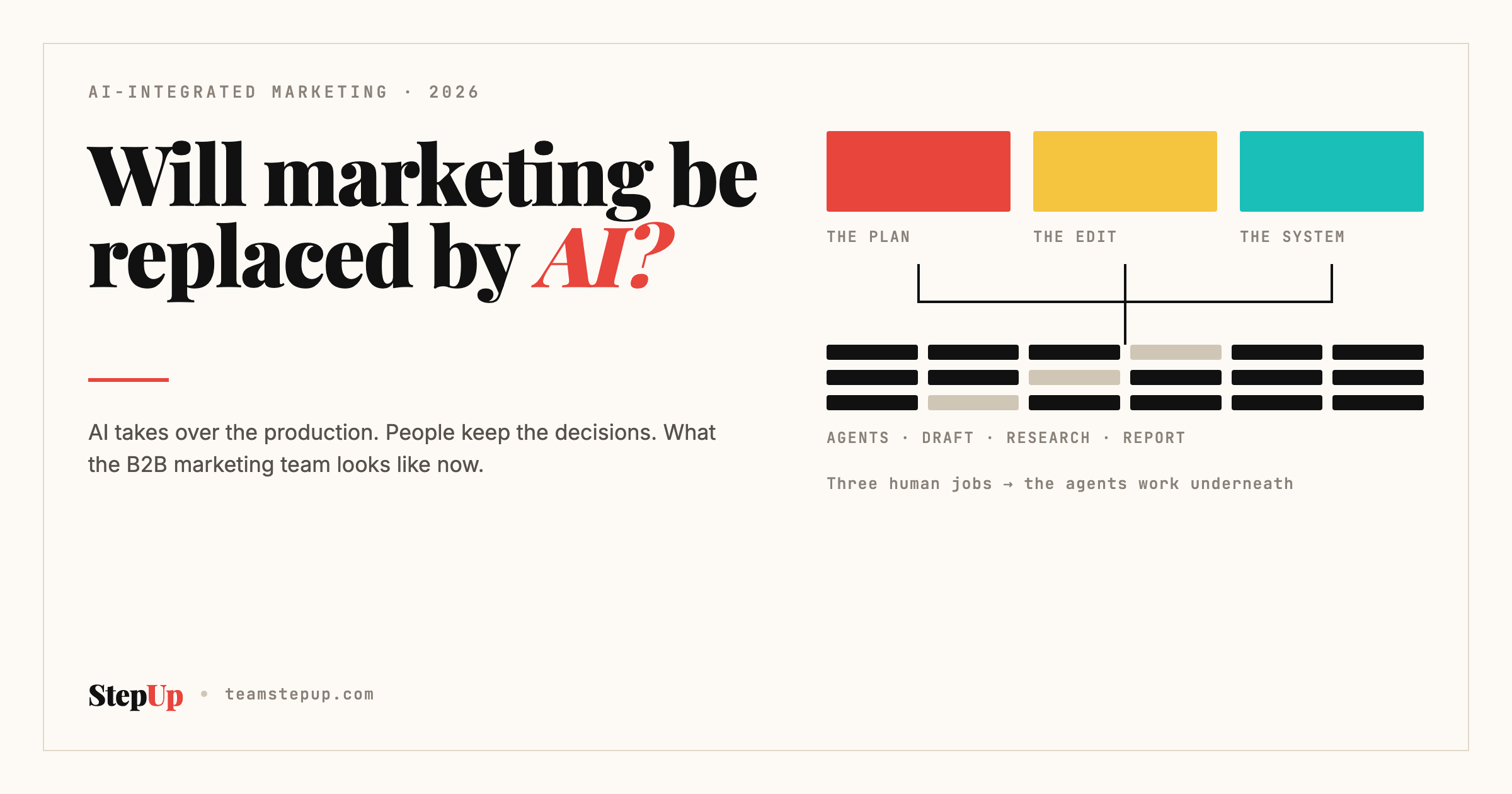
An AI-integrated marketing team is smaller in some places and deeper in others. The agents take the production. The people take everything that requires a point of view.
In our experience, it comes down to three human jobs.
The owner of the plan
One senior person who holds the goals, the narrative and the priorities. She decides what the team works on this quarter and, just as important, what it does not. She reports to leadership in language leadership understands. In a small company, this is often the only full-time marketing seat, and it should be the most experienced one.
The editor
Someone who reads what the agents produce and knows when it is wrong. Wrong does not only mean inaccurate. It also means off-brand, off-strategy, or technically correct and completely forgettable. The editor is the quality bar. Without one, the bar is whatever the model defaults to.
The operator of the system
Someone who maintains the instructions the agents work from: the brand file, the audience definitions, the writing rules, the examples of good and bad. When an output is wrong, she does not just fix the output. Instead, she fixes the rule that produced it, so the mistake does not come back.
In a lean team, one person may hold two of these jobs. What matters is that all three are held by someone.
The agents sit underneath. They draft, research, repurpose, report and build lists. They work fast, and they work from what the humans wrote down.
How we run our own marketing this way
We use this model on ourselves first, because we would not ask a client to trust a system we have not lived in.
Our marketing runs on Claude, with a set of written files every agent reads before it works. One describes who we are and what we believe. Another describes who we write for. Another holds the writing rules, down to the words we never use. Those files are the real asset. The model is replaceable. The thinking in the files is not.
When we rebuilt our website, the build took four days instead of the usual months. That was not because the AI designed a strategy. Rather, the strategy was already written down, so the AI had something precise to build from. We wrote up the whole process in how we built our website in 4 days with AI.
Our outbound works the same way. Agents find the companies, check them against our customer profile, and draft the messages. A person reviews and approves.
It is not flawless. When an agent gets something wrong, we do not just fix that one message. Instead, we fix the rule the agents read before every message, so the same mistake cannot come back.
Each correction takes minutes. Because the whole system learns from it, it keeps paying off. That is the difference between using AI and running a team with it.
What this means for headcount and budget
This is the question behind the question. So here is a direct answer.
Do not cut first. Before you remove anyone, write down what your marketing is supposed to achieve and what the team actually spends its week on. Most leaders find that half the week goes to work nobody would miss. That is the real saving, and AI is not required to find it.
Move budget from hours to systems. Money that used to pay for production time should now pay for the plan, the narrative and the written rules that make AI output worth using. Those are one-time builds that keep working.
Hire senior, not more. A team of juniors with AI produces a lot of average work very quickly. One experienced marketing leader with AI produces less, and it moves the business. If you can only afford one person, make it the owner of the plan.
Measure execution, not output. Output will go up no matter what, because that is what AI does. Therefore the useful question is whether the work matches the plan and whether the plan is moving the numbers leadership cares about.
For many companies with a small team, the realistic end state is one senior marketing leader, a partner for depth, and a set of agents doing the production. That is not a smaller marketing function. In most cases, it is a more capable one.
Where to start
If you are being asked to “do more with AI” this quarter, start here.
Write down the narrative. Who you are for, what you believe, and why a buyer should care. If this does not exist in writing, every AI output will be a guess.
Write down the plan. Three to five measurable goals for the quarter. Not activities. Outcomes.
Pick one function. Content, outbound research or reporting. Put AI to work on one, with one owner, before expanding.
Give every agent a human owner. Someone who reads the output, corrects it, and updates the rules when it is wrong.
Review the rules monthly. The agents are only as good as the instructions they read. Instructions age.
If you want a wider view of where AI fits across B2B marketing functions, our AI in B2B marketing playbook goes function by function.
Frequently asked questions
Will AI replace marketing jobs?
AI will replace some marketing tasks and shrink some roles, especially roles built mostly on production, like drafting, reformatting and reporting. It will not replace the people who decide strategy, positioning and priorities, or the people who can judge whether work is good. In fact, those roles become more valuable, because AI multiplies whatever direction they set.
Will digital marketers be replaced by AI?
Digital marketers whose work is mainly executing channel tasks will see much of that work automated. Digital marketers who understand the audience, the message and the numbers will use AI to do far more than before. The skill that matters now is directing and correcting AI, not competing with it on speed.
Can a small B2B company run its marketing with AI and no marketing team?
It can produce content with AI and no team. However, it will struggle to produce marketing that works, because no one is deciding what the content is for or checking whether it is good. The minimum viable setup is one experienced person who owns the plan, supported by AI and, where needed, an outside partner.
What is an AI marketing team?
An AI marketing team is a marketing team where AI agents handle production work, such as drafting, research, repurposing and reporting, while people handle strategy, judgment and quality. The people write the rules the agents follow and correct them when the output is wrong.
Which marketing roles are most affected by AI?
Roles centered on first drafts, content repurposing, basic reporting, list building and routine campaign setup are most affected. Roles centered on positioning, planning, editing, customer insight and leadership communication are least affected, and often grow.
What should a CEO do first when told AI can replace the marketing team?
Ask what the marketing team is supposed to achieve, and whether that is written down. If it is not, AI will not fix it. It will only produce more work in the absence of a plan. Write down the narrative and the plan first, then decide where AI takes over production.
The question was never whether AI can write the blog post. It can.
The question is who decides which blog post is worth writing. That job is still open, and it is still the most important one in marketing.
The keyword research behind this article took about fifteen minutes. Claude pulled close to 900 related searches from SEMrush, checked who ranks on Google for the main ones, and handed back a ranked list.
Deciding which of those searches deserved an article took longer. That part was ours.
That split is the most useful thing we can tell you about using Claude for marketing. It does the work at a speed that still surprises us. However, it does the work you point it at, and pointing it well is a marketing skill, not a technical one.
We are a B2B marketing team. Our website, our SEO, our content and a large part of our daily planning run on Claude. Here is how that works in practice, including the parts where we overrule it.
The short version
Claude is very good at marketing work that has clear inputs. Research, drafts, rewrites, audits, reporting, and anything that follows written rules.
It is only as good as what you tell it about your company. A few written files describing who you are, who you sell to and how you sound matter more than any prompt.
There are three ways to use it. Chat and Projects for writing and thinking. Claude Code for building and data work. Skills for tasks you repeat.
Keep a person in charge of judgment. Claude produces confident output whether or not it is right for your market.
Start with one job, not ten. Pick the task that eats the most hours and move it first.
What Claude is good at in marketing
Most marketing work is not creative in the romantic sense. Instead, it is structured work with a clear input and a clear standard. Claude is strong at exactly that.
In our own work, it handles:
Research. Keyword research, competitor pages, what currently ranks for a search and why.
First drafts. Blog posts, LinkedIn posts, emails and page copy, written against our brand files.
Rewrites and refreshes. Updating old blog posts, fixing outdated facts, tightening structure.
Audits. Checking a page for readability, broken links, missing descriptions, or spelling that slipped into British English.
Building. Our website theme, our publishing tools and the scripts that move a draft onto the site.
It is also patient in a way people are not. It will check 80 blog posts for a missing field without getting bored at post 40.
Still, notice the word in every item: clear. Where the input is vague, the output is vague, just faster.
The setup that matters more than any prompt
Most people start with prompts. We think that is backwards.
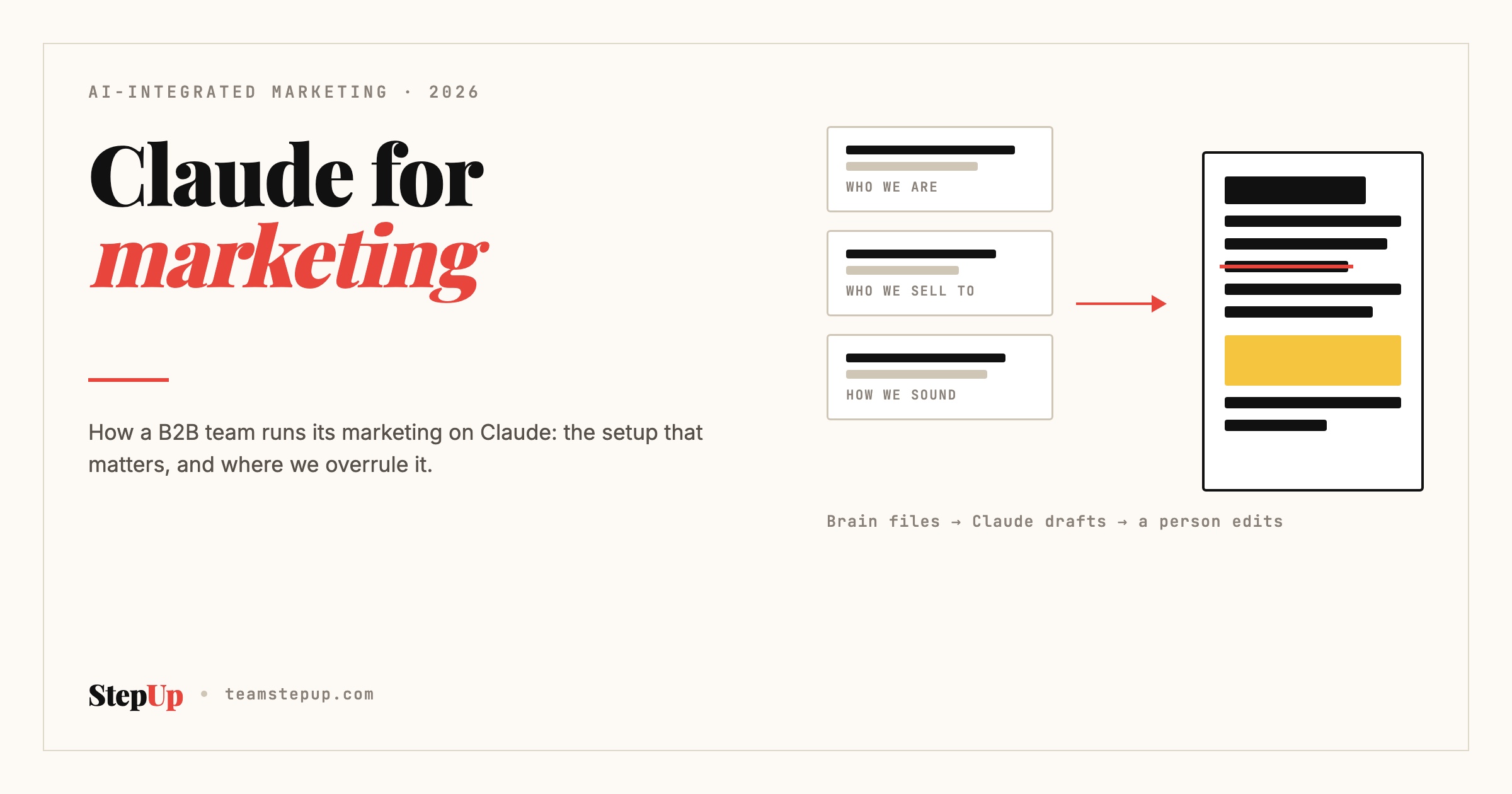
Before Claude writes anything for us, it reads a small set of written files. One describes who StepUp is and what we believe. Another describes who we write for, down to the job title and the problem they would describe in their own words. A third holds the voice rules: sentence length, the phrases we never use, American spelling only.
We call these brain files. In Claude, you can attach them to a Project so every conversation starts with them. In Claude Code, they sit in the project folder and load automatically.
The difference is obvious in the first draft. Without the files, Claude writes like the average of the internet. With them, it writes something we can edit rather than rewrite.
This is also where most teams get stuck. The files force you to decide things marketing has often left vague: who exactly the customer is, what you believe that competitors do not, what you will never say. Claude cannot make those decisions for you. Nevertheless, it will expose very quickly that nobody has made them.
Claude chat, Projects, Claude Code and skills: which one for what
Claude comes in a few forms, and the names confuse people. Here is how we use each one.
Tool
What it is
What we use it for
Claude chat
The regular Claude conversation
Quick questions, brainstorming, editing a single piece
Claude working directly with files and tools on a computer
The website, the SEO pipeline, keyword research, publishing
Skills
Saved, reusable instructions for a specific task
Repeat jobs, such as a daily plan or a set of workshop steps
Connectors
Links to tools like Google Drive, Gmail, HubSpot and Canva
Reading source material and working inside the tools we already use
You do not need all of them. Most marketing teams will get far with Projects alone.
Claude Code sounds technical, but it is not only for developers. We are marketers, not engineers, and we rebuilt our website with it in four days. The skill it requires is the same one a good marketing brief requires: knowing exactly what you want and saying it clearly. We wrote up that whole build in how we built our website in 4 days with AI.
How we use Claude across our marketing
Here is where it actually sits in our week.
SEO and the blog
Our blog runs through a set of Claude tools. Claude pulls keyword data from SEMrush, finds which of our pages compete with each other, drafts or refreshes the article against our brand files, and checks it against the readability rules our site uses. Then it prepares the page for publishing.
A person decides the topic, approves the draft and says when it goes live.
The website
Our site was rebuilt in Claude Code, working inside WordPress rather than replacing it. Before any code was written, we wrote the brain file. That file did more to protect the result than any technical choice.
Content and LinkedIn
LinkedIn posts start in a Project that holds the voice rules and examples of posts that worked. Claude drafts; we rewrite the opening, cut what does not sound like us, and post by hand.
Planning
Each week’s plan lives in a written file Claude reads before any session. As a result, it knows what this week is for before we ask it anything. It also stops it from suggesting work nobody agreed to.
Where we overrule Claude
Using Claude well means knowing where not to trust it. These are the places we overrule it most.
It sounds confident when it is wrong. A draft can read beautifully and still make a claim we cannot support. So every factual statement gets checked before publishing.
It drifts toward generic. Left alone, it reaches for familiar phrases and neat three-part lists. The brand files reduce this, but they do not remove it. An editor still has to read everything.
It cannot tell which work matters. It will happily optimize a page nobody visits. Choosing priorities is a human job, and it should stay one.
It misses tone. A message can be accurate and still land wrong with the person reading it. That is why anything going to a real prospect or client gets read by a person first. When the tone is off, we fix the rule behind it, not just the message.
None of this is a reason not to use Claude. Rather, it is the job description of the person who runs it. We wrote more about that shift in will marketing be replaced by AI.
How to start using Claude for marketing
If you are starting this month, this order works.
Write your brain files first. One page on who you are and what you believe. A second on who you sell to. A third on how you sound, including the words you never use. If you have a clear ICP, start there.
Create one Project and load the files into it. Every piece of writing starts there, not in a blank chat.
Move one job. Pick the task that takes the most hours each week, often first drafts or reporting.
Correct the rules, not just the output. When a draft is wrong, change the file that caused it. That way the fix applies to every future draft.
Expand only when the first job is working. Then consider Claude Code for anything involving files, data or your website.
Before any of this, it helps to know what your marketing is supposed to achieve. Our AI marketing strategy article covers that part. For a wider view of AI across B2B marketing functions, see our AI in B2B marketing playbook.
Frequently asked questions
Is Claude good for marketing?
Yes, for work with clear inputs and standards: research, first drafts, rewrites, audits and reporting. It is especially strong at following long written instructions, such as a brand voice guide. It is weaker at judgment, like deciding which idea is worth pursuing, which is why a person should stay in charge of priorities.
How do I use Claude for marketing?
Start by writing a few short files about your company, your customer and your voice. Then load them into a Claude Project so every conversation begins with that context. From there, move one repeated task, such as first drafts, into Claude and review the results before expanding.
Is Claude better than ChatGPT for marketing?
Both are capable. We chose Claude because it handles long documents well and follows detailed written rules consistently, which matters when every draft has to match a brand voice. In practice, the setup matters more than the model. A well-briefed tool beats a better tool with no context.
What are Claude skills for marketing?
Skills are saved sets of instructions Claude can use for a specific, repeated task. For example, a skill could hold the steps for writing a weekly plan or running a content audit. They save you from re-explaining the same process every time.
Do marketers need Claude Code?
Not to start. Projects cover most writing work. Claude Code becomes useful when your work involves many files, data or your website, such as bulk-updating blog posts or pulling keyword data. It does not require being a developer, but it does require clear instructions.
Can Claude replace a marketing team?
No. It replaces a large share of production work, but it cannot decide positioning, set priorities or judge whether work is good for your market. Teams that use it well tend to shift people toward those decisions rather than remove them.
We did not get better at marketing by using Claude. We got faster at the parts we already knew how to do.
The parts we did not know how to do, it simply showed us sooner.
Most marketing problems inside a company are relationship problems wearing a job title.
A CEO briefs a brand strategist the way she’d brief a designer, and gets a logo when she needed a position. Likewise, a VP Product treats the product marketer as a copywriter with a launch calendar. Someone senior is hired to build a department and spends eight months receiving tasks, then leaves. Yet nobody in any of those stories is bad at their job. The wiring is wrong.
This guide is about the wiring. For every kind of marketing professional: what they own, how you should work with them if you’re the CEO, how you should work with them if you’re a peer running sales or product, and whether they belong inside your company or outside it.
What job titles hide
Two people can hold the same title and be doing entirely different jobs. The thing that separates them isn’t years, and it isn’t the org chart. It’s how far their decisions reach.
Specialists own a craft. The question they answer best is how. How do we get this page ranking. How do we cut cost per lead in half. Hand them a clear problem and a real standard, and they will beat anyone in the building at that one thing.
Function owners own an outcome. The question they answer best is what, and by when. What produces pipeline next quarter. What this launch needs to land. They direct specialists, run a budget line, and answer for a result — inside a scope that stops at the edge of their function.
By comparison, department builders own the system everything else runs inside. The question they answer best is why this and not that. What marketing is for. What it measures. Who gets hired, in what order. What the company stops doing. Every company has exactly one of these, and if nobody was hired for it, it’s the CEO, doing it in the margins of another job.
Where the three get mixed up
Almost every leadership-level frustration with marketing is one of these three mismatched. A function owner promoted into a builder’s seat, still executing because that’s what they know. Or a builder hired to run a channel, restless by month four and gone by month twelve. A specialist handed a strategy question they were never equipped to answer, giving a confident answer anyway because somebody had to.
It shows up in the numbers. The average Fortune 500 CMO lasts 4.3 years, against 4.9 for the C-suite as a whole. Indeed, marketing is the seat that turns over fastest, and being wired in at the wrong altitude is a large part of why.
Altitude doesn’t cost you depth
There’s a lazy version of this map where the people at the top are pure orchestrators — fluent in meetings, no craft left, forwarding the real questions to the real practitioners. That version describes a specific kind of failed executive. It does not, however, describe the job.
Altitude is what depth becomes when you’ve accumulated enough of it. After all, nobody arrives at the top of marketing as a generalist. Instead, they arrive as a writer, or a demand gen lead, or a brand strategist, or the person who rebuilt the attribution model — and then they kept going and added the rest. Fifteen years in, a good one has two or three disciplines they can still personally out-execute their own team in, and enough working knowledge of the others to know within ten minutes when they’re being sold something.
Ultimately, that accumulation is the whole reason their judgment is worth anything. By contrast, breadth on its own produces an administrator who can’t tell good work from expensive work. Depth on its own, meanwhile, produces someone who over-funds their own specialty and starves everything else. The combination — real range, real depth, real scars — is what you’re actually buying at the top of a marketing organization, and it takes a long time to make.
Message, brand and voice don’t get delegated
Here’s the mis-wiring that costs companies the most: treating positioning, messaging, brand and tone as craft work to hand off.
They aren’t deliverables. Instead, they’re the system itself — the thing every campaign, page, deck and sales call derives from. Instead, the person who owns the marketing system owns them, full stop. A CMO who has outsourced what the company sounds like has outsourced their actual job, and you’ll see the result within two quarters as every channel starts saying something slightly different.
Of course, senior people absolutely bring in help. A brand strategist for a repositioning. Or a researcher for the customer language. A naming specialist, a voice writer, an analyst to pressure-test a claim. But that’s a consult, the way a surgeon consults a radiologist — the input sharpens a decision that stays firmly with the person accountable for it. And often enough the CMO is the specialist in the room, because brand or messaging or measurement is one of the deep areas they came up through. Naturally, being able to do the work yourself doesn’t oblige you to do all of it. Rather, it’s what lets you direct it.
Trust the judgment. Ask for the defense.
Still, trusting a senior person is not the same as taking their word for it. The test is whether they can defend any choice they’ve made, on the spot, in two registers:
Pattern. “I’ve watched this fail at three companies and it fails the same way each time — here’s the shape of it.” That’s fifteen years of watching things break, compressed into a call you get to make in thirty seconds instead of eighteen months.
Proof. “Here’s the evidence behind it. Here’s what I’d expect to see by March. And here’s the number that would tell us I’m wrong.”
Either one alone should worry you. All pattern and no proof is instinct with a résumé attached. Conversely, all proof and no pattern is somebody reading you a dashboard. Proof and pattern combined? They’re the thing you can’t hire cheaply, and the thing that makes it safe to stop worrying, second-guessing and supervising.
One more marker: a genuinely senior person will change their position when the evidence turns, and they’ll and say so out loud. That’s the system working, and a confident leader showcasing their expertise. What should worry you is the leader who sticks to their guns despite evidence and who can’t articulate why they’re doing so.
Worth sitting with: if you find yourself second-guessing your marketing lead’s subject lines and colour choices, one of two things is true. You hired the wrong person, or you’re spending your time at the wrong altitude.
Five ways to work with someone
Once you’ve hired the right person, you’ve got to understand your relationship and execute your leadership properly. The wrong relationship can send departments spiraling. Figure out what the appropriate dynamic is and stick with it. And be thoughtful. If you pick the wrong mode you could paralyze or undermine even the most senior leaders.
Partner. You bring the business problem. They bring the answer. You argue it out and decide together. This is for department builders — anyone you’d want contradicting you in front of the board.
Direct. You agree the outcome and the deadline. They pick the method. You review results, not steps. This is how you work with function owners.
Brief. Then you supply context, audience and the standard for good. They produce. You respond to the work. This is how you work with specialists.
Commission. You buy defined work against a written spec. Deliverable in, deliverable out. Most outside vendors.
Route. You don’t manage them directly at all. You go to whoever owns their function. This one applies whenever a CEO is tempted to Slack a specialist, which is most weeks.
Pro Tip for CEOs on the “route” method. When a CEO briefs a specialist directly, the specialist always says yes — you’re the CEO, no one wants to say no to you. The work gets done, great, but then their actual manager finds out afterwards. This can undermine authority and disrupt workflows. Try to avoid this. If you really want something fast, ask the function owner for it fast.
Inside or outside — ask this last
Knowledge, altitude and function come first. Get those wrong and where the person sits is irrelevant.
Once they’re right, here’s what changes. Inside buys context and continuity: someone who knows how your company argues, what you mean when you say “premium,” which customer stories are safe to tell. They also carry political weight, which decides everything cross-functional. Outside buys range and candor: someone who has watched thirty companies solve this, who starts faster, and who can say the uncomfortable thing because their salary doesn’t depend on the answer. More per hour, less per year.
The rule that holds up: buy craft outside, build judgment inside. Specialist execution outsources beautifully. Anything that needs deep knowledge of your company — narrative, positioning, hiring, what to kill — belongs inside, or in a fractional arrangement designed to leave the system behind if it ends.
The roles
Chief Marketing Officer
Altitude: Department builder If you’re the CEO:Partner. Your peer, not a report with extra steps. If you’re a peer VP:Partner. Align quarterly on plans. Don’t hand them work. Where they sit: Inside. Fractional if you prefer not to fund the full-time seat.
The CMO builds marketing as a system, holds the company’s message, and answers for both to the rest of the executive team.
They own the narrative — one documented answer to what the company is, who it’s for, and why it wins, that everything downstream derives from. The department design is theirs too: which roles exist, in what order, what’s in-house, what’s bought, what’s automated. They also own measurement, which mostly means deciding what to stop measuring. So is the operating rhythm — quarterly objectives, weekly check-ins, and a straight answer every Monday to whether the needle moved. Similarly, they own the budget and the trade-offs that fund it. And they translate marketing into language a CFO makes decisions with, and company strategy back into direction the team can act on.
And they own AI at the system level. Not which tools to buy — which parts of the engine AI runs, what standard its output is held to, who reviews it, and how the whole thing stays coherent while producing several times as much.
What a CMO needs from you
The real business problem and the real constraints. Revenue targets, cash position, where the board is nervous, what you’re afraid of. Do not give them a task list. Give a department builder a task list and you’ve bought a very expensive project manager.
VP Marketing
Altitude: Builder in a small company, function owner in a large one If you’re the CEO:Direct, moving toward partner as trust builds. Where they sit: Inside.
A VP Marketing runs the team and hits the plan. A CMO, by contrast, writes the plan, holds the narrative, and sits where company strategy gets decided. At thirty people that’s one person wearing both. At three hundred, though, it rarely is. If you’re recruiting a “VP Marketing” and expecting them to define what the company stands for, you’re recruiting a CMO and underpaying for it.
Fractional CMO
Altitude: Department builder If you’re the CEO:Partner, on a clock. Where they sit: Outside, deliberately.
The same altitude as an internal CMO, bought part-time, for when the company needs the architecture — narrative, structure, metrics, hiring plan and leadership, but runs lean, agile or remote.
Product Marketing Manager
Altitude: Function owner If you’re the CEO or CMO:Direct or Brief. Agree the launch outcome, determine the working relationship on a case-by-case basis. If you’re a VP:Direct. This is your closest counterpart in marketing, trust their judgement so long as the plans are signed off by the CMO. Where they sit: Inside. Notably, the role runs on product and customer knowledge that takes months to build, they’re a great counterpart to a Fractional CMO for this reason.
(PMMs are chronically undervalued. A strong PMM is often the only person in the building who can describe the product in the customer’s own words, and the difference between a launch with one and a launch without one is visible from across the company).
Where the confusion starts
The PMM works with product, sales, content, demand gen and support, so from outside the role looks like leadership. It isn’t the same thing. The scope is a product, a launch calendar and a sales team to equip — inside a roadmap someone else sets and a company narrative someone else holds. Coordinating across teams and being accountable for the system are different jobs, and conflating them is how companies end up with a very good manager in a seat that needed a builder.
The clean test: ask about the company narrative. A product marketer will describe messaging for their product, well. A department builder will describe the story the whole company tells, and then show you where the product messaging hangs off it.
What they need from you: roadmap visibility, direct access to customers, and a settled company narrative to work inside. Ask a PMM to invent that narrative between launches and you’ll get positioning for a product, applied to a company. It’s the single most common reason, therefore, that a company’s message reads like a feature list.
PMM vs Product Manager: the PM owns what gets built. Meanwhile, the PMM owns how it’s explained, launched and sold. (A distinction necessary only for very large companies).
Brand strategist
Altitude: Function owner, working under the marketing lead’s ownership of the message If you’re the CEO or CMO:Partner during a repositioning, brief for execution — and route the final call through whoever owns your narrative. Where they sit: Fractional or outside for the strategic sprint, outside for execution. Some CMOs are also brand strategists.
A brand strategist works on what the company means to people who aren’t buying today: the positioning story, the identity, the voice, the consistency of it everywhere.
Note the altitude carefully, because this is where companies most often mis-wire. Bringing in a brand strategist doesn’t transfer ownership of the message — it buys concentrated expertise for a decision your marketing lead still owns and still has to defend. In plenty of companies the CMO is the stronger brand thinker of the two and hires the specialist for execution horsepower and an outside read. Both arrangements work. What doesn’t work is a brand project that runs around the person accountable for the narrative, which produces a beautiful deck nobody’s marketing actually uses.
Brand is also the hardest discipline to prove on a quarterly cycle, which is why it’s cut first and missed longest. Nevertheless, good brand people tie it to commercial reality without pretending the attribution is cleaner than it is. Be wary of certainty here, and equally wary of anyone who uses the difficulty as an excuse to avoid numbers altogether.
Demand generation manager
Altitude: Function owner If you’re the CEO or CMO:Direct. Agree the pipeline number and the budget. Leave the channel mix alone. If you’re the VP Sales:Partner. You two either agree on what a good lead is, or you blame each other indefinitely. Where they sit: Inside, with outside execution help.
Owns the programs that produce qualified pipeline: campaigns, paid channels, webinars, nurture, scoring, and the handoff to sales. Answers for pipeline volume, quality and cost.
The classic failure is a demand gen lead optimising toward a target sales can’t actually work. That’s almost never their fault — it happens when nobody above them reconciled the pipeline number with the capacity to follow it up.
Altitude: Specialist, sometimes function owner If you’re the CEO or CMO:Direct — and protect their right to run experiments that fail. Where they sit: Inside. The work needs product access.
Experiment-driven, working across acquisition, activation and retention rather than one channel. Heavy on analytics and product-adjacent work: onboarding, funnels, in-product prompts. Most at home where the product itself is a channel.
In long-cycle B2B, “growth marketer” is frequently demand gen with a newer title. So it’s worth checking which one you’re getting before you build a team around it.
Performance / paid media marketer
Altitude: Specialist If you’re the CEO:Route. Go through demand gen or CMO. CEOs in ad accounts is a well-documented way to burn money. Where they sit: Outside, usually. Platform depth is a craft, and an agency sees more accounts in a month than you will in a decade.
Owns paid channels and their economics: cost per acquisition, spend efficiency, channel mix. Deeply technical inside the platforms, and genuinely fast when the inputs are right.
Their results depend entirely on someone else having defined the audience and the message correctly. So when paid performance disappoints, look hard at the positioning before you replace the person.
Content marketer
Altitude: Specialist, rising to function owner when they own the architecture If you’re the CEO:Brief or Route. Your thinking is the scarce input here. Your edits aren’t. Where they sit: Strategy inside, production outside. The cleanest split in marketing.
At specialist level: writes and publishes. At function-owner level: owns a content architecture where every piece maps to a buyer question and a business objective — and can tell you why something shouldn’t be written at all.
What they need from you: thirty minutes of your real thinking, not a review cycle. Executives who give content people access to their genuine opinions get content worth reading. By contrast, executives who only give edits get bland work, and then complain about it.
SEO specialist
Altitude: Specialist If you’re the CEO:Route, through content or marketing leadership. Where they sit: Outside, or one person inside directing outside execution.
Owns organic visibility: technical health, site structure, keyword and topic strategy, internal linking, and increasingly whether AI answer engines cite you at all. Distinct from content marketing, and both fail badly when they operate separately.
Lifecycle / CRM marketer
Altitude: Specialist to function owner If you’re the CEO:Direct if retention is a live problem. Otherwise route. Where they sit: Inside. They live in your customer data.
Owns everything after the first touch: onboarding, nurture, retention, reactivation, and the segmentation underneath it all. Usually knows the CRM better than anyone else and is the only person who can explain why the data looks the way it does.
Marketing operations
Altitude: Function owner, load-bearing If you’re the CEO:Direct — and take their objections seriously. When MOps says the data won’t support the report you want, they’re right. Where they sit: Inside. Implementation projects outside. Often the CMO is wearing this hat as well especially in smaller B2Bs.
Owns the plumbing: tech stack, data hygiene, lead routing, attribution, reporting infrastructure, integrations. Invisible until it’s missing, at which point every dashboard disagrees and nobody can say what produced pipeline.
Pro Tip: Any marketing leader who can’t hold a real conversation with their MOps person will eventually present numbers that don’t make sense.
Field marketer and partner marketer
Altitude: Function owner If you’re the CEO:Direct. Expect to see them at customer events beside you. If you’re the VP Sales:Partner. Field marketing is closer to your team than to marketing’s. Where they sit: Inside, regionally. Event logistics outside.
Field marketing owns regional and in-person programs: events, roadshows, local campaigns, tight alignment with regional sales. Partner marketing owns co-marketing with resellers, integration partners and alliances. Both are relationship businesses, and both are undervalued in enterprise selling.
Communications and PR
Altitude: Specialist to function owner If you’re the CEO:Partner in a crisis, brief the rest of the time. Where they sit: Outside for reach and media relationships. Inside once you need someone reachable in ten minutes.
Owns earned attention: press, analysts, executive visibility, and what happens on the bad day. A different muscle from demand generation, a slower clock, and usually a different personality in the room.
Marketing analyst
Altitude: Specialist If you’re the CEO:Brief — and ask for the answer you don’t want. Where they sit: Inside, or shared with the wider data team.
Owns measurement itself: models, dashboards, and the uncomfortable conclusions. Folded into MOps in small teams; separating the two is what ends attribution arguments.
Where AI sits in all of this
The common assumption is that AI eats this map from the bottom — specialists get automated, everything above carries on unchanged. The first half is partly true. The second half, however, is wrong, and it’s the half that determines how you should organise.
What AI really changes is the ratio between producing and judging. Drafts, variants, reports, first-pass analysis: nearly free now. Deciding what should exist, what standard it’s held to, and what to do when it’s wrong: exactly as hard as it ever was, and now the bottleneck.
The adoption question is settled. McKinsey’s 2025 survey puts organisational AI use at 88%, up ten points in a year, with marketing and sales the function where generative AI is used most. Everyone has the tools. That was never the hard part.
Why strong managers make strong AI managers
Which leads somewhere people find counterintuitive. The strongest people managers turn out to be the strongest AI managers. It’s the same skill set, close to line for line.
Managing a capable person well means writing a brief that survives contact with reality. Giving context instead of instructions. Defining what good looks like before the work starts. Reviewing against that standard rather than your mood that afternoon. Recognising a confident answer that’s wrong — which you can only do in a discipline you actually know. Building a loop so the same mistake doesn’t reappear next month.
Every one of those is what running AI systems well requires. And notice the one in the middle: catching the plausible wrong answer takes real depth in the subject. This is where the accumulated expertise of a senior marketer stops being a nice-to-have. AI produces work that looks right. Only someone who has done the work can tell you it isn’t.
The inverse, meanwhile, is easier to watch happen. Managers who never learned to delegate — who hand over tasks with no context, accept work because it’s polished, and can’t articulate a standard — get exactly the result from AI they always got from people. Fast output, wrong direction, and a growing pile of rework nobody owns.
AI integration is a leadership question, not a procurement one
So AI integration is a leadership question, not a procurement one. Anyone can buy the tools, and most companies already have. What decides whether it works is which parts of the system AI runs, what the review standard is, who owns the output when it’s wrong, and how the whole thing stays coherent while producing three times the volume. Those are the same decisions a department builder makes about people, applied to a faster and considerably more literal kind of worker.
Three questions that show you someone’s altitude in ten minutes
“What did you kill, and how did you decide?” Builders have a list, and the cost of each one. Function owners have one example inside their own scope. Specialists have none, because killing things was never theirs to do.
“Show me how your metrics connect.” Ask for the line from a weekly team number all the way up to something the board sees. A builder draws it in one breath. Everyone else describes their dashboard.
“Defend a choice I might disagree with.” You’re listening for both registers — the pattern from experience and the proof from evidence, plus the number that would change their mind. One without the other is half a leader.
A closing note on shape
You’ll hear people described as T-shaped — a term David Guest coined in 1991, and one IDEO’s Tim Brown made standard: broad working knowledge across marketing, with real depth in one or two areas. It matters more the higher you go, because leading marketing means making trade-offs between disciplines. Only depth, and you over-fund your own specialty. Only breadth, and you can’t tell competent work from expensive work — something specialists detect inside a month.
The variants are worth knowing. I-shaped is deep in one area and narrow elsewhere: excellent specialists, rarely happy running a department. Generalists are broad with no strong stem: invaluable in an early-stage company where one person does everything, ceiling-bound as soon as the team grows. M-shaped people carry several deep areas plus breadth, usually built across fifteen or more years and several stages of company. Those are the people who build departments out of nothing, because they’ve personally done enough of the jobs to know how the pieces fit — and because they can still sit down and do any one of them when it matters.
None of this ranks anyone’s worth. After all, a brilliant specialist beats a mediocre executive on almost any given day. It’s a map of scope and of accumulated judgment, and those are the two things a job title reliably hides.
Frequently asked questions
What are the main types of marketing professionals?
Marketing roles fall into three altitudes rather than a flat list of titles. Specialists own a craft and answer how — SEO, paid media, content, analytics. Function owners own an outcome and answer what, and by when — product marketing, demand generation, lifecycle, marketing operations, field and partner marketing, communications. Department builders own the whole system and answer why this and not that — the CMO, the fractional CMO, and a VP Marketing in a smaller company.
What is the difference between a CMO and a VP Marketing?
A VP Marketing runs the team and hits the plan. A CMO writes the plan, holds the company narrative, and sits where company strategy is decided. In a thirty-person company that is often one person doing both. In a three-hundred-person company, however, it rarely is. Recruiting a VP Marketing and expecting them to define what the company stands for means recruiting a CMO and underpaying for it.
How should a CEO work with their marketing team?
Match the working mode to the altitude. Partner with department builders: bring the business problem, decide together. Direct function owners: agree the outcome and the deadline, review results rather than steps. Brief specialists: supply context, audience and the standard for good, then respond to the work. Commission outside vendors against a written spec. And route around specialists you do not manage — ask the function owner, not the practitioner.
Should marketing roles be hired in-house or outsourced?
Ask this last, after knowledge, altitude and function. The rule that holds up is buy craft outside, build judgment inside. Specialist execution — paid media, SEO delivery, content production, event logistics — outsources well. Anything that needs deep knowledge of your company, such as narrative, positioning, hiring and what to kill, belongs inside, or in a fractional arrangement designed to leave the system behind when it ends.
What is a fractional CMO, and when does it make sense?
A fractional CMO is department-builder altitude bought part-time, for a company that needs the architecture — narrative, structure, metrics, hiring plan — before it can justify a full executive salary. Judge them on what survives their exit. If the system keeps running after they leave, it worked. If everything stalls the week they stop invoicing, you bought labour and called it leadership.
Does AI replace marketing specialists?
AI has made producing nearly free — drafts, variants, reports, first-pass analysis. It has not made judging any easier, and judging is now the bottleneck. Catching a confident but wrong AI answer requires real depth in the subject, which is exactly what an experienced marketer has. The strongest people managers turn out to be the strongest AI managers, because writing a brief, defining a standard and reviewing against it are the same skills either way.
If reading this map made you realise the mis-wiring is in your own company — the wrong altitude in a seat, or the right person being briefed the wrong way — that is a structural question, not a hiring one. It is the first thing we look at when we build a marketing system for a company. What would change if the person holding your message were sitting at the right altitude?