Marketing Team Structure for 2027: The Org Chart With AI Employees on It

Every few years, someone redraws the marketing org chart and calls it the future. We’ve had the full-funnel team, the growth team, the pod, the squad and (my personal favorite) the tiger team, which as far as I can tell was a regular team that had a very good offsite.

Now the boxes on the chart are filling up with AI. Some companies are doing it with care: a research agent here, a writing assistant there, and a person who checks the work before anything goes out. Others bought eleven tools in a single quarter, wired them together with digital duct tape, and are still waiting for pipeline to fall out the bottom.

It’s a confusing time to run a marketing team.

And the pressure is real. Somewhere a board deck says marketing will do twice the work with half the headcount by Q2, and someone (usually you) has to work out what that means on Monday morning. Nobody ever says which half.

So before anyone moves another box, it helps to answer the question underneath all of it: what should your marketing team structure look like in 2027, when part of the team is AI?

This guide covers the classic structures, what changes with AI employees on the team, the 2027 org chart, three set-ups by team size, and how to make the change without breaking what already works.

What Is a Marketing Team Structure?

A marketing team structure is how you divide marketing work into roles, who owns each role, and who reports to whom. In other words, it is the answer to “whose job is this?” for every task marketing does.

Most B2B companies have used one of three classic models, or a mix of them.

Structure by Function

Each person owns a type of work: content, demand generation, product marketing, events, marketing operations. This is the most common marketing department structure in B2B, because each skill gets a clear owner. The weak spot is handoffs, since a campaign has to pass through four people to go live.

Structure by Channel

Each person owns a channel: the website, LinkedIn, email, paid ads, events. It works well when one or two channels bring most of the business. However, it tends to produce channel goals (more followers, more opens) instead of business goals.

Structure by Product, Region or Segment

Each person or small team owns a market: a product line, a region, an industry. Large companies use it so each market gets its own voice. For a team of five, though, it usually means everyone does a little of everything.

In practice, most B2B companies under 500 people run a mix: a head of marketing, two or three generalists, and an agency or freelancers filling the gaps. If you want to see the roles themselves in more detail, our field guide to the types of marketing professionals walks through each one.

What Changes When Part of the Team Is AI

The classic models divide work by job. AI divides it by task. That one shift changes the whole chart.

A content marketer’s week, for example, includes research, outlining, drafting, editing, repurposing, publishing and reporting. Some of those tasks can go to AI, some should stay with a person, and some are shared. So the useful question is no longer “do we hire a content marketer?” but “which parts of content work does a person need to own?”

We call the AI side of that split an AI employee: an AI agent with one defined job, written instructions, access to the tools it needs, and a person who reviews its work. The last part matters most. An AI agent without a manager is a tool someone forgot to put away. (Our guide to AI agents for marketing covers what they do well and where they slip.)

Four things change once AI employees join the team:

  • The team gets smaller in headcount, not in responsibility. Someone still owns every result.
  • The scarce skills move. Judgment, voice, priorities and review become the core of each human role.
  • Every AI employee needs a named manager. One person writes its instructions, checks its output and answers for its mistakes.
  • Written material becomes infrastructure. Your plan, your message and your voice guide are what the AI employees work from, so they have to exist on paper.

The 2027 Marketing Org Chart

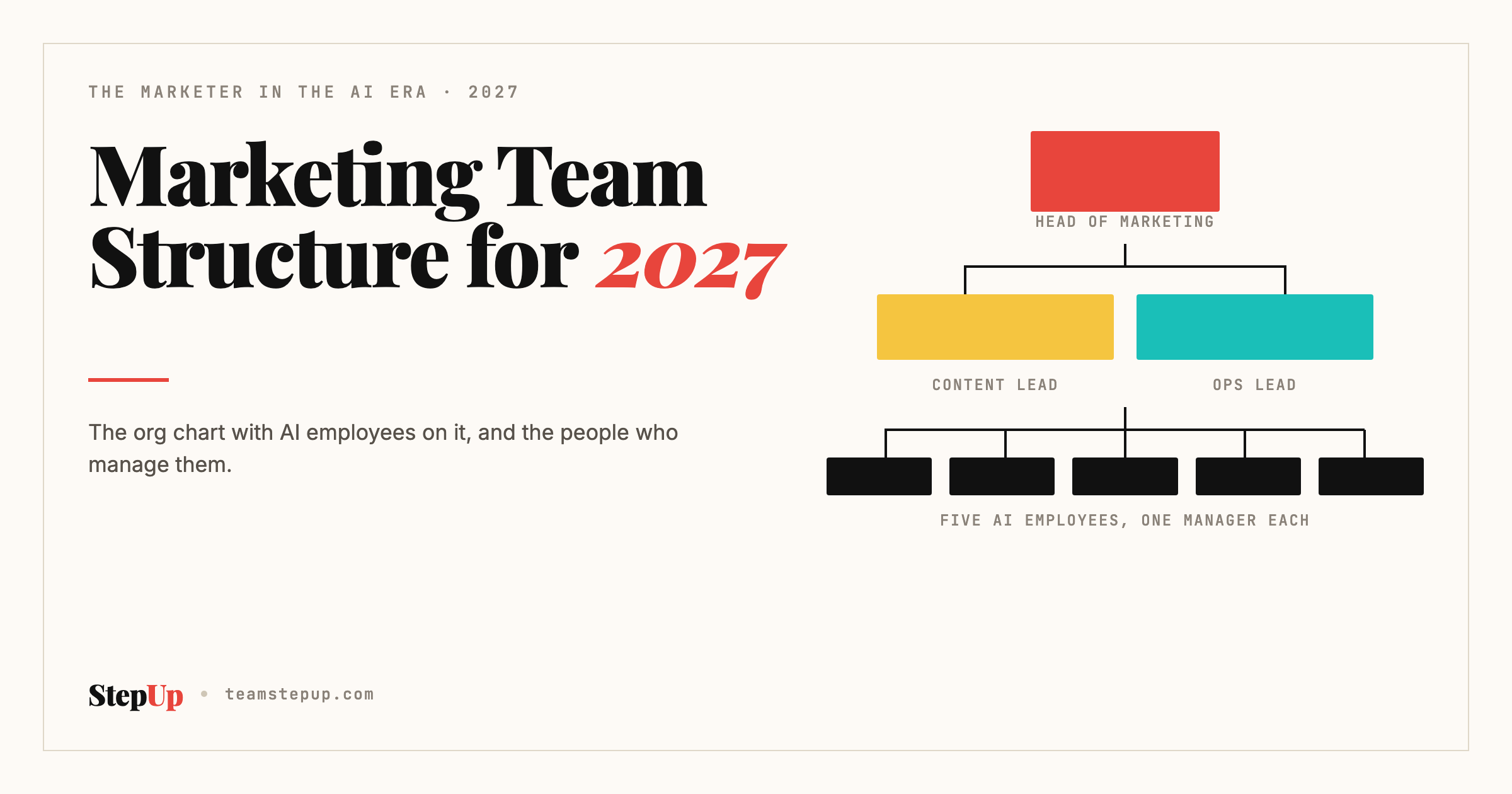
Here is the structure we use and recommend for a B2B marketing team in 2027. It has a person at the center, two or three people around her, and a small set of AI employees, each reporting to one of them.

Role Human or AI What It Does Reports To
Head of Marketing Human Sets the plan and goals, owns the message, makes the calls, signs off on what goes out CEO
Content and Brand Lead Human Owns the voice, edits everything public, runs thought leadership Head of Marketing
Marketing Operations Lead Human Owns the systems: CRM, website, tracking, and the AI employees’ set-up Head of Marketing
Market Researcher AI Tracks competitors, keeps the customer profile current, turns sales notes into buyer questions Head of Marketing
Content Writer AI Drafts blogs, posts and newsletters from the brand files; turns one piece into five Content and Brand Lead
Search Specialist AI Reads Search Console, fixes page titles and links, plans the searches to win Marketing Operations Lead
Outreach Rep AI Builds account lists, drafts first messages and follow-ups, keeps the CRM clean Head of Marketing, with sales
Analyst AI Writes the weekly one-page report and checks every number against its source Marketing Operations Lead

Two details in this chart do most of the work. First, every AI employee has exactly one human manager. Second, nothing public goes out without a person’s sign-off, which is why the content lead and the head of marketing sit where they do.

Agencies and freelancers still have a place. Design, video, events and paid media buying often stay outside the team, because they need specialist hands or bursts of capacity.

Who Is Human, Who Is AI, and What Is Shared

For every task on the team, ask one question: does this need judgment about our business, or does it need speed on a clear standard? That sorts most tasks into three groups.

Keep Human Share Hand to AI
Strategy, positioning and priorities Campaign planning Research summaries
The final word on voice Message testing First drafts
Relationships with customers, sales and leadership Reading the numbers Repurposing one piece into many
Budget and goals Editing Pulling reports
Sign-off on anything public Customer profile updates Website and search upkeep

The middle column is where most of the value is. In shared work, the AI employee does the first 70% fast, and the person does the last 30% well. Teams that skip the middle column tend to land at one of two extremes: they either use AI for almost nothing, or they publish whatever comes back.

Three Marketing Team Structures by Size

The chart above is the full version. Most B2B teams start smaller, so here is how the same structure works at three sizes.

A Team of One

One person runs marketing, often next to another job. She is the head of marketing, the content lead and the operations lead at once. In this case, start with one AI employee, usually the content writer or the analyst, whichever task eats more of her week. She keeps strategy, voice and sign-off. An agency or freelancer still handles design.

A Team of Two or Three

A head of marketing plus one or two people, usually a content person and someone who handles the website and CRM. Here the split above works almost as drawn: the content lead manages the content writer, the operations person manages the search specialist and the analyst, and the head of marketing manages research and outreach with sales.

A Team of Four to Ten

At this size, the change is less about adding AI and more about reorganizing around it. Roles that were mostly production (a second content writer, a reporting analyst) shift toward review and editing. Meanwhile, the marketing operations role grows, because someone has to own how the AI employees are set up, what they can access and how their work is checked.

Who Reports to Whom

Reporting lines matter even more with AI on the team. An AI employee will happily do the wrong work at great speed, so each one needs a person who decides what it works on.

In our experience, three rules keep the lines clear:

  • One manager per AI employee. Two managers means nobody checks the work.
  • The manager owns the output. If the AI content writer gets a fact wrong, the content lead answers for it, the same way she would for a junior writer.
  • Marketing and sales share the goals. The outreach rep works for both, so its instructions, lists and results should be agreed with sales.

How to Restructure Without Breaking the Team

The safest way to change a team structure is one step at a time. Here is the order we use with clients.

Start From the Plan, Not the Tool

Write down what marketing has to achieve this quarter before choosing any AI employee. The one-page marketing plan is a good format. Then pick the AI employee that moves the plan most, rather than the one with the best demo.

Write Your Message Down First

AI employees work from what you give them. If your positioning, audience and voice live only in someone’s head, the output will sound like everyone else. Our guide to brain files shows how to put them on paper.

Add One AI Employee at a Time

Give each new AI employee a month. Check the work every week, write down what it got wrong, and update its instructions. Only then add the next one.

Name the Reviewer Before You Start

Decide who reviews each AI employee’s work before it does any. Also decide what “good” looks like, so the review is quick and consistent.

Measure After 30 Days

Compare the month with the month before: hours saved, output, quality and results against the plan. If the numbers didn’t move, change the job or retire the AI employee. Either way, you learn something about your structure.

Frequently Asked Questions

What is a marketing team structure?

A marketing team structure is how a company divides marketing work into roles, who owns each role, and who reports to whom. The classic models organize by function, by channel, or by product, region or segment. Most B2B companies use a mix.

What does a marketing department structure look like in 2027?

In 2027, a B2B marketing department has a small human team at the center, usually a head of marketing plus one or two leads, and a set of AI employees with defined jobs. Each AI employee reports to one person, and people keep strategy, voice, relationships and sign-off.

How do you structure a small B2B marketing team?

Start with the plan and one owner for marketing. Then add one AI employee for the task that takes the most time, usually drafting content or pulling reports. Keep strategy and sign-off with a person, and use an agency or freelancers for specialist work like design.

Will AI replace marketing team roles?

AI replaces tasks more than roles. Research, first drafts and reporting move to AI employees, while judgment, voice and relationships stay with people. We go deeper in Will Marketing Be Replaced by AI?

Who should manage AI employees in a marketing team?

Each AI employee should report to one named person, usually the lead whose work it supports. That person writes its instructions, reviews its output and owns its mistakes.

The Chart, Redrawn

The tiger team had a great offsite. Your 2027 team gets something more useful: a written plan, a few AI employees with clear jobs, and one person in the middle who decides.

And when the board deck asks which half of the work AI is doing, you’ll have an org chart that answers.

So which job would you hand off first? The free AI-Readiness Self-Audit shows whether your team is ready for its first AI employee.
Building an AI Workforce for Marketing: Where to Start and What to Hire First

Every few months a new report arrives to tell us how many jobs AI will take. The number is always large, always precise to the decimal, and always slightly different from last month’s equally precise number. Somewhere, a consultant is building a slide that says “47.3% of tasks are automatable,” and somewhere else, a CEO is reading it upside down on a plane.

Meanwhile, the marketing team has a more practical question: what do we actually do on Monday?

Because “build an AI workforce” sounds like something you do with a budget line and a press release. In real life, it starts with one agent, one job and one very patient person checking its work. (The press release, if there is one, comes much later, and it should probably be written by a human.)

It’s a strange moment to be planning a team.

And it’s easy to get wrong in both directions. Buy too little, and the team keeps doing by hand what a well-briefed agent could do in minutes. Buy too much, and you get eleven tools, no owner, and a CRM full of confident nonsense.

So if you’re going to build an AI workforce for marketing, it helps to know where to start and what to hire first.

This guide covers what an AI workforce is, what it means for marketing jobs, the order to build it in, which AI worker to start with, and the mistakes to avoid.

What Is an AI Workforce?

An AI workforce is the set of AI agents a company uses to do recurring work, each with a defined job, managed by people. In marketing, that usually means a handful of AI workers handling research, drafting, search upkeep, outreach preparation and reporting, alongside a small human team.

The word “workforce” matters. A workforce has roles, instructions, managers and rules. A pile of AI subscriptions does not.

What an AI Workforce Means for Marketing Jobs

This is the question most people searching for “AI workforce” actually want answered, so here’s the short version from inside a working team.

  • Tasks move first, not roles. First drafts, research summaries, reports and website upkeep move to AI workers. The jobs around them change shape rather than vanish.
  • The scarce skills shift. Judgment, voice, priorities, relationships and checking AI output become the core of every human marketing role.
  • New work appears. Someone has to write the agents’ instructions, decide their access, review their work and turn mistakes into rules. That work didn’t exist three years ago.
  • Smaller teams can do more. A team of two or three with a well-run AI workforce can cover work that used to need six. That’s a real change in hiring, and it’s worth being honest about.

For a longer look at what stays human, see Will Marketing Be Replaced by AI?

Before You Build: Four Things to Have in Place

An AI workforce amplifies what’s already there. These four need to exist before the first agent starts.

A Written Plan

What marketing must achieve this quarter, in numbers. Without it, AI workers produce more of whatever is easiest, not what matters. The one-page marketing plan is a good format.

Written Brand Files

Positioning, audience, voice and the words you never use. AI workers write from these every time, so they have to be on paper. Our guide to brain files shows how.

A Rule for Every Tool

Buy smart, build fast. Most of the workforce can run from one workspace on top of the tools you already have, rather than a new platform per job. And if setting something up and keeping it running takes more energy than the result, it isn’t a growth system, so cancel it.

A Named Owner

One person who runs the AI side of the team: assigns work, controls access, reviews output. In a small team, it’s the head of marketing. In a larger one, it’s often marketing operations. Our guide to marketing operations in 2027 covers the role.

The Order to Build It In

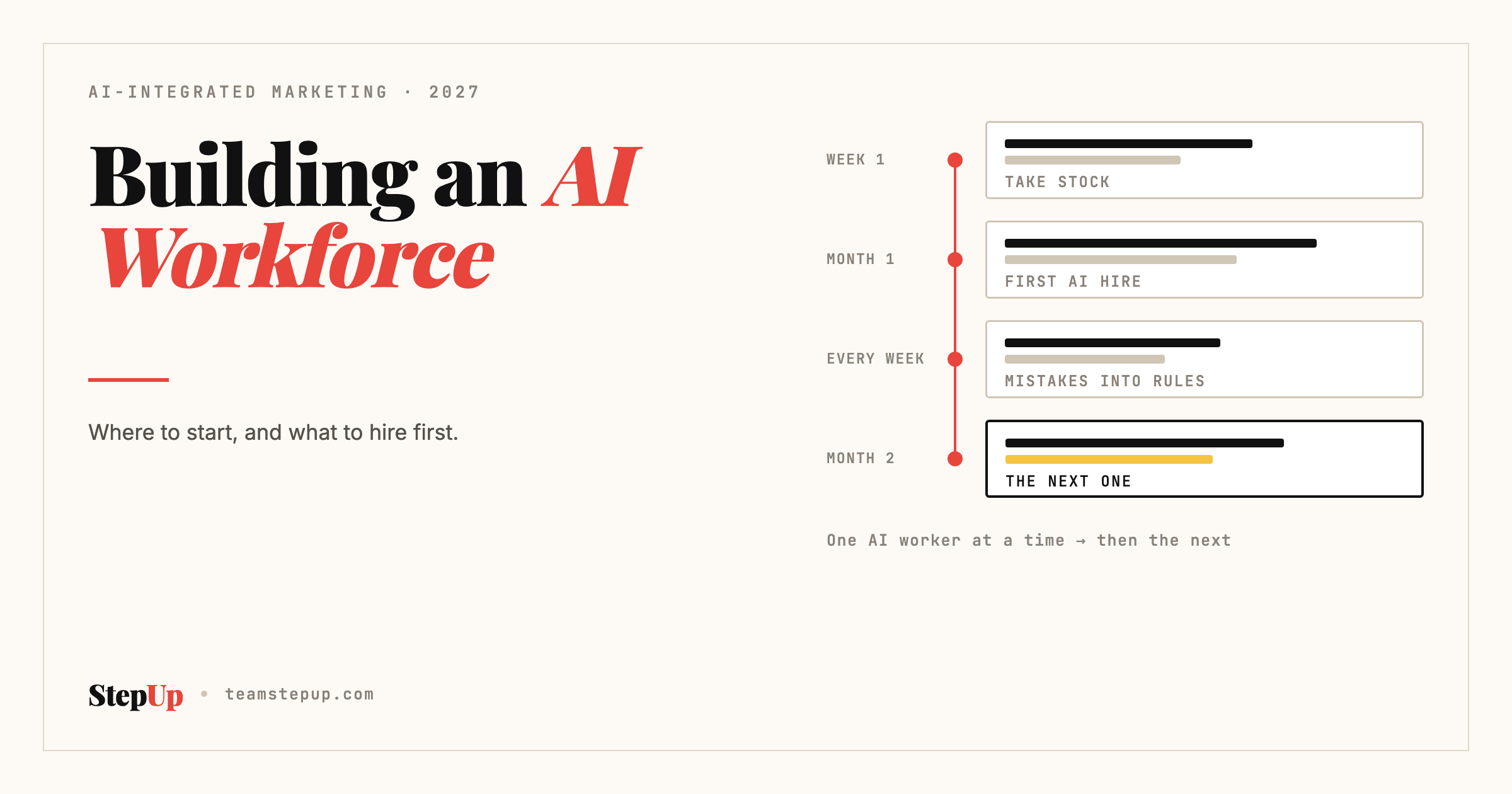
Build one AI worker at a time. Each one gets a month before the next one starts.

Step What Happens Done When
1. Take stock List every AI tool already in use and match each to a job, or cancel it Every tool has an owner, and the gaps are named
2. Hire the first AI worker The job that eats the most hours and follows a clear standard A month of its work reviewed, with hours saved written down
3. Write down every correction Each mistake becomes a line in its instructions The same mistake stops coming back
4. Add the second Usually the job that feeds or uses the first one’s work Both run for two weeks without extra effort from you
5. Lock the weekly routine Plan, agents work, review, publish, read the numbers Three weeks running on it
6. Measure and decide Compare output, quality, hours and results against before A one-page before-and-after

This is the same order we’re using to build StepUp’s own marketing team, and the before-and-after will become one of our case studies.

Which AI Worker to Hire First

The best first hire is the one that removes your biggest weekly time sink. Here’s how to choose.

If This Sounds Like You Hire First Its First Week
You know what to say and never have time to write it Content writer Three LinkedIn posts and a blog draft, in your voice, from one conversation
You can’t tell your CEO what marketing did last month Analyst A one-page report on last month, every number checked against its source
Your website has good content nobody finds Search specialist The ten pages closest to Google’s first page, and what to fix on each
You’re not sure why you win or lose deals Market researcher A one-page profile of your best customer and what three competitors changed
Sales has no time to start new conversations Outreach rep A list of 50 right-fit companies and a first message you approve

For a fuller description of each one, including what it can’t do, see What Is an AI Employee?

How to Keep People in Charge

An AI workforce works when the people running it stay in charge of four things.

  • The work. A person decides what each AI worker does this week, based on the plan.
  • The access. Each AI worker gets only what its job needs. Most read and draft; people publish and send.
  • The output. A person reviews everything public before it goes out, and spot-checks the rest.
  • The rules. Every correction becomes part of the worker’s instructions, so the workforce gets better every week.

Common Mistakes When Building an AI Workforce

Buying Tools Before Writing the Plan

The tool is the easy part. Without a plan, it’s just faster busy work. Our guide to the best AI marketing tools for B2B explains why the tool is rarely the problem.

Hiring Five at Once

Five new AI workers in a month means five sets of mistakes to catch at the same time, with nobody sure which one caused what. One at a time is faster in the end.

No Owner

AI workers without a named manager drift. Their instructions go stale and nobody checks the output. It’s the most common reason AI projects stall.

Giving Publishing Access Too Early

An AI worker that can publish to the website or send email on its own will, eventually, publish something it shouldn’t. Keep that permission with people.

Measuring Only Speed

Hours saved matter, but so do quality and results. An AI workforce that produces twice the content and no extra pipeline hasn’t helped yet.

Frequently Asked Questions

What is an AI workforce?

An AI workforce is the set of AI agents a company uses to do recurring work, each with a defined job and a human manager. In marketing, it typically includes AI workers for research, content drafting, search upkeep, outreach preparation and reporting.

How will an AI workforce affect marketing jobs?

Tasks move to AI workers first, especially first drafts, research and reporting. Marketing roles shift toward judgment, voice, relationships and reviewing AI output, and new work appears in managing the AI workers. Smaller teams can cover more work than before.

How do you build an AI workforce for marketing?

Write the plan and the brand files, name one owner, then add one AI worker at a time, starting with the job that takes the most hours. Review its work every week for a month, turn each mistake into a rule, and measure the before-and-after before adding the next.

Which AI worker should a marketing team hire first?

The one that removes the biggest weekly time sink. For most B2B teams, that’s either a content writer, for teams short on writing time, or an analyst, for teams that struggle to report on results.

Do you need technical skills to manage an AI workforce?

Not deep technical skills. The key skills are writing clear instructions, spotting wrong output quickly and deciding what each AI worker should be allowed to access. Comfort with the CRM and analytics tools helps.

Monday, Then

The 47.3% slide will be updated again next month. Let it.

On Monday, you’ll pick one job, write one page of instructions, and name the person who checks the work. That’s an AI workforce. It just starts smaller than the press release.

And the CEO can turn the slide the right way up.

Not sure which AI worker to hire first? The free AI-Readiness Self-Audit shows whether your team is ready.

What Is an AI Employee? What It Does, What It Can’t, and Who Manages It

The first time someone told me they’d “hired an AI employee,” I pictured a robot in a lanyard, sitting in the Monday meeting, nodding at the right moments and silently judging everyone’s slides.

What they meant was a chatbot with a name.

That’s most of the confusion in one sentence. The phrase “AI employee” now covers everything from a genuinely useful agent with a job, instructions and a manager, to a subscription with a cheerful avatar and a pricing page that says “replace three hires for $49 a month.” (If only. Three hires would at least argue with you about the strategy.)

It’s hard to know what you’re buying.

And the people trying to work it out are usually the same small marketing team that is already running the website, the trade show and the CEO’s LinkedIn. They don’t need a philosophy of digital labor. They need to know what this thing does on a Tuesday, what it can’t do, and whose job it is to check its work.

So here is a plain answer to the question everyone is searching: what is an AI employee?

This guide covers the definition, how an AI employee differs from a tool or a chatbot, five AI employees a B2B marketing team can use, what they can’t do, and who should manage them.

What Is an AI Employee?

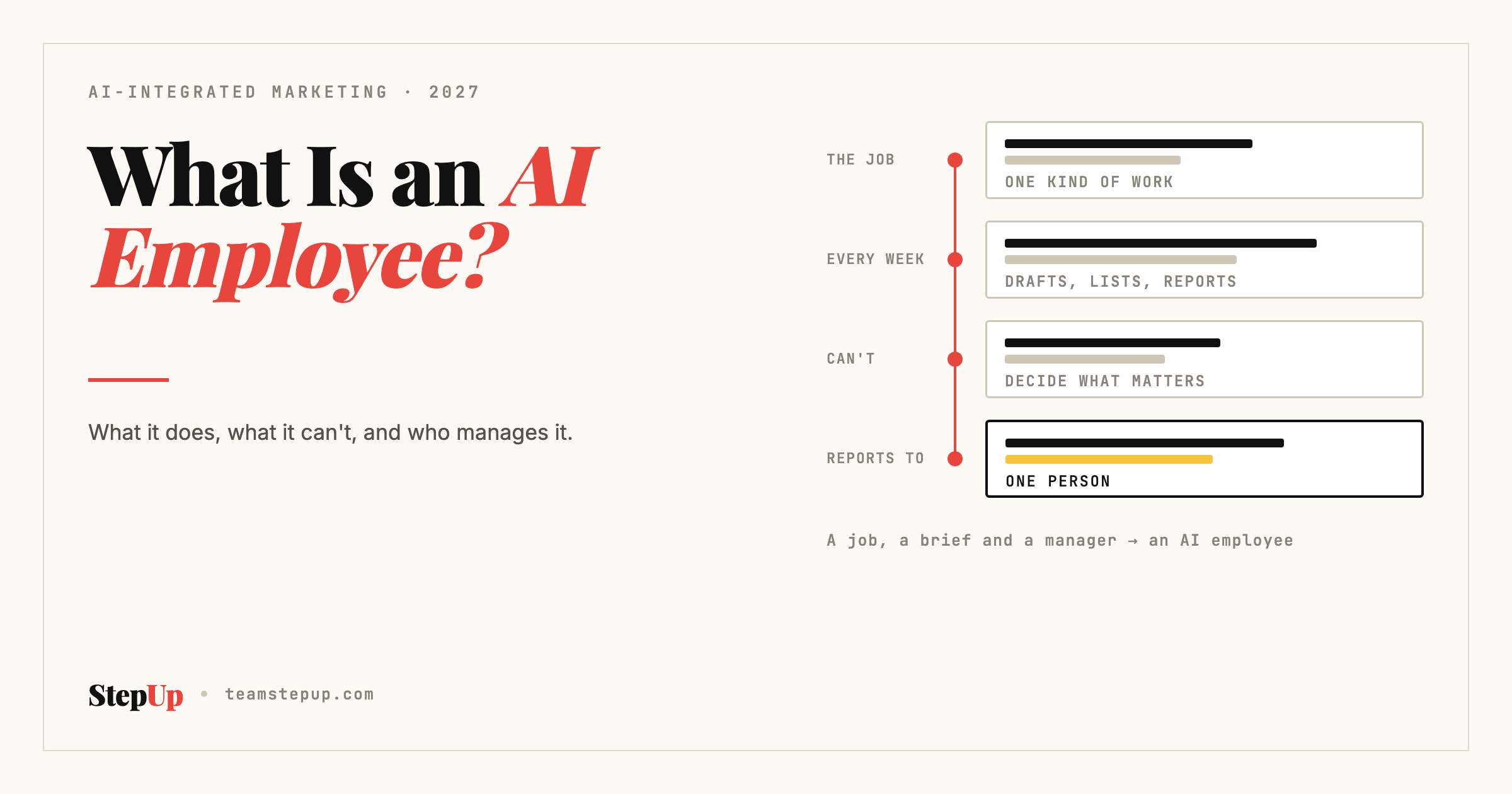
An AI employee is an AI agent with one defined job, written instructions, access to the tools that job needs, and a person who reviews its work. It does a recurring piece of work, week after week, the way a junior team member would, within limits you set.

Four parts make it an employee rather than a tool:

  • A job. One kind of work, described in a sentence.
  • Instructions. A short written job description: what it does, what it needs, what it can’t do.
  • Access. Only the systems its job needs, usually to read and draft, rarely to publish.
  • A manager. One named person who assigns its work and checks the output.

Take away the manager and you have a tool someone forgot to put away. Similarly, take away the instructions and you have a chatbot that has to be briefed from scratch every time.

AI Employee vs. AI Tool vs. Chatbot

The three terms get mixed up constantly. Here’s how they differ in practice.

Chatbot AI Tool AI Employee
What it is A conversation you start A feature that does one task when asked An agent with a recurring job
Knows your business Only what you paste in Little or nothing Works from your brand files every time
Works on its own schedule No No Yes, within its instructions
Has a manager No No Yes, one named person
Example Asking for ten blog ideas A button that rewrites a headline An analyst that builds the Monday report and checks every number

In short, the difference is the job description and the manager, not the technology underneath.

Five AI Employees for a B2B Marketing Team

These are the five jobs that cover most of a B2B marketing team’s recurring work. Each one has a clear “hire first if” signal.

The Market Researcher

Every week: tracks what your top competitors changed, keeps your ideal customer profile current, and turns sales call notes into the questions buyers actually ask. Needs from you: who your best customers are, and access to sales notes or the CRM. Can’t: talk to customers for you, or decide which market to go after. Hire first if: you’re not sure why you win or lose deals.

The Content Writer

Every week: drafts blogs, LinkedIn posts and the newsletter from your brand files, and turns one strong piece into five smaller ones. Needs from you: your message written down, your voice guide and your opinions. Can’t: have your opinions, or know what happened in yesterday’s sales call unless you tell it. Hire first if: you know what to say and never have time to write it.

The Search Specialist

Every week: reads Search Console, fixes page titles, descriptions and links, and shapes content so Google and AI answers can quote it. Needs from you: Search Console access and a person who approves changes to the site. Can’t: make Google move faster, or earn links from other sites on its own. Hire first if: your website has good content that nobody finds.

The Outreach Rep

Every week: builds lists of the right companies and people, drafts first messages and follow-ups, and flags who replied. Needs from you: your ideal customer profile, an approved message, and someone who sends and signs off. Can’t: build the relationship or close the deal. Hire first if: sales has no time to start new conversations.

The Analyst

Every week: writes a one-page report on what changed and why, and checks every number against its source. Needs from you: access to analytics, the CRM and ad accounts, and the goals you agreed. Can’t: decide what matters. Hire first if: you can’t tell your CEO what marketing did last month.

The real value comes once the five work together as a department, rather than as five separate tools. That’s the difference between buying an agent and running a team. For how they fit around the people on the team, see our guide to marketing team structure for 2027.

What an AI Employee Can’t Do

This is the part vendor pages tend to skip. An AI employee can’t:

  • Decide what matters. It works on what it’s given, so choosing the priority is a person’s job.
  • Know what it wasn’t told. If the plan changed in Tuesday’s meeting, it doesn’t know until someone updates its instructions.
  • Tell a true claim from a confident one. In fact, it can write a convincing sentence with nothing behind it. Every claim needs a check.
  • Build trust. Customers, sales and leadership trust people. An AI employee can prepare the conversation, not have it.
  • Take responsibility. When something goes wrong, a person answers for it.

None of this makes AI employees less useful. Instead, it tells you where the person has to stay in the loop.

Who Manages an AI Employee?

Every AI employee needs one named manager, usually the person whose work it supports. The content lead manages the content writer. The person who owns the website manages the search specialist. However, on a team of one, that’s the same person for all of them.

The manager’s job is short but non-negotiable:

  1. Assigns the work each week, from the plan.
  2. Reviews the output before anything goes out.
  3. Updates the instructions when the agent gets something wrong, so the mistake doesn’t come back.
  4. Owns the result, the same way she would for a junior hire.

Two managers for one AI employee is a bad idea. In practice, it means nobody checks the work.

How to Set Up Your First AI Employee

Pick the Job That Eats the Most Hours

Look at last month. Which recurring task took the most time and followed a clear standard? That’s your first hire.

Write the Job Description

One page: the job in one sentence, what it does every week, what it needs from you, what it can’t do, who it reports to.

Give It Your Brand Files

Your positioning, audience, voice and the words you never use. Without them, every AI employee sounds like every other company’s, because it has nothing else to go on. Our guide to brain files shows how to write them.

Set the Access

Read and draft, in most cases. Also, keep publishing and sending with a person.

Give Each Job Its Own Conversation

Run each AI employee’s work in its own chat or project, with one goal. Short conversations with a clear goal stay accurate, and they’re easy to come back to a week later.

Review Every Week for a Month

Check the work, note what went wrong, and add a rule to the instructions each time. After a month, compare hours saved and quality against before. Then decide whether to keep it, change its job, or add the next one.

Frequently Asked Questions

What is an AI employee?

An AI employee is an AI agent with one defined job, written instructions, access to the tools that job needs, and a person who reviews its work. It does recurring work, such as drafting content or building reports, within limits set by its manager.

What is an AI marketing employee?

An AI marketing employee is an AI agent that handles one recurring marketing job, such as market research, content drafting, search upkeep, outreach drafts or reporting. It works from the company’s brand files and reports to a named person on the marketing team.

Can an AI employee replace a human employee?

An AI employee can take over recurring tasks that follow a clear standard, which can reduce the hours a team spends on them. It can’t decide priorities, build relationships, judge whether a claim is true, or take responsibility, so it works alongside people rather than replacing them.

How do you create an AI employee?

Pick the recurring task that takes the most time, write a one-page job description, give the agent your brand files, set its access to read and draft only, and name one person to review its work every week for the first month.

Who should manage an AI employee?

One named person, usually the team member whose work it supports. That person assigns its work, reviews its output, updates its instructions when it makes mistakes, and owns the result.

Back to the Lanyard

There’s no robot in the Monday meeting. There’s a short document that says what the AI employee does, a person who checks its work, and a list of rules that grows every time it gets something wrong.

Less cinematic. Much more useful.

And nobody has to worry about it judging their slides.

Which AI employee should your team hire first? The free AI-Readiness Self-Audit shows whether you’re ready.

Your Marketing Department in 2027: Who Is Human and Who Is AI

Every era of marketing gets its prophecy. Television would kill print. The internet would kill television. Social media would kill the website, and then the website would come back, slightly embarrassed, with a cookie banner.

The prophecy this time is that AI will kill the marketing department. Some say gently, by doing all the work. Some say rudely, by making the work so cheap that nobody needs to be paid for it.

Meanwhile, the actual marketing department is in a meeting, trying to work out why the new AI writing tool keeps describing the company as “a leading provider of innovative solutions.” (It is not a leading provider. Nobody is sure what the solutions are. The tool has been told this three times.)

It’s an unnerving time to work in marketing.

The honest answer to “what happens to the marketing department?” is more interesting than either prophecy. Your department doesn’t disappear. It changes shape. Part of the team is now AI, part of it is still people, and the work that matters most is deciding which is which.

This is the main guide to our series on the marketing department in 2027: what it does, how it’s built, who is human and who is AI, and the principles we use to build one.

What Does a Marketing Department Do?

A marketing department finds the right customers, gives them a reason to choose you, and makes it easier for sales to win them. In a B2B company, that usually covers five jobs:

  • Understanding the market. Who the best customers are, what they need, and who else they’re considering.
  • Deciding the message. What you stand for, who it’s for, and how you say it.
  • Getting found. The website, search, content, social, events and ads.
  • Starting conversations. Turning interest into leads and handing them to sales.
  • Measuring what works. Reporting results and changing the plan when the numbers say so.

None of those jobs go away in 2027. What changes, however, is who does each part of each one.

The Three Layers of the 2027 Marketing Department

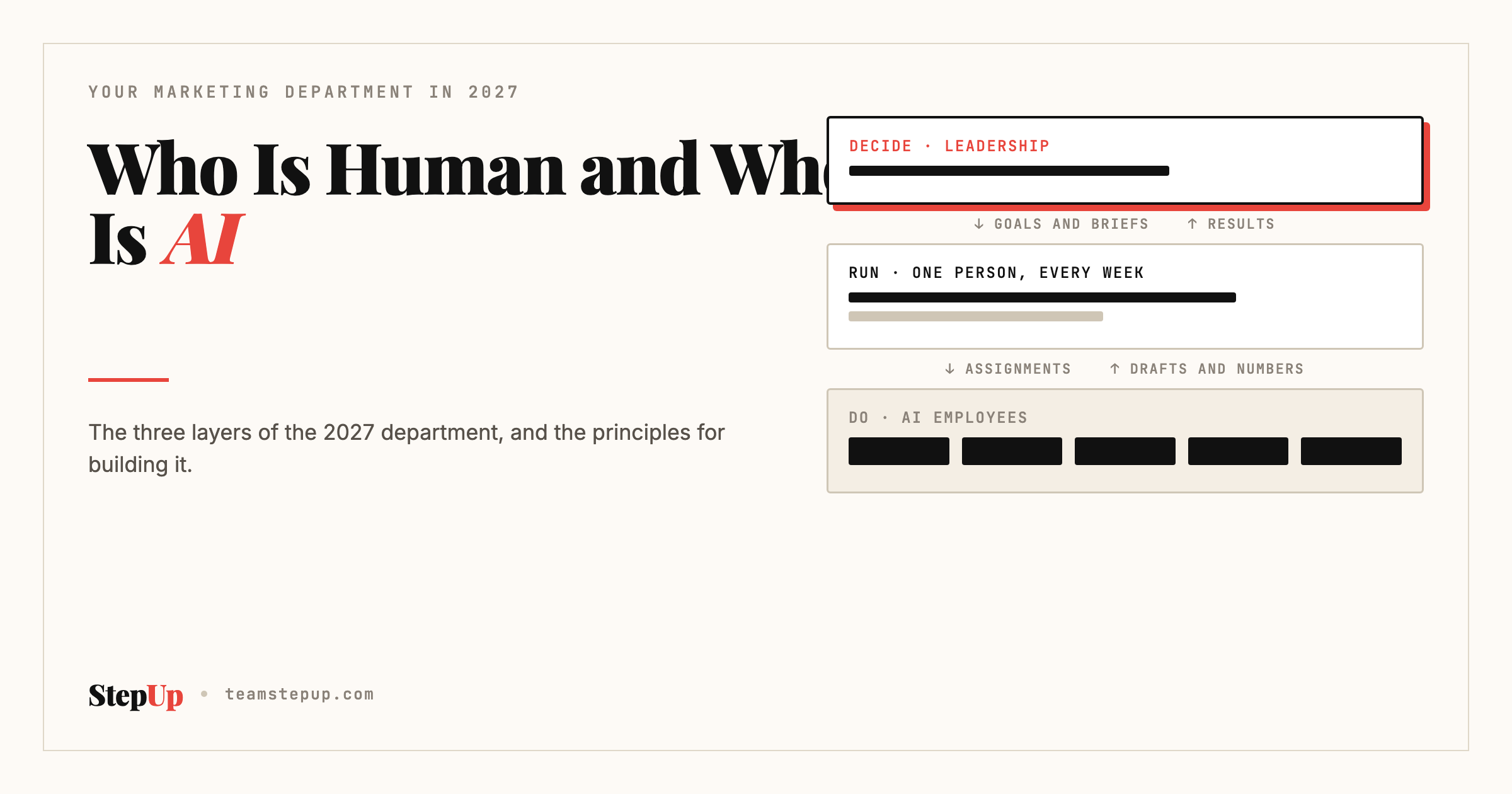
The simplest way to picture the new department is in three layers.

Layer Who What They Do
Decide Leadership: the CEO and the head of marketing Set the goals, approve the message and the budget, decide when to stop
Run One person who runs the week, usually a marketing lead Turns goals into weekly work, briefs the AI agents, reviews and approves what they make
Do AI agents, each with one kind of work Research, draft, update the website, prepare outreach, pull the numbers

Goals and briefs move down. Drafts and results move up. When an agent starts deciding, or a leader starts drafting, the department stops working.

For the org chart version, with each role and who reports to whom, see our guide to marketing team structure for 2027.

Who Is Human and Who Is AI

For every task in the department, ask three questions:

  1. Does it need judgment about our business? Priorities, positioning, budget and anything that commits the company.
  2. Does it need a relationship? Customers, sales, partners and leadership.
  3. Does it need speed on a clear standard? Research, first drafts, reports and upkeep.

If the answer to the first or second question is yes, a person keeps it. If only the third is yes, it can go to AI. A mix means it’s shared: AI does the first version fast and a person finishes it.

For example, here’s how that sorts the work in a typical B2B department.

Area What AI Does What Stays With a Person
Strategy Market and competitor research, summaries of customer interviews The decision, the goals, when to stop
Content Drafts of blogs, posts and newsletters from the brand files The opinion, the voice, approval of every message
Search and the website Pages to fix, new titles and descriptions, the questions buyers ask Approving changes to the live site
Outreach Lists of the right accounts, drafts of first messages and follow-ups Sending, the calls, the relationship
Data and the CRM Duplicate cleanup, tagging where each lead came from The lead rules: stages, scoring, who gets which lead
Numbers The weekly report, with every number checked against its source What matters, and what to do about it

This is the split StepUp uses for its own marketing, and the one we recommend to clients.

Meet the AI Employees

We call the AI side of the department AI employees: agents with one job each, written instructions, the access their job needs, and a person they report to. In most B2B departments, five jobs cover the work. Still, the value is in the whole department rather than in any single agent. Most companies are buying agents one at a time, so the teams that get results are the ones that design how the agents work together.

  • Market Researcher. Tracks competitors, keeps the customer profile current, and turns sales notes into the questions buyers ask.
  • Content Writer. Drafts blogs, posts and newsletters in your voice, and turns one strong piece into five smaller ones.
  • Search Specialist. Reads Search Console, fixes page titles and links, and shapes content so search engines and AI answers can find it.
  • Outreach Rep. Builds lists of the right companies, drafts first messages and follow-ups, and keeps the CRM clean.
  • Analyst. Writes the weekly one-page report and checks every number against its source.

However, none of them decide what to work on, and nothing they make goes out without a person’s approval. For a closer look at what an AI employee is and isn’t, see our guide to AI employees.

What Stays Human, No Matter What

Some parts of marketing don’t move to AI, and they’re the parts that make the department worth having.

  • Deciding what matters. Which customers, which message, which three things this quarter.
  • The voice. AI can write in your voice once you’ve defined it. It can’t decide what you believe.
  • Relationships. With the CEO, with sales, with customers. Trust is built by people.
  • Judgment on the output. Catching the claim with nothing behind it, the number that doesn’t fit, the post that’s on brand but wrong for this week.
  • Accountability. When something goes wrong, a person answers for it.

These are also the skills that make a marketer hard to replace. If anything, they’re worth more now.

The Principles for Building the Department

These are the rules we build by, with clients and in our own team.

Start From the Plan, Not the Tool

Write down what marketing has to achieve before choosing any AI agent. Then pick the agent that moves the plan most. Our one-page marketing plan is a good format.

Buy Smart, Build Fast

You don’t need a new platform for every job. Most of the department can run from one workspace that sits on top of the tools you already have: the CRM, the website and analytics. So buy only what fills a real gap, and build the rest quickly. We also use one test for every tool and every agent: if setting it up and keeping it running takes more energy than the result it brings, it is not a growth system.

Write the Brand Down First

Agents work from what they’re given. Your positioning, audience, voice and the words you never use have to exist on paper before any agent starts. Our guide to brain files shows how.

Hire One AI Employee at a Time

Give each new agent a month. Check its work every week, write down what it got wrong, and update its instructions. Only then add the next one.

Every Agent Gets a Job Description and a Manager

One page per agent: what it does every week, what it needs from you, what it can’t do, and who it reports to. One manager per agent, so someone always checks the work.

Give Each Agent Only the Access It Needs

Most agents read and draft. Publishing and sending stay with a person.

Turn Every Correction Into a Rule

When an agent gets something wrong, fix the draft and add a line to its instructions. In the end, those lines become the department’s most valuable document.

A Person Signs Off on Everything Public

No exceptions. In fact, this is the rule that protects the brand.

Where to Start

You don’t need to redesign the whole department at once. Start here:

  1. Write the plan for next quarter on one page.
  2. Write the brand files, if they don’t exist yet.
  3. Pick the task that eats the most hours each week, and give it to one AI employee.
  4. Name the person who reviews that agent’s work.
  5. Check after 30 days: hours saved, quality, results against the plan.

If you’re a team of one, our guide to the one-person marketing team shows how far that can go.

Frequently Asked Questions

What does a marketing department do?

A marketing department finds the right customers, gives them a reason to choose the company, and helps sales win them. In B2B, that covers understanding the market, deciding the message, getting found, starting conversations and measuring what works.

Will AI replace the marketing department?

AI replaces tasks more than departments. Research, first drafts, reporting and website upkeep move to AI agents, while strategy, voice, relationships and the final sign-off stay with people. The department gets a new shape, not a pink slip. We go deeper in Will Marketing Be Replaced by AI?

What does an AI marketing department look like?

It has three layers: leadership decides the goals and budget, one person runs the week and reviews the work, and AI agents each handle one kind of work, such as research, writing, search, outreach drafts or reporting. Every agent reports to a named person.

Which marketing jobs should stay human?

The jobs that need judgment about the business or a relationship: strategy and priorities, the brand voice, relationships with customers, sales and leadership, review of AI output, and accountability for results.

How do you start building a marketing department with AI?

Write the plan and the brand files first, then give the most time-consuming task to one AI employee with a named reviewer. Check the results after 30 days before adding the next one.

The Prophecy, Revised

The marketing department survived television, the internet and the cookie banner. It will survive this too, with fewer people doing the typing and more people doing the deciding.

And that writing tool will eventually stop calling you a leading provider of innovative solutions. Somebody just has to write the rule.

Which job would you hand off first? The free AI-Readiness Self-Audit shows whether your team is ready for its first AI employee.
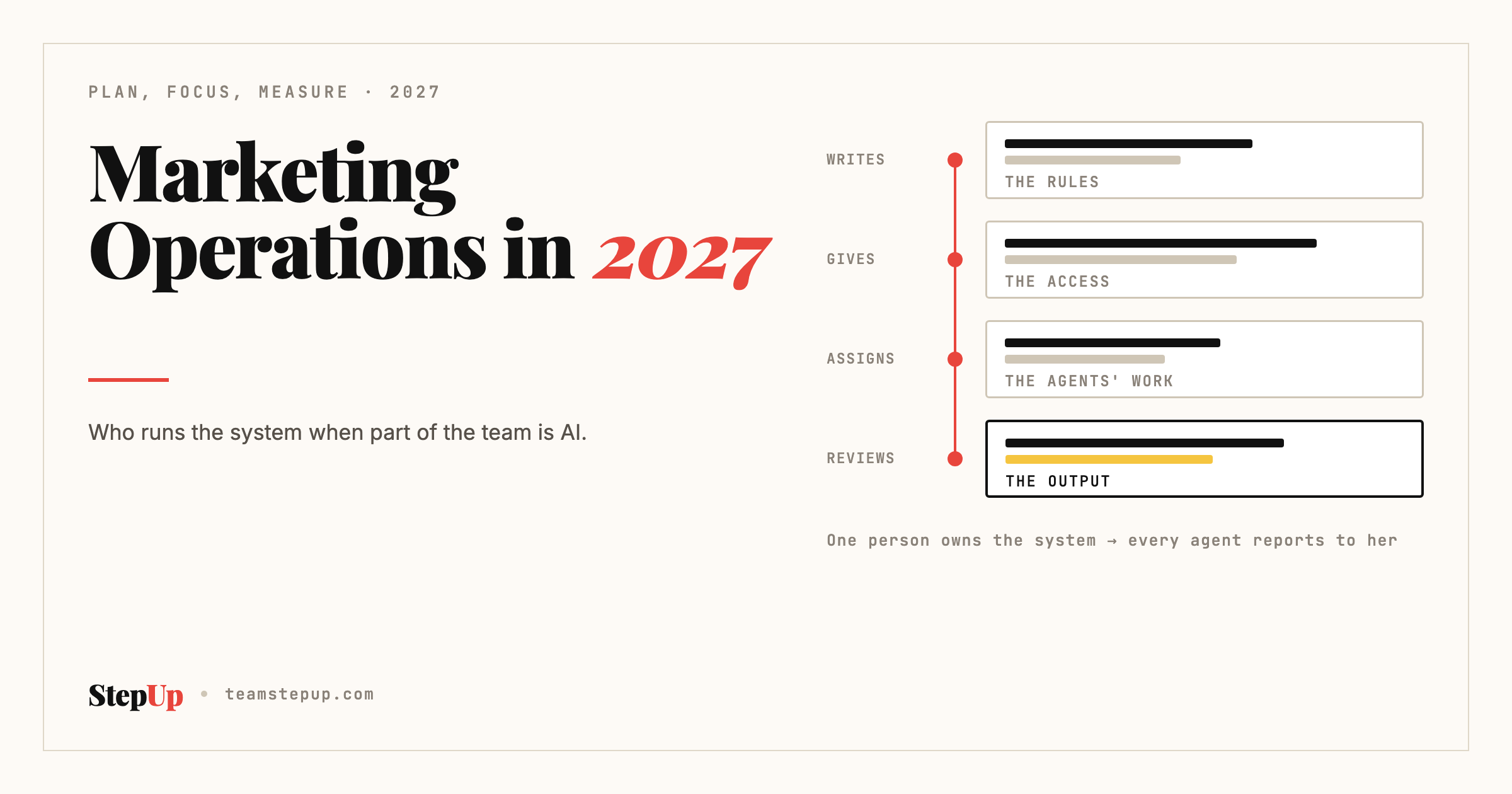
Marketing Operations in 2027: Who Runs the System When Part of the Team Is AI

Every marketing team has one person who knows where everything is. She knows why the lead form has a hidden field called “source_final_v2.” She knows which of the three CRM pipelines is the real one. She is the only person alive who remembers the password to the old webinar tool, and she is, frankly, underpaid.

That person does marketing operations, whether or not her title says so.

For years, marketing operations was the plumbing. Important, invisible and only noticed when it leaked. Now the plumbing is getting crowded. AI agents are drafting emails, scoring leads, pulling reports and updating the website, and every one of them needs access, instructions and someone to check its work.

Somewhere, a leadership team has concluded that this means fewer people are needed to run marketing. (In my experience it means the person who knows the passwords is now also managing a small fleet of robots, and nobody has told her yet.)

So it’s worth asking plainly: what is marketing operations in 2027, and who runs the system when part of the team is AI?

This guide covers what marketing operations is, what it owns, how AI changes the job, and how to set it up for a small B2B team.

What Is Marketing Operations?

Marketing operations is the part of marketing that makes the rest of it work. It owns the systems, data, processes and measurement behind every campaign, so the team can plan, launch, track and report without starting from scratch each time.

If strategy decides where marketing is going and the creative team makes the work, marketing operations builds and runs the road. In a small company, that might be one person a few hours a week. In a larger one, by contrast, it’s a team.

What Marketing Operations Owns

The scope varies by company, but most marketing operations roles cover five areas.

Area What It Includes
Systems The CRM, marketing automation, website forms, analytics and the connections between them
Data Clean contact records, lead sources, lifecycle stages, and rules for who gets which lead
Process How campaigns go from brief to launch, who approves what, and the handoff to sales
Measurement Dashboards, the weekly and monthly reports, and the definitions behind every number
Budget and tools What the team pays for, what it actually uses, and what to cancel

For a fuller view of where marketing operations sits among the other roles, our field guide to the types of marketing professionals walks through each one.

Why Marketing Operations Matters More With AI

AI agents are only as good as the system they plug into. An agent that writes follow-up emails needs clean contact data. One that reports on pipeline needs agreed definitions. And one that updates the website needs permission rules, so it can draft without publishing.

In other words, the things marketing operations has always owned (data, process, access, measurement) are exactly what AI needs to work. As a result, teams that skip that groundwork get faster mess: the same messy data, acted on at machine speed.

Therefore, marketing operations is the natural home for running the AI side of the team.

How the Job Changes in 2027

The work doesn’t disappear. Instead, it shifts from doing the tasks to designing and checking how they get done.

Before AI Agents In 2027
Builds the report every Monday Checks the report an AI analyst built, and fixes the source when a number is wrong
Cleans the CRM by hand each quarter Writes the data rules an agent follows every day
Sets up each campaign in the automation tool Sets up the templates and approval steps that agents and people both use
Manages the tool stack Manages the tools and the agents: what each can access, read, draft or publish
Answers “where did this lead come from?” Makes sure every agent tags its work, so the answer is always in the data

The common thread: marketing operations becomes the person who writes the rules, gives out the access and checks the output. The agents do more of the clicking.

Who Runs the System When Part of the Team Is AI

In the teams we work with, one person owns the marketing system end to end, and every AI agent that touches it reports to her. That person can be a dedicated marketing operations manager, or the head of marketing in a very small team. Still, what matters is that the role is named.

Her job, week to week:

  • Assigns the work. Decides what each agent works on, based on the plan.
  • Writes the instructions. Each agent has a short written job description: what it does, what it needs, what it can’t do.
  • Controls access. Each agent gets only the access its job needs. Most can read and draft. Publishing and sending stay with a person.
  • Checks the output. Reviews a sample of every agent’s work each week, and checks reports against their source.
  • Turns mistakes into rules. When an agent gets something wrong, she fixes the draft and adds a line to its instructions so it doesn’t happen again.

We describe the full set-up in our guide to marketing team structure for 2027, including who reports to whom.

Skills a Marketing Operations Manager Needs Now

The classic skills still apply: knowing the CRM inside out, building clean processes, reading data. Three more have become essential.

Writing Clear Instructions

An agent works from what it’s told. The ability to write a short, precise brief, with examples of good and bad output, is now a core operations skill.

Spotting Wrong Output Fast

AI makes mistakes confidently. A good operations lead can scan a report or a list and see the number that doesn’t fit before it reaches the CEO.

Thinking in Permissions

Who can read, who can draft, who can publish. As the number of agents grows, this becomes one of the most important decisions in the department, and one of the easiest to get wrong.

Setting Up Marketing Operations in a Small B2B Team

You don’t need a big team to run marketing operations well. Here is a simple starting point.

1. Name the Owner

One person owns the system. In a team of one or two, that’s usually the head of marketing, with a few hours a week set aside for it.

2. Write Down the Definitions

What counts as a lead, a qualified lead and a customer. Where each lead source is tagged. Otherwise, every report is an argument. Our guide to MQL vs. SQL covers the lead definitions.

3. Fix the Data Before Adding Agents

Remove duplicates, tag lead sources and agree the stages. It’s the least exciting week of the year, and it makes everything after it work.

4. Map the Access

For every tool and every agent, write down whether it reads, drafts or publishes. Keep publishing with a person.

5. Automate the Weekly Report First

The weekly numbers are the easiest, safest first job for an AI agent, because every number can be checked against its source. Our guide to B2B marketing KPIs lists which numbers to include.

6. Review Every Month

Once a month, look at what the agents did, what went wrong, what rules changed, and which tools nobody used. Cancel the unused ones. Someone has to.

Frequently Asked Questions

What is marketing operations?

Marketing operations is the part of marketing that owns the systems, data, processes and measurement behind every campaign. It makes sure the team can plan, launch, track and report reliably, and connects marketing’s work to sales and revenue.

What does a marketing operations manager do?

A marketing operations manager runs the marketing tools and CRM, keeps the data clean, sets up the processes campaigns follow, builds the reports and dashboards, and manages the tool budget. In teams that use AI agents, she also assigns their work, controls their access and checks their output.

How is AI changing marketing operations?

AI agents now handle many repetitive operations tasks, such as building reports, cleaning data and setting up campaigns. The marketing operations role shifts toward writing the rules agents follow, deciding what each agent can access, and checking their work.

Does a small marketing team need marketing operations?

Yes, even if it isn’t a full-time role. A small team needs one named owner for the CRM, the data definitions, the reports and the access rules, especially before adding AI agents.

What is the difference between marketing operations and revenue operations?

Marketing operations focuses on marketing’s systems, data and measurement. Revenue operations covers marketing, sales and customer success together, with shared data and processes across the whole path to revenue. Many small companies combine both in one role.

The Passwords, Revisited

The person who knows where everything is still runs the system in 2027. The difference is that now it’s in writing: the definitions, the access map, the rules each agent follows.

That makes her job easier to explain, easier to hand over, and much harder to replace.

She should probably get a raise. And someone should finally delete “source_final_v2.”

Not sure your marketing system is ready for AI agents? The free AI-Readiness Self-Audit shows where you stand.

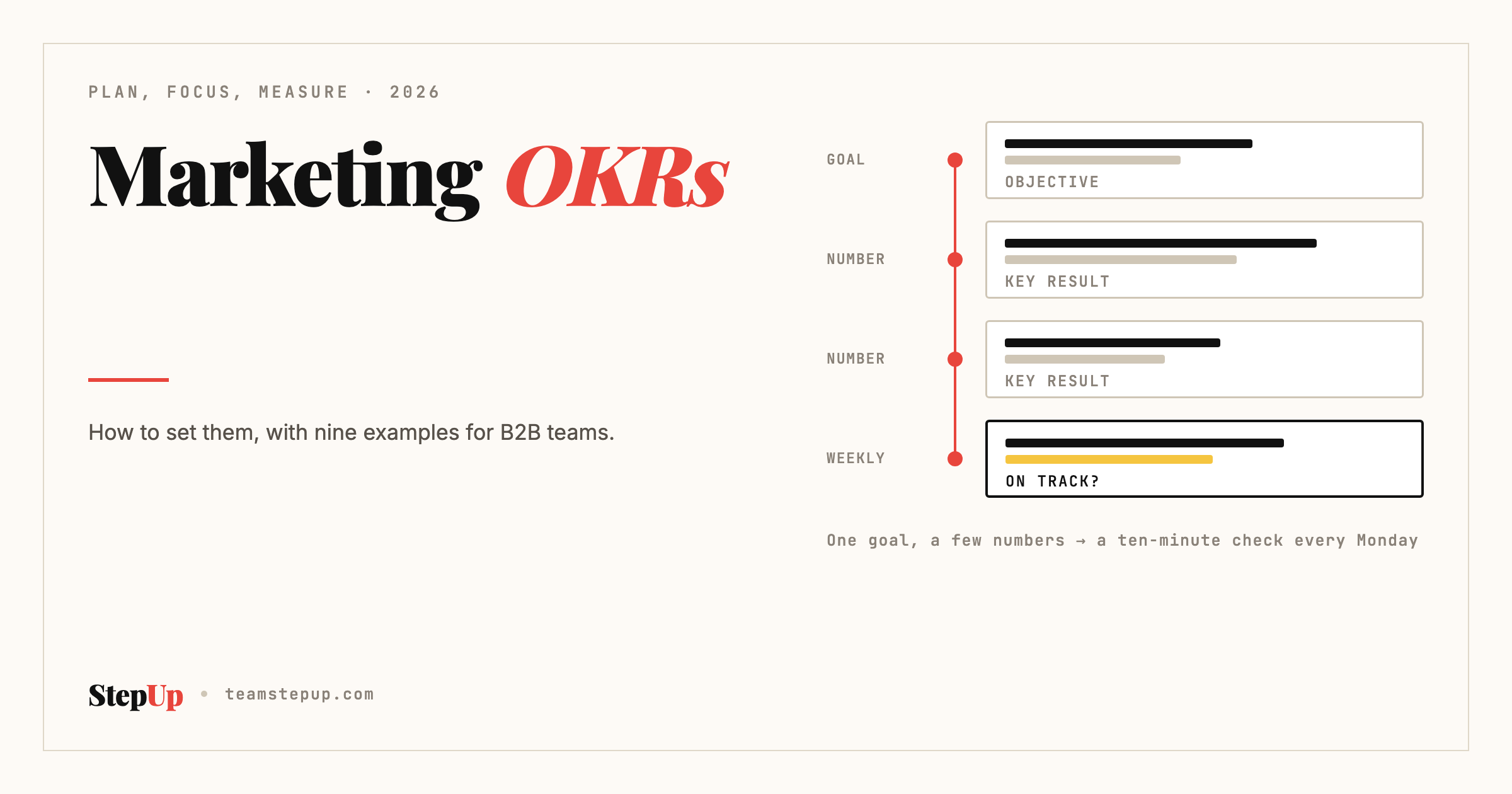
Marketing OKRs: How to Set Them, With Examples for B2B Teams

Every January, a marketing team somewhere writes 23 objectives on a whiteboard. By February, nobody can remember objective 14. By March, the whiteboard is being used for the office fantasy football league, and the quarter is being run the way it always was: by whoever shouted last.

OKRs were supposed to fix that. Done well, they do. A short list of goals, a few numbers that prove you got there, and a team that knows what to say no to.

Done badly, they are a to-do list wearing a blazer.

And lately there’s a new twist. Your CEO has read that AI can “run the OKR process,” so the expectation is that the objectives will now write themselves, the key results will track themselves, and you will spend the saved hours (all 40 of them) on strategy. (I’d love to see the calendar where that happened.)

Truth is, AI can help a lot with OKRs. It can pull the numbers, draft the first version and flag the key result that’s sliding. What it can’t do is decide what matters this quarter. That part is still yours, and it’s the part that makes marketing OKRs work.

This guide explains what marketing OKRs are, how to write them, nine examples for B2B teams, and the mistakes to avoid.

What Are Marketing OKRs?

OKR stands for Objectives and Key Results. An objective is what you want to achieve, written in plain words. Key results, meanwhile, are the two to four numbers that prove you achieved it.

For a marketing team, OKRs turn “we want more pipeline” into a goal the whole team can work toward, check every week, and report on without arguing about what counts.

A simple example:

  • Objective: Make our website a real source of sales conversations.
  • First key result: Google clicks grow from 40 to 140 per four weeks.
  • Second: Website form fills grow from 5 to 12 per quarter.
  • Third: 6 sales calls booked from website leads.

The objective says where you’re going. The key results say how you’ll know you got there.

OKRs vs. KPIs: What’s the Difference?

KPIs and OKRs get mixed up all the time, partly because a KPI can become a key result. The difference is in the job each one does.

KPIs OKRs
What it is A number you watch all the time A goal for a set period, with numbers attached
Time frame Ongoing Usually a quarter
Job Tells you if things are healthy Tells you what to change and by how much
Example Cost per lead Cut cost per lead from $240 to $180 by March 31

In short, KPIs are the dashboard and OKRs are the destination. If you want the dashboard side in more detail, our guide to B2B marketing KPIs covers which ones a CEO actually needs.

How to Set Marketing OKRs in Six Steps

1. Start From the Company’s Goals

Marketing OKRs sit under the company’s goals, not next to them. Before writing anything, find out what the business needs this quarter: more pipeline in a new region, more revenue from existing customers, a launch that has to land. Then ask which part of that marketing owns.

If the company has no written goals, write down what the CEO said in the last two leadership meetings. That’s usually the real plan anyway.

2. Write One to Three Objectives

An objective should be short, plain and a little ambitious. Moreover, it should describe an outcome, not an activity. “Publish 60 blogs” is an activity. “Become the site B2B buyers find when they search for our category” is an outcome.

So keep it to three objectives at most. Teams with five objectives usually have zero priorities.

3. Give Each Objective Two to Four Key Results

Each key result has a starting number, a target and a date. For example, “improve SEO” is not a key result. “Searches where we show on Google’s first page grow from 232 to 315 by December 31” is.

A useful test: could someone outside marketing read the key result and agree, on the last day of the quarter, whether you hit it? If not, rewrite it.

4. List the Work Under Each Objective

The work (campaigns, blogs, the new landing page) goes underneath as initiatives. They are how you plan to move the key results, so they can change mid-quarter if they aren’t working. The key results stay put.

Many teams skip this split, and as a result their OKRs fill up with tasks. Keeping the work separate is what lets you say “this campaign isn’t moving the number, let’s change it” without rewriting the goal.

5. Agree Them With Sales and Leadership

Marketing OKRs that sales has never seen are a private diary. Walk your CEO and head of sales through them before the quarter starts, especially any key result that depends on them: lead follow-up times, the definition of a qualified lead, budget.

6. Check Them Every Week, Score Them Every Quarter

Each week, update the numbers and ask one question per key result: on track, at risk or off track? Then, at the end of the quarter, score each key result from 0 to 1. A score around 0.7 on an ambitious key result is a good quarter. A team that scores 1.0 on everything set its targets too low.

Marketing OKR Examples for B2B Teams

Here are nine marketing OKR examples, grouped by the three goals most B2B teams have. Swap in your own starting numbers.

Website and Search

Objective: Make the website a reliable source of new buyers.

  • Google clicks grow from 40 to 140 per four weeks.
  • Pages fixed for search grow from 26 to 50.
  • 5 of 7 target searches show the website on Google’s first two pages.

Demand and Pipeline

Objective: Fill the pipeline with buyers who match our ideal customer.

  • 120 people join the funnel (quiz, audit or contact form).
  • 40 of them come from our target region.
  • 6 sales calls booked from marketing-sourced leads.

Brand and Audience

Objective: Become the voice our buyers follow on LinkedIn.

  • Newsletter subscribers grow from 156 to 400.
  • Company page followers grow by 300.
  • 39 posts published across the company page and the founder’s profile.

Marketing Operations OKR Examples

Marketing operations OKRs are a small search on their own, and a useful one, because they cover the systems everyone else depends on.

Objective: Make our numbers something leadership trusts.

  • Every lead in the CRM tagged with its source, from 60% to 100%.
  • Weekly marketing report sent every Monday, 13 of 13 weeks.
  • Analytics connected to the CRM by October 31.

Where AI Helps With OKRs, and Where It Doesn’t

AI is genuinely useful through the OKR cycle. Still, the split matters, because the parts it can’t do are the parts that decide whether the OKRs mean anything.

Step What AI Does Well What Stays With a Person
Research Pulls last quarter’s numbers, finds benchmarks, summarizes what sales heard Deciding which numbers matter
Drafting Writes a first version of the objectives and key results from your plan Choosing the one to three objectives
Tracking Updates the numbers every week and flags what’s sliding Deciding what to change
Reporting Drafts the quarterly score and the summary The story you tell leadership, and the ask

In our own team, AI pulls the Search Console and CRM numbers each week and checks each one against its source. Then a person reads the five-minute version and decides what moves. Overall, that split saves hours without handing over the judgment.

Common Mistakes With Marketing OKRs

Writing Tasks as Key Results

“Launch the new website” is a task. “Website form fills double after launch” is a key result. If you can complete it by doing the work, regardless of the outcome, it’s a task.

Too Many Objectives

Every objective you add takes attention from the others. Three is the ceiling. One is fine.

Key Results Nobody Can Measure Yet

If the tracking doesn’t exist, the first key result is to build it. Otherwise you’ll reach the end of the quarter with a target and no number.

Setting Them and Forgetting Them

OKRs that are only opened at quarter end are a report card, not a plan. Therefore, the weekly check is the part that actually changes behavior. It takes ten minutes.

Measuring Marketing Alone

If a key result depends on sales following up, say so, and agree it with sales. Shared key results are the honest way to measure the handoff. Our guide to MQL vs. SQL covers how to define it.

A Simple Marketing OKR Template

Copy this into a doc or spreadsheet and fill it in for next quarter.

Field What to Write
Company goal it supports One line from the company’s plan
Objective A plain-language outcome, ambitious but believable
Key result 1 to 4 Starting number, target number, date
Owner One person per key result
Initiatives The work you’ll do to move each key result
Weekly status On track, at risk or off track, with one line on why
Quarter-end score 0 to 1 for each key result

If you’d rather start from a full plan, the one-page marketing plan puts the OKRs, the audience and the budget on a single page.

Frequently Asked Questions

What are OKRs in marketing?

OKRs in marketing are a goal-setting method: one to three objectives for the quarter, each with two to four key results that prove you reached it. They connect marketing’s work to the company’s goals and give the team a short list to focus on.

How many OKRs should a marketing team have?

One to three objectives per quarter, each with two to four key results. More than that and the team loses focus, because every objective competes for the same people and budget.

What is a good marketing OKR example?

Objective: make the website a reliable source of new buyers. Key results: Google clicks grow from 40 to 140 per four weeks, website form fills grow from 5 to 12 a quarter, and 6 sales calls are booked from website leads.

What is the difference between OKRs and KPIs in marketing?

KPIs are numbers you watch all the time to check the health of your marketing, like cost per lead. OKRs are goals for a set period, with key results that say how far a number should move and by when. A KPI can become a key result when you decide to change it.

Can AI write marketing OKRs?

AI can draft OKRs from your plan, pull the starting numbers and track progress every week. A person still has to choose the objectives, agree them with sales and leadership, and decide what to change when a key result slides.

Back to the Whiteboard

Twenty-three objectives was never a plan. It was a list of everything everyone wanted, written in dry-erase marker so nobody had to commit.

Three objectives, ten numbers and a ten-minute check every Monday will do more. Let the AI update the numbers. You decide what they’re for.

And the fantasy football league can keep the whiteboard.

Not sure your team is set up to run OKRs with AI in the loop? The free AI-Readiness Self-Audit shows where you stand.