Nowadays, strategic marketing for engineers and industrial professionals has changed dramatically. Engineers mostly use the internet for seeking information about technologies, products, or services, which is why industrial marketers increasingly turn to online and content marketing. And as GlobalSpec’s 2019 Smart Marketing for Engineers Survey demonstrates, the importance of digital marketing cannot be overstated. In this article, we take a look at the survey’s most effective strategies, show you exactly how engineers prefer to consume your marketing, and how to gain a competitive edge using this information.
It is clear that engineers regularly seek to consume content, most of it in digital form. This runs the gamut from vendor websites to trade publications, newsletters and so much more. That’s why content marketing is an integral part of any successful industrial marketing strategy.
2. Use Alternative forms of Content
Datasheets, cast studies, product demos, and how-to videos are the most preferred content types for engineers. And it makes sense, knowing how engineers are bottom-line thinkers, always looking for informative, dense, to-the-point content.
3. Use Newsletters
When it comes to newsletters, the statistics are hard to argue with. Across all age groups, 86% of engineers are subscribed to 2 or more newsletters, 87% of which they browse through or fully read. So maintaining a regular newsletter and inviting engineers to subscribe, is an opportunity that is too good to pass up.
4. Keep an Up-to-date Website
The survey shows that engineers find supplier/vendor websites the most valuable source of information, outranking even search engines and technical trade publications. This is why companies must have a website with a professional look and feel, coupled with informative and original content. These factors are important in building trust with engineers and can highly influence their decision-making.
5. Strive for Brand Awareness
Maintaining a uniform brand presence throughout all media is very important. For uniform visuals, invest in your brand’s logo & visual guidelines. Equally important is to invest in having a content marketing style guide, to ensure uniformity of content as well. With those two combined, you are guaranteed to keep your message consistent. This will ultimately breed brand trust and familiarity with engineers and industrial professionals, to your benefit.
6. Reach Out to Prospects Fast
Engineers are constantly dealing with challenges requiring immediate solutions. Once an engineer shows interest in your product or service, reach out to him as soon as possible. The ideal response time is immediate and up to 8 hours, although not always possible in our connected world of different time zones. However, as a rule of thumb, it’s best to reply within 24 hours.
7. Engage With Them Regularly
A large portion of engineers are either decision makers themselves or influence the purchasing decisions of industrial companies, mainly influenced by online content. That’s why it’s important to regularly engage with engineers through valuable and informative content, mainly achieved through inbound marketing and publishing material such as articles, newsletters, blog posts and white papers.
Gain a Competitive Edge
Research clearly shows that targeting engineers and industrial professionals is a very effective strategic marketing method for b2b companies. However, companies are often hesitant to take a deeper dive into this area. After all, targeting highly technical audiences requires specialization and skill, which can be challenging to master.
Now is your chance to act on this information. Today more than ever, getting the attention of engineers from all over the world can be achieved easily and quickly, using customized inbound marketing methods. But at the same time, you need to act fast, while the market is still new to inbound marketing targeted to technical audiences. This will ensure you stay ahead of the competition, giving you a competitive edge.
Do you want to create a proven industrial marketing strategy?
Originally published June 2019. Updated September 2026.
Somewhere in Ohio, a plant engineer is scrolling past an ad for a pressure valve. She will not click it. She has never clicked an ad in her life and would like that on her headstone.
Industrial advertising has always lived in two worlds. In one, the trade show booth: a ten-by-ten patch of carpet, a bowl of branded stress balls and a sales rep who has been standing since seven. In the other, a dashboard reports that 48,000 people saw your ad this week, a suspicious number of them in countries you do not sell to.
The best industrial ads turn up exactly when someone is specifying a part, and they speak fluent spec sheet. The worst are a stock photo of two hands shaking in front of a wind turbine. (Nobody has ever closed a deal in front of a wind turbine. It’s far too loud.)
It’s a strange job, marketing to people who distrust marketing.
The pressure comes from above, as usual. The CEO’s niece ran Google Ads for a dental practice and got 212 new patients in a month, so surely a company that makes industrial compressors can do the same with $2,000 and a spare afternoon. (Somewhere, a sales director is already clearing her calendar.)
Truth is, industrial buyers do respond to advertising. Just not the kind built for dentists. They research for months, decide as a committee and remember the supplier who explained something useful before anyone asked for a quote.
So if industrial advertising is in next year’s budget, it helps to know what it’s for, where it works and how to reach the people who sign the purchase order. This guide covers all three, plus how to measure it without fooling yourself.
What is industrial advertising?
Industrial advertising is paid promotion by manufacturers, industrial suppliers and technical B2B companies, aimed at the people who specify, approve and buy their products. Those people are engineers, plant and operations managers, procurement teams and, for bigger purchases, executives.
It covers more channels than most people expect: trade publications and industry newsletters, trade show sponsorships, Google search ads, LinkedIn ads, industrial directories, remarketing and video.
The role of advertising in industrial marketing differs from consumer advertising in three ways. First, the audience is small. A company selling specialized pumps may have a few thousand real buyers worldwide. Second, buying is a group decision, so one ad rarely reaches everyone who matters. Third, the cycle is long. A purchase can take many months, sometimes more than a year, and buyers often form a shortlist before they talk to any supplier.
As a result, industrial advertising works best as a steady presence over months. Short bursts tend to end before the buyer is ready.
The functions of industrial advertising: 5 reasons to advertise
Industrial companies advertise for more than sales. In practice, advertising does five jobs, and a good plan decides which of them matter most this year.
1. Build awareness before the buyer starts looking
Most industrial buyers have a shortlist in mind before they contact anyone. If your name is not on it, even the best sales team never gets the call. Advertising in the right trade publications and on LinkedIn keeps your company familiar during the months when nobody is buying yet.
Remarketing helps here too. These are ads shown to people who already visited your website. However, set a frequency cap. An engineer who sees your valve eleven times in one afternoon starts to wonder if the valve is following her.
2. Reach the whole buying committee
An engineer may find you first, but procurement, operations and finance all get a say. Each of them cares about something different. So use advertising to reach the people your sales team cannot easily get a meeting with. LinkedIn is useful here, because it lets you target by job function, industry and company.
3. Capture demand that already exists
Some buyers are searching right now, for a part, a specification or a fix for a specific problem. Search ads put you in front of them at that moment. In industrial markets, the best keywords are often long and technical, such as “stainless steel ball valve for food processing” rather than “valves.” They usually cost less, and the people typing them know what they want.
4. Support deals that are already in motion
Industrial deals stall. A champion leaves, a budget moves, a committee meets once a quarter. Ads aimed at the specific companies your sales team is working with, often called account-based advertising, keep your case studies and proof in front of everyone involved while the deal waits. Think of it as follow-up that does not need a phone call.
5. Test messages before you commit to them
Advertising also gives you fast, cheap answers to questions that would otherwise take a year. Does “30% less downtime” beat “installs in one shift”? Run both for two weeks and compare. Then use the winner on your website, your trade show booth and your sales deck.
Where industrial advertising works: the channels
No company needs every channel. Instead, pick the two or three where your buyers already spend time, and run them well.
Channel
Best for
Watch out for
Google search ads
Buyers searching for a part, spec or application
Broad terms burn budget fast. Use exact technical phrases and a list of excluded terms.
LinkedIn ads
Reaching specific roles, industries and target companies
Clicks cost more than on most platforms, so offer something useful instead of a sales pitch.
Trade publications and industry newsletters
Credibility with a niche, technical audience
Hard to measure. Ask the publisher for audience data before you buy.
Industrial directories such as Thomasnet
Buyers comparing suppliers
Your listing has to be complete and current, or it works against you.
Remarketing
Staying visible through a long buying cycle
Too many impressions feel like being followed. Cap them.
Trade show sponsorships
Face time with serious buyers
Expensive. Plan the follow-up before the show, not after it.
Industrial advertising strategy: how to reach the right buyers
Targeting is where most industrial campaigns go wrong. The ads themselves are often fine. They just reach the wrong people.
Start with your ideal customer
Before choosing a channel, write down which companies you serve best: industry, size, region and the problem they are trying to solve. If you do not have this written down yet, our guide on how to create an ideal customer profile walks through it. Everything in your targeting follows from that document.
Map the buying committee
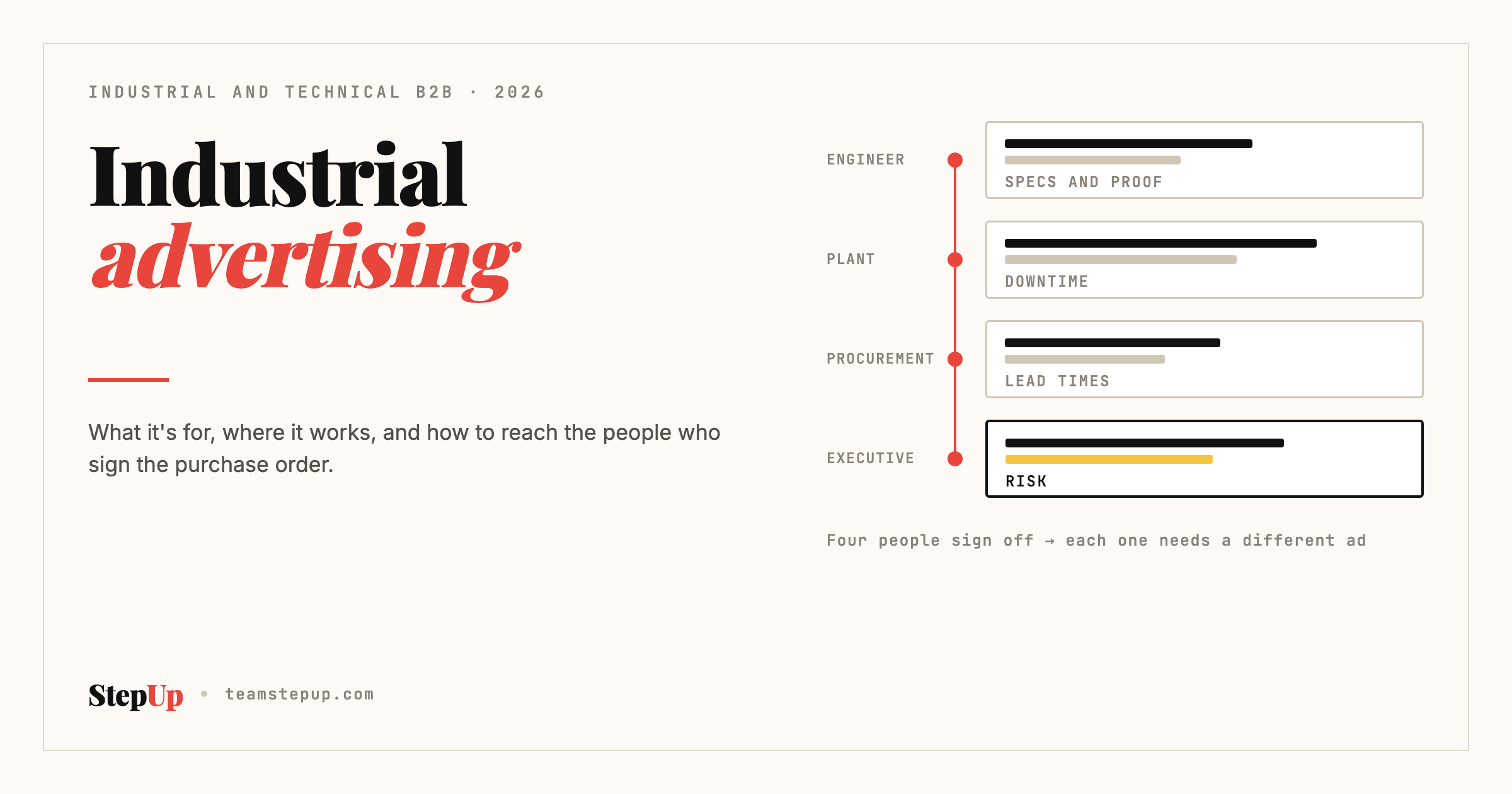
Next, list who is involved in a typical purchase and what each person needs to see.
Role
What they care about
What your ad should show
Engineer
Specs, tolerances, proof it works
Data sheets, test results, CAD files
Operations or plant manager
Downtime, installation, support
Case studies, installation time, service terms
Procurement
Lead times, certifications, total cost
Certifications, delivery times, pricing logic
Executive
Risk, growth, supplier stability
Customer names, track record, results
Each role gets its own message, because a single ad written for all four usually lands with none of them.
Use their words, not yours
Engineers spot marketing language immediately. So take your wording from sales calls, customer interviews and support tickets. Our guide to B2B market research shows how to collect it in four weeks. If customers say “changeover time” and your ad says “operational agility,” they will scroll right past.
What industrial product advertising should say
Good industrial product advertising leads with the application. “Seals rated to 300°C for continuous kiln operation” tells an engineer in two seconds whether to keep reading. By contrast, “innovative sealing solutions” tells her nothing.
Next, include one specific number or proof point: a tolerance, a certification, a result from a real installation. Specifics signal that there is an engineer behind the ad, and technical buyers trust that.
Finally, offer a useful next step. Industrial buyers rarely want a sales call from an ad. They will, however, happily download a spec sheet, a CAD file, an application note or a sizing calculator. Send the click to that page, never to your homepage.
Here are three industrial advertising examples that follow the pattern. They are composites, not named clients.
A filter manufacturer runs search ads on one application, hydraulic filters for injection molding machines, and sends each click to an application note.
One components supplier runs LinkedIn ads to maintenance managers at 200 target plants, offering a downtime checklist.
A machine builder sponsors a trade publication’s newsletter with a short video of the machine running at a customer site.
How much to spend, and how to measure it
There is no correct number. Instead, start with a test: one product line, one or two channels, a fixed budget and 90 days. That is long enough to learn something and short enough to change course. Our B2B marketing budget guide shows how to fit advertising into the wider plan.
Then measure what matters to sales. Clicks and impressions tell you the ads ran. They say little about whether anyone useful saw them. So track these instead:
Which search terms and audiences produce real inquiries
Spec sheet and CAD downloads by channel
Sales conversations that started from an ad
Engagement from your target accounts
What it costs to start one qualified sales conversation
Add a free-text “How did you hear about us?” field to your forms as well. A lot of industrial buying is shaped by forwarded emails and private conversations that analytics never sees, which we cover in our guide to dark social.
Finally, judge the results over a quarter, not a week. Industrial cycles are long, so an ad that runs in March may turn into a purchase order in September. Set one objective for the quarter with two or three measurable results, and review it every month. That way, advertising becomes part of your marketing plan instead of a line item nobody can explain.
Common mistakes in industrial advertising
Most wasted industrial ad budget comes from a handful of habits.
The most common is sending every click to the homepage. The buyer asked a specific question, so the ad should lead to a specific answer.
Broad keywords come next. “Industrial equipment” attracts students, job seekers and competitors, while long technical phrases attract buyers.
Then there is the single message for everyone. The engineer and the CFO need different reasons to care.
Many teams also stop too soon. Four weeks is rarely enough to judge anything in a market where buying takes a year.
And finally, there are ads that sound like marketing. Technical buyers trust specifics and tune out adjectives. We wrote more about that in marketing for engineers.
Frequently asked questions
What is industrial advertising?
Industrial advertising is paid promotion by manufacturers and industrial suppliers, aimed at the engineers, operations managers, procurement teams and executives who specify and buy their products. It includes trade publications, trade shows, search ads, LinkedIn ads, industrial directories, remarketing and video.
What are the functions of industrial advertising?
Industrial advertising does five main jobs. It builds awareness before buyers start looking, reaches the whole buying committee, captures demand from people already searching, supports deals already in progress, and tests messages quickly before a company commits to them.
Does advertising work for industrial companies?
Yes, when it is targeted and patient. Industrial buyers research for months and decide as a group, so advertising works best as a steady presence aimed at specific roles and companies, with a useful next step such as a spec sheet or an application note.
Which channels work best for industrial product advertising?
Search ads work well for buyers looking for a specific part or application. LinkedIn reaches specific roles and target companies. Trade publications and industrial directories add credibility with technical audiences. Most companies should pick two or three channels and run them well.
How do you measure industrial advertising?
Measure the inquiries, downloads and sales conversations that start from ads, plus engagement from your target accounts. Judge the results over at least a quarter, because industrial buying cycles are long.
The plant engineer in Ohio still won’t click your ad.
She will, however, download the spec sheet, forward it to procurement and put your name on the approved supplier list. The stress balls can stay at the booth.