
Demand Generation Vs Lead Generation – What Are The Differences, And Why It Matters For B2B Growth?

Demand generation vs lead generation. Many marketers use these terms interchangeably because of their similar traits. However, the goals, tactics, and approaches to both lead and demand generation are quite different. Both concepts have a crucial role in any B2B marketing strategy and understanding the fundamental differences between them is important. Leveraging them together and effectively translating demand into qualified leads can accelerate your growth and potentially reduce your CAC.

In this article, we’ll take a look at the main differences between demand and lead generation and discuss how using them together can help you create an effective marketing strategy.

The need for demand generation in B2B businesses

For the longest time, companies have been using lead generation as a metric to gauge their marketing performance. Marketing professionals are always under a lot of pressure to increase more qualified leads through different marketing channels. However, the digital marketing sphere has changed. Customers want more control of their buying process and dislike being pushed to sales before they are ready. Just like the B2C model, modern B2B customers expect to have all the information before they decide to buy anything.

Most marketing departments have yet to recognize this change and continue to operate as before. As a result, there’s been a noticeable drop in overall B2B conversion rates for many businesses. Today, about 80% of marketers rate their lead generation effects as slightly or somewhat effective.

Sales teams get increasingly frustrated from the lack of quality leads and think that marketing is wasting both time and resources. Consequently, the departmental divide and lack of direction further deteriorates the customer experience and ultimately hurts the business.

Optimizing the buying experience and nurturing potential customers through proven demand generation techniques is the only way forward for modern businesses. Changing their approach to a targeted, and more personalized model can make things significantly better. This approach allows businesses to generate more high-quality leads at a lower cost and increase their overall revenue with consistent sales.

Demand generation vs lead generation: The main differences.

Demand generation vs lead generation

Many make the mistake of grouping demand and lead generation together and thinking of them as similar concepts. However, that’s wrong. Both frameworks have separate aims and use different methods of leveraging content to meet them. Lead generation is a single tactic to obtain more contacts of potential customers while demand generation is a complete buyer’s journey funnel that focuses on building authority and creating awareness through engaging content.

Primarily, the lead generation process is designed to maximize the number of leads and reduce the overall cost per lead. It captures contact info through gated content and passes out that info to the sales team. On the other hand, demand generation considers the big picture and focuses on measuring different metrics until closing the deal. This approach distributes content freely and creates engagement with the prospects. Demand generation requires detailed attention to every step of the buyer’s journey in order to create a comprehensive nurturing process. The results of which are genuinely qualified leads that produce better conversion rates and sales.

Another prominent difference between lead and demand generation frameworks is the involvement of the sales team. The lead generation process is purely a marketing effort with little to no involvement from sales and other departments. Contrarily demand generation is a combined effort. Both marketing and sales work together in an ongoing effort to facilitate customers and streamline the entire buyer journey.
New Call-to-action

The ultimate marketing strategy – Demand generation framework

After understanding the key differences between demand and lead generation, you’ll naturally want to learn more about the method of integrating them into your strategy. What is inbound marketing’s role in demand generation? How do you implement demand generation in your company? How do you build a demand generation plan? All of these are important questions that any marketing professionals starting with demand generation would ask.

We, at StepUp, have come up with an infallible and easy-to-implement formula that can work for any B2B marketing environment. We call it the Demand Generation Framework.

The demand generation framework stands on 5 pillars starting from customer profiling to the very end of the marketing funnel. Let’s take a brief look at it now!

1 – Ideal customer profile mapping. Ultimate astrategy

As a marketer, you’ll need to deal with the inherent duality of trying to make your business scalable whilst niching down to attract more sales and traction in your target market. An ideal customer profile (ICP) is a perfect tool that makes it easier for you to get those sales by first focusing on customers that are excited, ready, and willing to buy your product. Your ICP doesn’t have to be a real company. As its name suggests, it’s an ideal organization that checks all the boxes when it comes to the kind of company your product/solution is suitable for.

Generally, there are numerous factors you’ll need to consider while making an ideal customer profile. Your selection process will evolve over time and the list can get exhaustive. The more details you add, the easier it will be for your sales team to qualify or reject a lead. If you haven’t done this before, setting up an ideal profile by focusing on the following 6 aspects is a great starting point.

  1. Industry: What is the ideal industry you want to target. Your product or service can be used across many fields, but there will still be some that you’ll prefer over others.
  2. Firm characteristics: Everything from the company size to its revenue matter. You don’t want to join a sinking ship or punch above your weight from the get-go.
  3. Demographic and geographical traits: Are your solution more leaned towards a particular age group or a geographical region. If that’s the case, you’ll have to identify these details as well.
  4. Technological awareness: Some solutions can only be for a particular profession or audience. Can your solution have any intricate processes that need prior industrial knowledge?
  5. The limitations of your solution: You can’t serve everyone. So, you need to make sure that the solution you are selling will be able to solve an existing issue for the business. This is very important for gaining marketing credibility ensuring a sustainable business.
  6. Psychographic behaviors: In the end, it’s the people making the buying decisions. Your marketing strategy and content should focus on them and try to answer the questions they might have. For this, it’s a common practice to create buyer personas that represent the same things as your ICP. The only difference is that the ICP is the business you want to deal with, while the personas are the people.
2 – Crack the buyer’s intent

Modern buyers do not want to deal with a traditional marketing department that pushes them along different stages. They instead want to become aware of the current solution, consider all the benefits, and then finally decide to purchase at their own pace. It’s a three-stage process and requires you to present information about your product/service to help the buyer reach a decision.
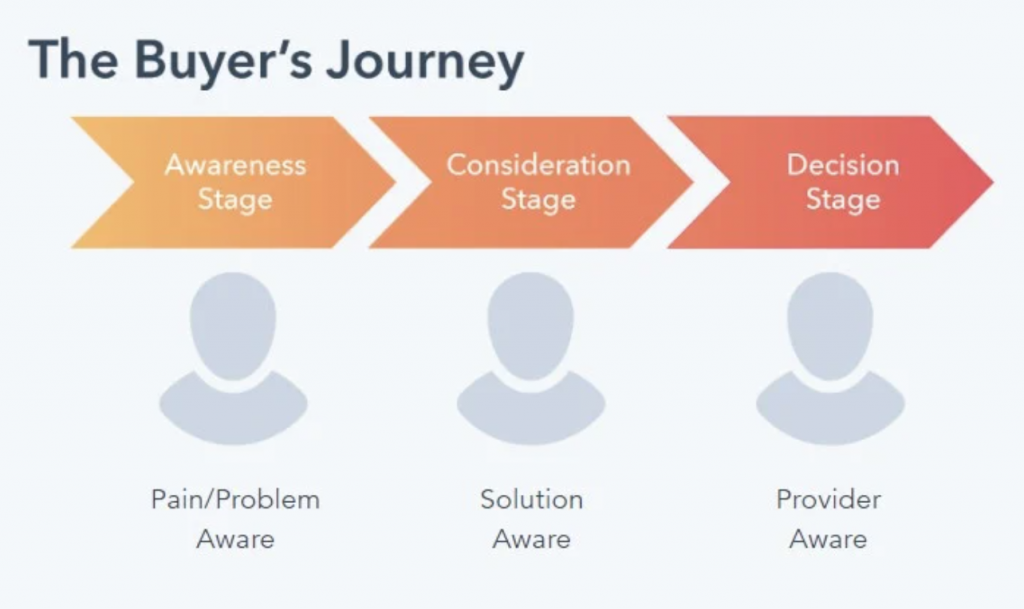
Buyers Journey
Source: https://blog.hubspot.com/sales/what-is-the-buyers-journey

Demand generation requires you to create appropriate strategies to facilitate, not direct the buyer’s journey. Mapping out the expected journey will also help you streamline the process and make sure that you won’t be losing out on any opportunities to capitalize.

3 – Generate and distribute value to the buyer

One thing is always constant in any marketing approach you adopt, and that is the importance of content. You’ll need to create engaging content that adds value to the buyer and moves them along the journey.

You’ll have to plan and execute multiple content strategies for each stage of the buyer’s journey. Every piece must also have some conversion points to help the potential client contact you for more information or anything else. You’ll also need to ensure that your content covers all the media channels your targeted customers frequent as a multi-channel approach yields better and faster results by solidifying your brand authority.

4 – Sales and marketing alignment

sales and marketing alignmentYou may have different departments for certain jobs, but your customer is dealing with a single entity and expects a streamlined process. To ensure that, you must align the priorities of your marketing and sales department and ensure a smooth and timely process. The customers control the pace in demand generation models, but they also expect to get quick answers whenever they initiate contact. Through a well-defined lead handoff process, you can ensure a smooth and consistent process for all your customers.

5 – Utilizing advanced technologies

Advanced CRM tools and data analytics has completely changed the marketing landscape. Businesses now have access to multi-channel data streams that track the customer’s journey and can create dynamic strategies with marketing and sales automation tools. If you are still not leveraging data analytics and modern tools for your marketing campaigns, you are probably behind your competition and might need to overhaul your processes.

Navigate the modern marketing landscape with StepUp

Modern marketing has changed. According to a survey, 70% of B2B marketing professionals believe that the quality of the lead is more important than quantity. Demand generation is the proven methodology of attaining that quality.

Today, numerous top-tier marketing companies use demand generation to guide their customers throughout their marketing journeys till the closed deal. Implementing demand generation in your team is easier than you think. The best part is that StepUp can help you improve your chances of success. Our demand generation framework, along with other customized solutions, can help you successfully navigate the modern marketing environment and increase your revenue pipeline in the most efficient manner.

Want to experience the power of demand generation on your company? Schedule a Free customized Demo Session to see how demand generation can work for your company, and get tips and analysis on your website, competitors, and market.
 

MQL vs SQL: How to Fix the Lead Handoff Between Marketing and Sales

Most B2B companies do not have a lead quality problem. They have a definition problem that looks like a lead quality problem.

Marketing sends what it believes are qualified leads. Sales works a few, decides the rest are junk, and stops trusting the queue. Marketing sees leads going untouched and concludes sales is lazy. Both teams are looking at the same records and reading them completely differently, because nobody wrote down what “qualified” means.

Forrester has put the average B2B lead acceptance rate at around 42%. More than half of what marketing hands over is never properly worked. That is not a volume problem you can spend your way out of. It is a handoff problem, and it is fixable in about two weeks.

Here is the difference between an MQL and an SQL, and the five things that make the handoff between them actually work.

MQL vs SQL: what is the difference?

A Marketing Qualified Lead (MQL) has shown enough interest to be worth marketing’s continued attention. A Sales Qualified Lead (SQL) has shown enough intent and fit to be worth a salesperson’s time.

The distinction is not seniority or company size. It is what the lead has demonstrated:

MQL SQL
What it signals Interest — they are paying attention Intent — they are evaluating a purchase
Evidence Content engagement, repeat visits, email response Demo request, pricing enquiry, stated timeline, budget signals
Who owns it Marketing Sales
Next action Nurture, educate, qualify further Direct contact, discovery call
Failure mode Passed to sales too early and burned Left in nurture and lost to a competitor

An MQL understands your product and is interested in it, but is not ready to buy. An SQL has shown real intent and needs a conversation, not another whitepaper.

Why the distinction breaks down in practice

Three things go wrong, and they go wrong at almost every company:

Interest gets mistaken for intent. Somebody downloads a report and hits an MQL score threshold. Nothing about that download says they intend to buy anything. Scoring models that count activity without weighting type of activity produce exactly this.

Fit gets ignored entirely. A perfect-fit company showing moderate interest is worth far more than a wrong-fit company showing high interest. Most scoring models reward the second and miss the first.

The threshold is arbitrary. Somebody picked 100 points in a meeting three years ago. Nobody has checked since whether leads crossing 100 actually close at a better rate than leads at 80.

The five essentials of an MQL to SQL handoff that works

Marketing owns the alignment here. Not because it is marketing’s fault, but because marketing controls the definitions, the data, and the moment of transfer.

1. Establish shared lead definitions

The definition of a qualified lead is the single biggest source of conflict between marketing and sales, so settle it first.

Get marketing, sales, and whoever owns revenue in one room and write down, in plain language, what makes a lead an MQL and what makes it an SQL. Not a score — the actual criteria. Then have both leaders sign it.

The test of a real definition is whether two people, given the same lead record, independently assign the same stage. If they cannot, the definition is not finished.

2. Build the vocabulary and the SLA

Sales evaluates incoming leads on two axes: fit — how well you can serve them — and interest — how much of a priority you are to them. Marketing is responsible for defining lifecycle stages against those two axes, creating the lead categories, and documenting how each is handled.

That document is a Service Level Agreement, and it needs to be genuinely bilateral:

  • Marketing commits to a volume of MQLs meeting the agreed definition, with required fields populated.
  • Sales commits to working every accepted lead within a defined window, and to recording a disposition reason for every rejection.

That second commitment is the one people skip, and it is the one that makes the system learn. Without a structured rejection reason, you never find out why half the leads are being dropped.

3. Document the handoff properly

Leads slip because the information does not travel with them. A rep opens a record, sees a name and a company, and starts the conversation from zero — when marketing already knew what the lead read, what problem they searched for, and which competitor they compared.

Define the minimum record that must accompany every handoff: source, the content or campaign that drove engagement, the problem indicated, relevant firmographics, and any stated timeline. Make the fields required rather than optional. Optional fields do not get filled.

4. Get the timing right

Speed is the highest-leverage variable in the entire handoff, and the cheapest to fix.

The working standard is contact within 24 hours of qualification, and faster for high-intent actions. A demo request should be answered in minutes, not the following morning. Intent decays — the person who requested a demo at 10am is comparing three vendors by lunch.

If you fix nothing else on this list, measure your median time from qualification to first contact. It is usually far worse than anyone believes, and it is usually a routing problem, not an effort problem.

5. Keep marketing in the room early

Most B2B purchases require a relationship before conversion. Marketing has often already built one — through content, through email, through months of low-grade familiarity.

Keeping a marketer in the first sales conversation makes the transition feel like a continuation rather than a handoff to a stranger. It also gives marketing direct exposure to how buyers actually describe their problem, which is worth more than any amount of survey data.

What to measure once the definitions are fixed

Definitions are only half the work. Without instrumentation you cannot tell whether the new definitions are better than the old ones, so agree these five numbers at the same meeting where you agree the definitions.

Metric What it tells you Healthy signal What it means when it slips
Lead acceptance rate Share of MQLs sales actually works Above 70% Your MQL definition is letting the wrong leads through
Median time to first contact How fast qualification turns into a conversation Under 24 hours; minutes for demo requests A routing problem, almost never an effort problem
MQL to SQL conversion rate Whether interest is turning into intent Stable or rising quarter on quarter Nurture is not moving people, or the threshold is set too low
Rejection reasons, grouped Why sales is dropping leads Two or three reasons, each shrinking Nobody is recording dispositions, so nothing is learning
SQL to opportunity rate Whether sales agrees with its own definition Consistent across reps Reps are applying the SQL definition differently

Review all five together, monthly, with both teams in the room. Looked at individually they mislead: acceptance rate rises trivially if marketing simply sends fewer leads, and conversion rate rises if sales quietly stops accepting anything marginal. Read as a set, however, they tell you whether the handoff is genuinely improving.

The one to watch first is lead acceptance rate. It is the closest thing to a single measure of whether the two teams are describing the same thing when they say “qualified.”

A worked example: what the arithmetic looks like

The numbers below are illustrative rather than a specific client, but the shape of them is what an audit of this kind usually finds.

Take a mid-market industrial supplier where leadership has called the problem a lead quality crisis. Marketing reports 180 MQLs a quarter. Sales reports that “almost none of them are real.” Both are telling the truth as they see it.

Pull the records and the picture resolves. Of those 180, sales contacted 71 — roughly 39%, close to the Forrester figure above. Of the 109 never worked, the reasons cluster into three groups:

  • Wrong company size. Around half are sub-25-employee firms that cannot meet the minimum order quantity. No size field is required on the form, so this stays invisible until a rep opens the record.
  • No stated problem. A second group downloaded a single top-of-funnel guide and hit the score threshold on page views alone. Nothing indicates what they are trying to solve.
  • Existing customers. A smaller group are contacts at accounts the company already serves, re-entering through the website and being scored as new.

None of that is a lead quality problem. Each one is a definition or a data problem, and all three are fixable inside a fortnight.

What actually gets changed

The fixes are unglamorous. Company size becomes a required form field and a hard disqualifier below the threshold. The score model is reweighted so that a single downloaded asset can no longer, by itself, cross the MQL line — some evidence of a stated problem becomes mandatory. Existing accounts are suppressed from the MQL queue and routed to account management instead.

Then volume drops. Marketing reports 96 MQLs the following quarter instead of 180, which feels like a loss until the second number arrives: sales works 78 of them. Acceptance moves from 39% to 81%, and the number of leads actually contacted rises from 71 to 78 — more real conversations, from barely half the reported volume.

That pattern is the normal outcome. Fixing the definitions almost always reduces reported MQL volume and increases the amount of genuine sales activity. If your MQL number is a target somebody is measured on, agree in advance that it is expected to fall.

How AI changes lead qualification in 2026

The five essentials above have been true for a decade. What has changed is that the expensive parts are no longer expensive.

Qualification stops being a score and becomes a judgement. Point-based scoring was always a workaround — a crude proxy because reading every lead record by hand did not scale. It does now. An agent with your ICP definition, your won/lost history, and your product constraints can assess fit and intent on each lead individually and explain its reasoning in a sentence a rep can read.

The important part is the explanation. A score of 87 tells a rep nothing. “Manufacturing, 200 employees, viewed pricing twice this week, their current vendor was just acquired” tells them how to open the call.

The definitions become a living document. The hardest part of the SLA has always been maintaining it. Nobody revisits qualification criteria quarterly because it means a painful meeting and a data pull nobody has time for. When rejection reasons are captured in a structured way, that analysis runs continuously — and the criteria get corrected from evidence instead of from opinion.

Two warnings. First, this only works if the ICP definition is genuinely written down. An agent working from a vague ideal customer profile produces confidently wrong qualification, faster and at greater volume. The system amplifies your definition — so the definition has to be right. Second, automating the handoff without fixing the definitions just industrialises the existing disagreement. Fix the definitions first, then automate.

This is the difference between AI-decorated and AI-integrated operations. Decorated is a scoring model with a machine-learning label on it. Integrated is a qualification process that improves every week because it is learning from what sales actually accepted and closed.

How to fix your handoff in two weeks

Week one — establish the truth. Pull every lead marketing passed to sales in the last quarter — the same exercise a full marketing audit starts with. Calculate what percentage sales actually worked, and what percentage of those became opportunities. Then take the twenty most recent rejected leads and find out, individually, why each was rejected. You will almost always find two or three recurring reasons that account for most of the rejections.

Week two — rewrite and commit. Sit both teams down with those reasons. Rewrite the MQL and SQL definitions so the recurring rejection reasons are screened out before handoff. Agree the SLA in both directions. Make the required handoff fields mandatory in your CRM. Set the response-time standard and instrument it.

Then review the same numbers in thirty days. Acceptance rate is the metric that tells you whether the definitions are working.

Frequently asked questions

What does MQL stand for?

Marketing Qualified Lead — a lead that has engaged enough with marketing to warrant continued attention, but has not yet demonstrated buying intent.

What does SQL stand for in marketing?

Sales Qualified Lead — a lead that has shown enough intent and fit that a salesperson should contact them directly. In a marketing context it has nothing to do with the database query language of the same abbreviation.

What is the difference between an MQL and an SQL?

An MQL has shown interest; an SQL has shown intent. Interest means they are paying attention to you. Intent means they are actively evaluating a purchase. The MQL belongs to marketing, the SQL belongs to sales.

Who decides when an MQL becomes an SQL?

Both teams, in advance, in writing. If sales alone decides, marketing has no target to work toward. If marketing alone decides, sales will not trust the queue. The definition should be agreed jointly and reviewed quarterly.

What is a good MQL to SQL conversion rate?

It varies widely by category and deal size, so external benchmarks are of limited use. What matters more is your lead acceptance rate — the share of MQLs sales actually works. If that is below roughly half, your definition is wrong, regardless of what any benchmark says.

Should we use lead scoring at all?

Scoring is a useful triage signal and a poor decision-maker. Use it to prioritise, not to qualify. And check at least once a year whether leads above your threshold genuinely close at a higher rate than leads just below it — often they do not.

How long should a lead stay an MQL before it is recycled?

Set an explicit expiry rather than letting records sit indefinitely. A common working rule is 90 days: if an MQL has not progressed to SQL in that window, it returns to nurture with its score reset. Otherwise your MQL pool slowly fills with contacts who looked interested two years ago.

Should marketing be measured on MQLs or on pipeline?

On pipeline, with MQLs as a diagnostic rather than a goal. The moment MQL volume becomes the number marketing is judged on, the definition starts drifting to make the number easier to hit — which is how most companies arrive at the problem in the first place.

What is an SQL versus an SAL?

Some organisations add Sales Accepted Lead (SAL) between MQL and SQL: marketing passes an MQL, sales formally accepts it as an SAL, and it becomes an SQL once discovery confirms fit and intent. The extra stage is worth adding only if you need to measure acceptance separately from qualification.

The short version

MQL and SQL are not scoring tiers. They mark the boundary between interest and intent, and between two teams that need to agree on where that boundary sits.

Write the definitions down. Commit to both sides of the SLA. Make the handoff record mandatory. Answer fast. Capture why leads get rejected, and let that evidence correct the definitions.

The companies that get this right are not generating better leads than you. They have simply agreed what a lead is.

StepUp builds and runs AI-integrated marketing operations for global B2B companies — including the qualification systems that make the marketing-to-sales handoff work. Let’s talk about where your handoff is leaking.