In recent years I’ve met and spoken to hundreds of marketing executives at B2B companies. When I ask them to describe their challenges as marketers, the common denominator is a very strong and genuine desire to succeed in the role met by frustration with management who’s not on board with their initiatives for implementing new processes.
The explanations I get are usually along the lines of management’s lack of understanding of the CMO’s role or the lack of cooperation and desire to invest in the resources needed for the CMO to succeed.
What’s in a Title?
These challenges of the marketer have been covered in-depth many many times before. But this only proves that the role of the marketing manager is the most challenging role at the management levels and the most difficult to maintain over time. Research shows that the marketing manager’s position lasts for approx. 42 months, which is in comparison, half the time other managing roles.
Furthermore, there are companies such as Johnson and Johnson, Uber and Hyatt Hotels that have decided to completely eliminate the role of Chief Marketing Officer (CMO) and convert it to more general role definitions such as company Growth Manager or Customer Success Manager.
Is the Role of CMO Facing Extinction Or Rebirth?
Let’s first try to understand the reason for friction between the marketing manager and upper management mentioned above.
It begins with the digital revolution that has transformed the marketing world. If once companies had few means of reaching the customer and only companies with enormous budgets could advertise and stand out, today every company can reach its entire potential clientele, sometimes, at the cost of cents.
This new reality created possibilities for the rapid growth of unprecedented proportions which we’ve seen from the mega brands of today from the likes of Google, Facebook, Amazon, Airbnb, Uber and more who’ve gone from small startups into giant corporations at meteoric speed. This new reality changed the business world completely, and marketing as well.
A Source of Friction with Upper Management
On the one hand, it’s easier to reach your audience accurately and cheaply. But on the other, it’s much more difficult to stand out and get your audiences’ attention. This sets the ground for friction when companies struggle to grow today despite all the many media and advertising opportunities.
What then, differentiates between companies with amazing growth and those who stay stagnant? And how does this relate to the marketing strategy?
The answer, in my opinion, lies in a very common tendency of senior management, as well as marketing managers, to seek quick solutions. When it comes to using social media or advertising with Google whatever it might be – a “results now” mindset creates a difficulty when building a solid strategic plan.
The CMO of the Future
The CMO of the future will understand that no matter how easy and fast digital marketing can help the company grow, it will ultimately fail if the tactics used don’t have a long term strategy behind it.
The CMO of the future will also know that in order to further accelerate growth, a system needs to be in place for the strategy to be executed efficiently.
At StepUp our mission is to help you, the CMO of today become the CMO of the future by building the right strategy and implementing systems for accelerating your company’s growth.
As a CMO, part of your work is to uncover new methodologies and plans that can work for your business. You have done the research, and you might have even tested it out. Now you need approval from your managers to implement that shiny new B2B marketing plan.
Uncovering a B2B marketing plan that will work for the unique needs of your company is no small feat. However, the hard part may still be ahead of you. You want to make sure that your superiors are supportive of your work, understanding of the tasks at hand, and, perhaps most importantly, are willing to back you up with the budget that you need to execute it properly.
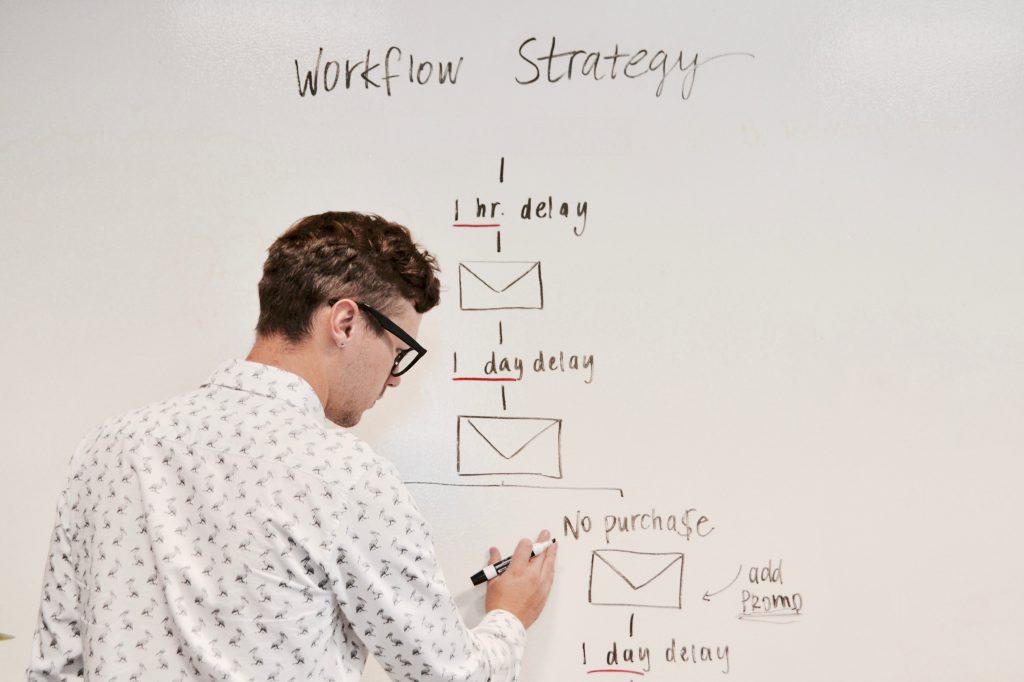
The very first step to implementing your B2B marketing plan is to let your managers know that it exists. Set up a meeting for your upper management team, and make sure the agenda is clear. It might be a good idea to send an email to give your meeting the attention it deserves. This is not the kind of meeting that you mention in passing to your supervisor in the hallway. Rather, this is the kind of meeting that requires a calendar invitation, and probably an email follow-up explaining the purpose of the meeting.
You want to let them know ahead of time that they will be presented with a new plan and a new budget. In your meeting invitation, including “teasers” about the plan, mentioning key elements or out-of-the-box components that will grab their attention. At the bottom of the email invitation, add a line about discussing a proposed budget that requires their approval.
Own it
In the B2B world, a lot of your meetings might take place without so much as a whiteboard. As the CMO of the company, in a digital world, you want to bring technology into the board room. You’ll want to wow your supervisors with a PowerPoint presentation – or even take the time to create an interactive presentation like one of the free templates on Prezi.
Include all of the relevant details of your B2B marketing plan, and be open to questions about the smaller details that you might think are obvious. Once your presentation is prepared, take the time to review it. More than once. You want to be the captain of the ship – and practice is key.
Follow up
After the flawless presentation of your ideas for implementing a new marketing plan, the room might sit silent. Or, your upper management team might have asked dozens of questions throughout the presentation, turning your 30-minute meeting into an hour and a half. However your meeting ended, you likely don’t have final approval from the managers. You might need an extra push to get that budget approval you’re seeking.
This is where your follow-up is vital. Sending out an email to those present at the meeting is a basic first step. Thank them for attending and for taking the time to meet with you. Attach a copy of your presentation PDF for their records. And most importantly, include a deadline for their response.
You’ve now given upper management all the tools they need to make a decision. Your next step is to make sure it happens. You’ll want to schedule a follow-up email close to the deadline, to check in on the status of their decision-making process, and ask if they have any additional questions.
Want to call in an expert?
Sometimes, presenting your new marketing plan to upper management can seem daunting. Why not bring in an expert to do the hard part for you? At StepUp, our team can support you throughout your work – from presenting a marketing plan and growth strategy, to helping you implement it. Set up a call with a member of our team to consult on what kind of marketing strategy will work best for your B2B company. We’re here for you, every step of the way.
Originally published February 2020. Updated October 2026.
Ask a marketing team for its goals and you’ll usually get one of two answers. The first is a single word, said with great conviction: “Growth.” The second is a list so long it needs a table of contents, a glossary and its own project manager.
Neither one tells anyone what to do on Tuesday.
Goals are supposed to be the easy part. You decide where you’re going, then you go. But marketing goals have a way of drifting into wishes (“be thought leaders”), activities (“post more on LinkedIn”) or numbers nobody can explain (“30% more engagement,” engagement with what, by whom, and why would the CFO care?).
Add AI to the mix and it gets stranger. Ask a chatbot for marketing goals and you’ll get twelve beautifully formatted ones in four seconds. All of them sound right. None of them know that your sales team is drowning in bad leads from the wrong country.
Good marketing goals are specific to your business, tied to what sales and leadership need, and short enough to remember. The examples below will give you a head start, and the steps after them will help you choose the few that fit.
Marketing Goals vs. Marketing Objectives
The two words get used as if they mean the same thing. In practice, it helps to split them.
A marketing goal is the outcome you want: “Become the supplier engineers find first when they search for our category.”
A marketing objective is a specific, measurable step toward it: “Show on Google’s first page for 20 of our 30 target searches by June 30.”
Goals give direction. Objectives make the direction measurable. In general, teams need one to three goals, each with two or three objectives under it. If that structure sounds familiar, it’s the same idea behind marketing OKRs.
How to Write SMART Marketing Goals
SMART is the oldest checklist in goal setting, and it still works. Each objective should be:
Letter
Means
Ask Yourself
S
Specific
Would two people read this and picture the same result?
M
Measurable
Is there a number, and do we have a way to track it?
A
Achievable
Can this team, with this budget, get there?
R
Relevant
Does it connect to what the business needs this year?
T
Time-bound
Is there a date?
Here’s the difference in practice. “Increase conversions” is a wish. “Raise the share of website visitors who fill in the demo form from 0.8% to 1.5% by the end of Q2” is a SMART marketing goal. As a result, anyone can check it, and everyone knows what success looks like.
Still, the one trap with SMART is that it checks the wording, not the choice. A perfectly SMART goal can still be the wrong goal. That’s why the next sections matter.
15 Marketing Goals Examples for B2B Teams
These are grouped by where they sit on the path from stranger to customer. So pick from the stage where your business has the biggest gap.
Getting Found
Grow clicks from Google from 40 to 140 per four weeks by December 31.
Show on Google’s first page for 20 of 30 target searches by June 30.
Grow visits from the target region by 50% this quarter.
Get cited in AI answers (ChatGPT, Google’s AI results) for 5 of our core questions by year end.
Building the Audience
Grow newsletter subscribers from 150 to 400 by December 31.
Grow the company page by 300 followers from the target market this quarter.
Publish 3 posts a week across the company page and the founder’s profile for 13 weeks.
Turning Interest Into Leads
Raise the demo-form conversion rate on the top three pages from 0.8% to 1.5%.
Get 120 people from the target customer profile to join the funnel this quarter.
Cut cost per qualified lead on LinkedIn from $240 to $180.
Working With Sales
Agree a written definition of a qualified lead with sales by the end of month one.
Get the average time to first follow-up on inbound leads under 24 hours.
Book 6 sales calls from marketing leads this quarter.
Revenue and Retention
Create $500,000 in pipeline from marketing leads this year.
Get 20% of existing customers to attend one product webinar, to support renewals.
Swap in your own numbers. Otherwise, a goal with someone else’s starting point is just a nice sentence.
Marketing Objectives Examples by Goal
To show how goals and objectives fit together, here are three goals with their objectives underneath.
Goal
Objectives
Make the website a source of sales conversations
Google clicks from 40 to 140 per four weeks · form fills from 5 to 12 a quarter · 6 calls booked from website leads
Become the voice our buyers follow
Newsletter from 150 to 400 subscribers · 39 posts in the quarter · 300 new followers from the target market
Give sales better leads, not more leads
Qualified-lead definition agreed by week 4 · 60% of marketing leads accepted by sales · follow-up under 24 hours
How to Choose the Right Marketing Goals
Start From the Business, Not From Marketing
Read the company’s plan for the year, or ask the CEO what has to be true by December. Then pick the part marketing can move. By contrast, goals that start inside marketing (“more content”) tend to stay inside marketing.
Find the Biggest Gap in the Funnel
Look at each stage: getting found, building the audience, leads, the handoff to sales, revenue. Where do the most good prospects fall out? Set your goals there first. For example, a team with plenty of traffic and no leads needs a conversion goal, not a traffic goal.
Keep It to Three
One to three goals per quarter. In fact, each one you add takes time and attention from the others. Teams with eight goals don’t have priorities, they have a wish list.
Agree Them With Sales
Any goal that depends on sales (follow-up, lead acceptance, calls) needs their yes before the quarter starts. In the end, shared goals are how marketing and sales stop arguing about whose numbers are right. Our guide to MQL vs. SQL helps settle the definitions.
Make Sure You Can Measure It
If the tracking doesn’t exist, the first objective is to build it. Our guide to B2B marketing KPIs also lists the numbers worth tracking and where each one comes from.
Where AI Helps, and Where It Doesn’t
AI can draft a list of goals in seconds, pull last quarter’s numbers to set realistic starting points, and track progress every week. That’s real help, especially for a small team.
Still, AI doesn’t know what your CEO said in last week’s leadership meeting, which customers are the profitable ones, or that the sales team just lost two people. Choosing the goals is a judgment call about the business, so it stays with a person. Use AI for the research and the tracking, then decide.
Frequently Asked Questions
What are examples of marketing goals?
Examples of marketing goals include growing clicks from Google from 40 to 140 per four weeks, growing newsletter subscribers from 150 to 400, raising the demo-form conversion rate from 0.8% to 1.5%, booking 6 sales calls from marketing leads in a quarter, and creating $500,000 in pipeline from marketing leads in a year.
What is the difference between marketing goals and marketing objectives?
A marketing goal is the outcome you want, such as making the website a source of sales conversations. A marketing objective is a specific, measurable step toward that goal, such as growing website form fills from 5 to 12 a quarter.
What are SMART marketing goals?
SMART marketing goals are specific, measurable, achievable, relevant and time-bound. For example, “raise the share of website visitors who fill in the demo form from 0.8% to 1.5% by the end of Q2” is a SMART goal, while “increase conversions” is not.
How many marketing goals should a team have?
One to three goals per quarter, each with two or three measurable objectives. More than that spreads the team too thin and makes it hard to say no to work that doesn’t serve the goals.
How do you set marketing goals that support sales?
Start from the sales target, work backward to how many qualified conversations marketing needs to help create, and agree the definition of a qualified lead with sales. Then set shared goals for the handoff, such as follow-up time and the share of leads sales accepts.
Tuesday, Sorted
“Growth” is a fine word for a mug. It’s a terrible goal.
Three goals, a few numbers under each, and a date. That’s enough for everyone on the team to know what Tuesday is for, and what it isn’t.
The chatbot’s twelve beautifully formatted goals can go in the drawer with the mug.
Want to know whether your team is ready to plan with AI in the loop? The free AI-Readiness Self-Audit shows where you stand.
If you’re responsible for marketing, sales or business development for your B2B company, you have a unique and different set of challenges than businesses looking to market directly to consumers. While B2B marketing uses many of the same techniques as B2C marketing, the application is very different and marketing to other businesses requires a different content strategy focused on different channels. It’s essential to set good metrics and make sure you’re tracking the impact of your efforts. While there are a number of challenges of industrial marketing, here are a few common ones, and how you can overcome them.
Producing Quality Content
Content marketing, as part of a broader inbound marketing system, is an incredibly effective way to draw in an audience of potential leads, showcase your expertise, and get leads reaching out to you. However, producing that content, especially in an industrial setting, can be a challenge. The content has to be technical enough to show a clear understanding of the material without being so complex as to turn off potential leads who come from business backgrounds, like a VP Purchasing or CMO, who aren’t experts in the technical side of your product. The solution is to have content marketers work closely with technical staff to ensure that content produced is both accurate and readable. With the directive from upper management to participate, technical team members often enjoy explaining everything they do.
Promoting Your Content
Putting out great content is only the first step. Once you’ve written an article that you think will resonate with potential leads, you have to publish it in different channels that will get their attention. Your business needs to have a presence in a number of different content channels and plans to attract leads to your content. It’s key to think about your target market and to understand what channels they use most for industry learning and research. For example, in the US LinkedIn is a primary content channel for serious B2B companies. However, in India, Facebook and Youtube are extremely relevant even for highly technical businesses. Making a good content distribution plan based on your target audience before you start publishing content is a good way to ensure that what you write gets read by the right people.
Setting Expectations
Everyone, including upper management, reads stories about runaway successes with internet marketing, so it’s important before you begin your marketing campaign to research what is typical for your industry and set expectations accordingly. Then, revisit your plan periodically and compare your expectations to actual campaign metrics. Show how many people are viewing your content in different channels and how many are clicking through to your website or reaching out for follow up. If you can, work with your sales team to track how many of these leads convert into sales so you can show, with a dollar amount, the impact of your marketing efforts.
Maintaining Publishing Schedules
Once you’ve started a successful content campaign, you need to continue to develop content so that fresh material containing the correct keywords appears on your website and in your content channels. Someone on the marketing team has to take responsibility for researching and creating content and making sure it gets out on time. If you don’t have an in house marketing team, consider outsourcing your marketing to an external agency that specializes in B2B companies – sticking to a publishing schedule gets challenging if there is no one dedicated to the project. Don’t think you need to publish daily for success. Instead, focus on quality, reliability and applicability so that your articles have the biggest impact.
Trying New Channels
If your organization is having success with one content channel, it may be difficult to get them to consider trying a different or new channel. This is often a place where recycling old content can be useful to establish yourself on the channel or, if you’re looking at something like YouTube where you’d have to create video content, that content can then be used on your existing channels. Shaking up the type of content offered can get the attention of your existing audience and give you a great way to cross-promote your efforts.
While inbound marketing for industrial B2B businesses can be challenging, with good planning and execution, it can be very effective. Bringing in a team like StepUp can help meet this challenge. We take the time to understand your business and brainstorm content ideas that will resonate with your leads. Then we work with your staff to ensure our content is accurate but we take the responsibility for keeping the good content coming. If you’d like to learn more, reach out to us for a free marketing strategy session and learn how to apply inbound marketing principles to your business.
Digital marketing has become increasingly popular for B2B and manufacturing companies. The field of digital marketing has also evolved both contextually and technologically.
Marketers constantly need to consider how they incorporate the new online channels and platforms that are emerging. They also need to adjust how they work with their existing marketing tools which are also constantly being updated.
With all of this change, keeping up with the current marketing trends can be challenging. Even more so for marketers of B2B and manufacturing companies, where marketing can be a greater challenge due to the highly technical nature of the value offer. In this article, we present our top 6 picks for the most important B2B marketing trends to follow this year.
One of the most important marketing principles in B2B is content marketing.
The trend is moving from generalized “marketing speak” to presenting technical information in a educational, concise and easy to understand manner.
Educational content is found to be effective for all different types of formats: professional articles, videos, podcasts, and webinars.
2. Smart Lead Qualification
We are increasingly seeing more companies investing in smart CRMs, powered by artificial intelligence for lead qualification automation. These systems help in identifying qualified leads from early on in the process. When companies increase the effectiveness of their marketing and sales efforts in this way, they are able to allocate resources towards leads that are more likely to convert to paying customers.
3. Personalization
Marketers are increasingly serving prospects with personalized content, rather than the traditional one-size-fits-all approach. Personalization tools can target content depending on personal information such as demographics, interests, and other profiling criteria. This type of targeted content resonates more with the audience, resulting in increased engagement.
4. Offline & Online Working Together
The benefits of participating in trade shows and industry meetups is multiplied when they are coupled with online marketing activities. Firstly, targeted online marketing efforts before a trade show can increase the effectiveness of the trade show. Secondly, by adapting and customizing online marketing after a trade show, a company will have an even stronger impression on their target audiences. When offline and online marketing activities are in sync, a company is able to optimize their effects and provide maximum returns in both cases.
5. PR & Influencer Marketing
Companies are increasingly turning to PR techniques for online marketing. For example, a manufacturer will select middle to high-level managers to publish guest posts on industry trade magazines. Another technique is involving renowned celebrity professionals in their marketing to strengthen their brand.
6. B2B2C
For B2B and especially manufacturers, it can be extremely effective to sell directly to the consumer. Even though they are not the ones who will be purchasing directly from you. The aim is simple, by educating you can influence the end consumer and thereby create demand in your market.
Although we see a technology shift in the industry, what most B2B and manufacturing companies still lack is a clear marketing strategy and an actionable plan. Moreover, there are so many marketing possibilities for B2B manufacturers to choose from. Structuring an actionable strategy that contains the parts that are right for your company can be difficult. This is where StepUp comes in, an inbound marketing agency for manufacturers and B2B companies in unlocking their full potential.
Our clients worked hard to achieve where they are today and we strive to build on that by helping them devise strategies that not only raise their visibility and competitive advantage, but also accelerate their sales and growth.
Contact us for a free consultation to hear how we can help you conceive and implement a solid online marketing strategy plan, tailored to your needs and budget.
Originally published January 2020. Updated October 2026.
Manufacturing marketing has a reputation problem, and it’s mostly earned. For decades the plan was a trade show booth, a brochure that hadn’t been updated since the previous CEO, and a sales team that “handled the relationships.” (It’s always the relationships.) Marketing was the department that ordered the lanyards.
Then buyers changed. The engineer who specs your part now does most of her research before she ever talks to you. She reads datasheets at 11 pm, compares three suppliers on Google, and asks ChatGPT which one has the better tolerance range. By the time she calls, the shortlist is done.
It’s a strange time to be marketing a machine.
Meanwhile, someone in the boardroom has decided AI will fix it, and that by Q3 the company will have “a digital-first industrial brand” with the same two people who currently run the website and the trade shows. Bless.
The good news is that manufacturers don’t need a giant team to compete. They need a plan: written down, tied to sales, aimed at the right buyers and honest about what the team can do. A manufacturing marketing plan is that document, and it fits on a few pages.
This guide walks through how to build one in eight steps, with a template at the end.
What Is a Manufacturing Marketing Plan?
A manufacturing marketing plan is a written plan for how a manufacturer will find, win and keep the right customers over the next year. In short, it sets the goals, names the buyers, picks the channels, assigns the work and decides how results are measured.
What makes it different from a general marketing plan is the buyer. Industrial purchases are technical, slow, expensive and decided by several people at once. So the plan has to speak to an engineer, a buyer in procurement and an operations manager, often for the same order.
Why Manufacturers Need a Different Plan
Four things set manufacturing marketing apart:
Long sales cycles. Six to eighteen months is normal. The plan has to support buyers for that long, rather than chase a burst of leads.
Technical buyers. Engineers want specs, data and proof. Vague claims lose them on the first page.
Several decision-makers. Engineering, procurement, operations and finance each need a different reason to say yes.
Sales owns the relationship. So marketing’s job is to make sales conversations easier, start more of them, and keep the company in the buyer’s mind between them.
As a result, the plan leans on content that answers technical questions, a website that works as a sales tool, and tight alignment with the sales team. Our post on industrial marketing challenges also covers the common traps in more detail.
How to Build a Manufacturing Marketing Plan in 8 Steps
1. Set Goals That Start From Sales
Begin with the number sales needs. How many new customers this year? Then, how many opportunities does that take, at your usual win rate? How many qualified conversations to create those opportunities?
Work backward from there. If sales needs 40 opportunities and half of qualified conversations become opportunities, marketing needs to help create 80 qualified conversations. That is a goal both teams can agree on, and it beats “increase brand awareness” every time.
Then write the goals as two or three objectives with numbers attached. Our guide to marketing OKRs shows the format.
2. Define Your Ideal Customer
List the industries, company sizes and regions where you win most often and at the best margin. Then describe the companies you want more of. This list then becomes your ideal customer profile, and every other step points at it.
For each target account, name the people involved in a purchase and what each one needs from you.
Role
What They Care About
What Wins Them Over
Design or process engineer
Specs, tolerances, materials, compatibility
Datasheets, CAD files, application notes, a fast answer from a real engineer
Procurement
Price, lead times, supplier risk
Clear terms, certifications, references
Operations or plant manager
Uptime, installation, support
Case studies, service plans, training
Finance or leadership
Total cost, payback, risk
A cost comparison and proof from similar companies
Engineers deserve special attention, because they often decide the shortlist. Our post on marketing for engineers explains why your own technical team belongs in the process.
4. Write Your Positioning Down
In one paragraph: who you serve, the problem you solve, and why you’re the better choice. Then the three proof points that back it up, such as a certification, a performance number, or a customer result.
This sounds basic, yet most manufacturers skip it. As a result, the website, the brochure and the sales deck each describe the company differently. Write it once and use it everywhere.
5. Choose Your Channels
Pick the few channels where your buyers actually look, and do them well. For most industrial B2B companies, that means:
The website and search. Engineers search for specific problems, materials and part types. So pages that answer those searches bring buyers who are already looking.
Technical content. Application notes, comparison guides and how-to articles that an engineer would bookmark.
LinkedIn. For reaching named accounts and keeping leadership visible between sales cycles.
Trade shows. Still valuable, if you plan the follow-up before the show. Our trade show ROI tips cover how.
Email to existing contacts. The cheapest channel most manufacturers underuse.
In general, two to four channels done consistently beat seven done occasionally. For inspiration on the website side, see our roundup of industrial website examples.
6. Build the Content Plan
List the questions each member of the buying group asks, then plan one piece of content for each important question. Organize the plan by quarter, with one main theme per quarter, so the work builds on itself.
For example, a quarter on “reducing downtime” might include an application note for engineers, a cost comparison for finance, a customer story for operations and a webinar recording for sales to send. Our collection of content marketing examples for manufacturers has more ideas.
7. Set the Budget and the Team
Decide what you’ll spend on each channel and who does the work: your team, sales, engineering, an agency or AI. Be honest about capacity, because a plan that needs 30 hours a week from a team of one will fail by March.
This is also where AI earns its place. An AI assistant can draft application notes from engineering’s notes, keep product pages current, pull the monthly numbers and repurpose one webinar into five posts. A person still owns the technical accuracy and the sign-off, which in manufacturing matters more than anywhere. Our AI marketing playbook for manufacturers goes deeper.
8. Measure and Review Every Quarter
Track a short list of numbers tied to the goals in step 1: qualified conversations, opportunities created, website leads from target accounts and pipeline from marketing. Then review them every month with sales and adjust every quarter.
Keep the list short. Our guide to B2B marketing KPIs covers which numbers to keep and which to drop.
A Manufacturing Marketing Plan Template
Use this outline as your plan’s table of contents. Each section can be a few lines.
Section
What Goes In It
1. Goals
Two or three objectives with numbers, worked back from sales targets
2. Ideal customer
Industries, sizes, regions, and why you win there
3. Buying group
Each role, what they need, what wins them over
4. Positioning
One paragraph and three proof points
5. Channels
Two to four channels and the job of each
6. Content plan
One theme per quarter and the pieces under it
7. Budget and team
Spend by channel, who does what, where AI helps
8. Measurement
Five to seven numbers, reviewed monthly with sales
If you’d like to fit it all on a single page first, start with our one-page marketing plan and expand from there.
Common Mistakes in Manufacturing Marketing Plans
Planning Activities Instead of Outcomes
“Attend four trade shows” is an activity. “Create 30 qualified conversations from trade shows” is a goal, and it changes how you plan each show.
Writing for Everyone
A plan aimed at “manufacturers” is aimed at no one. Name the industries and roles. It’s also fine to say no to the rest.
Leaving Sales Out
A plan that sales hasn’t seen will be ignored by sales. Instead, build the goals with them, agree on what a qualified lead is, and review results together.
Treating the Website as a Brochure
For an engineer at 11 pm, your website is the salesperson. If she can’t find specs, compare options or reach someone technical, she moves to the next supplier.
Frequently Asked Questions
What should a manufacturing marketing plan include?
A manufacturing marketing plan should include goals tied to sales targets, an ideal customer profile, a map of the buying group, written positioning, two to four channels, a quarterly content plan, a budget with owners, and a short list of numbers reviewed monthly.
How do you create a marketing plan for a manufacturing company?
Start from the sales target and work backward to how many qualified conversations marketing must help create. Then define the ideal customer, map who is involved in buying, write the positioning, choose the channels, plan content by quarter, set the budget and team, and review results with sales every month.
What marketing channels work best for manufacturers?
For most industrial B2B companies, the website and search, technical content, LinkedIn, trade shows with planned follow-up, and email to existing contacts. Two to four channels done consistently work better than many done occasionally.
How long should a manufacturing marketing plan be?
A few pages is enough. Each of the eight sections can be a short paragraph or a table. A one-page version is a good starting point, and the full plan grows from it.
Can a small manufacturing team use AI in its marketing plan?
Yes. AI can draft technical content from engineering’s notes, keep product pages current, pull monthly numbers and repurpose content. A person should still own technical accuracy, the message and the final sign-off.
The Lanyards Can Stay
Marketing at a manufacturer doesn’t need to stop ordering lanyards. It just needs a plan that sits next to the order form: goals sales agreed to, buyers with names and roles, and a website that answers the engineer at 11 pm.
Write it down. Review it with sales. Let AI carry some of the load, and keep the technical sign-off with someone who knows the tolerance range by heart.
The board’s “digital-first industrial brand” will show up eventually. Probably by Q4.
Want to know if your team is ready to bring AI into the plan? Take the free AI-Readiness Self-Audit.
In the last couple of years, industrial B2B companies are increasingly investing in content marketing. The first step they take is to regularly publish content appealing to their target audience. However, even though this is a logical first step, much more is required to maximize the effects of content marketing for manufacturers.
The biggest challenge is devising a strategic content marketing plan, which can convert good content into sales leads for your company. In this post, we will outline the core principles of an effective content marketing strategy, and 5 prominent examples of content marketing for manufacturers.
The Buyer’s Journey
A core principle of content marketing is serving prospects the right content, at the right time. To achieve this requires an understanding of “the buyer’s journey,” a core inbound marketing concept. It begins at the awareness stage when the customer is getting overall acquainted with your offerings and solutions. Next is the consideration stage when the buyer is considering your solutions or technologies. Finally is the decision stage in which the buyer is seriously deciding whether or not they will proceed with a purchase or cooperation.
Each stage requires a different marketing approach, along with its own type of content. As with most marketing concepts, the three stages follow a “funnel” pattern. Did you know that 97% of your audience is at the awareness stage? Most of your prospects will spend time researching information online before they move to the consideration stage and decision making. And even though the content is proportional to this trend, it is important to have content materials aimed at every stage, in order to result in sales conversions.
The most common and most important type of content is blog posts. Best published in regular (usually weekly) intervals, blog posts can cover a wide range of concepts and work best for prospects in the awareness stage. A good blog example can be found over at Suzuki’s blog.
2. Product Datasheets
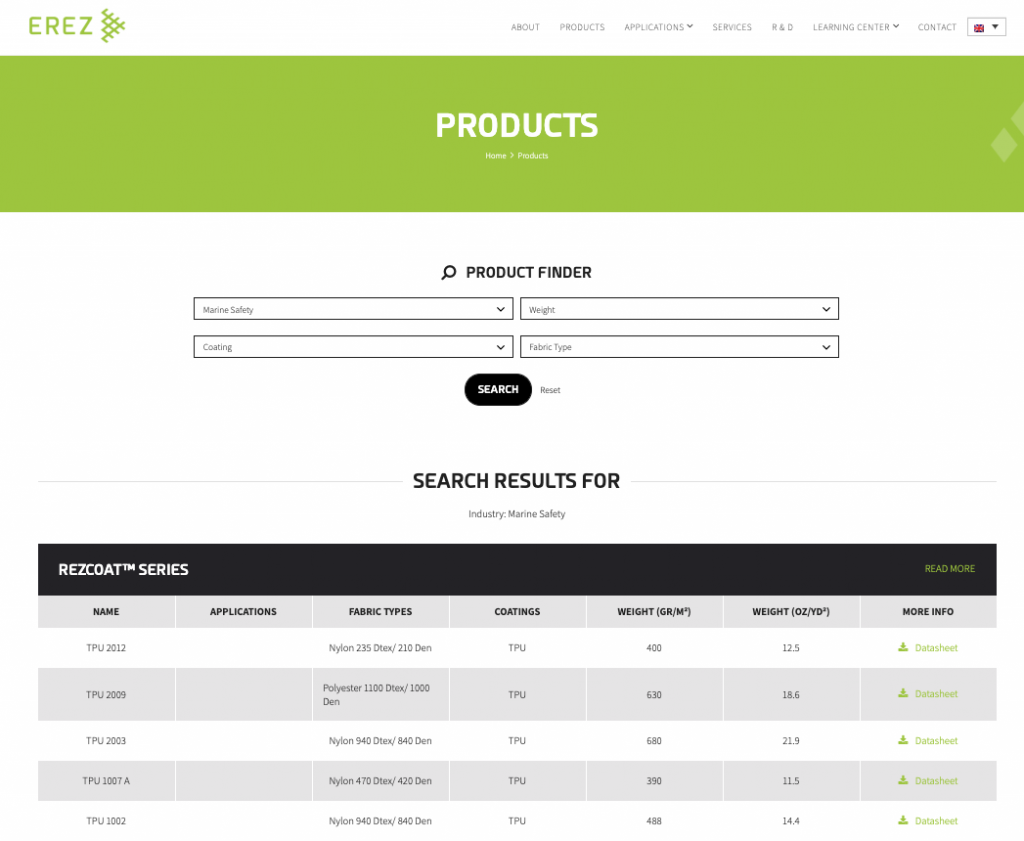
Equally good for both awareness and consideration stages, product datasheets are a basic form of content marketing for manufacturers that summarize the performance and technical characteristics of your product offerings. Erez Technical Textiles marine safety product datasheetis a good example of an informative document that supplies engineers with the required level of technical detail.
3. Specialized Guides & Learning Center
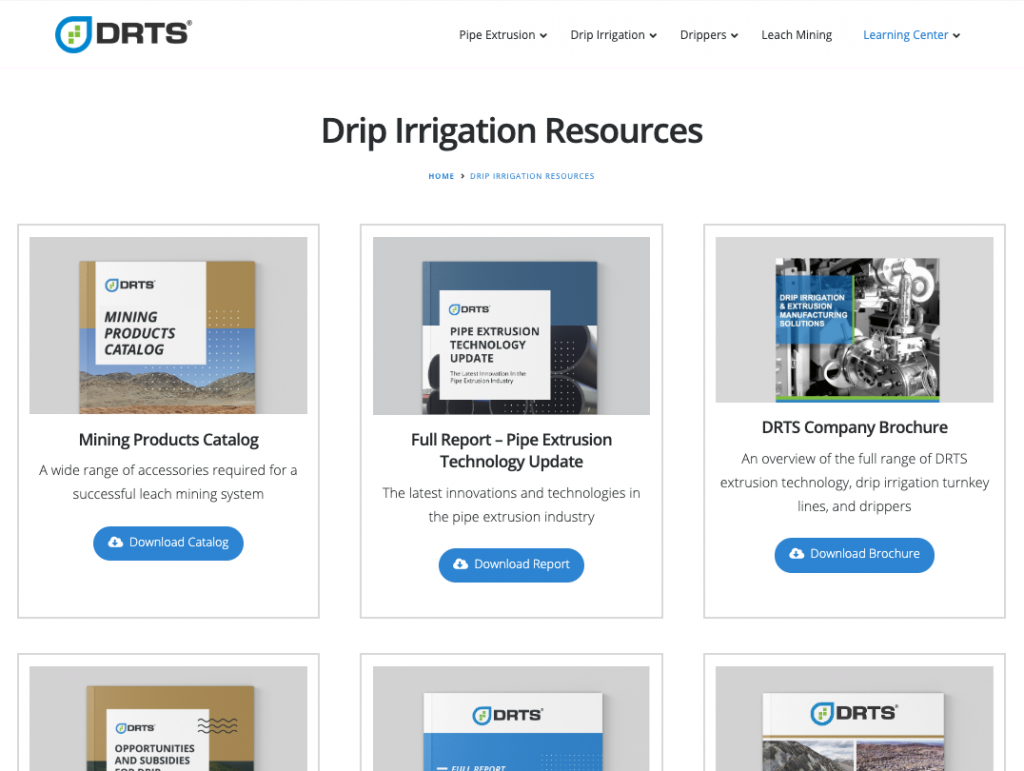
A learning center containing specialized guides can bridge the gap between the awareness and consideration stages. This will contain detailed information targeted at a specific issue or product/solution. Take a look at DRTS website for an example of a learning center.
4. Case Studies & White Papers
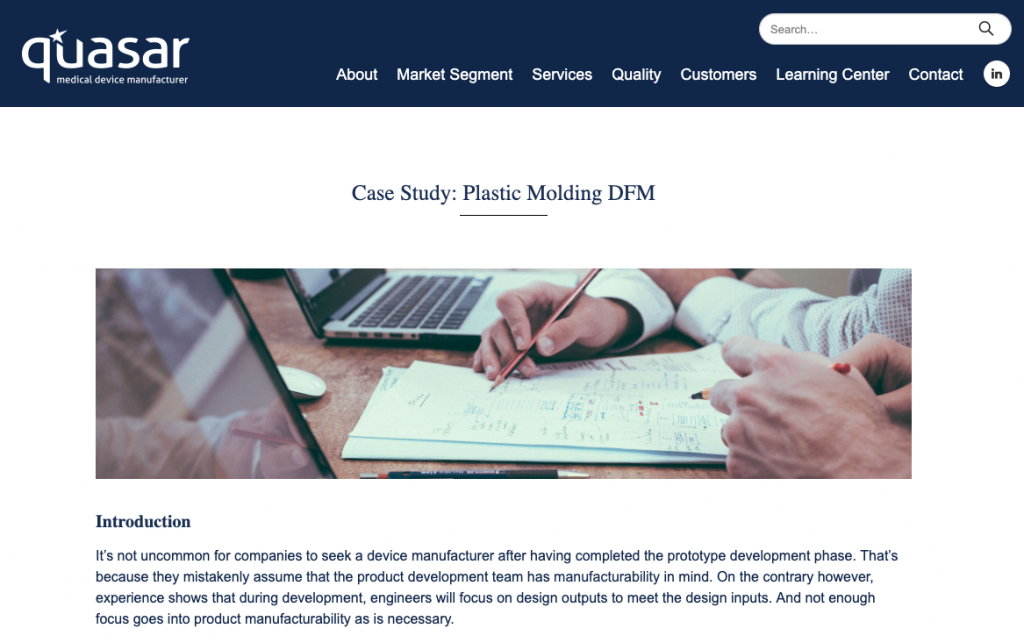
Case studies & white papers detail real stories, showcasing your products and offerings in real life applications. These are best suited for the advanced consideration stage, as they instill confidence to interested prospects. They can be published through a learning center or even as a part of the blog, as in this Quasar medical devices case study.
5. Presentations & Demo Videos
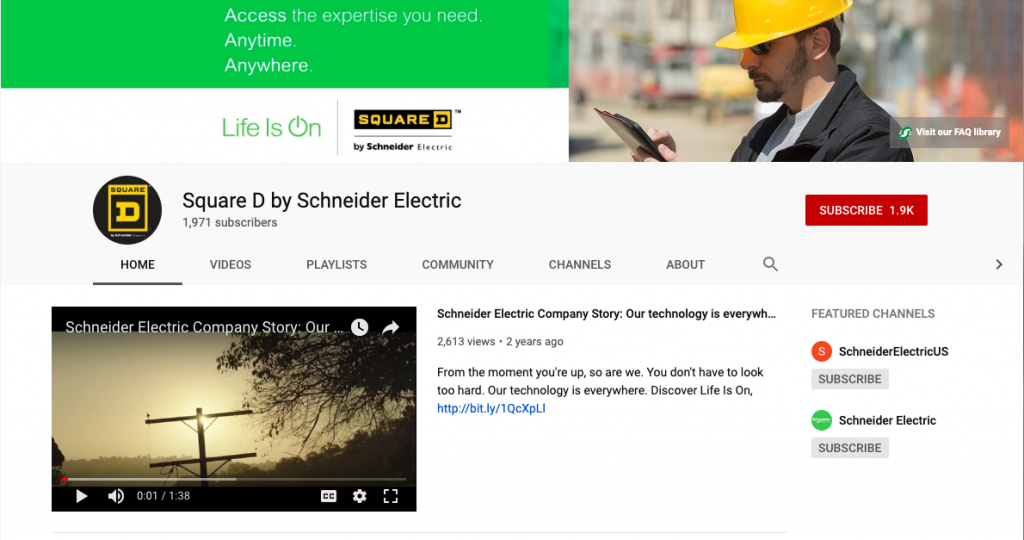
Presentations & demo videos are usually targeted at buyers in the decision stage. They are the most visualized type of content, allowing technical companies to showcase their products in an appealing and easy to comprehend way. Here is a good example of a product demo video from Schneider Electric.
Conclusion
It is important to consider the buyer’s journey when building a content plan structure. It will provide a basis to facilitate the outlining of an effective content marketing plan. This way you will serve the proper content to all types of buyers, yielding better results.
Nowadays, strategic marketing for engineers and industrial professionals has changed dramatically. Engineers mostly use the internet for seeking information about technologies, products, or services, which is why industrial marketers increasingly turn to online and content marketing. And as GlobalSpec’s 2019 Smart Marketing for Engineers Survey demonstrates, the importance of digital marketing cannot be overstated. In this article, we take a look at the survey’s most effective strategies, show you exactly how engineers prefer to consume your marketing, and how to gain a competitive edge using this information.
It is clear that engineers regularly seek to consume content, most of it in digital form. This runs the gamut from vendor websites to trade publications, newsletters and so much more. That’s why content marketing is an integral part of any successful industrial marketing strategy.
2. Use Alternative forms of Content
Datasheets, cast studies, product demos, and how-to videos are the most preferred content types for engineers. And it makes sense, knowing how engineers are bottom-line thinkers, always looking for informative, dense, to-the-point content.
3. Use Newsletters
When it comes to newsletters, the statistics are hard to argue with. Across all age groups, 86% of engineers are subscribed to 2 or more newsletters, 87% of which they browse through or fully read. So maintaining a regular newsletter and inviting engineers to subscribe, is an opportunity that is too good to pass up.
4. Keep an Up-to-date Website
The survey shows that engineers find supplier/vendor websites the most valuable source of information, outranking even search engines and technical trade publications. This is why companies must have a website with a professional look and feel, coupled with informative and original content. These factors are important in building trust with engineers and can highly influence their decision-making.
5. Strive for Brand Awareness
Maintaining a uniform brand presence throughout all media is very important. For uniform visuals, invest in your brand’s logo & visual guidelines. Equally important is to invest in having a content marketing style guide, to ensure uniformity of content as well. With those two combined, you are guaranteed to keep your message consistent. This will ultimately breed brand trust and familiarity with engineers and industrial professionals, to your benefit.
6. Reach Out to Prospects Fast
Engineers are constantly dealing with challenges requiring immediate solutions. Once an engineer shows interest in your product or service, reach out to him as soon as possible. The ideal response time is immediate and up to 8 hours, although not always possible in our connected world of different time zones. However, as a rule of thumb, it’s best to reply within 24 hours.
7. Engage With Them Regularly
A large portion of engineers are either decision makers themselves or influence the purchasing decisions of industrial companies, mainly influenced by online content. That’s why it’s important to regularly engage with engineers through valuable and informative content, mainly achieved through inbound marketing and publishing material such as articles, newsletters, blog posts and white papers.
Gain a Competitive Edge
Research clearly shows that targeting engineers and industrial professionals is a very effective strategic marketing method for b2b companies. However, companies are often hesitant to take a deeper dive into this area. After all, targeting highly technical audiences requires specialization and skill, which can be challenging to master.
Now is your chance to act on this information. Today more than ever, getting the attention of engineers from all over the world can be achieved easily and quickly, using customized inbound marketing methods. But at the same time, you need to act fast, while the market is still new to inbound marketing targeted to technical audiences. This will ensure you stay ahead of the competition, giving you a competitive edge.
Do you want to create a proven industrial marketing strategy?
Originally published June 2019. Updated September 2026.
Somewhere in Ohio, a plant engineer is scrolling past an ad for a pressure valve. She will not click it. She has never clicked an ad in her life and would like that on her headstone.
Industrial advertising has always lived in two worlds. In one, the trade show booth: a ten-by-ten patch of carpet, a bowl of branded stress balls and a sales rep who has been standing since seven. In the other, a dashboard reports that 48,000 people saw your ad this week, a suspicious number of them in countries you do not sell to.
The best industrial ads turn up exactly when someone is specifying a part, and they speak fluent spec sheet. The worst are a stock photo of two hands shaking in front of a wind turbine. (Nobody has ever closed a deal in front of a wind turbine. It’s far too loud.)
It’s a strange job, marketing to people who distrust marketing.
The pressure comes from above, as usual. The CEO’s niece ran Google Ads for a dental practice and got 212 new patients in a month, so surely a company that makes industrial compressors can do the same with $2,000 and a spare afternoon. (Somewhere, a sales director is already clearing her calendar.)
Truth is, industrial buyers do respond to advertising. Just not the kind built for dentists. They research for months, decide as a committee and remember the supplier who explained something useful before anyone asked for a quote.
So if industrial advertising is in next year’s budget, it helps to know what it’s for, where it works and how to reach the people who sign the purchase order. This guide covers all three, plus how to measure it without fooling yourself.
What is industrial advertising?
Industrial advertising is paid promotion by manufacturers, industrial suppliers and technical B2B companies, aimed at the people who specify, approve and buy their products. Those people are engineers, plant and operations managers, procurement teams and, for bigger purchases, executives.
It covers more channels than most people expect: trade publications and industry newsletters, trade show sponsorships, Google search ads, LinkedIn ads, industrial directories, remarketing and video.
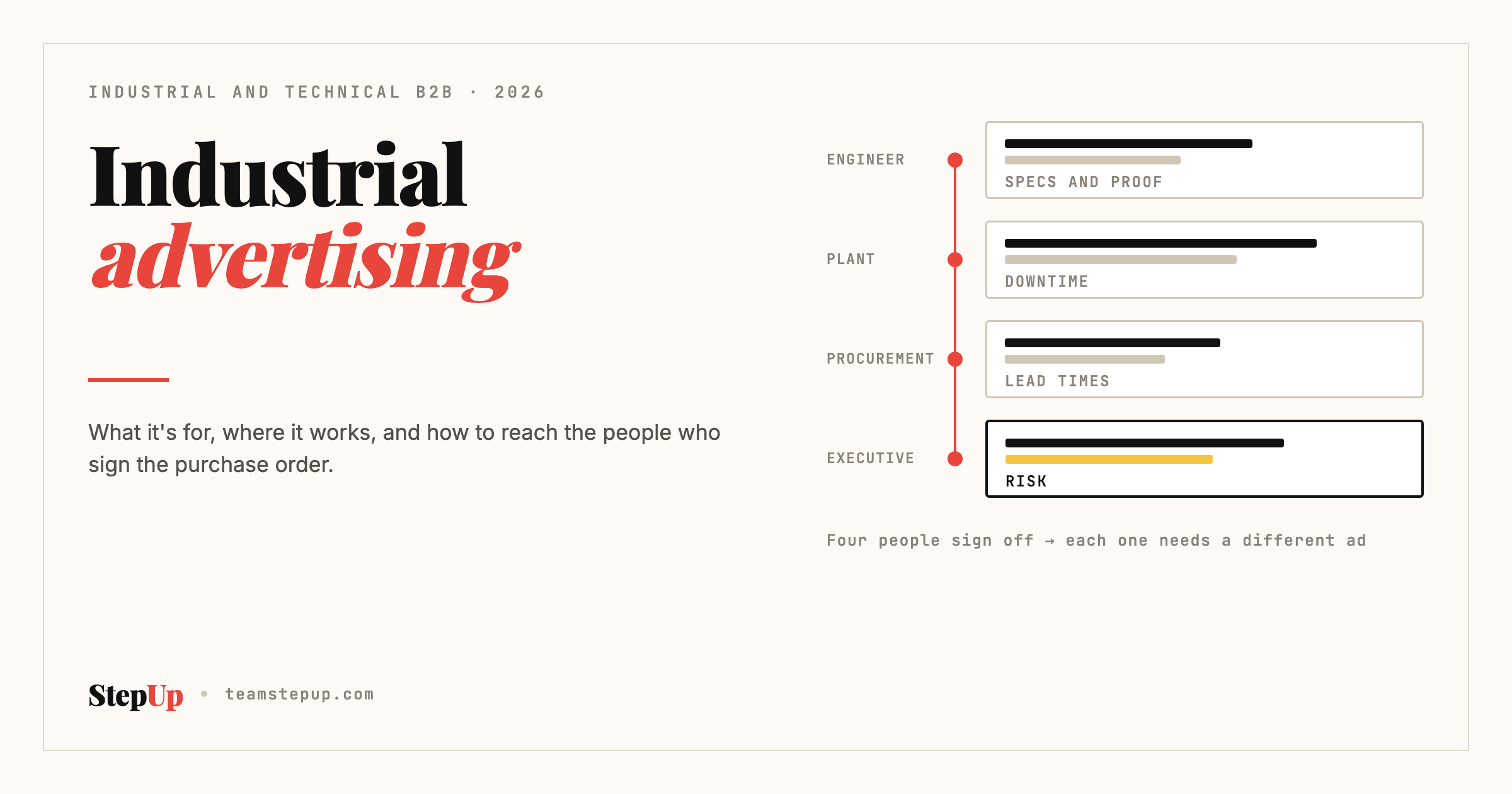
The role of advertising in industrial marketing differs from consumer advertising in three ways. First, the audience is small. A company selling specialized pumps may have a few thousand real buyers worldwide. Second, buying is a group decision, so one ad rarely reaches everyone who matters. Third, the cycle is long. A purchase can take many months, sometimes more than a year, and buyers often form a shortlist before they talk to any supplier.
As a result, industrial advertising works best as a steady presence over months. Short bursts tend to end before the buyer is ready.
The functions of industrial advertising: 5 reasons to advertise
Industrial companies advertise for more than sales. In practice, advertising does five jobs, and a good plan decides which of them matter most this year.
1. Build awareness before the buyer starts looking
Most industrial buyers have a shortlist in mind before they contact anyone. If your name is not on it, even the best sales team never gets the call. Advertising in the right trade publications and on LinkedIn keeps your company familiar during the months when nobody is buying yet.
Remarketing helps here too. These are ads shown to people who already visited your website. However, set a frequency cap. An engineer who sees your valve eleven times in one afternoon starts to wonder if the valve is following her.
2. Reach the whole buying committee
An engineer may find you first, but procurement, operations and finance all get a say. Each of them cares about something different. So use advertising to reach the people your sales team cannot easily get a meeting with. LinkedIn is useful here, because it lets you target by job function, industry and company.
3. Capture demand that already exists
Some buyers are searching right now, for a part, a specification or a fix for a specific problem. Search ads put you in front of them at that moment. In industrial markets, the best keywords are often long and technical, such as “stainless steel ball valve for food processing” rather than “valves.” They usually cost less, and the people typing them know what they want.
4. Support deals that are already in motion
Industrial deals stall. A champion leaves, a budget moves, a committee meets once a quarter. Ads aimed at the specific companies your sales team is working with, often called account-based advertising, keep your case studies and proof in front of everyone involved while the deal waits. Think of it as follow-up that does not need a phone call.
5. Test messages before you commit to them
Advertising also gives you fast, cheap answers to questions that would otherwise take a year. Does “30% less downtime” beat “installs in one shift”? Run both for two weeks and compare. Then use the winner on your website, your trade show booth and your sales deck.
Where industrial advertising works: the channels
No company needs every channel. Instead, pick the two or three where your buyers already spend time, and run them well.
Channel
Best for
Watch out for
Google search ads
Buyers searching for a part, spec or application
Broad terms burn budget fast. Use exact technical phrases and a list of excluded terms.
LinkedIn ads
Reaching specific roles, industries and target companies
Clicks cost more than on most platforms, so offer something useful instead of a sales pitch.
Trade publications and industry newsletters
Credibility with a niche, technical audience
Hard to measure. Ask the publisher for audience data before you buy.
Industrial directories such as Thomasnet
Buyers comparing suppliers
Your listing has to be complete and current, or it works against you.
Remarketing
Staying visible through a long buying cycle
Too many impressions feel like being followed. Cap them.
Trade show sponsorships
Face time with serious buyers
Expensive. Plan the follow-up before the show, not after it.
Industrial advertising strategy: how to reach the right buyers
Targeting is where most industrial campaigns go wrong. The ads themselves are often fine. They just reach the wrong people.
Start with your ideal customer
Before choosing a channel, write down which companies you serve best: industry, size, region and the problem they are trying to solve. If you do not have this written down yet, our guide on how to create an ideal customer profile walks through it. Everything in your targeting follows from that document.
Map the buying committee
Next, list who is involved in a typical purchase and what each person needs to see.
Role
What they care about
What your ad should show
Engineer
Specs, tolerances, proof it works
Data sheets, test results, CAD files
Operations or plant manager
Downtime, installation, support
Case studies, installation time, service terms
Procurement
Lead times, certifications, total cost
Certifications, delivery times, pricing logic
Executive
Risk, growth, supplier stability
Customer names, track record, results
Each role gets its own message, because a single ad written for all four usually lands with none of them.
Use their words, not yours
Engineers spot marketing language immediately. So take your wording from sales calls, customer interviews and support tickets. Our guide to B2B market research shows how to collect it in four weeks. If customers say “changeover time” and your ad says “operational agility,” they will scroll right past.
What industrial product advertising should say
Good industrial product advertising leads with the application. “Seals rated to 300°C for continuous kiln operation” tells an engineer in two seconds whether to keep reading. By contrast, “innovative sealing solutions” tells her nothing.
Next, include one specific number or proof point: a tolerance, a certification, a result from a real installation. Specifics signal that there is an engineer behind the ad, and technical buyers trust that.
Finally, offer a useful next step. Industrial buyers rarely want a sales call from an ad. They will, however, happily download a spec sheet, a CAD file, an application note or a sizing calculator. Send the click to that page, never to your homepage.
Here are three industrial advertising examples that follow the pattern. They are composites, not named clients.
A filter manufacturer runs search ads on one application, hydraulic filters for injection molding machines, and sends each click to an application note.
One components supplier runs LinkedIn ads to maintenance managers at 200 target plants, offering a downtime checklist.
A machine builder sponsors a trade publication’s newsletter with a short video of the machine running at a customer site.
How much to spend, and how to measure it
There is no correct number. Instead, start with a test: one product line, one or two channels, a fixed budget and 90 days. That is long enough to learn something and short enough to change course. Our B2B marketing budget guide shows how to fit advertising into the wider plan.
Then measure what matters to sales. Clicks and impressions tell you the ads ran. They say little about whether anyone useful saw them. So track these instead:
Which search terms and audiences produce real inquiries
Spec sheet and CAD downloads by channel
Sales conversations that started from an ad
Engagement from your target accounts
What it costs to start one qualified sales conversation
Add a free-text “How did you hear about us?” field to your forms as well. A lot of industrial buying is shaped by forwarded emails and private conversations that analytics never sees, which we cover in our guide to dark social.
Finally, judge the results over a quarter, not a week. Industrial cycles are long, so an ad that runs in March may turn into a purchase order in September. Set one objective for the quarter with two or three measurable results, and review it every month. That way, advertising becomes part of your marketing plan instead of a line item nobody can explain.
Common mistakes in industrial advertising
Most wasted industrial ad budget comes from a handful of habits.
The most common is sending every click to the homepage. The buyer asked a specific question, so the ad should lead to a specific answer.
Broad keywords come next. “Industrial equipment” attracts students, job seekers and competitors, while long technical phrases attract buyers.
Then there is the single message for everyone. The engineer and the CFO need different reasons to care.
Many teams also stop too soon. Four weeks is rarely enough to judge anything in a market where buying takes a year.
And finally, there are ads that sound like marketing. Technical buyers trust specifics and tune out adjectives. We wrote more about that in marketing for engineers.
Frequently asked questions
What is industrial advertising?
Industrial advertising is paid promotion by manufacturers and industrial suppliers, aimed at the engineers, operations managers, procurement teams and executives who specify and buy their products. It includes trade publications, trade shows, search ads, LinkedIn ads, industrial directories, remarketing and video.
What are the functions of industrial advertising?
Industrial advertising does five main jobs. It builds awareness before buyers start looking, reaches the whole buying committee, captures demand from people already searching, supports deals already in progress, and tests messages quickly before a company commits to them.
Does advertising work for industrial companies?
Yes, when it is targeted and patient. Industrial buyers research for months and decide as a group, so advertising works best as a steady presence aimed at specific roles and companies, with a useful next step such as a spec sheet or an application note.
Which channels work best for industrial product advertising?
Search ads work well for buyers looking for a specific part or application. LinkedIn reaches specific roles and target companies. Trade publications and industrial directories add credibility with technical audiences. Most companies should pick two or three channels and run them well.
How do you measure industrial advertising?
Measure the inquiries, downloads and sales conversations that start from ads, plus engagement from your target accounts. Judge the results over at least a quarter, because industrial buying cycles are long.
The plant engineer in Ohio still won’t click your ad.
She will, however, download the spec sheet, forward it to procurement and put your name on the approved supplier list. The stress balls can stay at the booth.
Today’s industrial sector is well aware that digital marketing is an integral part of reaching and interacting with their target audience, prospects, and customers. And even though they are tasked with engaging in online and content marketing, the majority of manufacturers still fall short of demonstrating a positive return from their digital marketing activities.
In this article, we present the challenges that manufacturers face when it comes to digital marketing. We’ll also share our Industrial Marketing Methodology, a digital marketing strategy geared toward the needs of manufacturers.
The Challenges of Digital Marketing for Manufacturers
Even though manufacturers and B2B industrial companies recognize the value of engaging in digital marketing, they face several challenges in doing so:
Many manufacturers lack a clear plan on how to implement online and content marketing activities. A clear, actionable plan is the basis of all marketing activities.
Manufacturers rarely take advantage of tracking and measuring tools and therefore can’t demonstrate their digital marketing activities ROI (or lack thereof). As the saying goes, “you can’t manage what you can’t measure.”
In some cases, manufacturers don’t have the necessary experience on how to target, reach, and appeal to technical audiences. This results in inadequate planning and budgeting, as well as slow corrective or pivoting actions when it comes to optimizing their online marketing.
GlobalSpec’s 2019 survey on manufacturing content marketing demonstrates how engineers and technical professionals primarily use the internet to research products and services, before reaching out to a company’s sales team. This points to a meaningful shift in marketing that manufacturers have to make.
Digital marketing has become vital in the technical customer’s journey. Where taking part in trade shows and running trade magazine ads used to suffice, manufacturers must now shift towards digital marketing to achieve results.
The StepUp Growth Wheel
We at StepUp specialize in digital marketing for businesses, industries, and manufacturers that target highly technical audiences. In the last 4 years, our team has created a comprehensive Industrial Marketing Methodology, that guarantees company growth, generation of qualified leads, and building authority in the company’s corresponding industrial sector.
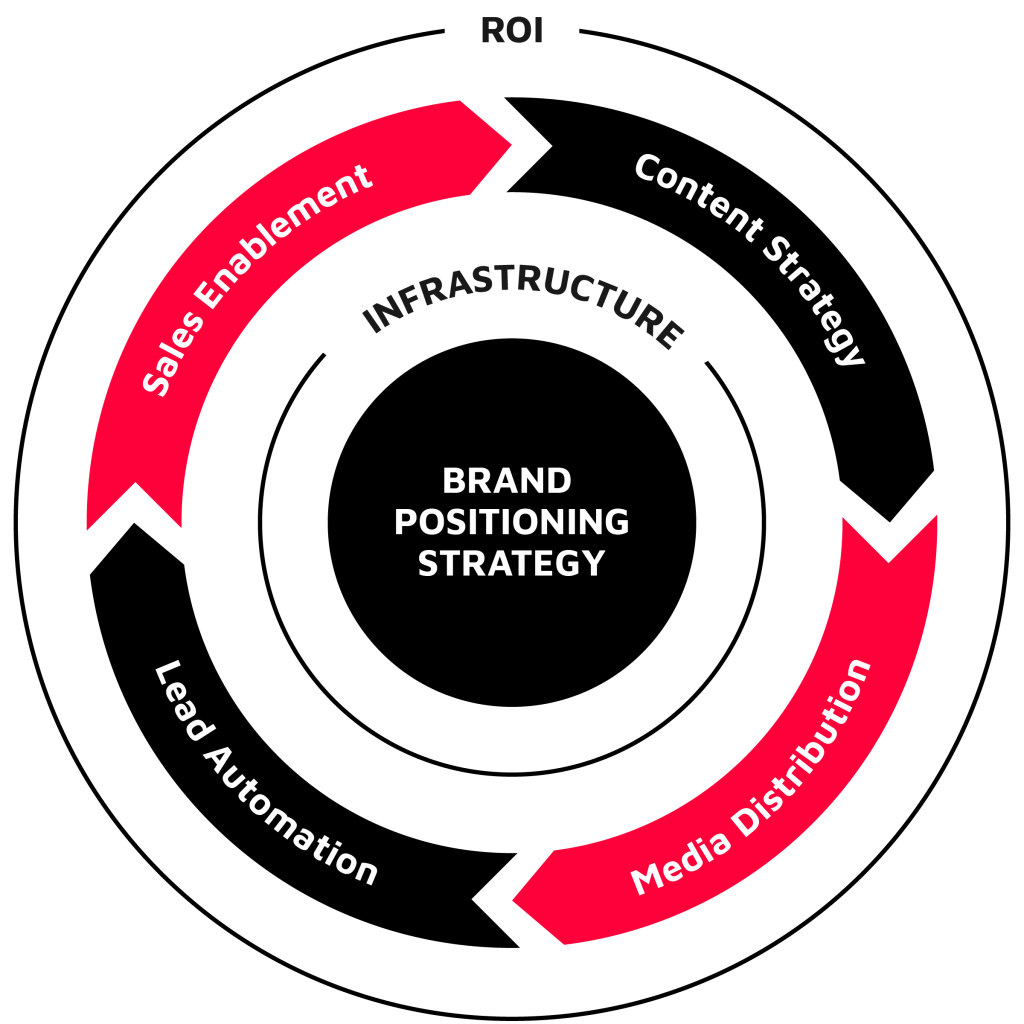
Here are the 7 steps of The StepUp Growth Wheel, chosen to help manufacturers dominate their market using digital marketing:
Brand Positioning: A determining first step is to set the brand positioning strategy & statement, market research, and annual marketing plan.
Infrastructure: Creation of clear visual and content guidelines, to maintain consistent messaging in all future marketing materials.
Content Strategy: Defining a comprehensive content plan based on target audience characteristics, such as the buyer personas and mapping of the buyer’s journey.
Media Distribution: Deciding on the most effective places and methods to publish and distribute content, in a way that resonates with your target audience.
Lead Automation: Employing lead qualification and nurturing techniques, together with marketing automation tools, to ultimately convert leads into satisfied customers.
Sales Enablement: The creation of seamless sales processes that guide prospects through your sales funnel and convert them into customers with minimal effort.
ROI Tracking and Reporting: Setting up the necessary infrastructure to properly track and measure all marketing activities, in order to continuously optimize and achieve the best ROI.
While some manufacturers are having difficulties implementing digital marketing tactics, others are seeing exponential growth, building authority in their sector, and dominating their market. Contact us today to arrange a free 30-minute custom digital marketing session to find out how you can utilize automated digital marketing systems that will guarantee your success for years to come.











 Digital marketing has become vital in the technical customer’s journey. Where taking part in trade shows and running trade magazine ads used to suffice, manufacturers must now shift towards digital marketing to achieve results.
 We at
We at