Much has been published about the use of social media for marketing campaigns, but for certain businesses, particularly those who work in the B2B space, LinkedIn might just be the most powerful social network. Running a marketing campaign on LinkedIn is different from running one on Facebook or Instagram because you’re targeting professionals based on their work interests and trying to present yourself as a thought leader rather than an aspirational figure. While there’s a lot to learn about LinkedIn campaigns, here are just a handful of tips to remember as you get set up.
#1 Choose a Clear Goal
Before starting any advertising campaign, it’s important to choose a clear goal for the campaign. If you’re pursuing LinkedIn, are you looking to raise awareness of your company, drive new recruits, or reach out to potential leads? Once you have your goal clearly defined, it’s easier to create an effective campaign as well as use the different metrics LinkedIn provides to track your success.
#2 Choose the Right Types of Ads
There are many different ways to reach people on LinkedIn. If you’ve built a following, you can share content directly to their wall. You can also sponsor content and have it appear on people’s feed based on various demographics you can control. However, if you’re targeting people who aren’t frequently checking LinkedIn, you can also send InMail, which acts as a personal connection between you and the person you’re reaching out to and goes to their email inbox.
#3 Deliver a Strong Message
Copy that is short, direct, and helpful is the best way to get and hold someone’s attention. The right images are important on LinkedIn, like any social network. But unlike other networks, real, meaningful content is what makes professionals stop and look. Think about your audience and what they might need and then write articles or messages that help them answer some of their questions. Even in a business to business marketing scenario, people are searching for answers to help them work smarter, faster, or more efficiently.
#4 Measure and Compare
As you run your LinkedIn campaign, take the time to look at the information you’re getting from your metrics and adjust your material accordingly. See if there are certain demographics that are responding to your content, if people are searching for certain key terms, or run an A/B test to see which version of a headline gets the most clicks.
#5 Maximize Your ROI
Knowing what the goals of your campaign are, you can track your effort and advertising spend against success on those goals to determine which parts of your campaign are working. There are many clever uses of LinkedIn for brand awareness, recruiting, and lead generation, so take the time to find the strategies that work best for your organization.
Implementing a LinkedIn campaign requires planning, quality content, and deliberate execution. StepUp Marketing has experience helping businesses handling their social media and online marketing, not just in LinkedIn, but on a variety of other platforms. We craft each unique marketing campaign to fit the needs of our clients and use metrics to be sure we’re delivering value. Reach out today to set up a free consultation and learn what the StepUp Marketing team can do to help your business.
Attending a trade show, especially if you’re putting up a booth, is a huge expense for most businesses. In some cases, it’s the biggest marketing project of the year. Therefore, it’s important to maximize your efforts to get the most ROI possible from each trade show you attend. Here are five tips you can use to help guarantee your trade show ROI.
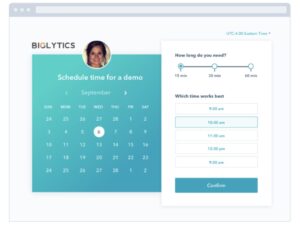
A sample of HubSpot Meeting Scheduler- one of many tools to help automate meeting scheduling before tradeshow- or anytime!
By the time people are walking around the trade show and have a chance to see your booth, you want to make sure this is the third of fourth time they’ve heard of your brand and their mind will connect your booth with a familiar idea. This will drive more traffic to your booth and keep your sales team happy. The best way to approach this may vary depending on your industry and the size of your company, but providing valuable educational content via your website and email marketing campaigns will both position your company as an industry thought leader before the trade show, and build your mailing list so you can let as many people as possible know where you will be pre-show.
Consider adding a call-to-action below your company email signatures, directing contacts to sign up for meetings in advance, and even offering them a discount or special offer in exchange for pre-registration at events your company is running during the trade show.
Get a Good Location
If possible, scout the trade show a year before you plan to attend to figure out the best place to put your booth and sign up as early as possible to reserve the best spot. You don’t want to be off to the side were no one wanders. Another great strategy is to try and get a booth that’s close to one of the biggest sponsors of the event. They’ll likely attract a lot of foot traffic that will pause and look at your booth as they pass.
Prep Your Sales Team
Everyone who will be manning your booth needs to be familiar with your products and understand the main challenges of your target customers. If you have several junior associates supporting a few top salespeople, it’s important to teach the junior people how to qualify leads before passing them on to the senior sales people. Everyone should know what the post-show marketing plan is and encourage people who drop by the booth to swipe their contact badges to collect email addresses – or better yet have ipads set up in your booth to collect more extensive info and enter new leads into your CRM right on the spot.
Follow Up FAST
The leads you’ve collected from a trade show can be sales gold, but only if you capitalize efficiently on the follow up process. If you have a sales team, divide the leads among the sales team and ensure that individualized contact happens quickly.
Collecting the right information at the trade show will also make this follow up process easier. If certain leads came to the trade show ready to purchase, it’s vital to collect this information (ideally through a form that syncs directly with your CRM) and to mark them as top priority for personal follow up (preferably within 24 hours after meeting them, and then again within 24 hours after the trade show ends). You can be sure you won’t be the only company contacting them, so it’s important to be the first! For less important leads, consider automating or semi-automating the follow up process with email templates.
Continue to Educate
While your sales team is following up with each lead, you also want to take advantage of the wealth of information you gained at the trade show to nurture some longer-term leads. Not everyone who visited your booth is ready to enter directly into your quoting process, so you want to make sure you keep your brand in front of them so that you’re their first thought when they reach that point. Follow up emails after the trade show and a well-planned, educational, value-added lead nurturing campaign are great ways to make this happen.
Marketing professionals like the team at StepUp can help you maximize your trade show follow up to ensure people who are interested stay informed and your brand stays top of mind. Reach out today to find out about the services we offer and learn more about how to maximize your trade show ROI.
Businesses looking to do some marketing through search engine optimization (SEO) and pay-per-click (PPC) campaigns know that one of the big secrets of success is finding the right keywords. You want to strike that perfect balance between using the words your ideal target customers are using to search on google and words that are specific enough that they won’t cost you a significant amount. This is particularly significant for B2B companies, where the right keywords might take more time and research to find.
Once you’ve chosen the right keywords, your conversion-per-click rate will increase enough so that, even if the keywords are expensive, when people do click on your website, they’re in the process of making a purchasing decision or are ready to get a quote from your sales team. Tracking your click rate as well as your conversion rate will ensure you’re spending on the right keywords.
Searching for and Finding the Right Keywords
For many businesses with moderate keyword budgets, this means focusing on “long tail keywords” or keywords that get less traffic, but are more specific to what someone is searching. Because these phrases have less people searching for them, it’s easier to rank higher and have you ad displayed more frequently for less.
Another detail to consider when looking to find the right keywords is their relevance to your business. Relevant keywords are likely to attract more clicks and Google tracks how many people click on your link from a search and how long they stay on your site after they click. You can also optimize your searches around location, which is especially useful if your business only serves a certain geographic area.
Understanding your Audience
How well do you really know your target customers? Do you know what and where they tend to look for answers when they encounter a challenge? Even more than being relevant to your
business, your chosen keywords need to be relevant for your target customers. Call some of your best customers and have a chat. Ask them questions like, “When you have a challenge in your business, do you search on Google? Do you turn to Facebook groups, or a professional forum? If you search on Google, do you type in full questions or do you type in the minimal amount of information?”
The methods used to learn more about a professional challenge or find a solution differ between industries and between cultures. If you have customers in multiple countries or in multiple industries, be sure to have conversations with a good sampling to make sure you understand all the parts of your audience. You might be surprised by some of their answers.
Keyword Planning Tools
To help you find the right keywords, and to get a sense of how popular certain keywords are, Google offers their Keyword Planner for free as part of your adwords campaign as well as Google Trends to let you get a better sense of search history over time and compare search volumes for different keywords.
Since so many businesses now base their success on their SEO campaigns, other sophisticated tools have come onto the market such as Keyword Tool.io, which generates a list of suggested keywords based on Google’s autocomplete feature and Wordstream’s Keyword Tool, which suggests keywords similar to the one you’re interested in that may apply to your business.
As you decide which keywords to choose, you’ll want to wade through the ideas suggested by each tool and choose only those most relevant to your business. After you’ve set up your campaign, you want to continue to monitor keyword tools and traffic to your website to tweak your SEO.
There are a number of paid offerings as well, such as Accuranker and Hubspot’s Keyword Tool. These tools give a more sophisticated analysis and feedback on each keyword to help you focus in on those most likely to give you the best return on your advertising dollar.
Planning your company’s SEO strategy and monitoring it can quickly become a complicated process, which is why it may be helpful to pull in the experts at StepUp Marketing. To help you get started, we offer a free consultation where we discuss your specific business and your goals with SEO and how StepUp can not only help with finding the right keywords, but also creating the unique content that draws in potential customers and helps them connect with your brand.
Originally published December 2017. Updated September 2026.
Most sales teams already have LinkedIn open all day. They check who viewed their profile, accept a few connection requests and send the occasional message that starts with “Hope you’re well.” Then they go back to the call list.
That is not social selling. It is social presence, and it rarely moves a deal.
Social selling is something narrower and more useful. It is the discipline of using social networks, mostly LinkedIn in B2B, to find the right buyers, understand what they care about, and earn enough trust that a conversation feels welcome rather than intrusive. Done well, it shortens the distance between a cold name and a warm meeting.
This guide covers what social selling actually is, why it matters more now than when the term first appeared, and how sales and marketing can run it together without turning it into another box to tick.
What social selling means
Social selling is the practice of building relationships with potential buyers through social networks before, during and after a sale.
The definition sounds soft. In practice, however, it comes down to three concrete activities:
Finding the people who match your customer profile and noticing when their situation changes.
Understanding what they post, share and respond to, so your outreach speaks to their real problem.
Earning trust by being useful in public before you ask for anything in private.
What it is not: mass connection requests, automated messages with a first-name merge field, or a sales rep reposting the company’s product announcements. Those look like social selling on a dashboard. Buyers, however, recognize them instantly as selling.
Why social selling matters more now
B2B buyers do most of their research before they ever speak to a salesperson. They read, compare, ask peers and watch who shows up with something worth saying. By the time they fill in a form, the shortlist is often already written.
Meanwhile, buying decisions now involve several people. A single deal might need a finance lead, an operations head, a technical evaluator and an executive sponsor to agree. Each of them is researching separately, and most of them are on LinkedIn.
Buyers are on social networks. So the real question for a sales team is whether your people are visible and credible there at the moment a buyer starts looking.
There is also a simpler reason. Cold outreach is harder than it used to be. Inboxes are full of AI-written sequences that all sound the same. As a result, a message from someone the buyer already recognizes, because they have read her posts or seen her comment thoughtfully on a peer’s update, stands out in a way a cold email cannot.
Social selling vs. traditional prospecting
Traditional prospecting starts with a list and works outward. You find names, you reach out, and you hope the timing is right.
Social selling reverses the order. You start by paying attention. You watch for the signals that suggest someone might need you soon, and you build familiarity before you reach out. The contact still happens. It simply happens with context.
Traditional prospecting
Social selling
Starting point
A list of names
Signals and shared context
First contact
Cold
Warm, or at least familiar
What the buyer sees first
Your pitch
Your thinking
Timing
Your quarter
Their situation
Measure of success
Replies
Conversations that turn into meetings
Neither replaces the other entirely. Most healthy sales teams need both. Nevertheless, teams that only prospect cold tend to work much harder for the same number of meetings.
The four parts of a social selling system
1. A profile that serves the buyer
A salesperson’s LinkedIn profile is usually the first thing a buyer checks after receiving a message. Most profiles are written like a résumé for the next employer. That is the wrong audience.
A buyer-facing profile says who the person helps, what problem they solve and what they know about the buyer’s world. The headline speaks to the customer, not to recruiters. Below it, the about section explains the problem in the buyer’s words. Meanwhile, the featured section holds something useful, like an article or a guide, rather than a product brochure.
2. The right network, not the biggest one
Connection count is a vanity number. What matters is whether the right people are in the network.
Start with your ideal customer profile. If you have not written one precisely, that is the first job, and our guide on how to create an ideal customer profile walks through it. Then map the roles inside your target accounts: the decision maker, the people who influence the decision and the people who will use what you sell. Connect deliberately, with a short note that explains why.
3. Signals worth acting on
Social networks surface changes that matter for sales. A new executive joins a target account. A company announces an expansion, a funding round or a new product line. Someone posts about a problem you solve.
These are signals, and they are the heart of social selling. A signal gives you a reason to reach out that is about the buyer, not about your quota. Therefore the discipline is to notice them consistently and act within days, not weeks.
4. Content that earns the conversation
This is where marketing earns its place. Salespeople should not have to write everything they share. Instead, marketing supplies the raw material: articles that answer real buyer questions, short insights from customer work, and a clear point of view about the market.
The salesperson adds the human layer. She shares the piece with a sentence about why it matters to this buyer, or she uses it as the reason for a message. That combination, company substance plus personal context, is what makes social selling credible.
How marketing and sales run it together
Social selling fails most often when it is left entirely to sales. Reps are measured on meetings and revenue, so posting and commenting quickly become the first thing dropped in a busy week.
It works when marketing and sales share the job.
Marketing owns the narrative, the content and the profile guidance. It makes sure every rep describes the company the same way, and it keeps a steady supply of material worth sharing. In addition, it can give each rep a short weekly brief: two posts to share, one idea to comment on, and the accounts showing signals this week.
Sales owns the relationships. Reps decide who to engage, how to open a conversation and when to move from public interaction to a direct message or a call.
Together, they agree on what counts as progress. That is where many teams go wrong, so it deserves its own section.
How to measure social selling
Likes and follower counts are easy to track and almost meaningless. The useful measures sit closer to revenue.
Conversations started with people who match the customer profile.
Meetings booked where the first touch came through social activity.
Accounts engaged, meaning target accounts where at least one relevant person has interacted with a rep or the company.
Time to first meeting for socially sourced contacts compared with cold ones.
LinkedIn also offers its own Social Selling Index, a score that reflects profile strength, network quality, engagement and relationship building. It can be a useful coaching tool for reps. Still, treat it as a habit tracker, not a business result. A high score with no meetings is still no meetings.
For the handoff from marketing interest to sales conversation, our guide on converting MQLs to SQLs covers how to agree on what a qualified contact actually is.
Common social selling mistakes
Pitching in the first message. A connection request followed immediately by a product pitch is the fastest way to be ignored. Lead with relevance, not with the offer.
Automating the human part. Tools can find signals and organize accounts. However, messages that are obviously automated undo the trust social selling is meant to build.
Posting for peers, not buyers. Many reps post content that impresses other salespeople. Buyers, meanwhile, want insight into their own problems.
Treating it as a campaign. Social selling compounds over months. A two-week push followed by silence gives buyers no reason to remember you.
No shared message. When every rep describes the company differently, buyers notice. The fix is a clear narrative that marketing owns and sales uses.
Where to start this quarter
Agree on your customer profile and the three or four roles you want to reach inside each target account.
Rewrite each rep’s LinkedIn headline and about section for the buyer.
Give each rep a list of 20 target accounts and a simple way to watch them for signals.
Have marketing publish one useful piece a week and send reps a short sharing brief.
Set a weekly rhythm: a few thoughtful comments, one share with context, and outreach only where there is a real reason.
Review after 90 days using conversations and meetings, not likes.
Frequently asked questions
What is social selling in simple terms?
Social selling is using social networks, mostly LinkedIn in B2B, to find the right buyers, understand what they care about and build trust before asking for a meeting. It replaces cold, context-free outreach with conversations that start from something relevant to the buyer.
Is social selling just posting on LinkedIn?
No. Posting is one part of it. Social selling also includes building the right network, watching for signals like job changes or company news, engaging with buyers’ content, and reaching out when there is a genuine reason to talk.
Does social selling work for B2B?
Yes, and B2B is where it fits best. B2B purchases involve several decision makers who research independently, often on LinkedIn. Being visible and credible to each of them shortens the path to a first conversation.
What is the difference between social selling and social media marketing?
Social media marketing is mostly one to many: a company publishes content to an audience. Social selling is one to one: an individual salesperson builds relationships with specific buyers. The two work best together, with marketing supplying the content and sales supplying the relationships.
How long does social selling take to work?
Expect early conversations within the first month if the targeting is right, and a meaningful effect on meetings after about three months of steady activity. Like most relationship work, it compounds, so consistency matters more than intensity.
Who should own social selling, sales or marketing?
Both. Marketing should own the narrative, the content and the profile guidance. Sales should own the relationships and the conversations. When either side carries it alone, it tends to fade.
Tomorrow the LinkedIn tab will still be open all day.
The test is whether the next message your team sends from it could start with anything other than “Hope you’re well.”
While sales isn’t the only profession that has to deliver impactful presentations frequently, it’s certainly something sales professionals do regularly. So how can you go about keeping your prospect’s attention and covering all the information you need? Try these five creative presentation ideas I learned from Julie Hansen of Performance Sales and Training to improve your presentation style and gain new and effective presentation skills.
#1 Break Your Talk Down Into Chunks
People are constantly being bombarded with new and exciting information and the average attention span has gone down to five minutes. This means long, linear presentations are no longer the most effective way to present your material. Instead, you should break your talk into three to five minute chunks and focus each chunk on a certain part of the message. Changing chunks is as simple as changing topics or shifting to a new point.
#2 Focus on What’s Most Important
Your prospect has already read your website and reviewed enough information to determine whether you’re likely to be able to help them, so skip the parts of the presentation where you introduce your company. Just like movies and novels start with the most compelling part of the action, your presentation should start by answering the main questions that they’re likely to have. Focus on what’s going to be most important to them.
#3 Customize For Your Audience
Different buyers of the same product will be interested in different features or aspects. Take the time to think about what might be driving their purchasing decisions and customize your presentation to talk to the specific prospect. This is more than putting their logos on your standard slide deck. This is doing your research and getting into their heads to be able to answer those most important questions first. Ask yourself how your features will impact them. When you understand your customers, you can help connect the dots between the problem they have and the solution you’re offering.
#4 Know Your Key Point
What is the one thing you want your audience to walk away from your presentation remembering? For a sales professional, it’s probably that you can help them solve a certain problem. If you know the key point you want them to take home, you can then build the rest of your presentation about that topic and present it in a number of different fashions to improve its stickiness.
#5 Keep Your Audience Engaged
When your audience is actively engaged with your presentation, they are much more likely to remember the details of the material you’re presenting. There are many different ways to engage your audience, asking questions is only one. Simple engagement such as slides, videos, and stories is the first step. Active engagement such as questions and contests are even better. You can add these engaging sections in between the different chunks of your talk to help break it up and keep your audience attentive.
With these five tips, you’ll be sure to keep your audience engaged and spark an ongoing conversation about how you can help your prospect. While we can’t replace the charisma and art of the sales professional in the field, Team StepUp can support your company with great branding, insightful content, and lead generation. We can also help with automation – get a taste of how automation can improve efficiency with our free guide to email follow-up. These and other automation tools free your sales team to do what they do best – take the story of your company and share it with your best prospects, personally.
Where does team motivation come from? In our blog post last week we talked about training for sales teams, which when done right can definitely contribute to motivation. Some motivational speakers might argue that a great video or talk can give your sales team the motivation they need to grow. Warren Greshes, of Speaking of Success, would disagree. Greshes argues that it is next to impossible to externally motivate someone and the only effective way to motivate anyone was to figure out their personal motivating factors.
Rather than trying to motivate someone externally through inspiring them or pushing them, it’s better to help them become intrinsically motivated. As a sales leader, your job is to give your team the tools and techniques they need to be successful. First, you have to start by finding out everything about each person on your team, from their personal goals to their wants and needs, just like you would if you were trying to sell to a client. Once you have that information, you have the key to motivating them by showing them how working for you moves them closer to their personal goals.
Go Through a Goal-Setting Process
It can take some time to go through a goal-setting process, but help them draw up a one to five year plan with specific steps attached. You may have to connect the dots and help them see that the lifestyle or personal goals they have are obtainable and exactly how much selling they’ll have to do to achieve those goals. Everyone is motivated by something different, so you’ll need to sit down with each person and discover what motivates them and what their goals are.
In some situations, you may need to help them draw the lines between how they envision their future and how their career success will get them there. If they know what kind of lifestyle they want in five years, then you can turn that into specific numbers of sales calls or meetings they need to make each quarter to make it happen. In other words, you translate their efforts into the money necessary to create the lifestyle they want. Money by itself doesn’t motivate, it’s the lifestyle money enables. It’s important to understand that business and personal goals work together to create motivation.
Tie Long Term Goals to Short Term Action
Once you know the goals, you can reverse engineer and write down milestones you want to meet every month to build up towards your final goal. Then write your goals down, set the metrics you want to meet, and track everything. Tracking allows you to manage someone by showing them what else they need to do to meet their goals and keeps you from having to micromanage your sales team.
Sustaining motivation over time is done by showing people how their actions are moving them forward. A five year plan is great, but you should break that into smaller milestones so that you can measure your progress and celebrate your results more frequently. Once you help your sales team members make a plan, you’ll want to revisit it every quarter to make sure they can see how they’re moving forward and make changes as life changes.
Your sales team is your client, so in addition to helping motivate them to work, you also want to provide them the training, tools, and support they need to reach their goals. You can start by sending them the link to our guide on email follow-up, which sets out key tips and tools for customising and automating email follow-up and making efficient use of the leads your sales team gets. You’ll have to motivate your sales team, but we can make sure they’re getting the content, leads, and digital support they need to turn those goals into reality.
Part of managing a sales team, especially at a growing or large company, is facilitating development of sales skills among team members. Katie Early and Kieran O’Flynn, Hubspot sales managers, recently shared a video within the Hubspot community in which they discussed their role in building a team with sales skills that translated to success.
Being a sales manager means you’re motivated to move the needle at your company in a big way, but you’re also focused on supporting the team members who work with you to make that possible. This means when it comes to training, you should pay attention to both what will improve the team as a whole and what will help your sales staff continue their professional growth. A good sales manager pays attention to each of these concerns and implements skills training options that address each one.
Internal or External Training?
Training can be accomplished both internally by a company trainer, sales manager, or other sales leader and externally by bringing in experts in the field or sending members of the team out into the community to get training. Sales leaders should have the ability and flexibility to mix the types and formats of the training their team receives to keep people engaged and reach those with different learning styles.
For example, sometimes having team members sit in a round table and discuss how they handled a particular aspect of the sales process is valuable because everyone gets an opportunity to share and learn from the others. In other cases, it helps to do simulated sales calls or one-on-one reviews to work with a specific team member on the skills they need to master. For the specific needs of certain team members, being able to send them to a training conference or executive classes at a community college can be helpful.
Training for Top Performers
It is important for sales managers to really get to know the individuals on their teams so that they can not only pinpoint what skills will help the most people, but how everyone likes to learn. Further, you should keep conversations open with your highest performing sales members to find out what kind of specialized training they need or would like to receive. Everyone wants to keep learning and growing, so you shouldn’t ignore the top performers just because they’re doing so well already. Sales teams often have high turnover after 2-3 years. A good sales manager is paying attention to everyone on their team, even the senior members, to make sure they feel like their careers are still moving in the right direction and that the company is invested in their success.
The other consideration for sales managers is how to make this training repeatable. After all, the odds are that if one salesperson needs this training, so will another. Can you replicate the curriculum you prepared by saving slides, taking a recording, or teaching others on the sales team to deliver the training?
If you’re wondering how your sales team can leverage digital data and inbound marketing information, download our guide on automating email followup. It’s packed with more tips for sales teams on customizing and automating lead followup to increase productivity and save time.
Originally published November 2017. Updated September 2026.
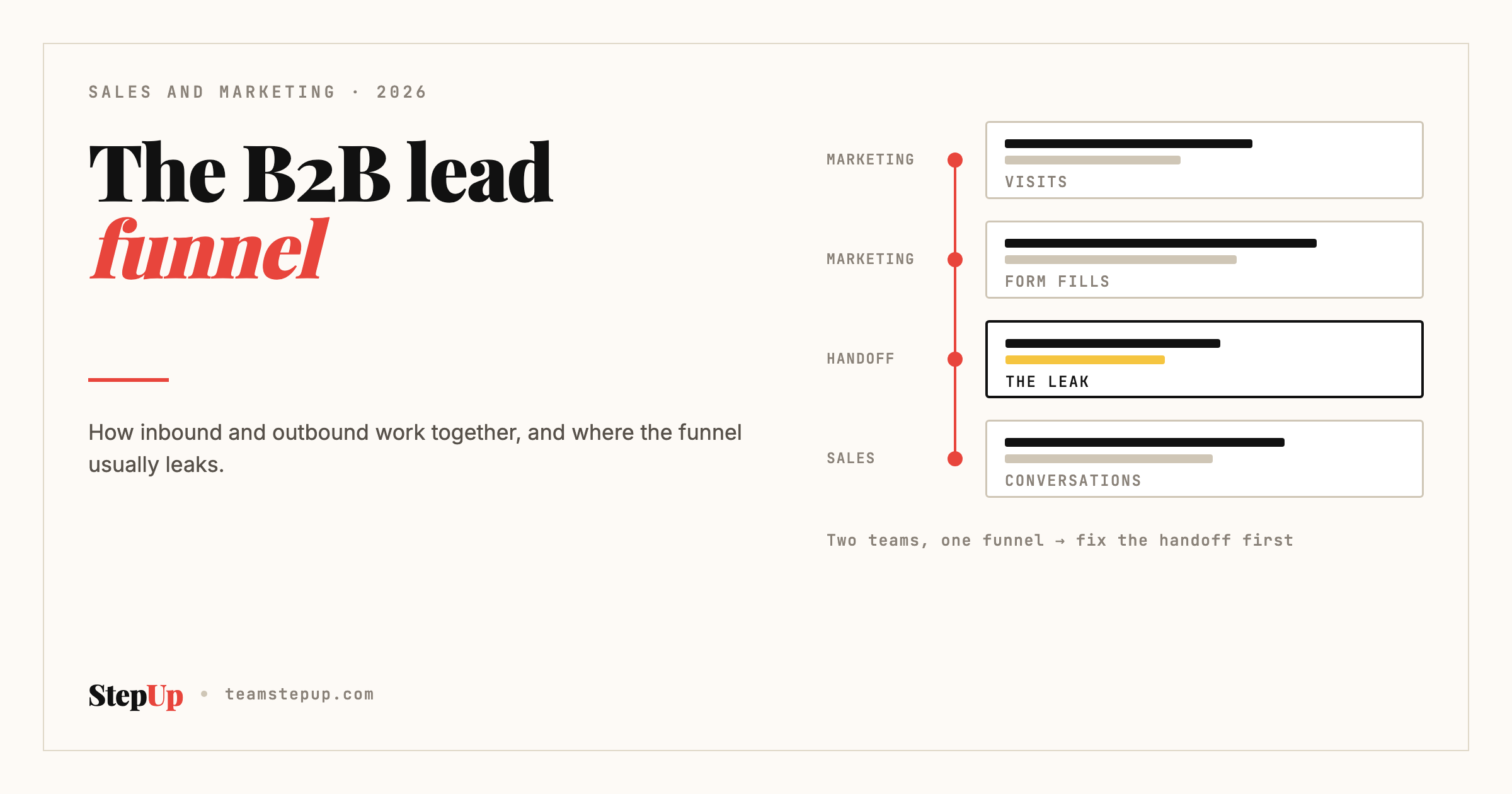
Most B2B companies have two funnels and do not know it.
Marketing runs one. It attracts visitors, collects form fills and scores contacts. Sales runs the other. It works a list, makes calls and books meetings. Each team reports its own numbers. As a result, each is convinced the other one is the problem.
A lead funnel only works when those two become one. This guide explains what a B2B lead funnel actually is, where inbound and outbound each belong, and how to connect them so interest turns into conversations instead of stalling somewhere in the handoff.
What is a lead funnel?
A lead funnel is the path a potential buyer takes from first becoming aware of you to becoming a sales conversation. It is called a funnel because many people enter at the top and fewer move through each stage.
In B2B, the funnel has a few features that consumer funnels do not:
Several people buy together. A single decision can involve a finance lead, an operations head and a technical evaluator, each moving at their own pace.
The cycle is long. Months, sometimes more than a year.
Most of the research happens without you. Buyers read, compare and ask peers long before they speak to a salesperson.
So a B2B lead funnel is less a straight line and more a set of stages that different people move through at different times. Still, the stages are useful, because they tell you what each person needs next.
The stages of a B2B lead funnel
Stage
What the buyer is doing
What they need from you
Awareness
Noticing a problem, or noticing you
A clear point of view on the problem
Interest
Reading, comparing, asking around
Useful content that helps them think
Consideration
Building a shortlist
Proof: examples, clear offers, answers to hard questions
Conversation
Talking to vendors
A salesperson who already understands their situation
Decision
Getting internal agreement
Material that helps them make the case to others
Different teams name these stages differently. The names matter less than agreeing on them, and on what moves someone from one stage to the next.
Inbound and outbound: two ways into the funnel
Inbound
Inbound brings buyers to you. They find an article through search, see a post on LinkedIn, hear a colleague mention you, or download a guide. They arrive with a need already forming.
Inbound is strong at the top and middle of the funnel, because it builds familiarity and trust over time, and it tends to attract people who are already looking. Its weakness, however, is timing. It works on the buyer’s schedule, not yours, and it can take months to build.
Outbound goes to buyers. Your team identifies the right companies and people, then reaches out directly: email, phone, LinkedIn, events.
Outbound is strong when you know exactly who you want to reach and cannot wait for them to find you. In addition, it gives you control over timing and focus. However, cold outreach without context is getting harder. Buyers are flooded with generic sequences, and most of them get ignored.
Why you need both
Inbound without outbound tends to attract some people who are not a fit and miss some who are. Outbound without inbound tends to reach the right people with no reason for them to listen.
Together, they cover each other’s gaps. Inbound creates familiarity, so outbound lands warmer. Outbound focuses attention on the accounts that matter most, so inbound content gets read by the right people.
How to connect inbound and outbound in one funnel
The idea is simple. The execution is where most teams struggle, so here is how to make it concrete.
1. Agree on who the funnel is for
First, both teams need the same customer profile, in writing. Which companies, which roles and what problem. If marketing is attracting one kind of buyer and sales is calling another, no process will fix the gap. Our guide on how to create an ideal customer profile walks through building one.
2. Use inbound signals to guide outbound
When someone from a target account reads three articles about a specific problem, that is a signal. Rather than waiting for a form fill, sales can reach out with context: “A few people on your team have been reading about this. Is it something you are working on?”
This is where inbound and outbound genuinely meet. Marketing surfaces interest. Sales responds to it quickly and personally.
3. Make outbound point to inbound
Similarly, outbound messages should rarely end with “book a demo.” A better first touch offers something useful: an article that answers a question the buyer probably has, or a short guide. That gives the buyer a low-pressure way to engage and brings them into the part of the funnel marketing nurtures.
4. Define the handoff
Decide exactly when a contact moves from marketing’s care to sales. What behavior or information qualifies them? How fast must sales follow up? What happens if sales decides the contact is not ready? Our guide on converting MQLs to SQLs covers this handoff in detail.
5. Close the loop
Finally, sales should tell marketing what happened to every contact it received. Which ones became conversations, which went quiet and why. Without that feedback, marketing keeps optimizing for volume instead of quality.
Where the phone still fits
Speed matters more than most teams admit. When a qualified buyer shows interest, a prompt, personal response, often a phone call or a short personal message, turns interest into a conversation far more reliably than an automated email sequence.
The call is not a pitch. Instead, it is a question: what prompted your interest, and what are you trying to solve? Listening well on that first call does more to move the funnel than any clever sequence.
How to measure a lead funnel
Resist measuring each team on its own numbers alone. Marketing reporting form fills and sales reporting meetings creates two funnels again.
Instead, track a small set of shared measures:
Conversion between stages, so you can see where people stall.
Time between stages, especially from first interest to first conversation.
Source of conversations, including self-reported sources like “a colleague recommended you.”
Quality feedback from sales, meaning how many handed-over contacts were genuinely a fit.
Together, these show where the funnel leaks. In most B2B companies, the biggest leak is in the handoff, where interested buyers wait too long or get a generic response.
Common lead funnel mistakes
Treating the funnel as marketing’s job. The funnel belongs to both teams. When sales treats it as marketing’s problem, the handoff breaks.
Chasing volume at the top. More contacts are not better if they do not match the customer profile. They just create work.
Slow follow-up. Interest fades quickly. A day’s delay costs more conversations than most teams realize.
Automating the first real conversation. Automation is useful for organizing and nurturing. However, the moment a buyer is ready to talk, a person should respond.
No agreed definitions. If the teams disagree on what a qualified contact is, every meeting about the funnel becomes an argument about numbers.
Frequently asked questions
What is a lead funnel?
A lead funnel is the path a potential buyer takes from first becoming aware of your company to becoming a sales conversation. It is usually divided into stages, such as awareness, interest, consideration and conversation, with fewer people moving through each stage.
What is a B2B lead funnel?
A B2B lead funnel is a lead funnel designed for business buying, where several people are involved in each decision, the cycle is long and most research happens before a buyer speaks to sales. It needs to serve multiple people at different stages at the same time.
What is the difference between inbound and outbound marketing?
Inbound attracts buyers to you through content, search, social media and referrals. Outbound reaches out to buyers directly through email, phone, LinkedIn or events. Inbound works on the buyer’s timing. Outbound gives you control over who you reach and when.
Can inbound and outbound marketing work together?
Yes, and they work best together. Inbound creates familiarity, so outbound outreach lands warmer. Outbound focuses attention on the right accounts, so inbound content reaches the people who matter. The connection point is a shared customer profile and a clear handoff.
What are the stages of a lead funnel?
Common stages are awareness, interest, consideration, conversation and decision. The exact names vary by company. What matters is that marketing and sales agree on them and on what moves a buyer from one stage to the next.
How do you improve a B2B lead funnel?
Start with a shared customer profile, agree on the handoff between marketing and sales, respond quickly and personally when a qualified buyer shows interest, and track conversion and time between stages. In most companies, the handoff is where the biggest gains are.
So next quarter, give both teams one report with one set of numbers.
Then see how long it takes someone to ask where the webinar leads went.
Why should you spend time planning and writing a sales email? Because when done right, it absolutely works to drive traffic to your business. A recent talk by Heather Morgan from SalesFolk highlighted ways to create the best sales emails for your business.
There are many reasons to consider reaching out to prospects via email. First, marketing has changed significantly in the last decade. There is more competition in all industries and it is no longer enough just to shout “I am here!” and wait for the work to appear. Telemarketing and cold calls are hard and not as effective. You need to adapt your approach to continue to gain new customers and projects.
Inbound marketing is the new way to attract and educate qualified leads, but building quality content takes time. You also have to spread this content over multiple channels such as email marketing, Facebook, and LinkedIn to attract leads to your website.
If done right, sales emails can be very an effective way to attract, educate, and retain clients. Here are five principles to follow to create an effective sales email:
Know Your Audience
Are you writing to the CEO? Then your email should address concerns most CEOs have such as cutting costs and boosting sales. Writing to the engineers? Then talk about tolerance, maintenance costs, or customization options. Spend some time looking at the web profiles of the company and individuals you’re targeting. You’ll be able to learn what they’re reading about and where their interests are. You can also see what thought leaders and industry influencers they follow. From this information, you can understand what their concerns are and how they’re making decisions. All this information can help you draft a better sales email.
Get a Reaction
People react to an email for three reasons:
Curiosity: Humans are, by nature, curious about things they aren’t familiar with. Use curiosity to get people to open your emails by employing leading questions as your subject line.
Desire: When you can paint a compelling picture of how you’re going to solve a problem and improve their situation, clients are quickly motivated to take action.
Fear: This is when you talk about situations people want to avoid. You can target their problems and pain points. Just be careful that your email is designed to motivate quick action and not make them give up.
Call on existing customers to brag about your company. When it’s someone else exclaiming your virtues, prospects are more likely to take note. Ask your current clients to share a story about how you’ve helped them succeed. Get them to describe what it’s like working with you. Share a picture of your client or their name so that they are relatable.
Have a Clear Goal for Your Email
It is important to be specific about the goal of your email. Do you want the prospect to call you? Fill out a form? If you know what your goal is, you can craft your entire email towards the one simple action you want the prospect to take.
Collect Data
Be a data fanatic. Set goals for your sales campaigns and measure your results. Modern email marketing tools come equipped with email testing capabilities, advanced reporting, and lots of specific insight into what’s happening with each email.
Many people are afraid of cold emailing, but success really depends on your state of mind. If you have a great product or service that can truly help the people you’re contacting, then it is your obligation to sell it.
Now you know you need to send sales emails – but what to write? Check out our free guide of proven follow up sales email templates for ideas of emails to use throughout the sales process, and for every kind of lead. Templates can help you semi-automate your follow up process, save time, and reach more of the leads you want. When you use the right tools, the right leads will come your way.
Every business has a specific customer they’re looking for – preferably one who can afford their services and is ready to make a purchasing decision. For B2C companies, this customer might be clear to everyone. But for B2B companies and in particular industrial companies, often only the owner of the business inherently understands the profile of their ideal customer. Communicating this to sales and marketing teams, and making sure that you are converting the right leads, is a challenge.
Inbound marketing is a marketing methodology that addresses this issue. In contrast to traditional marketing or even digital marketing, inbound marketing involves creating a system that starts with understanding the ideal customer. This understanding then guides an entire process of communication. Here are three key steps you can follow to start building an inbound system:
1. Create a Clear Buyer Persona
Take the time to sit down and draft a persona for your ideal customer. What role do they hold within their organization? How educated are they about your industry? What specific needs do they have that your company can fill? Is there a certain size or type of order they might need? For businesses marketing to other businesses, this means that your buyer is generally someone in management or procurement at another business. They’re generally well educated and have done at least some basic research about your industry. Define exactly who this person is so that sales and marketing are reaching people who can make decisions, have projects your business can complete, and are focusing on converting the right leads.
2. Ensure Marketing and Sales Alignment
Particularly when businesses focus heavily on a professional sales team, marketing may get less focus. However, marketing still plays an important role in making sure the message is consistent and that potential leads are aware of the brand. Regular communication between marketing and sales personnel will ensure that marketing isn’t over-promising the company’s capabilities and the sales team is presenting a consistent, professional image.
3. Create a Clear Sales Funnel
In a manufacturing company, there is a clear process required for each task within the manufacturing process. In the same way, creating a sales funnel where a prospect goes from a stranger to a customer makes sure you’re capturing the information you need to make informed marketing decisions. It also ensures you can properly analyze every lead that comes your way, focusing on converting the right leads that will become customers. Start with a clear process to document and track leads and move them from someone who is just learning about your business into a prospective customer. Your sales team should also have a clear process to follow for approving and sending out request for quotes and handling changes requested by customers. Even a simple process can be useful to make sure you don’t miss any details and, if set up correctly, can scale as your company grows.
Handling the marketing aspects of a growing business may seem like you have to learn a completely new, and highly technical, subject. That’s why collaborating with an outside marketing firm that specializes in B2B sales such as StepUp Marketing is helpful. While you’ll still have to articulate clearly who your buyer is, they have the technical expertise to set up the marketing processes that feed directly into your sales funnel.