Three Key Tips for Converting the Right Leads

Every business has a specific customer they’re looking for – preferably one who can afford their services and is ready to make a purchasing decision. For B2C companies, this customer might be clear to everyone. But for B2B companies and in particular industrial companies, often only the owner of the business inherently understands the profile of their ideal customer. Communicating this to sales and marketing teams, and making sure that you are converting the right leads, is a challenge.  

Inbound marketing is a marketing methodology that addresses this issue. In contrast to traditional marketing or even digital marketing, inbound marketing involves creating a system that starts with understanding the ideal customer. This understanding then guides an entire process of communication. Here are three key steps you can follow to start building an inbound system:

1. Create a Clear Buyer Persona

Take the time to sit down and draft a persona for your ideal customer. What role do they hold within their organization? How educated are they about your industry? What specific needs do they have that your company can fill? Is there a certain size or type of order they might need?

For businesses marketing to other businesses, this means that your buyer is generally someone in management or procurement at another business. They’re generally well educated and have done at least some basic research about your industry. Define exactly who this person is so that sales and marketing are reaching people who can make decisions, have projects your business can complete, and are focusing on converting the right leads.

2. Ensure Marketing and Sales Alignment

Particularly when businesses focus heavily on a professional sales team, marketing may get less focus. However, marketing still plays an important role in making sure the message is consistent and that potential leads are aware of the brand. Regular communication between marketing and sales personnel will ensure that marketing isn’t over-promising the company’s capabilities and the sales team is presenting a consistent, professional image.

3. Create a Clear Sales Funnel

In a manufacturing company, there is a clear process required for each task within the manufacturing process. In the same way, creating a sales funnel where a prospect goes from a stranger to a customer makes sure you’re capturing the information you need to make informed marketing decisions. It also ensures you can properly analyze every lead that comes your way, focusing on converting the right leads that will become customers.

Start with a clear process to document and track leads and move them from someone who is just learning about your business into a prospective customer. Your sales team should also have a clear process to follow for approving and sending out request for quotes and handling changes requested by customers. Even a simple process can be useful to make sure you don’t miss any details and, if set up correctly, can scale as your company grows.

Handling the marketing aspects of a growing business may seem like you have to learn a completely new, and highly technical, subject. That’s why collaborating with an outside marketing firm that specializes in B2B sales such as StepUp Marketing is helpful. While you’ll still have to articulate clearly who your buyer is, they have the technical expertise to set up the marketing processes that feed directly into your sales funnel.


get a free marketing assessment

Blogging For Business – 5 Reasons To Apply It To Your Business ASAP

In the past, blogs were considered a rarity within the business world – very niche specific, without much value. Now, this is no longer true – blogging for business has evolved to be the main staple in most business marketing strategies and more specifically, within any inbound marketing strategy.

While blogging can take some time and may even seem slightly daunting, the advantages of having a blog for your business are numerous and hard to ignore.

Blogging for business

Business Blogging Defined

First, it’s important to note that business blogging looks different than other forms of blogging. Perhaps you choose to blog in your free time, or maybe you’re a frequent reader of travel blogs, that’s all great. But with business blogs, you must keep in mind that its main purpose is to be part of a strategic marketing plan.

The length of posts can range drastically, yet what’s important is that you treat the blog as a part of your company’s website, and keep the subject of posts relevant to what you are selling or providing.

The goal of the blog should be to increase online visibility, whether that is through SEO or social media. Use your company’s expertise to share insights of real value with potential customers. Ensure that posts are speaking to your client’s challenges, holding their interest and proving to them that you are established within your specific industry. Showing them the value that your company has to offer simultaneously promotes your service or product, prompting traffic to be converted into leads.


Why Blog?

In 2017, a blog for your business has more to offer than ever before. The overhead is low, and the benefits are high. Consider this:

  • Companies that blog have 97% more inbound links
  • 82% of consumers enjoy reading relevant content from brands
  • Websites with a blog have 434% more indexed pages
  • 77% of internet users admit to using blogs


Here are five best reasons why we believe blogging for your business is a must:


#1. Business Blogging Drives Traffic

This was briefly mentioned above but is important enough to really dig into. Specifically, with Inbound Marketing, driving traffic (instead of being annoying/distracting) truly is key.

Make sure to view your blog as an extension of your website. Hopefully, your website has been kept simple and doesn’t have a lot of pages, yet most likely isn’t updated as frequently as a blog would be updated. Which is perfectly fine, because blog posts are basically just indexed pages on your website.

A statistic from Hubspot notes that 78% of internet users are turning to the internet to do their product research. With frequent blog posts addressing the concerns of your potential consumers, the odds of them stumbling upon those indexed pages are high.

With every blog that you write and post, you are increasing your chances of:

  1. Showing up in search engines (driving traffic)
  2. Increasing your social media presence with your current audience/followers
  3. Expanding the potential of being discovered via social media by new potential leads

Think of it this way – with each blog post you are publishing, you are increasing the odds that your audience will be sharing and re-sharing this post to others. It’s a simple way to build on free marketing, while also building credibility.

All the above examples are working towards your end goal of driving more traffic, resulting in more potential leads. Which brings us to our second reason.


#2. Blogging & Building Leads

In short, having a blog for your business is going to generate more leads, it’s as simple as that. The traffic that we mentioned above, some of it is looking specifically for your product or service, and therefore are well-positioned to be converted into leads once discovering your blog. When it comes to converting those leads, the use of ‘call to action’ opportunities within the blog are crucial.

Blogs are a GREAT opportunity to utilize CTA’s. Some simple CTA’s to consider adding to blog posts can range from free fact sheets, webinars, training, even an e-book; any simple value-add that encourages a visitor to exchange their contact information. Without a CTA, it may be little more challenging to ensure that you’re turning blog traffic into leads.

Part of turning your traffic into leads is also developing that relationship. The language or tone that your blog uses may help to connect more with your audience than your actual website does. When writing posts, consider asking questions towards the end to promote comments from your readers; which also will give you a view into the kind of traffic you are seeing come through your blog, and what kind of solutions they may be seeking out.

Along with building relationships with your traffic and/or potential leads comes the perk of also building trust. Or in other words, credibility.


#3. Creating Credibility

Stemming directly from the concept of building relationships through your blog now comes the concept of establishing yourself as a credible source of information to your audience; one of authority. The more that you are able to interact with your prospects and answer their questions, the more quickly you can build up that authority.

Perhaps there is confusion around a certain issue, or a visitor is unsure of how to solve a particular problem. If an existing blog post of yours is able to answer a question or solve that problem, you’re able to quickly (and easily) build up that credibility with a visitor, simultaneously increasing the chances of turning them into a lead.

It makes sense; if you’re able to organically utilize a blog to answer questions, the chances of your audience then trusting you and being willing to enter the sales process will be much higher than without. Not to mention the fact that your leads are coming to you more educated because of that blog, which may enable them to actually move through the sales process more quickly than those being established from ground zero.

At the end of the day, you should be striving to create a blog that establishes yourself as the “go-to” resource when it comes to your industry. Provide educational, easy-to-digest knowledge for your blog traffic, and you will build leads that trust you – leading to higher customer conversion rates. It’s as simple as that.


#4. Connecting With Clients

A business blog is also a great tool to genuinely connect with your customers, and communicate with one another. Focus on posting content that addresses issues or pain points that they have (and that you can solve), or use posts to further explore areas that may also be of interest to your audience.

It can be a great resource to test new ideas and thoughts on different solutions or products, by posting and then seeing how your audience directly responds. Using the “comment” feature at the bottom of a blog post is a must; end posts by encouraging your readers to respond to it with their thoughts or questions, and then use that direct feedback as some navigation as your business continues to move forward.

Perhaps your readers are choosing to reach out and comment on challenges that you had never even considered before. Just like the use of social media, blogs can be a great opportunity to then use that information that is freely given to you, and explore ideas within your own business, so that you can possibly offer solutions around those pain points being voiced while growing your business over time.


#5. In it for the Long-Haul

The last thing to consider when it comes to blogging for your business is that blog posts can help grow your business, forever. If you are writing relevant content for your readers to absorb and utilize, your blog posts will continue to bring traffic to your website for years to come.

Think about it. Once you share a new blog post, the hope is that it gets shared, reshared, read through emails being sent out, social media, and so on. This helps your blog to get ranked in search engines and then sets you up to be found in the future – for the weeks and months to come.

So essentially we are suggesting that a blog is not only a short-term but a long-term investment. As long as posts contain a value, they will continue to offer value as long as they continue to exist out there on the world wide web. Be patient, don’t always expect immediate results, and trust that traffic (and leads) will continue to flow in from your blog, over time.

Hubspot – our marketing platform – actually reported that 70% of their blog traffic per month actually comes from posts that weren’t even published during that month. The traffic came from old posts. Old posts, with great value.


It’s Time to Blog for Your Business

When it comes to building your business, blogging can be an extremely relevant, helpful tool, without having to put excessive amounts of time and effort into it. And the best part is, if you don’t know where to start, there are plenty of resources out there to help you launch your business blog and get it underway.

Questions? Comments? Want some help with starting a blog – or your entire marketing campaign? Get in touch with us today!

5 Reasons To Use Hubspot As Your Marketing Platform

Are you still wondering why you should be using Hubspot for your marketing? It’s well known that inbound marketing has proven itself as the most effective option within the marketing world. Yet common hesitations to using inbound marketing can include concerns that too much work needs to go into it, and having to use many different software and/or applications at the same time.

Inbound marketing can be hard work, but that’s why it works. And with the help of Hubspot, it can become very simple and easy to track and act.


What is Hubspot?

In short, Hubspot helps you to maximize and simplify your inbound marketing efforts. It is a marketing platform, ranked as the best inbound marketing platform in the world, that serves over 10,000 companies in 65 different countries. The platform scoops up all of your current software, services, support systems, etc., and puts them all into one place, on one platform.

We’re confident that after just a short period of time using Hubspot as a platform, you’ll quickly see the added value it offers, and how it is contributing to your business growth. And while the platform comes at a price, let’s be honest; the use of several marketing applications at once can be JUST as pricey if not more. So instead of juggling several log-ins, software, and having to use four monitors at once just to keep track of it all – keep it simple, and put all of that money into one, easy-to-use platform. Hubspot.

Here are some reasons why Hubspot is the answer to your marketing needs:


#1. Centralized, All-in-One Toolset

How often do we find ourselves at work logging into many different software and tools, often having to pull up multiple screens, and jump from window to window to get work done? With Hubspot, it’s one password and one platform; everything you need to get your work done, all in one place.

Anything from your blog, email, landing pages, and forms is all kept and stored within Hubspot. There are even reporting options, and an SEO view, and a handy tool called Social Inbox that syncs your various social media accounts into one place.

That means that you don’t need to constantly be rotating from Twitter to Facebook to Instagram, and so on; it can all be pulled into the Hubspot platform so that you can monitor, respond, and even schedule future posts all from one place.


More Hubspot Platform tools:
  • Website content management system
  • Blogging platform
  • Social Media platform
  • Analytics software
  • Email marketing platform
  • CRM
  • Landing page & Call To Action tools
  • Excel or Google Sheets


#2. Personalization Options

The personalization and attention to detail that goes into your inbound marketing strategy are truly what brings the value. Hubspot offers some mind-blowing personalization option in regards to this.

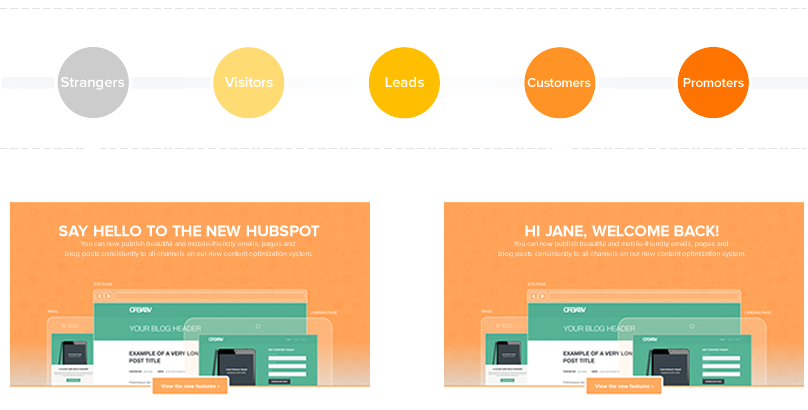
An example of this is Hubspot’s Smart Call to Actions (Smart CTAs) that can actually be built into your website with their Content Optimization System (COS). The entire system is built around website personalization, responsiveness, and the smart CTAs. Plus, with the use of the HubSpot software, everything is integrated into the platform – even your website!

With the use of Hubspot’s COS, you are able to craft and mold your website’s content for individual visitors based on things like location, language, source, device, or by literally any detail that’s stored in your contact database.

The feedback that you then get from the COS – which is labeled as HubSpot’s smart content insights – allows you to receive all of the information surrounding your website’s visitors, making personalization for your audience easier than ever before.


#3. Hubspot Automation

With only so many hours in the day, automating tasks and systems can not only be useful, it’s often quite necessary. Hubspot gets that; automation is their middle name.

Take Workflows for an example, their marketing automation app that can basically automate as much or as little of your marketing efforts as you desire, in a contextual and measurable manner. The best part is Workflows taps into Hubspot’s entire platform, allowing the creation of items like email lists to be built on literally any criteria – from persons to custom lead scores, etc.

It starts with setting the goal of whatever you want your automation to be. So take something simple like sending emails; from there you can choose to build in your contact properties, add them to a list, create and then label the emails. Hubspot can help you to schedule optimal timing while keeping the sales funnel in mind.
Or you may choose a ‘recipe’ that is listed within Workflows, which are automation that already exists, have been tested and proven to work in regards to lead nurturing and business growth. This simple option can speed up your automation process even further.

Other automation examples include:
  • Automating specific tasks
  • Updating contact properties
  • Automating emails sent to leads’ owners when a lead is sales qualified.


#4. Simple, Easy to Navigate the Platform

If you haven’t already noticed, Hubspot is all about simplifying your inbound marketing plan. So if it isn’t attractive enough just to know that all of your tools are in one place, how about also knowing that they are in one, easy to navigate software?

Let’s take a look at reporting, a task that a lot of people may dread or be intimidated by. Perhaps you don’t even know where to start when it comes to reporting. The HubSpot platform offers both free reporting, as well as event analysis. There are various reports on your contacts, companies, and attribution reports, or you can choose the route of letting Hubspot walk you through how to easily build your own customizable reports. 

Because inbound marketing is such a new, growing industry with tons of potential, there is the fact that you’ll be seeing constant improvements and additions to your platform. Hubspot does a fantastic job of consistently offering new, easy to use tools that are evolving to meet new demands within the industry, all while being mindful of keeping your life simple.


#5. Customer Relationship Management

CRM’s have pretty much become a ‘must have’ when it comes to your set of marketing tools. Guess what? With Hubspot, your CRM is free (and perhaps just this alone justifies the cost).

Of course, the CRM is located within that same platform and pulls from your contact information, helping to inform you on exactly how those leads are interacting with your content. As always, personalization is the name of the game, and the extreme personalization of your Hubspot CRM helps to ensure that you are staying relevant in the sales process.

The Hubspot CRM takes as much information as it’s able to piece together on a lead, and then presents it as a profile for your sales team to use for whatever they may need, from follow-ups and check-ins to pursuing hot leads.

More CRM Perks:
  • Integrates with the Hubspot database seamlessly
  • Timeline feature helps you to stay organized, track and manage details, organize your day.
  • Recording of phone calls/log emails

Last but not least, alongside the CRM tool comes the little brother – Hubspot Sales. HubSpot Sales comes in two versions – a free version, and a $50 option. This feature is similar to having a personal assistant that helps to manage your sales emails and makes sure you know your leads and potential buyers.

More Hubspot Sales Perks:
  • Insights from your email and your browser
  • Notification of when your email is read
  • Helps to schedule timely emails


The Wrap Up

To be honest, the list of what Hubspot has to offer as a marketing platform could go on for days; these are just a few of our favorites. At the end of the day, in order to both maximize and simplify your inbound marketing efforts, Hubspot is your one-stop shop. Make your marketing life easier, while continuing to grow your business and delight your customers.

How to use the new Facebook Messenger Ads to drive qualified leads to your business

This past fall, Facebook decided that it was time to change the advertising game with the update of Facebook Messenger Ads. You might jump to the opinion that this ad type will only work best with the more ‘techy’ audiences, or larger companies with a big social media presence, etc. But let’s look at this single statistic:
There are over 1 billion Facebook Messenger users. One. Billion.
All of your potential leads? They’re all on Facebook.


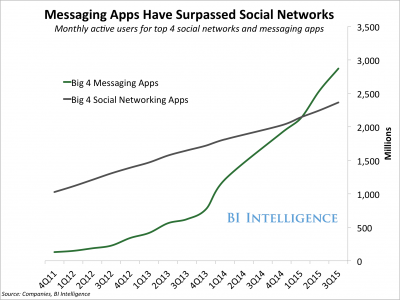
This chart from Business Insider is mind-blowing. At the beginning of 2015, monthly usage of the top four messaging apps surpassed usage of the top four social networks.

Anyone Can Benefit From Facebook Messenger Ads

With the right resources, any business can benefit from Facebook Messenger Ads. 

Here’s another quick stat for you: by the middle of 2015, the monthly usage of the top four messaging apps had surpassed the usage of the top four social media networks.

But let’s take a step back from the numbers. Instead, let’s look at the basic facts of business growth. When it comes to marketing, businesses should join the conversation as a possible resource as early in the game as possible.

Facebook Messenger allows us to enter that conversation much sooner. Your business can be present in the early stages when the customer is still forming opinions and educating themselves. It allows for the ability to be extremely reactive as a business, and hyper aware of the customer’s journey.

So how do Facebook Messenger ads even work? Great question. Let’s take a look.

Facebook Messenger as a Destination

Also known as Destination Ads, Messenger Ads hang out in your leads’ newsfeeds and are seen on both desktop and mobile views. One click and your potential consumers are then taken to a Facebook message to communicate directly with you/your bot.

The advertisement itself looks like any normal Facebook ad, but the exciting new advantage here is the option to start a conversation. Instead of a ‘call to action,’ consider it to be a “call to conversation.”

For many people, this may actually be very appealing. Often when people are searching for solutions or answers to questions, they would rather connect directly with you/your company. Otherwise they are clicking on a hyperlink and are taken away to another website, left searching for the answers to their questions.

The options are open when creating the ad, with the ability to select options like interests, behaviors, different custom audiences and so on.


Destination Ads: Audiences to Target

Facebook Messenger Destination Ads can be a great option when it comes to retargeting an audience. It gives the unique opportunity for people to ask the questions that may be holding them back from actually purchasing your product.

Yet another audience to consider are the potential customers that haven’t even heard of your company or solution. Overall, a Destination Ad can help to build awareness around what you have to offer. It allows for a sales conversation to be had at the choice of your potential lead. Running an ad with the right question could potentially prompt a quality conversation, leading to the gain of new customers more quickly.


Sponsored Messages

This is the second option for Facebook Messenger Ads, and while it holds more restrictions than the Destination Ads, it has a huge amount of potential.
With this type of ad, a sponsored message is no longer in the newsfeed but is actually sent to the Facebook Messenger inbox. The main difference here is that a conversation/ad can only be sent to someone who your company already has an “open, existing conversation” with. In other words, the lead needs to reach out to you first.

Ad options that can be sent within messenger include opportunities such as sending your lead a special offer, a new product, a free PDF, or even to a new destination (your company’s web page, etc.).

As a company you are charged by impressions; whether or not a customer opens the message. However, there is also the option to use and/or build your own chatbot with this method, which then personally builds a list of subscribers that you can message your advertisement to. The advantage to this is that bots are typically charged on a per month basis, versus a CPM basis with Facebook.

A disadvantage to note with sponsored messages is that the user does have the option to block you from sending messages.


Facebook Messenger and Chatbots

Facebook actually does a great job of walking you through the process of creating your Sponsored Message or Ad – check out the Facebook Business page for a very detailed how-to. However, in order to maximize your investment in Facebook Messenger Advertising, you’re most likely going to need a chatbot.

Currently, there is a wide variety of affordable bots out there that offer very high value (at a low price), when it comes to a campaign with Facebook Messenger. If it’s within your budget, there is also the option to create your own bot for a fairly affordable sum, even without basic coding knowledge. All it takes is a little bit of help from the internet.


More Business Advantages

Another advantage to using Facebook Messenger for advertising is the ability to incorporate the messenger option into your own website. The ad can lead to your landing page, or the ‘thank you’ page, or both.

This feature is a great way to prompt your buyers with the option to receive messages on Facebook Messenger. Information Regarding shipping updates, purchase confirmations, etc. A perk to this is that if customers do choose to use Messenger as their preferred form of communication, they are then adding themselves to your list of future leads who can receive message advertisements on Facebook down the line. Specific messages could then be sent to this audience around relevant upsells, cross-sells, or free resources.


Messengers are the Way of the Future

Let’s be honest; as time goes on, consumers are becoming less and less tolerant to interruptive, time-consuming forms of communication. The more simple, the better.  Messengers are continuing to become the most essential form of communication due to the quick responsiveness and ease of use.

We will leave you with this: Facebook has reported that more than one in two people say they are more likely to shop with a business that they can message, and 67% of people expect to message businesses more within the next two years.
Will you get on board with Facebook Messenger Ads? Don’t get left behind.

Inbound Marketing – The Future of Marketing and Sales

Marketing and sales: is one more important for business growth? It’s an ongoing discussion in the industry. For years sales people have argued they are the most important figures in the business and marketers have claimed that without them sales people are useless.

In 2017, marketing and sales are more competitive (and challenging) than ever. Prospects are tired of aggressive advertising and pushy sales pitches. Poeple are looking to find great products and services that are easy to consume and understand.

Cue: Inbound Marketing. The future of marketing and sales.
Why is Current-State Marketing Broken?

Current marketing, or outbound marketing, is the more common marketing approach of the past. Outbound marketing tends to be aggressive and interruptive, putting ads, billboards, and flyers in the faces of potential leads, and can often be irritating instead of attracting.

Digital marketing is already a very crowded space, and because of this consumers are more likely to get annoyed with ads instead of being drawn to them. Not only this, but they now have the ability to easily block ads, or the propensity to ignore them.

And the cherry on top? Data tells us that outbound marketing is actually less effective, yet more expensive.

Discover Inbound Marketing

Inbound marketing focuses on drawing in customers organically – using content that has been designed to solve the needs and questions of your audience. The main principle of inbound marketing is to ‘get found’ by the customer, instead of having to seek them out. When done correctly, your leads will end up on your unique landing page, social media site, etc. – and discover exactly what they’ve been searching for. This method is particularly effective because it helps to quickly build credibility.

How Does Inbound Marketing Work?

The inbound methodology itself is often broken into four marketing actions. We’ll keep it simple:

1. Attract.

More traffic doesn’t necessarily mean good traffic; we are looking for the right traffic. The right traffic can be defined as our ‘buyer personas’ or, people who are already able to relate to your product or service. They may have similar challenges, needs, questions.

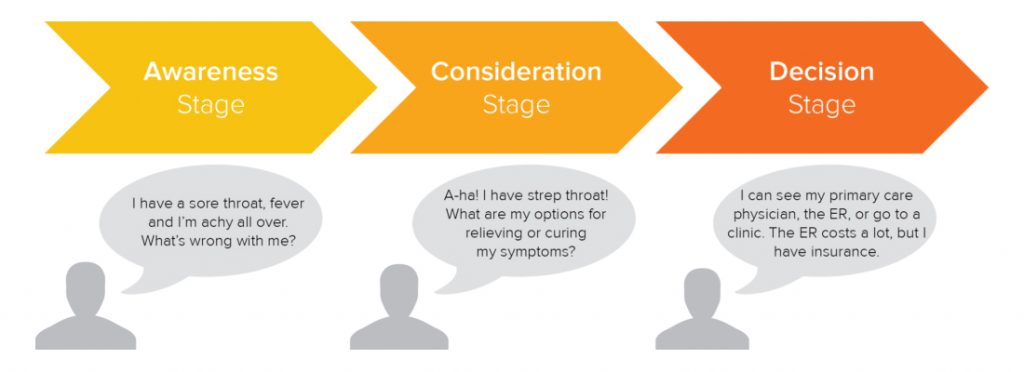
This timeframe is also considered the beginning of the Awareness stage, during which consumers first realize that they have a problem that needs to be solved. From there they move into the Consideration stage, which shifts potential personas towards defining and researching solutions to their problem.

The above stages are part of what we refer to as the “Buyer’s Journey”, and the inbound marketing strategy is built specifically around these, ensuring that the right message is being sent at exactly the right time.

2. Convert

Now let’s turn those personas into leads. How? Contact information! Methods such as simple forms, or a call to action on your website to get email addresses in exchange for something free – perhaps a helpful PDF, an ebook, etc. The options truly are endless.


3. Close

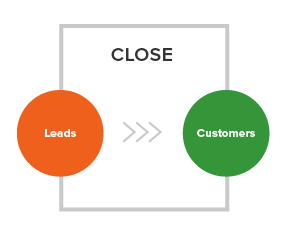
OK, so you’ve got your leads – now what? Using a variety of tools from Customer Relationship Management (CRM) systems to a series of simple emails, there are plenty of methods to transform your leads into customers. With the inbound marketing methodology you will nurture the leads with more useful content and identify the exact moment they are ready to buy. Only then will you close them as customers without being pushy or aggressive.

4. Delight

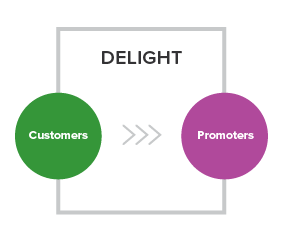
In order to keep those happy customers delighted for life, you can’t just forget about them post-purchase. Keep in touch with your audiences through outlets such as surveys asking for feedback, and social media interactions.

Authentic Marketing That Actually Improves Sales

The key to the inbound marketing strategy is that it isn’t just ONE key – it’s a whole bunch that come together to create success. Options range from content marketing, blogs, all forms of social media, organized events, search engine optimization, emails, and so much more. It’s a methodology that earns the attention of potential customers and sets up your company to easily be found – with our help of course.

It’s because of this personalized approach that you then draw in the most likely leads. Odds are that your leads are discovering you because they are already clicking around with questions about your specific industry, or product. This circles back to the concept of ‘earning the attention’ of your customers, instead of screaming at them and begging for attention.

Because let’s be honest, no one likes to be cold-called or approached out of the blue when they’re simply trying to mind their own business. With only 19% of consumers now utilizing salespeople as a resource for their buying decisions, it’s simply an outdated method of the past.

Digital Marketing Is Changing…

And we have the stats to prove it:
– Two billion people are using Facebook to search for content, daily.
– Four billion people are using messenger apps to communicate and search.
– Two out of three adults use social media to keep up on world events.
– Mobile ad blocking has increased 90% year over year.

(Source)

Now, more than ever, the customers have the power over the ads, not the marketers.

Let Inbound Marketing Change The Way You Do Business

The good news is, we have inbound marketing, a more authentic method that addresses those problems and needs that your potential leads are searching for. And it’s not just about using the right data – it’s about pushing it out at the correct time, in the correct place – so that your leads are delighted instead of irritated

Inbound marketing sets up the relative searches to be lead to you – perhaps your blog, or a recent tweet – in a completely natural and less aggressive way, personalized for the consumer.

An added perk: inbound leads cost roughly 61% less than outbound leads gained through the “louder” methods such as mailings, radio/TV ads, etc.

How Does This Apply to Me?

Let’s run through a real life scenario.

You’re leaving your house in the morning, and decide that you want a coffee on your way to work. Coffee shops using traditional marketing (the outbound method) may still be doing things like mailing coupons to your mailbox, or posting an ad to promote their new coffee shop.

This may have worked years ago. However, in our ever-changing, nonstop digital age, people aren’t pausing to check their mailbox on the way to work, and aren’t reading ads in newspapers or magazines. Where are they looking instead? To search engines on their phones, and to social media for recommendations or interesting content on hot new coffee shops.

Consumers today are more empowered than ever. Essentially any need or question they may have can be found by a simple search on Google, Facebook, and other digital media channels.

Marketing That People Love

Need more reasons as to why inbound is the future of marketing? Check it out:

  • Sparks social media sharing
  • Empowers your customers while encouraging brand interaction
  • Generates brand awareness
  • Fosters more leads, for less money
  • Develops and grows your search engine optimization (SEO).

Don’t get left behind – get on the inbound marketing train. It truly is the future of marketing and sales.

get a free marketing assessment

Sources:
https://www.marketo.com/inbound-marketing/ (stats)
https://www.hubspot.com/inbound-marketing (4 actions)
https://blog.hubspot.com/insiders/11-facts-about-inbound-marketing

The Best B2B Lead Generation Strategy To Use In 2017

Business owners have become an attractive target audience in the advertising world. Many startup companies create new tools and products for businesses and we are seeing an increase in marketing campaigns.
If you ever tried a B2B lead generation campaign, you probably already know that it can be very expensive to generate traffic and leads to that market, and in most cases the campaign results are non-effective and non-profitable.

There are three main reasons for this:

    1. Highly Competitive Market
      Google Adwords platform is one of the best sources in analyzing the competitiveness of the market. In the B2B market, big brands can spend a lot of money and choose to bid very high on the most targeted keywords. As a result, it will be very expensive to advertise and compete against those brands.Because the B2B market has proven to be so profitable, it is also crowded.Many companies are competing in it and therefore paying dearly to be seen first in Google Ads or on other ad platforms. It then ends up being a very expensive market that only companies with big advertising budgets can contend in.
    2. A Specific and Narrow Audience
      The B2B audience is more complex to target. Not only because it’s only for business owners, but in most cases you want to target businesses in a specific niche. On top of that, you might also want to zone in on a specific size or type of business, or even a specific person within the business. This makes targeting challenging.
    3. More Difficult to Convert and Close
      As described previously, the B2B market is a very competitive, offering high-ticket products and services, therefore also making it more challenging to convert to sales.
      Bridging the gap from generating the lead (the first step in the sales funnel) to then closing the sale can become even more difficult when the the product is expensive, and the consumer has several (sometimes less expensive) options to choose from.


Targeting Tactics For B2B Campaigns:

1) Direct Offer Targeting
(A direct campaign for b2b service or product through all ads platforms.)

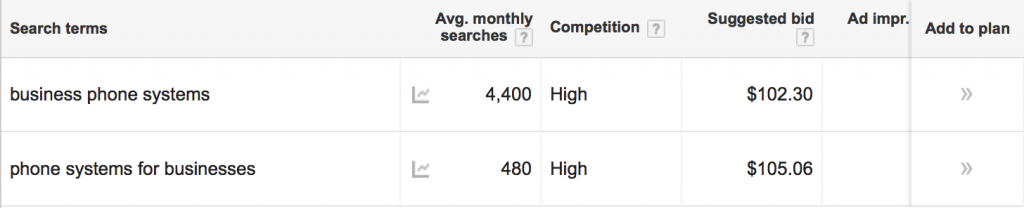
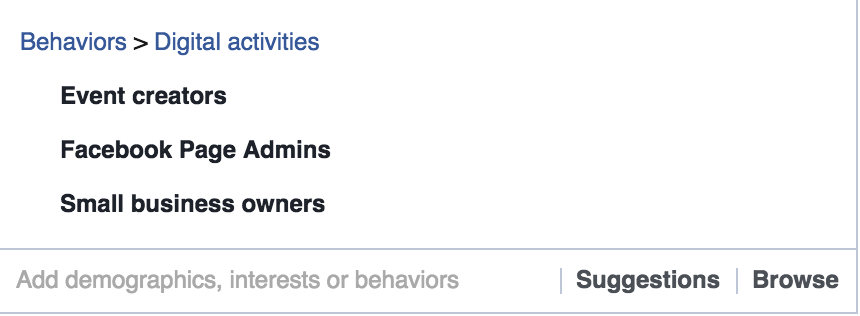
You can create a very direct campaign in Google Adwords using “Buying Keywords” – the exact keywords people use to search your products and services. In other platforms such as Facebook Ads you can target your audience by demographics, characteristics and even usability such as “page admins” by incorporating direct offer ads added right on their timelines.

Google Adwords Direct Targeting:

When To Use Direct Offer Targeting?
Google Adwords often sees great results, as the person who is searching the product or service has a better chance of being interested in the direct offer and converting into a lead. It can be tested immediately and shows results in no time. In Facebook ads, it might be more difficult as people are utilizing the site for more social reasons,  and not necessarily searching for solutions as they scroll through their newsfeed.

When Not To Use Direct Offer Targeting?
Within the many niches of Google Adwords, you’ll find out the competition to be fierce and expensive, not always giving a positive ROI for the campaign. It can sometimes cost much to drive traffic to the offer that a large budget is needed to win the game.

Facebook Ads Direct B2B Targeting:

2) Wide and Indirect Targeting

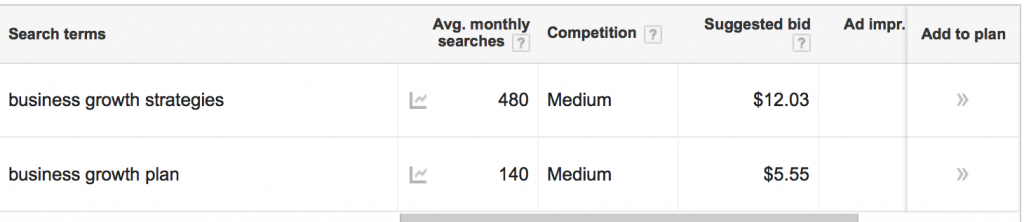
When attempting to target the  B2B audience indirectly, it may mean reaching them when they are not even fully sure what exact solution they are seeking. For example: If I’m selling a Task Manager Tool, the business owner might be searching in Google for “business growth strategies” or “business growth plan” (see pic.) Therefore my product may be very relevant for him.
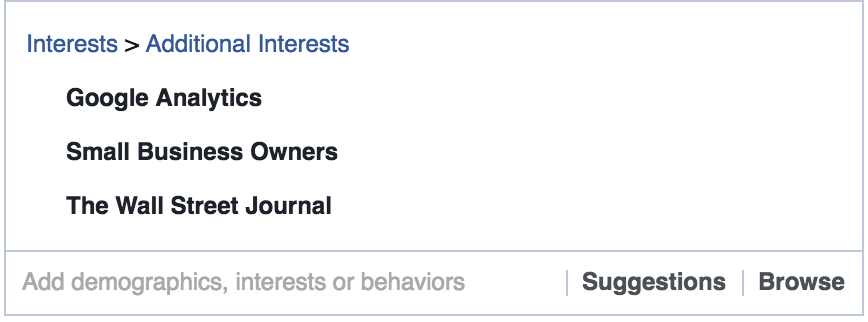
With Facebook Ads you can reach people that have an interest in “similar products”, or have already bought tools to help business productivity.

Google Indirect Keywords:

Why Use Indirect Targeting?

This method of targeting can drive cheaper traffic with much less competition. Furthermore, it reaches a very a large audience and provides many ideas for SEO and organic traffic.

Facebook Ads Indirect Targeting Options:

When Not to Use Indirect Targeting?

When you need fast conversions and have no patience or time, this method won’t work for you. You probably won’t see high conversion rate from that traffic at the very beginning, and may even attract some non-relevant traffic as well.

What Is The Best Tactic?

The idea is to combine both tactics and use the advantages of each tactic.
As we described in the beginning, it is expensive to generate leads and sales in the B2B market, therefore it is extremely important to create a great sales funnel that will have a higher probability of closing the deal at the end of the day.

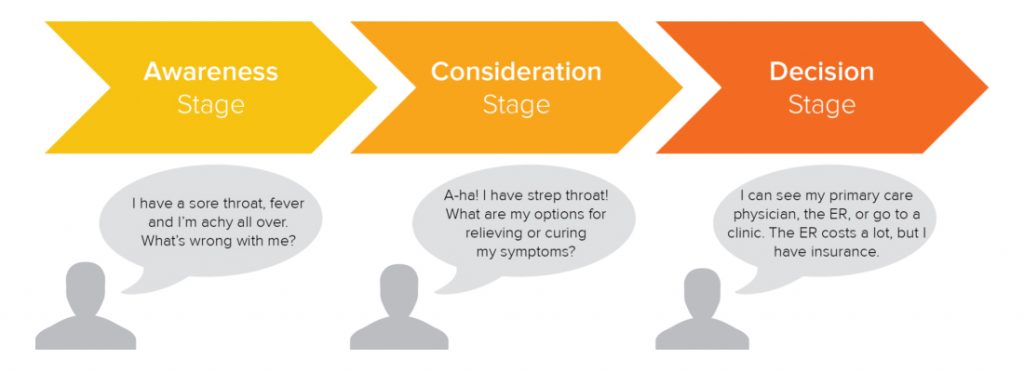
In order to do that, you should know a fundamental concept of the Inbound Marketing Methodology – The Buyer’s Journey! The Buyer’s Journey is the process each person goes through from the moment there is an interest in finding a solution to the problem, up to the moment they decide to buy.


"> Download our free guide for more tips on lead generation for your company.”/>


The Three Stages of the Buyer’s Journey:

  • Awareness: The moment the person realizes the problem exists,  and is strategizing around what to do.
  • Consideration: This stage prompts the evaluation of different solutions for the problem. The buyer is trying to understand what is the best fix from all the options there are in the market.
  • Decision: This is when the buyer wants to decide which brand will deliver the best results for him. There is now consideration between several companies that offer the same solution.

With the buyer’s journey, we understand that we can now prepare our sales funnel and create the best campaign for the B2B audience.

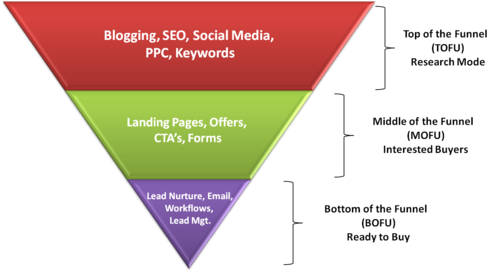
The sales funnel also divides into three parts:

TOFU – Top Of The Funnel:
At the top of the funnel we normally try to give our audience great content that will help them find different solutions for their problem, and show them that they have a fix for their situation.

Blogging, social media, articles, videos or any other content are used to raise their awareness about the solutions.

MOFU – Middle Of The Funnel:
In the middle of the funnel, we first want to convert cold traffic into a MQL (Marketing Qualified Lead). This is done by downloading a simple guide, reading a blog post or commenting on a relevant Facebook post. During this stage, content focus more on benefits of our product or service, and how it can help them in the future. Also at this stage the user is more qualified to consider using our solution, so direct offers may be in play as well.

BOFU – Bottom Of The Funnel:
The last stage is the closing deal. Here you should handle any objections the user may have before buying. The most effective content include successful case studies, testimonials, guarantees or smart pricing.

Most marketers and advertisers tend to compete for the attention of the B2B audience when they are at the second stage of the funnel, which is mostly expensive and highly competitive. There is no need to give up on it completely, but it is very important to give more attention to TOFU, where we can get much cheaper traffic and a bigger audience with less competition. After capturing their attention, we can then follow them up to the other stages of the funnel.

Here’s a simple explanation on how to do it:

  • Long tail Keyword Research: You should look for long tail keywords that have high search volume and little competition. From here, think about content with real value that you can create with those keywords in mind.
  • Cheap Traffic Sources: First, optimize your content for Google search results. If you find powerful keywords, this can equate to great traffic opportunities. It is also very easy to drive traffic for solid content from all social media networks. Whether it’s Facebook, LinkedIn, Twitter or others, people love great content and most likely will engage if it’s truly connecting with them.
  • Pixel Them: When visitors visit your content you can “paint” them with special pixels, and then follow them with different medias. With tools like Google Analytics and Facebook Ads, you can create different pixel lists and segment them by interactions and demographics
  • Direct Offers Campaigns: after they have expressed some interest in your message, you can then place your offers in front of your captivated audience on almost any media you want: Facebook Ads, Google Adwords, LinkedIn, Twitter, etc..

With this strategy we achieve:

  • Cheap Traffic
  • Bigger Exposure
  • Better Leads
  • Higher Conversions and More Sales

Here’s a quick example on how this method can be implemented into your business:

Let’s say you have a product for small businesses. You can see there are several hundreds of searches per month for terms like: “blogging for business” or “blog for business”.

You can create an interesting article about “7 advantages blogging for business has over other marketing methods”.

This article (with some SEO effort) can get to the first page in Google and drive consistent traffic to your website. You can also use social media and advertising platforms to promote this content and drive cheap traffic to your website.

Inside your article you can leave CTA’s (calls to actions) to your offer or to “Lead Magnets” where the visitors can leave their email to receive further great content. All the while, the visitors are pixelized to your remarketing lists and are now ready to see your offers.

Your remarketing lists can be also segmented by visitor behavior and interaction with your content. You should test several combinations until you find your winning and most converting funnel.

As you can see, the old method of direct offer targeting, especially for B2B audience, is getting more competitive and expensive. People are smarter than before and have less patience for annoying ads for things they have never expressed interest in. Nevertheless, the opportunity with B2B lead generation tactics is bigger than ever, as not many companies have adopted the Inbound Marketing Methodology yet.

If you want to win the game in 2017, you should join the movement and implement the tactics that are proven to work.


get a free marketing assessment


6 Ideas to Generate More Leads from Your Calls to Action

Calls to action (CTA) are the secret to driving people to your offers. If your CTAs aren’t effective at capturing people’s attention and persuading them to the click, then it makes the offer useless.

CTAs can be used on product pages (non-landing pages), in display ads, email, social media, direct mail and pretty much anywhere you can market your offer. But not all CTAs are created equal. In a world where every brand is fighting for consumers’ attention, it’s critical that prospects choose your offer over your competitors. In this article, we’ll uncover tips to creating CTAs that work.

#1 Place Your CTA Where the Eye Can See

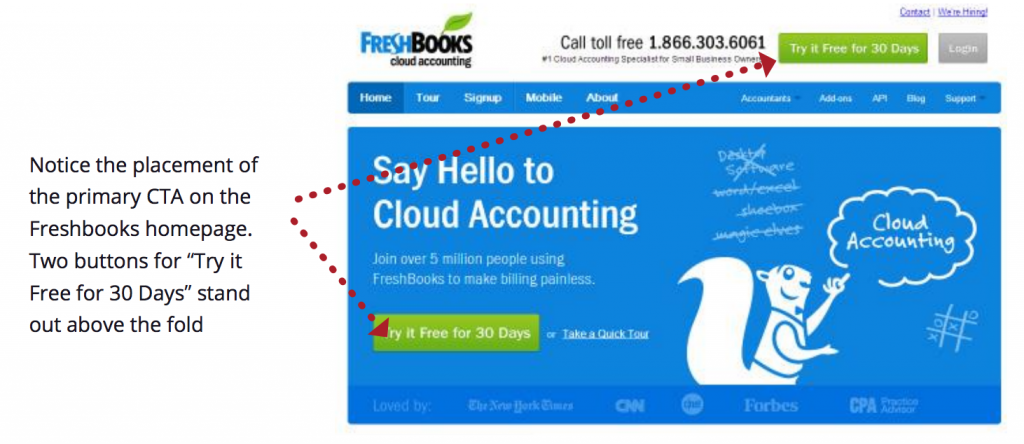
A call to action does best “above the fold” – the space where your web page is viewable to the user without having to scroll down. According to heat map analysis, anything “below the fold” will only be viewed by 50% of people who visit your page. Doubling impressions on your CTAs can significantly increase your lead generation count.

#2 Clarity Trumps Persuasion

That is one of my favorite phrases I learned from the folks at Marketing Experiments. Often, marketers will put more focus on being clever than clear. Be crystal clear about what offer is in your CTA. And be specific. If you’re giving away a free guide, say “Download our FREE guide to X.” If you’re hosting a free webinar, say “Register for our FREE webinar on X.” X should clearly convey a compelling benefit of receiving the offer. This is much more effective than “Download Now” or “Get a Free Article.” These simply aren’t specific enough.

#3 Use Contrast to Make CTAs Stand Out

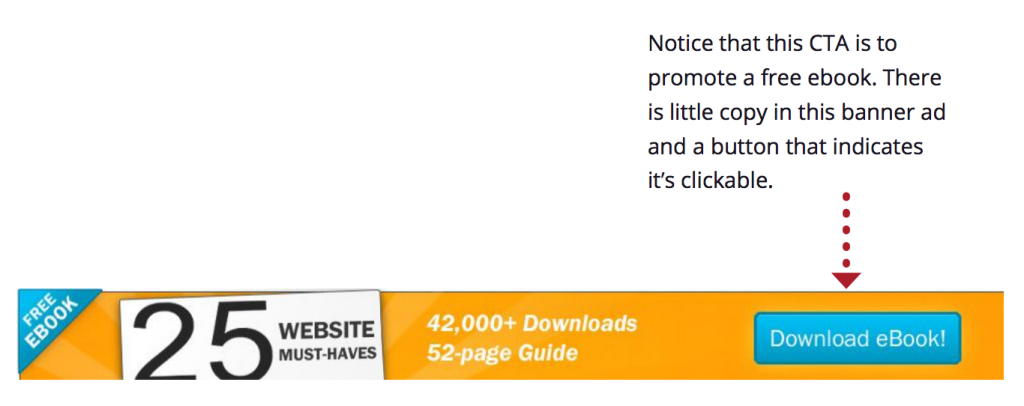
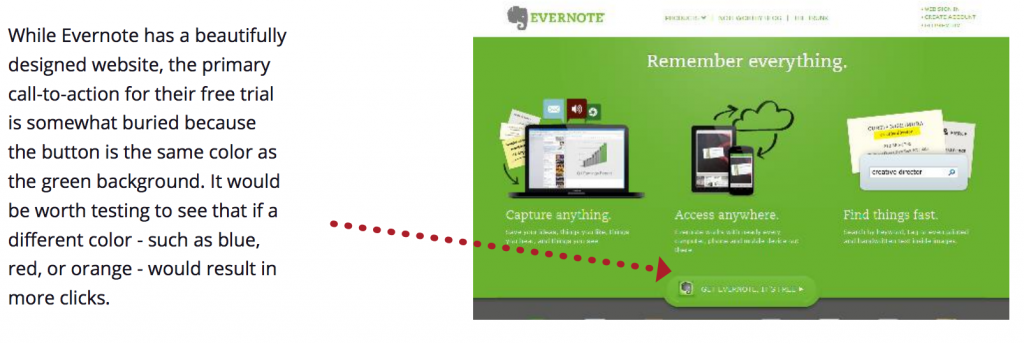
A call-to-action is meant to stand out, so if your CTA blends in too much with your site design, no one will notice it. You want as many eyeballs to land on that call-to-action as possible, so use contrasting colors to make the CTA stand out, and more importantly, use design to make it clear that it’s a clickable call-to-action.

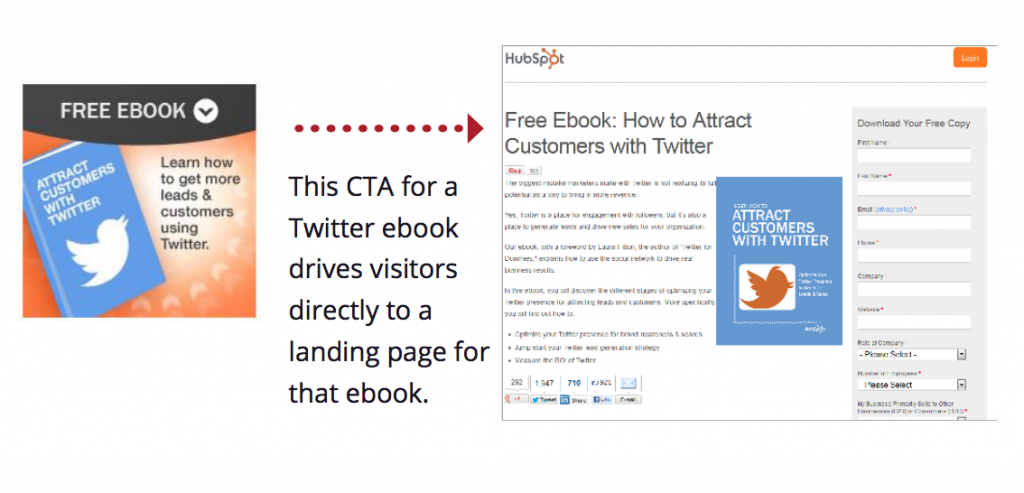
#4 Link Your CTA to a Dedicated Landing Page

This tip might seem minor, but it’s incredible how often businesses miss this opportunity. Calls-to-action are meant to send visitors to a dedicated landing page where they receive a specific offer. Do not use CTAs to drive people to your homepage. Even if your CTA is about your brand or product (and perhaps not an offer like a download), still send them to a targeted landing page that is relevant to what they are looking for. If you have the opportunity to use a CTA, send them to a page that will convert them into a lead.

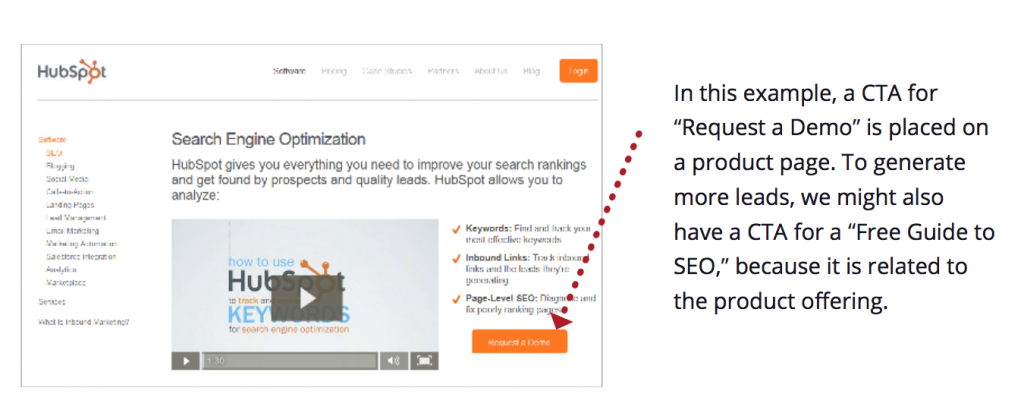
#5 Promote Offers on Product Pages

CTAs shouldn’t be one size fits all. If your company offers various products or services, you may want to consider creating a different offer for each of them. Then you can place CTAs linking to each offer on the website pages that are most relevant to that offer.

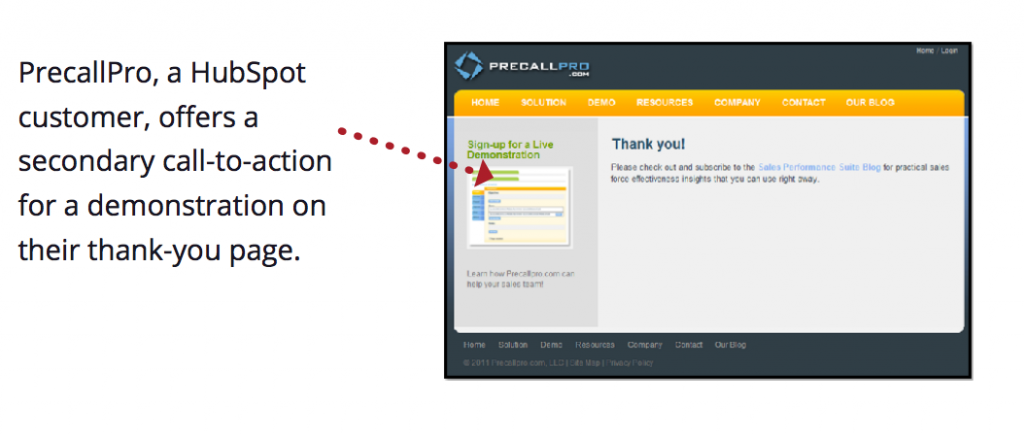
#6 Thank You Pages Are Great CTA Real Estate

Even if someone completes a form on your website (they’ve converted as a lead), don’t stop there. Increasing engagement is also a top priority for marketers so that prospects turn into loyal fans.
Once someone reaches a “thank you page,” the page that a visitor arrives on after completing a form, use that space as an opportunity to promote more offers and content. For example, if a visitor to our site downloads a guide on email marketing, we can then give them another offer for an email RFP for a chance to see a demo of our email marketing platform.

Internet marketing expert Jeff Bullas summarized it well: “Creating a persuasive call to action takes time. It needs to be simple enough so that users can easily understand your message and at the same time compelling enough to persuade them to do what you want them to do. That being said, it is essential to remember that practice makes perfect. Be experimental and see what works best for your audience.”

Need more awesome tips for generating leads ?

get the free guide!

12 Most important marketing tactics to grow your business in 2017

At the start of every new year we say to ourselves that this year is going to be different: “This year we will set some real goals and achieve them.” “This year we will be proud of ourselves and blown away by the progress that our business made.”

Yet usually, we wake up on the last day of the year and feel that something went wrong… again! We look at our business and see that we aren’t even close to where we wanted to be this year. We blame our planning, our goal setting, our optimism and our lack of time to handle everything.

So, how can we make this year different?
If you’re serious about seeing significant growth in your business, here are the 12 most important marketing tactics to focus on in 2017:

1) Smart Goals

It is not enough to set goals and simply believe that they will happen (we’ve tried it and been there), we need to set goals that we are fully committed to and passionate about.
In our inbound marketing methodology we use “SMART GOALS” as our compass for the client’s success journey. The SMART goal framework stands for:

  • Specific – Your goals should be clear to your team, so that everyone understands what needs to be done and who is responsible for what.
  • Measurable – You should be able to check if you have reached your goals exactly by numbers, and not by assumptions.
  • Attainable – You should set realistic goals that are actually achievable. . It is very frustrating to fall short of a goal every time – don’t set yourself up for failure!
  • Relevant – Your goals must be related directly to your business.
  • Timely – Your goals must be mapped out within a specific timeframe.

Without clear and measurable goals your rocket might fly high but actually miss the target! Know what you want to achieve by breaking down your goals “SMARTly” – with details!

2) Quick Wins

Half of all new businesses fail within the first five years – which is why you want to see positive results in your company as soon as possible. You must not depend only on strategies that take months to see progress. Instead, look for marketing activities that can get results fast in order to fuel and motivate both your team and yourself.

Every business has an opportunity to see fast interactions with its audience. The most common tactic is PPC advertising, yet you could find many other options such as flash sale to your email list, viral contests on Facebook, etc. No matter what you’re planning to do this year, start seeing your potential results as fast as possible, in order to build confidence and meet your goals for the year.

3) PERSONALIZATION

Your prospects are becoming less patient to marketing messages that don’t talk directly to their specific problems. In 2017 you should be much more aware of this, and adapt your marketing system to this environment.

For example, if you used to manage direct lead generation campaigns with PPC traffic, in 2017 it is going to be more challenging to get results. There are more and more ads on all digital platforms, the competition is getting fierce and expensive, and the people are more wise and aware of it.

With new technology and smart strategies you can send the right message to the right person at the right time. You need to segment your audience with more specific targeting and personalize your message to their state of mind. For example: Don’t advertise your service or product to the general audience, but instead send relevant and great content, segment them by their interest and interaction and then send them a specific offer, relevant to what they were interested in.

With today’s technology, it’s easier than ever!

4) Multiple Conversion Points

Many companies rely mainly on just one sales funnel, and try to sell the same thing to the same audience over and over again. This can be repetitive, and ineffective.

If you want to see exponential growth this year, you must create several different offers that can be delivered to your prospects in case they don’t convert on your main offer. Once you create different conversion points, you will significantly increase your sales opportunities and therefore your income.

5) Automation

Today’s marketing efforts can seem huge, and overwhelming. If you don’t automate some of your tasks, half of them may not even get done.

So – what are the main things you should automate? Here are some ideas:

  • Lead Nurturing: With a well-planned email automation process, you can nurture cold leads and turn them into real sales opportunities.
  • Post Scheduling: Whether it’s blog posts or social media content, most of this can be scheduled far in advance so you can let the computer do the work, and focus on the distribution of the content
  • Content curation: Use tools such as Google Alerts, Buzzsumo or others to help listen to conversations online that would be of interest to you, chatter around your brand, and industry-related content that is applicable to your audience. This makes it easy for you to share with your listeners.
6) Mapping Your Buyers Journey

There are three stages your prospect goes through before making decision to buy from you. The stages are: Awareness, Consideration and Decision.

If you don’t want to flood prospects with the wrong content and offers, you must map your buyer’s journey very clearly and organize your content planning and campaigns based on his or her buying stage. This makes it easier for you create the right content and lead your prospect through a smart pipeline until they are ready to buy from you.

Overall, a smart sales funnel will help you sell more easily, without being too pushy or aggressive in any stage of the sale.

7) Structured Sales Funnel

Your team is the most important yet most expensive asset in your business. Build a rock-solid sales funnel that will provide your sales team with high-quality leads, thus allowing them to work faster and smarter.

8) MULTI-CHANNEL TRAFFIC SOURCES

You can’t rely solely on one source of traffic. A strong and long-lasting business is always searching for new traffic sources that intelligently interact with one another, creating an unstoppable lead machine.

Each traffic source you use must be analyzed and tracked with a clear ROI report. This sheds light on which one has the highest benefit and where to focus your efforts on.

Multi-channel traffic sources are crucial for sustainable business and must be planned into your growth strategy.

9) Blogging

Research shows that businesses that use blogs generate higher traffic and significantly more leads than those that don’t.
Here are some stats to support it:

  • Business blogging leads to 55% more website visitors (Source: Hubspot)
  • Small businesses that blog get 126% more lead growth than small businesses that do not blog. (source: Impactbnd.com)
  • B2B marketers who use blogs generate 67% more leads per month than those who do not.
  • B2C companies that blog generate 88% more leads per month than those that do not.
  • On average, companies that blog receive 434% more indexed pages. (Source: Hubspot)

What more reason do you need to start blogging now?


Download our free guide for more tips on lead generation for your company.


10) Social Media Knock Out

Social media is not just a great source of traffic but also a main platform to engross and build trust with your audience.

Because of this, social media marketing should be an integral part of your businesses’ digital marketing strategy. By having the right social media marketing strategy, your brand can help you stay ahead of your competitor, and engage and interact with your audience, which ultimately will have a huge impact on your business.While using it to create raving fans that genuinely want to spread the word about you to their friends and family., it simultaneously becomes an amazing viral prospects lead machine when used with care and authenticity.

However, social media can backfire if you abuse it with too hard of a sales pitch, or not responding well to your audience; more specifically, unhappy customers.
Use it wisely, use it with care – and use it more often! Social media is dominating the way people communicate around the world.

11) Reports

I have found that so many businesses don’t actually know their numbers. If you don’t know and control your numbers, then odds are you are losing money, or at the minimum not earning as much as you can.

What’s your average sales conversion rate? What is your best traffic source that brings the biggest deals to the business? What is your EPC (Earning per Click) by media?

Do you know the answers to these questions? If not, we need to do some homework – together. It is crucial for you to understand exactly which source brings you money, and where you should invest your next campaign. Yet, without basic reports that will give you control over your business results, this is difficult to do.

12) All Platforms

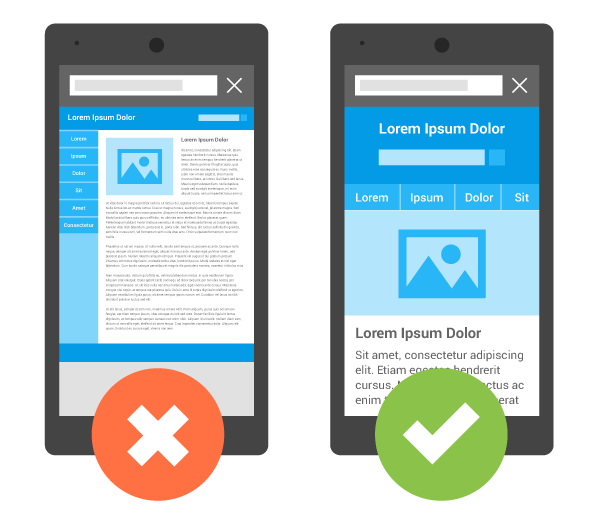
Mobile, apps, all screen sizes…. nowadays, people have less time and are less patient for non user-friendly interfaces. Adapt yourself to all platforms… or LOSE!

There are tons of responsive websites out there that have poor mobile interfaces. Chances are high that if a mobile user clicks to sign up and is taken to a tiny, non-mobile site asking for too many details, they will lose interest. It is crucial to optimize the conversion funnel for the user. Today more than ever, consider simplifying all of your platforms to make it as simple and easy as possible for all users.

Extra – Inbound Marketing with Hubspot

There is the old way of digital marketing and then there is… Inbound marketing! Inbound marketing is a methodology that creates a solid and long-lasting marketing system for any business. It utilizes all of the 12 points discussed above and fits them it into one great business execution plan.

Hubspot platform helps us manage and control all aspects of the methodology and automates it into the highest level of marketing performance. It even has artificial intelligence that optimizes and tailors each massage, to reach the right audience, at the exact time – converting the best leads you’ll ever get. Amazing!

The sooner you join the Inbound Marketing Movement the faster you’ll see change and growth in your business. Don’t get left behind!


get a free marketing assessment